




Abstract
Background:
Dirofilaria immitis, the agent of canine and feline heartworm disease (HWD), is a widespread mosquito-borne helminth. The true prevalence of HW infection in cats is likely underestimated due to the difficulty in establishing a definitive diagnosis. Aedes albopictus, a recognized competent vector for D. immitis, is currently considered the most invasive mosquito species worldwide and Italy presents the highest abundance of Ae. albopictus in Europe.
Materials and Methods:
The present study was aimed at evaluating the current seroprevalence of D. immitis antibodies in cats in Italy. Further, the ecological niche model (ENM) was applied to evaluate the potential future risk of feline HWD associated with the presence of Ae. albopictus.
Results:
Sera of 812 Italian cats were analyzed, and the average prevalence of D. immitis antibodies was 12%. Seropositivity was significantly associated with age (<6 years), whereas there was no association with sex or geographical area. Data obtained with the risk map showed that the highest risk of infection was found in northern inland areas and along coastal areas, whereas the lowest risk was identified at higher altitudes. The ENM correctly classified most of the areas where D. immitis seropositive cats were found, with 80.4% occurring in high and very high-risk areas.
Conclusions:
Results of the present study suggest that cats in Italy are exposed to D. immitis infection, and that routine prevention should be part of the general health care protocols in cats. Moreover, the resulting risk maps indicate that areas with a suitable habitat for Ae. albopictus may put cats at risk of exposure to D. immitis.
Introduction
D
Feline HWD can be present in two forms: (i) Heartworm Associated Respiratory Disease (H.A.R.D), due to the death of immature parasites when they arrive in the lung, or (ii) fatal acute lung injury, due to the death of adult parasites. Infection may induce an acute inflammatory response in the pulmonary arteries, lung parenchyma, and airways, and the most common clinical signs include dyspnea, tachypnea, and intermittent coughing (Litster and Atwell, 2008).
However, infected cats may also be asymptomatic or show nonspecific clinical signs, with sudden death in some cases (Garrity et al., 2019; Litster et al., 2008; Venco et al., 2015). The diagnosis of feline heartworm infection is challenging. The Knott's test for circulating microfilariae (Miller, 1998) and serology for circulating antigens lack sensitivity. A combination of diagnostic approaches, including cardiac ultrasound, is essential for correct diagnosis (ESDA Guidelines 2017).
As a result, data on the prevalence of D. immitis infection in cats in Italy are limited and are based mostly on serological studies for circulating antibodies (Grillini et al., 2022; Kramer and Genchi, 2002; Magi et al., 2002).
Similar to that reported for canine hosts, it is likely that feline HWD is spreading (Morchón et al., 2022; Simón et al., 2012; Smith et al., 2022). Global warming, climate change, urbanization, and increasing movement of pets have all likely influenced the geographic expansion of D. immitis (Genchi et al., 2009; Morchón et al., 2022).
The distribution of D. immitis is also dependent on the presence of competent vectors and associated suitable habitats (Genchi et al., 2009; Ledesma and Harrington, 2015). The introduction of new competent vectors is likely an important factor influencing risk of infection, including in cats. Aedes albopictus is currently considered the most invasive mosquito species worldwide, and Italy presents the highest abundance of Ae. albopictus in Europe (Giunti et al., 2023). The species has been confirmed as a competent vector for D. immitis (Gratz, 2004), and a recent study has evaluated the risk of D. immitis infection associated with the presence of Ae. albopictus (Couper and Mordecai, 2022).
Ecological niche models (ENMs) can be used to assess the geographic risk of transmission of vector-borne diseases (Cuervo et al., 2023). The ENMs are ecoinformatics-type tools that correlate the known distribution records of a vector species and the environmental variables to which it responds (Escobar, 2020; Rodríguez-Escolar et al., 2023).
The evaluation of climatic and environmental factors of a specific geographical area results in a potential distribution map of habitat suitability. Moreover, ENM tools can also consider other factors such as the presence of receptive hosts, and the human footprint, to better correlate the presence of a species and the potential risk for pathogen transmission. The evaluation of these variables, together with the potential number of D. immitis generations, could offer a picture of the transmission risk of the parasite by Ae. albopictus throughout the Italian peninsula.
The present study was aimed at (i) providing updated seroprevalence values for D. immitis antibodies in cats in Italy and (ii) evaluating the association of climatic factors, the presence of mosquitos, and the seropositivity of cats in Italy to build a risk map for D. immitis in Italy.
Materials and Methods
Sample collection and analyses
A total of 812 cats from 13 Italian regions, enrolled in a previous nationwide survey of feline ecto- and endoparasites in Italy (Genchi et al., 2021) (the cats' owners signed an informed consent authorizing the use of feces and hair for the study), were tested for circulating antibodies against D. immitis. All cats had outdoor access (exclusively outdoor, predominantly outdoor, predominantly indoor) and had not received any antiparasitic treatment in the 3 months before sampling.
Blood samples (2 mL) were collected from each cat and stored at −20°C. The protocol used for serology was that described by Morchón et al. (2004). Briefly, for the enzyme-linked immunosorbent assay, which detects IgG against D. immitis somatic antigens (DiSA) and recombinant Wolbachia surface protein (rWSP), 96-well plates pre-labeled with 0.8 μL of each antigen were used.
Serum samples were used at a dilution of 1:100 for anti-DiSA and 1:40 for anti-rWSP antibody detection, and an anti-IgG anti-cat peroxidase (Kirkegaard and Perry Laboratories, Gaithersburg, MD) labeled was applied at a dilution of 1:4000. Samples with an optical density of 0.8 for DiSA and 0.6 rWSP were considered positive (Montoya-Alonso et al., 2022).
ENM of Ae. albopictus
We used occurrence points of Ae. albopictus from all Italy from GBIF (Global Biodiversity Information Facility:
The spatial independence of these datasets was an important underlying assumption of this study, as it allowed an accurate representation of the observed occurrence of the species in the study area. However, we acknowledge that this database may not represent the full range of climatic conditions in which the species can be found outside of the study area. Thus, our estimates will always be a conservative representation of the full potential distribution of the species.
The bioclimatic data, including 19 bioclimatic variables related to temperature and precipitation, were downloaded from the
Further data on variables known to have an effect on the distribution of Ae. albopictus, such as human footprint (data taken from Socioeconomic Data and Application Center [SEDAC] at
In terms of the human footprint, it represented a global map of cumulative human pressure on the environment. Human pressure was measured using eight variables, including built environment, population density, electric power infrastructure, cropland, grazing land, roads, railways, and waterways.
All these variables were processed using ArcGIS, 10.8 software (ESRI, Redlands, CA) at a resolution of 1 km2, GCS_WGS_1984 coordinates, and the extent of the Italian territory. The Maxent program was used to model the habitat suitability and potential geographical distribution of Ae. albopictus (Ecological Niche Modelling) within the study area (data downloaded from American Museum of Natural History:
This algorithm, based on the maximum entropy principle, calculated the habitat suitability of a species as a function of environmental constraints (Phillips et al., 2006). For choosing an appropriate amount of model complexity, we used the KUENM package in R, which selected the best Maxent models of a series of candidates arranged by different combinations of parameter settings.
For our study, we generated 119 models using a set of climate variables, 17 values of the regularization multiplier (0.1–1.0 at intervals of 0.1, 2–6 at intervals of 1, and 8 and 10), and the 7 possible combinations of 3 feature classes (linear, quadratic, and product). The model performance was assessed in terms of statistical significance (Partial_ROC <0.05), omission rates (OR = 5%), and model complexity using the Akaike information criterion corrected for small sample sizes (AICc).
Significant models with an omission rate ≤5% were selected. Then, from this set of models, those with an AICc delta value of ≤2 were selected as the final candidate models. The candidate models were built using the “kuenm_cal” function, and the evaluation and selection of the best model were carried out using the “kuenm_ceval” function.
We generated the final ENM (best-fit model) using the variables and the same parameters as previously selected. Ten bootstrap replications with logistic outputs were performed. The evaluation of these final models was based on the ROC_partial, OR, and AICc calculations using an independent dataset. The creation of the final models was carried out by using the “Kuenm_mod” function (Cobos et al., 2019).
D. immitis generations and risk map
Once the ENM of Ae. albopictus was created, the number of D. immitis generations was calculated according to Genchi et al. (2009), Genchi et al. (2005), and Rodríguez-Escolar et al. (2023), based on temperature suitability, in R-4.3.0 software. This model estimated that the full development of D. immitis L3 in mosquito vectors (extrinsic incubation) needed the accumulation of 130 growing degree days (GDDs), in a period of 30 days, the maximum expectancy life of the vector species.
Each day accumulated a number of GDDs equivalent to the degrees by which the mean daily temperature exceeded 14°C. The threshold of 130 GDDs was accepted only if it was reached in 30 consecutive days. The mean daily temperature data (Climatologies at High Resolution for the Earth's Land Surface Areas) from 1990 to 2016 were used to calculate the number of generations of Dirofilaria spp. in the different territories of Italy.
To create a risk map for Italy, the final Ae. albopictus ENM and the D. immitis generations were multiplied (weighting approach) using the raster calculator in ArcMap 10.8. The final result was reported on a scale from 3.03 to 0, with the highest value qualitatively qualified as “High” and the lowest as “Low.”
For the validation of the risk map, the D. immitis positive cats in this study were geo-referenced and the percentage of these cats found in the different risk zones of the resulting map was calculated. The location of the cats and geo-reference was obtained and processed after the serological tests were carried out to avoid bias. The different risk zones were established using the Natural Jenks method of data classification, and the classes are based on the natural groupings inherent in the data. Class breaks are created so that similar values are better grouped together and differences between classes are maximized. Entities are divided into classes whose boundaries are established where there are considerable differences between data values.
Statistical analyses
Comparison with groups of age was made with a chi-square test, Fisher's exact test, considering a p value <0.05 as statistically significant.
Results
Seroprevalence
The average seroprevalence for circulating anti-D. immitis antibodies in tested cats was 12.1% (98/812), ranging from 4.8% to 20.8%, depending on geographical area (Table 1 and Fig. 3), with the highest value recorded in Sardinia region (20.8%, 95% confidence interval [CI] 12.4–31.5) and the lowest in Abruzzo region (4.8%, 95% CI 1.3–11.8). Forty-eight percent (95% CI 37.76–58.29) of seropositive cats lived exclusively outdoors, 37.8% (95% CI 28.16–48.11) predominantly outdoors, whereas 14.3% (95% CI 8.04–22.81) lived predominantly indoors.
Analyses of the Serum Samples with Dirofilaria immitis Enzyme-Linked Immunosorbent Assay Test for Cats
No significant difference was observed between prevalence values in females (51%) versus males (49%). The average age of seropositive cats was 4.8 ± 3.5 years, ranging from 2 months to 14 years. When divided by age groups, the highest antibody seroprevalence was observed in cats from 1 to 5 years (39.8%, 95% CI 30.0–50.2), followed by cats aged 6–10 years (23.5%, 95% CI 15.5–33.1), cats 1–6 months (16.3%, 95% CI 9.6–25.2), and cats 7–12 months (14.3%, 95% CI 8–22.8). Cats >10 years of age had the lowest prevalence values (6.1%, 95% CI 2.3–12.9).
ENM of Ae. albopictus
The ENM developed for Ae. albopictus in the geographical study area showed an AUC of 0.802, indicating good model accuracy.
The habitat suitability map for this species, with a maximum value of 0.86 (high suitability) and a minimum value of 0.02 (low suitability), was reported in Fig. 1. The contribution of each bioclimatic and environmental variable to the ENM for Ae. albopictus is shown in Table 2. The variables with the highest contribution percentage were human footprint (80.1%) and BIO4 (temperature seasonality; 13.9%). The remaining variables had values <2.8%.
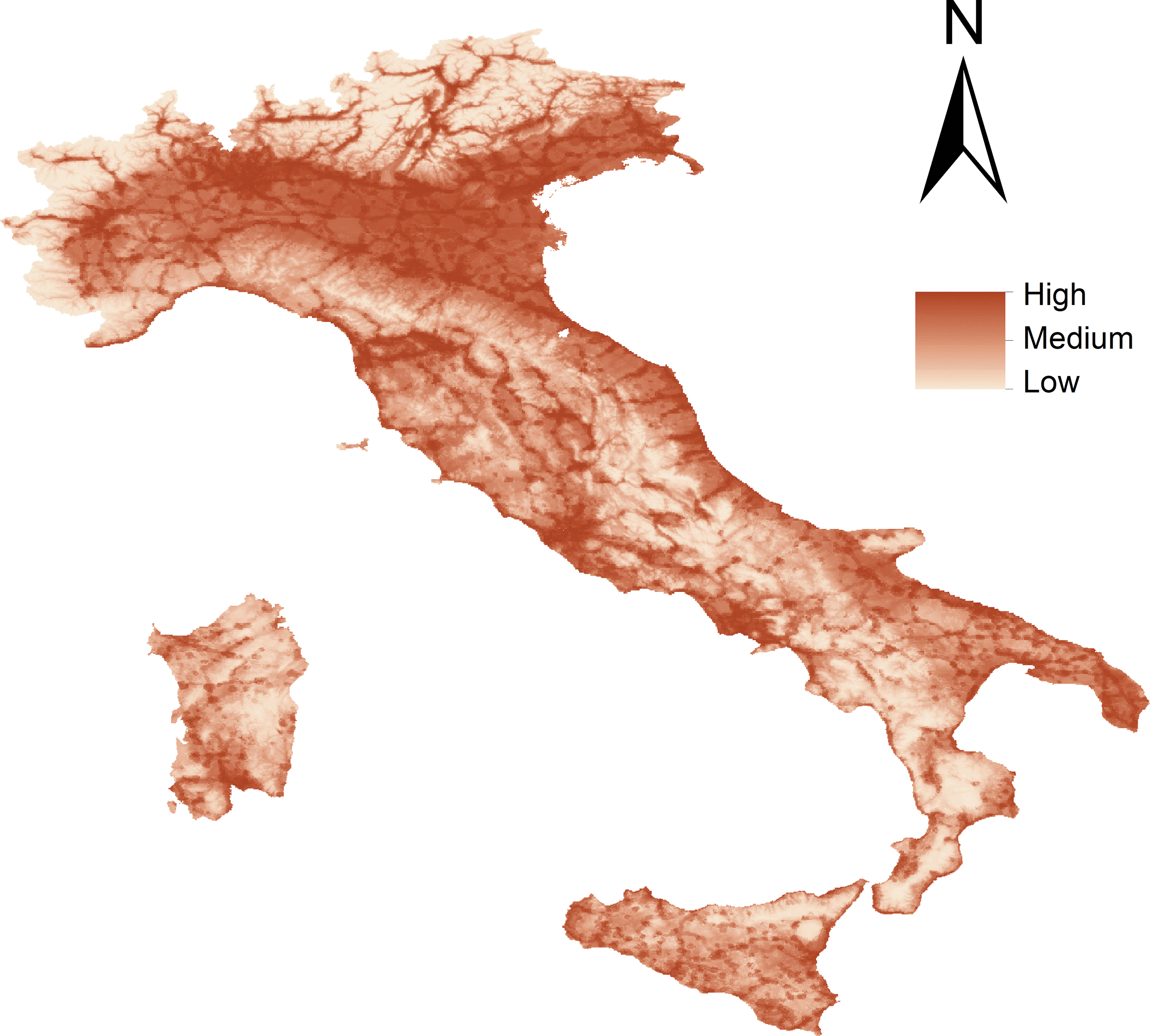
Ecological niche model for Aedes albopictus in the geographical area of Italy representing suitable habitat.
Analysis of the Contribution of the 13 Environmental and Bioclimatic Variables to the Ecological Niche Model for Aedes albopictus
According to the map, the areas with the best habitat suitability for Ae. albopictus are mainly located in Lombardy, Emilia-Romagna and Veneto regions, in areas close to the Mediterranean Sea, as well as in locations with a high intensity of anthropic use. In contrast, less populated and less cultivated mountainous areas, as well as inland areas in the south of the peninsula and on the islands, showed a low capacity to host Ae. albopictus.
Number of D. immitis generations
The highest number of generations (above 4) was found on the islands of Sicily and Sardinia, in the regions of Apulia, Lazio, Tuscany, and in the coastal areas of Calabria. In the regions of Lombardy, Emilia-Romagna, Veneto, and Friuli-Venezia Giulia, most of the recorded values varied between two and three generations, as did the east coast of the Italian peninsula. In general, mountainous areas showed values between 1 and 0. The predicted spatial distribution of the number of generations of D. immitis is shown in Fig. 2.
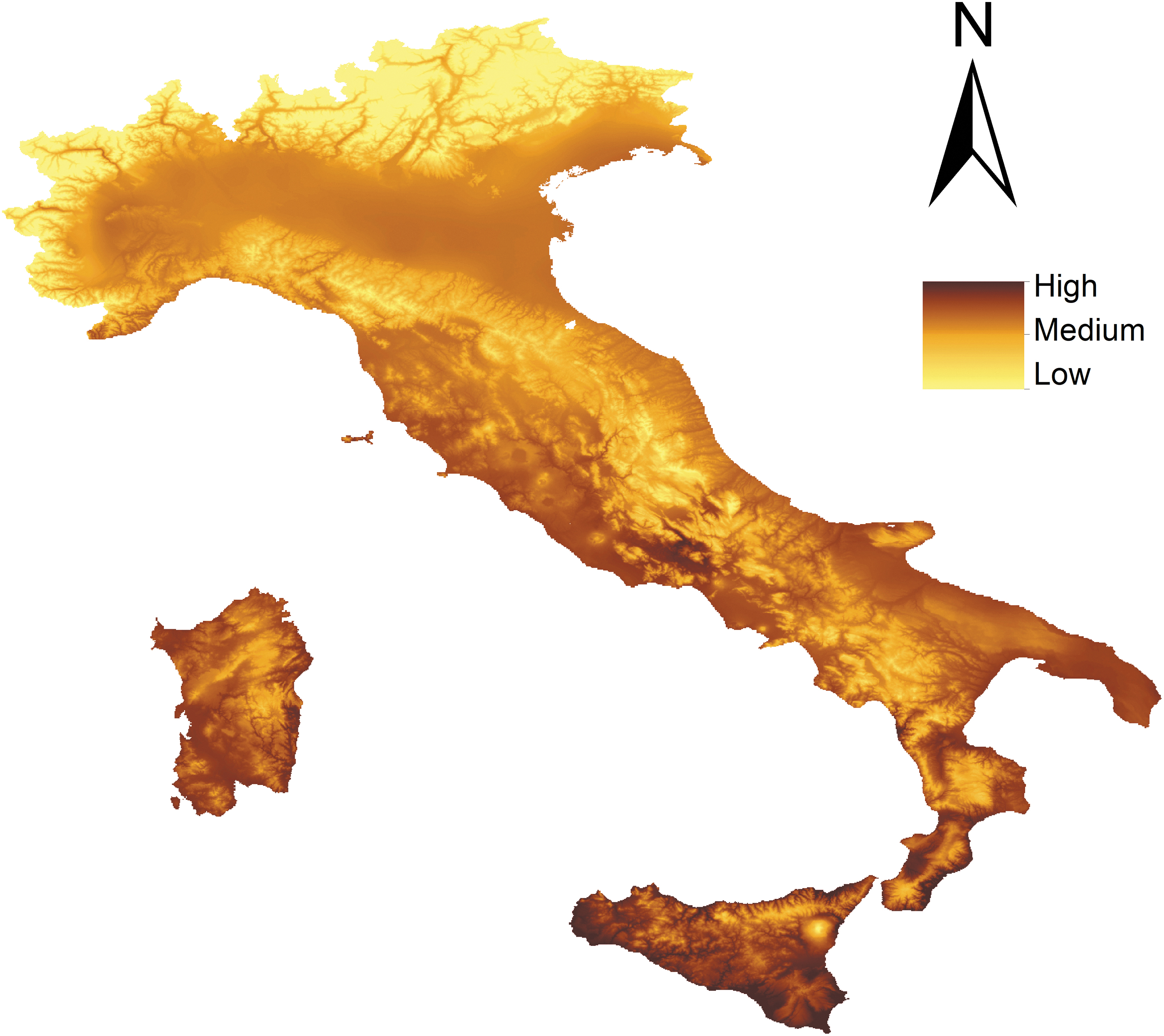
Prediction of the number of generations of Dirofilaria in Italy.
Potential risk of transmission and validation with the positive cats
The different values of the potential risk of transmission of D. immitis using different colors to indicate five value ranges, together with the seropositive cats data collected in this research are shown in Fig. 3. According to the map, 6.6% of the country is in the upper range, implying a very high risk of transmission, 13.3% is in the second range, implying a high risk of transmission, 21.6% is in the third range with a medium risk, 28.7% is in the fourth range indicating a low risk, and 29.8% of the national territory has a very low risk of transmission.
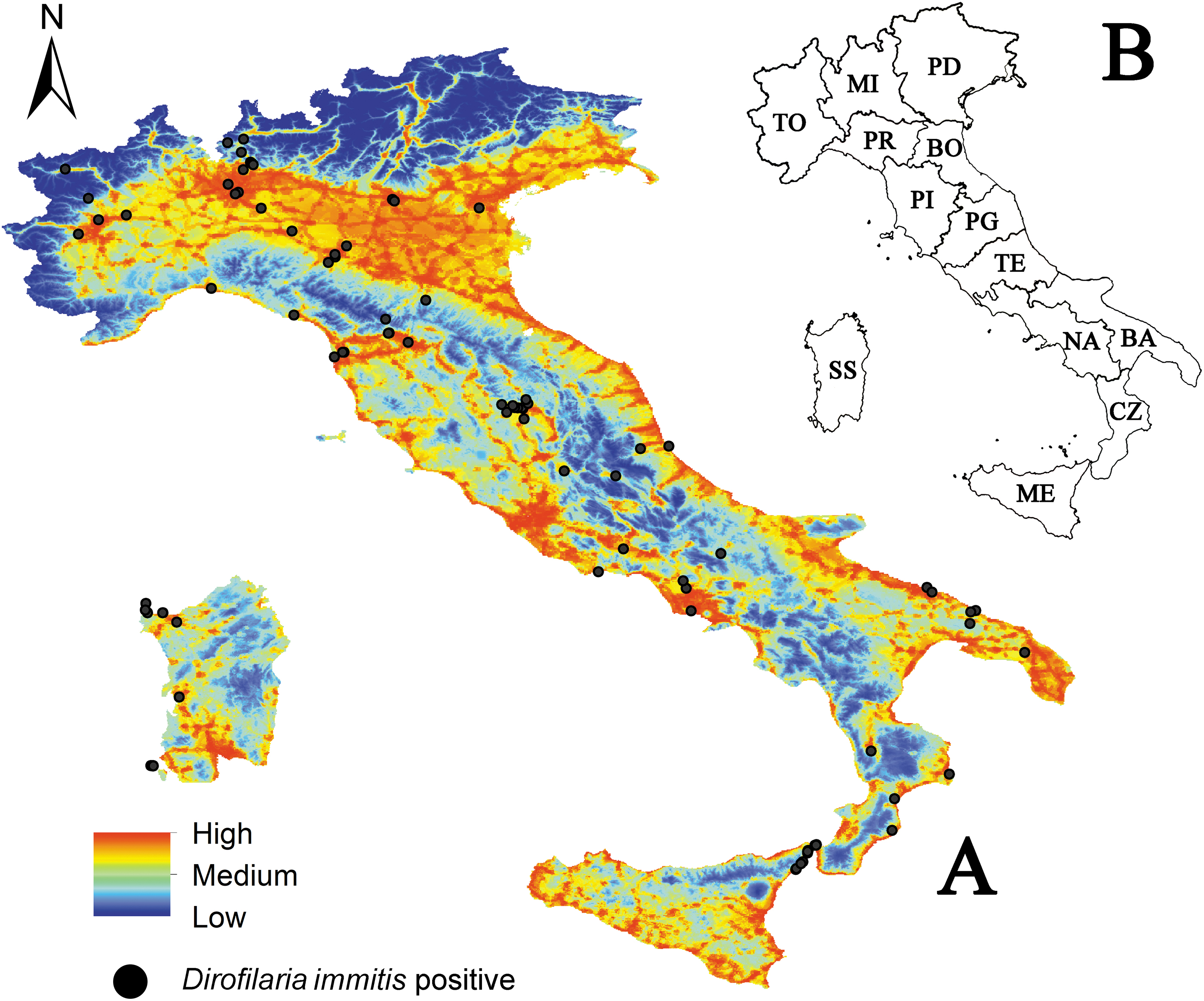
Regions with high- and very high-risk values are abundant in coastal areas, as well as in inland areas and areas close to the Adriatic Sea, where the number of D. immitis generations is high and habitats are very suitable for Ae. albopictus. Risk was also high in the urban areas around the cities of Florence, Pisa, Rome, and Naples, characterized by an important human footprint.
As expected, medium and lower risk areas were associated with lower human footprint, low numbers of D. immitis generations, and low habitats suitable for Ae. albopictus, all factors that may explain why mountainous areas had the lowest risk of infection.
The risk model correctly classified most of the records of D. immitis-infected cats, indicating that the model is validated. Indeed, 80.4% of the seropositive cats were from high or very high-risk areas, 8.3% in medium-risk areas, and the remaining 11.3% in low or very low-risk areas (Fig. 3).
Discussion
Results of the present study report that ∼12% of Italian cats are positive for circulating antibodies against D. immitis, with values ranging from 4.8% to 20.8%. The few previous studies carried out in different Italian regions have reported similar values. Kramer and Genchi (2002) carried out a large-scale study in over 1000 cats from northern Italy and reported an average seroprevalence of 16%. Magi et al. (2002) reported 26% of seropositive cats in the Tuscany region and Grillini et al. (2022) reported 5.8% in north-eastern Italy.
Previous studies have also reported highest prevalence values in cats between 1 and 10 years of age, with lower values in either very young or very old cats. This is likely due to the lower efficacy of the immune response or may also be due to older cats sleeping longer indoors. The remaining studies on D. immitis infection prevalence in cats in Italy are based on the presence of circulating microfilariae and/or antigens and/or parasite DNA.
Brianti et al. (2022) reported that 3 out of 17 cats from the island of Linosa in southern Italy were positive for parasite DNA, similar to that reported by Giangaspero et al. (2013), with 1 out of 12 cats being DNA-positive. No cats were positive to the other tests.
It has been suggested that the introduction of Ae. albopictus into a given geographical area could influence the distribution of D. immitis and the risk of infection for animal hosts (Gratz, 2004). However, the role of this invasive mosquito species in the epidemiology of heartworm infection has not been widely studied. Giangaspero et al. (2013) reported that the presence of Dirofilaria infection in dog and cat populations in southern Italy is likely due to the high density of Ae. albopictus in the area.
Couper and Mordecai (2022) evaluated available mosquito surveillance data and dog heartworm case data in different areas of California and reported significant association between the abundance of Ae. albopictus and cases of canine HWD in southern parts of the state. The results of the present study would appear to confirm that geographical areas with suitable habitats for Ae. albopictus correlate with the majority of D. immitis seropositive cats (>80%).
Interestingly, Gomes et al. (2007) evaluated the origin of blood meals from Ae. albopictus collected in the field in Brazil and the authors suggest that this species is likely an important vector for infection in cats. More recently, Faraji et al. (2014) evaluated the feeding pattern of Ae. albopictus in northerneastern USA and reported that, following humans, cats were the most frequent source of blood meals for this mosquito species. These studies would suggest that cats are fed upon by Ae. albopictus and in those areas where D. immitis is present, are at risk of exposure to the parasite.
Taking into account the health relevance of these zoonotic diseases and their apparent current expansion process, largely favored by anthropogenic alterations (such as the aforementioned global warming), it is necessary to develop detailed analyses that focus on the environmental circumstances that promote them.
The dimension of spatially explicit risk models makes it possible to establish correlations between the presence of zoonotic diseases and the variables associated with their transmission, correlations that can be extrapolated to other territories where data do not exist and also to other time frames, to be able to anticipate their future dynamics in time and take precautionary measures to deal with them before they occur (Rodríguez-Escolar et al., 2023).
Conclusion
According to current guidelines (AHW Guidelines, 2014; ESDA, 2017), the clinical importance of heartworms in cats is not to be underestimated. While serology does not necessarily indicate active infection, it does confirm that Italian cats are exposed to D. immitis and are at risk of developing lung pathology associated with the death of migrating larval stages (H.A.R.D.) or to acute respiratory disease associated with the death of adult parasites.
For this reason, feline heartworm should always be added to the differential diagnosis of cats presenting respiratory and gastrointestinal signs. The results of the present study confirm the absolute necessity to implement awareness and knowledge of the disease among cat-owners and veterinarians to protect cats, in Italy, from heartworm infection through the use of a continuous and adequate chemoprophylaxis. Further, the model of transmission risk developed here will aid veterinary practitioners in evaluating the potential risk of transmission in their area.
Footnotes
Authors' Contributions
M.G., L.K., L.C., and A.V.: Conceptualization; M.G., I.R.E., and A.V.: Data curation; M.G., R.M.G., I.R.E., L.K., and A.V.: Formal analysis; M.G., R.M.G., I.R.E., M.S., and L.K.: Methodology; M.G., R.M.G., L.K., and L.C.: Supervision; L.K., I.R.E., and A.V.: Writing—original draft; M.G., R.M.G., M.S., I.R.E., L.K., L.C., and A.V.: Review and editing.
Author Disclosure Statement
No conflicting financial interests exist.
Funding Information
No funding was received for this article.