




Abstract
Background:
Sphaerirostris picae is a parasitic species known for its ability to infect and transmit between hosts in the gastrointestinal tracts of wild avian species. However, there is limited information on its presence and impact on urban avian populations, particularly in China.
Materials and Methods:
In this study, morphological observations were conducted to detect the presence of Sphaerirostris sp. within the intestinal tract of the Oriental Magpie (Pica serica) collected in Beijing, China. Further confirmation of the parasite's identity was achieved through phylogenetic analysis using COX1 gene sequencing to compare with previously documented Sphaerirostris picae isolates.
Results:
The morphological and molecular analyses confirmed the presence of Sphaerirostris picae in the Oriental Magpie. Phylogenetic analysis indicated a close relationship with known Sphaerirostris picae isolates. This represents the first reported case of Sphaerirostris picae infection in magpies from Beijing, China.
Conclusion:
The findings highlight the potential health hazards posed by Sphaerirostris picae to urban avian populations and public health. The study suggests that additional research and surveillance efforts are necessary to better understand the risks associated with this parasite and to develop effective mitigation strategies.
Introduction
The type species, Sphaerirostris picae (Rudolphi, 1819) Golvan, 1956, was originally identified in the European magpie (Pica pica Linnaeus), which belongs to the genus Sphaerirostris and the phylum Acanthocephala (Amin et al., 2010). The phylum Acanthocephala consists of around 1,300 species, with the genus Sphaerirostris accounting for 27 recognized species. The prominent and significant morphological feature of S. picae, the genus’s type species, is the presence of protruding hooks on its anterior proboscis (Kang and Li, 2018). This parasite has been sporadically reported in countries such as Iran and Pakistan. These parasites are frequently encountered in the intestines of diverse organisms such as fish, amphibians, reptiles, birds, and mammals (Amin, 2013; Lisitsyna et al., 2012). S. picae often parasitizes the digestive tracts of various finch species, resulting in damage to the intestinal wall at the attachment site through the use of its neck and rostrum (Muhammad et al., 2019). The presence of hooks initiates a host immune response characterized by the recruitment of macrophages, giant cells, eosinophils, and heterophils (Dezfuli et al., 2021). Acanthocephalans are thought to possess specific defense mechanisms that diminish the phagocytic activity of host immune system cells (Skorobrekhova and Nikishin, 2016). Infected animals may exhibit symptoms such as lethargy and emaciation (Tarello, 2009), and in severe cases, the infection can result in mortality (Sala and Martorelli, 2007).
The Oriental magpie (Pica serica) is a bird belonging to the genus Pica in the family Corvidae of the order Passeriformes. It is a resident bird adapted to urban environments and has a wide distribution across Eurasia (Lee et al., 2003). Wild birds play a crucial role in the transmission and maintenance of zoonotic diseases due to their mobility and influence on the distribution and abundance of pathogens and vectors (Hamer et al., 2012; Rizzoli et al., 2015). They can harbor a wide variety of pathogenic microorganisms, including notable diseases like avian influenza, West Nile fever, and Lyme disease, as well as bacteria and parasites such as Campylobacter spp., Salmonella spp. and Toxoplasma gondii (Abulreesh et al., 2007; Contreras et al., 2016; Du et al., 2019). Close interaction between urban wild birds and humans can result in public health issues, underscoring the significance of comprehending the role of wild birds in disease transmission.
The objective of this study was to identify and characterize the presence of Sphaerirostris sp. in the intestinal tracts of Oriental magpies in Beijing, China. The results obtained serve as a valuable reference for species identification, molecular epidemiological investigations, and parasite diagnosis in urban-dwelling wild birds. Additionally, they contribute to the promotion of future local and national surveillance initiatives.
Methods
Parasite sample collection
On June 11, 2022, 11 deceased Oriental magpies were found in the vicinity of Beijing Normal University, Haidian District, Beijing (39.96424°N 116.35962°E). Immediately, they were transported to a biosafety Level II laboratory for testing. The dissection procedures adhered to the guidelines for experimental animal care and use established by the Institute of Zoology, Chinese Academy of Sciences. The acanthocephalans obtained during dissection were placed in a flat dish filled with saline solution. They were then observed and recorded for characteristics including color, movement, and natural structure. Afterwards, they were stored at 4°C until DNA extraction took place.
Parasitic stereoscopic microscope and scanning electron microscope observation
To morphologically identify the parasites, the washed worms were immediately immersed in a 1% formalin solution for 2 h. After the specified time, the worms were delicately removed and placed under a microscope for observation and photography. Once observed, the worms were returned to their original preservation solution for storage. The method utilized for this process was based on the procedure described by Zhang et al. (Zhang et al., 2021). More specifically, the worms were subjected to three washes using PBS (NaH2PO4) buffer at a concentration of 0.1 mol/L and pH 7.4, with each wash lasting 15 minutes. Afterwards, the specimens were fixed overnight in a 2.5% glutaraldehyde solution at 4°C. Subsequently, the fixed specimens were subjected to graded dehydration in ethanol, critical-point drying, coating with gold-palladium, and finally observed using a scanning electron microscope (SEM).
PCR amplification and sequencing
DNA was extracted from nematode tissues and fecal using Tiangen Biochemical Technology Ltd DNA extraction kits (DP340). The concentration of the extracted DNA was measured, and it was used immediately for further analysis. Any remaining DNA was stored at −20°C for future use. For the PCR amplification of the COX1 sequence in acanthocephalans, the COX1 gene amplification was performed using the upstream primer (JB3): 5′-TTTTTTGGGCATCCTGAGTTTAT-3′ and the downstream primer (JB4.5): 5′-TAAAGAAACAATGAAATG-3′ (Chen et al., 2022). The PCR reaction consisted of 35 cycles, with each cycle including denaturation at 94°C for 45 s, annealing at 47°C for 45 s, and extension at 72°C for 1 min. The PCR reaction started with an initial hot start at 94°C for 3 min and concluded with a final extension at 72°C for 7 min. As a result, a 441 bp PCR product was amplified. All PCR-positive products were purified and subjected to bidirectional sequencing by BGI Gene Sequencing (Beijing, China) to obtain the nucleotide sequence information.
Sequence alignment and phylogenetic analysis
The sequencing data obtained was processed using BioEdit software (v7.0.9) to ensure high-quality sequences. Manual editing and alignment were performed to optimize the accuracy of the sequences. The resulting sequences were then subjected to BLAST searches and compared with reference sequences available in GenBank for identification and verification. Phylogenetic trees were constructed using the maximum likelihood method (ML) in MEGA7 software, which facilitated the visualization and analysis of evolutionary relationships among the sequences.
Results
S. picae stereoscopic microscope and scanning electron microscope observations
During clinical dissection examinations, it was discovered that the primary site of parasitism by acanthocephalans is the intestinal tract of the magpies. The specimens were individually observed under a stereoscopic microscope, and measurements of trunk length using a vernier caliper and body width using a micrometer were taken. The trunk length ranges from 12.4–37.8 mm, while the width ranged from 0.9–5.6 mm, consistent with the characteristics of Sphaerirostris species. The larvae appeared creamy white, while the adults exhibited a yellowish-brown coloration. The trunk had a spindle-shaped morphology, gradually tapering towards both ends and possessing a rounded posterior (Fig. 1A, B, C, D, G). The proboscis was divided into two parts, separated by a constriction, and had a smooth and flat apex. The anterior proboscis was nearly spherical, while the posterior proboscis was cylindrical and had a more widely-spaced armature (Fig. 1E, F). All hooks emerged from elevated round rims on the surface of the proboscis (Fig. 1H).
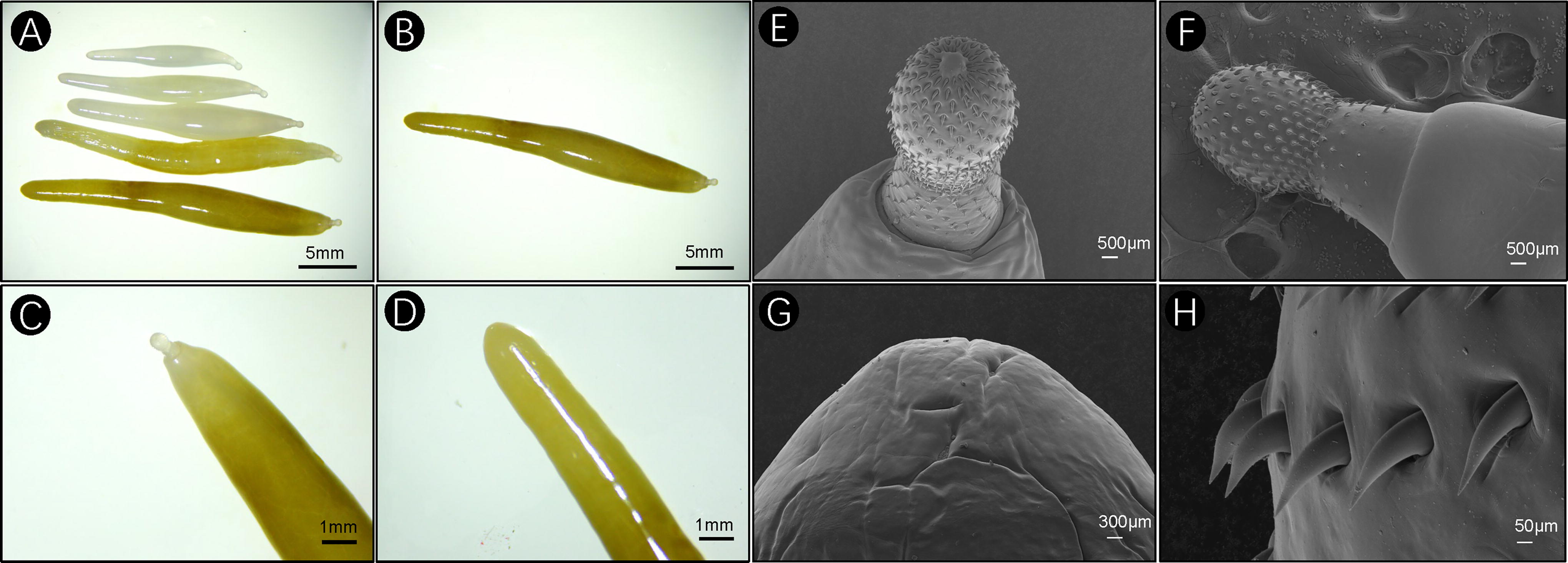
Stereoscopic microscope observation
Detection of parasitic infection status and molecular genetic characterization
To rapidly identify the species of the parasite and determine the infection status, PCR amplification using the nematode universal primer targeting the COX1 sequence was conducted. The obtained COX1 sequences were analyzed using Blast and tentatively identified as S. picae. Representative nucleotide sequences from this study have been deposited in the GenBank database under the registered COX1 genome OP881432. Out of the 11 Oriental magpies tested, four were found to be infected with S. picae, with a total of 23 parasites detected. To verify the infection status, fecal DNA samples from all 11 magpies were extracted and retested, yielding consistent results.
A phylogenetic tree was constructed by comparing and analyzing the COX1 gene sequences obtained from the samples with those of the reference species S. picae (Fig. 2). In order to establish the evolutionary relationship, other species of Sphaerirostris were selected as outgroup taxa. Our analysis revealed that the COX1 gene sequences obtained in this study formed a distinct cluster with the sequence of S. picae (MK471355.1). Notably, there is currently only one record of COX1 data available for S. picae on GenBank, which originated from Pakistan. The COX1 sequences obtained in our study appear to be most closely related to those of S. Lanceoides (MT476588.1). These findings suggest a close evolutionary relationship between these species based on the analysis of the COX1 gene sequences.

Phylogenetic relationships of Sphaerirostris picae identified in the present study and other known genotypes deposited on GenBank was inferred by a maximum-likelihood phylogenetic analysis of COX1 gene sequences using the Tamura 3-parameter model and with 500 replicates. The red font indicates the genotypes of the species found in this study.
Discussion
Due to the small sample size of Oriental magpie hosts, the epidemiological data in this study were not analyzed. In the past, traditional methods of parasite identification and classification relied heavily on morphological features, host specificity, and parasite location, which were subject to limitations such as sample integrity and the expertise of the identifier (Hasegawa et al., 2022; Nadler and De LeÓN, 2011). To enhance species identification, a combination of stereoscopic and SEM techniques, as well as molecular biology methods, were employed in this study. Notably, based on a comprehensive search of existing literature, the occurrence of S. picae infection in urban Oriental magpies represents the first reported case in wild magpie birds in urban areas of China. The available COX1 sequence of S. picae isolated in Pakistan is among the limited number of closely related sequences identified thus far (Muhammad et al., 2019). While other acanthocephalan parasites have been demonstrated to cause bird mortality (Sala and Martorelli, 2007), due to the lack of further experimentation, this study cannot definitively establish S. picae infection as the exact cause of bird death.
However, wild birds can play a crucial role in maintaining endemic infection cycles in specific geographic areas (Mather et al., 1989; Reed et al., 2003). In the case of S. picae infections, for instance, the newly discovered infection among urban wild birds in Beijing may be linked to infections in wild migratory birds. Migratory birds frequently traverse ecological barriers like oceans, facilitating the long-distance dispersal of various ectoparasites and associated pathogens (Pietzsch et al., 2008). Resident birds, such as those found in urban areas, have received relatively less attention in the field of public health. This is partly due to the limited potential for long-distance transmission of infectious diseases by birds that remain within a specific area throughout the year (Daszak et al., 2000). However, species within the Corvidae family, including crows and magpies, are known to serve as hosts for several significant parasitic worms. These bird species often come into close contact with human residential areas, as well as local and industrial poultry farms, which may include ostriches and turkeys. Consequently, the risk of parasite transmission is heightened in these scenarios (Halajian et al., 2011). However, as Beijing serves as a stopover site for migratory birds, with a large number of migratory birds arriving each year, it is speculated that S. picae infections in urban wild birds may be due to infections transmitted through migratory bird migration.
It is therefore speculated that there could be a circular transmission occurring between different hosts within the local network of parasitic infections, involving wild migratory birds, resident birds, and poultry. Further studies are required to investigate this possibility. In light of these findings, we recommend strengthening surveillance efforts not only for migratory birds but also for resident bird populations. Additionally, it is important to develop necessary control measures to mitigate the potential spread of parasites and associated infections.
Conclusions
In this study, we have provided the first documented report of S. picae parasites in urban areas of China. This discovery expands our understanding of the epidemiology of parasitic infections in wild bird populations within urban environments and contributes to ongoing research in the field of molecular epidemiology and control of parasitic diseases affecting these populations.
Footnotes
Acknowledgments

Authors’ Contributions
H.H., B.H. contributed to the conception of the study; B.H., J.W., Y.W., Y.L., B.W., C.X., and G.Y. performed the experiment; Y.X., S.H. contributed significantly to analysis and article preparation; Bi.H. performed the data analyses and wrote the article. All authors read and approved the final article.
Data Availability Statement
All data generated or analyzed during this study are included in this published article. The COX1 nucleotide sequences of parasites in this study were submitted to the GenBank database. The COX1 sequence of S. picae is registered as OP881432. And the COX1 sequence of Ascaridia galli is registered as OP881429.
Ethics Statement
This study was conducted in accordance with the Guidelines for the Care and Use of Animals at the Institute of Zoology, Chinese Academy of Sciences. This study was reviewed and approved by the Animal Ethics Committee of the Institute of Zoology, Chinese Academy of Sciences (IOZ-15042).
Author Disclosure Statement
The authors declare that the research was conducted in the absence of any commercial or financial relationships that could be construed as a potential conflict of interest.
Funding Information
The research was financially supported by the Strategic Priority Research Program of the Chinese Academy of Sciences (XDA19050204), National Key R&D Program of China, National Forestry and Grassland Administration, China, the National Key Research and Development Program of China (No.2022YFC2601600), Beijing Innovation Consortium of Agriculture Research System (BAIC04-2021).