




Abstract
Background:
Mosquito-borne orthobunyaviruses in Canada are a growing public health concern. Orthobunyaviral diseases are commonly underdiagnosed and in Canada, likely underreported as surveillance is passive. No vaccines or specific treatments exist for these disease agents. Further, climate change is facilitating habitat expansion for relevant reservoirs and vectors, and it is likely that the majority of the Canadian population is susceptible to these viruses.
Methods:
A scoping review was conducted to describe the current state of knowledge on orthobunyavirus epidemiology in Canada. The Preferred Reporting Items for Systematic Reviews and Meta-Analyses extension for Scoping Reviews guideline was used. Literature searches were conducted in six databases and in gray literature. The epidemiology of orthobunyaviruses was characterized for studies focusing on host species, including spatiotemporal patterns, risk factors, and climate change impact.
Results:
A total of 172 relevant studies were identified from 1734 citations from which 95 addressed host species, including humans, wildlife, and domestic animals including livestock. The orthobunyaviruses—Cache Valley virus (CVV), Jamestown Canyon virus (JCV), Snowshoe Hare virus (SHV), and La Crosse virus (LACV)—were identified, and prevalence was widespread across vertebrate species. CVV, JCV, and SHV were detected across Canada and the United States. LACV was reported only in the United States, predominantly the Mid-Atlantic and Appalachian regions. Disease varied by orthobunyavirus and was associated with age, environment, preexisting compromised immune systems, or livestock breeding schedule.
Conclusion:
Knowledge gaps included seroprevalence data in Canada, risk factor analyses, particularly for livestock, and disease projections in the context of climate change. Additional surveillance and mitigation strategies, especially accounting for climate change, are needed to guide future public health efforts to prevent orthobunyavirus exposure and disease.
Introduction
Four mosquito-borne zoonotic pathogens in the orthobunyavirus family endemic to North America have been identified as a public health concern for Canada: Cache Valley virus (CVV), Jamestown Canyon virus (JCV), La Crosse virus (LACV), and Snowshoe hare virus (SHV) (Drebot, 2015; Kulkarni et al., 2015; Otten et al., 2020). In humans, these viruses can cause meningoencephalitis with or without sequelae (Evans and Peterson, 2019; Gill et al., 2019).
CVV may cause reproductive failure and terminal congenital abnormalities, predominantly in sheep (Chung et al., 1990a; Chung et al., 1990b). There is also heightened concern because no vaccine exists for any of these viruses, and management is limited to supportive care. Further, a warming climate is facilitating range expansion of several mosquito vectors and wildlife reservoir hosts (Bush and Lemmen, 2019; Ogden and Gachon, 2019; Sutherland et al., 2013). For populations in Canada that lack previous orthobunyavirus exposure, these conditions could exacerbate the risk of orthobunyaviral disease.
In Canada, CVV, JCV, and SHV are considered endemic (Artsob, 1990). LACV has yet to be detected in Canada but has the potential for emergence (Otten et al., 2020) because competent LACV vectors (Ochlerotatus triseriatus, Aedes albopictus, and Aedes japonicus) and the primary animal reservoir (Eastern chipmunks, Tamias striatus) are established in Canada (Chambers and Garant, 2010; Gharnit et al., 2020; Giordano et al., 2020; Giordano et al., 2015).
In addition, the incidence of LACV disease (LACVD) in humans has recently risen in six American states along the Great Lakes border shared between Canada and the states of Montana and Ohio (Centers for Disease Control and Prevention, 2023b; Vahey et al., 2021).
Orthobunyaviruses are maintained in a sylvatic cycle in wooded areas, where multiple mosquito species act as vectors (Hollidge et al., 2010). The reservoir hosts vary depending on the virus. White-tailed deer are considered the primary reservoir hosts for CVV and JCV (Blackmore and Grimstad, 1998; Boromisa and Grimstad, 1987; Issel et al., 1972). The snowshoe hare is the predominant reservoir host for SHV (Hoff et al., 1969). Chipmunks are considered the main reservoir host for LACV (Cully et al., 1992; Cully et al., 1991). Seroprevalence studies indicate that exposure to these viruses is widespread across vertebrate species (Calisher et al., 1986; Centers for Disease Control and Prevention, 2023a; Centers for Disease Control and Prevention, 2023b). Humans and sheep are considered incidental hosts, in that they are susceptible to infection but do not generally transmit orthobunyaviruses. Despite some knowledge on the ecology of these viruses, a few experimental studies have examined vertebrate host maintenance or amplifying capabilities.
Currently, neither orthobunyaviruses nor encephalitis are reportable in Canada (Public Health Agency of Canada, 2023). This motivated a study investigating suspect West Nile virus (WNV) cases in Canada that reported that 25% of patients had actually been infected with an orthobunyavirus (Dimitrova et al., 2011; Makowski et al., 2011). Propelled by those findings, we aimed to synthesize the contemporary knowledge base of orthobunyavirus epidemiology in North America, to facilitate future works that assess the true public health burden of orthobunyaviral diseases in Canada.
The two objectives of this scoping review were to describe the epidemiology of orthobunyaviruses of public or animal health concern in Canada, and to describe how climate change may impact the ecology, distribution, and exposure risk for hosts of these mosquito-borne viruses.
Methods
Protocol
The scoping review protocol was established a priori (Supplementary Data S1). Both the protocol and reporting of this review adhered to the Preferred Reporting Items for Systematic Reviews and Meta-Analyses extension for Scoping Reviews (PRISMA-ScR) guidelines and methodological framework (Peters et al., 2015; Tricco et al., 2018).
Eligibility criteria
Primary research articles, dissertations, or gray literature reporting primary research were eligible for inclusion. The literature search strategy was designed to maximize the likelihood of detection of relevant primary data regardless of whether it was published in peer-reviewed journals or elsewhere (termed “gray literature,” which includes government and non-governmental reports).
Eligible citations had to be made available in English or French. Citations published during or after 1999 were included to reflect contemporary knowledge of orthobunyavirus epidemiology since mosquito surveillance efforts, in general, were rigorously improved in North America following the first detection of WNV in the United States of America (USA) in 1999 (Drebot et al., 2003; Ford-Jones et al., 2002; Nash et al., 2001). Eligible citations had to conduct research in the context of at least one of the four orthobunyaviruses endemic to or emerging in Canada, or any orthobunyavirus that was specifically referenced in the context of Canada.
Information sources
The following databases, which focus on research in the life sciences, including public, animal, environmental health, were searched on January 28, 2021: PubMed, Scopus, CAB, Global Health, GreenFILE; and on February 19, 2021: Web of Science Core Collection. Gray literature searches for relevant dissertations were conducted in the following databases on February 5, 2021: Libraries and Archives Canada, Open Dissertations, Open Access Theses and Dissertations, OAIster, and Networked Digital Library of Theses and Dissertations.
Theses with relevant primary data not subsequently published in a peer-reviewed journal were included and categorized as gray literature. Additional gray literature searches were conducted on February 6, 2021, which included the following websites: Public Health Agency of Canada (www.canada.ca/en/public-health) and the Centers for Disease Control and Prevention (www.cdc.gov). Gray literature searches applying the same terms were also conducted in Google and Google Scholar until three successive pages (each listing 10 citations per page) of results failed to identify a relevant citation.
Lastly, the bibliographies of seminal primary research papers or review articles on topics related to orthobunyaviruses were crosschecked to identify additional relevant citations not already included in the citation screening pool (Supplementary Table S1). Review articles were excluded from the scoping review.
In addition, notifications adhering to the original search strategy were set up on PubMed, Web of Science, and Google Scholar to identify new manuscripts published between the date of the literature search and the completion of screening: March 12, 2021. At this time, included theses were also crosschecked and replaced by newly published peer-reviewed citations reporting the same data as the theses.
Search strategy
Article titles, abstracts, and key words were searched using a standardized algorithm (Supplementary Data S1). No restrictions for the literature searches were placed on study location or date. Only articles in English or French were included; articles in other languages were identified but not included due to limited resources available for translation. A publication date restriction was only applied at the screening stage.
Relevance screening
Citations were included that presented primary data relevant to orthobunyavirus epidemiology as defined in Veterinary Epidemiology (Thrusfield, 2018), such as disease case or surveillance data, spatiotemporal or risk analysis, and forecasting. Modeling papers were included that presented primary data on a relevant orthobunyavirus, or on associated vectors or hosts that reported findings in an epidemiological context. Diagnostic or treatment methods papers that presented novel case data were also included (Supplementary Data S1). Studies were excluded that only conducted in vitro experimental research.
Search results were uploaded into reference management software (Zotero, Center for History and New Media, George Mason University, Virginia, USA); duplicates were documented and removed, as were studies published before 1999. Next, validation of the search was performed. Specifically, the bibliographies of randomly selected articles identified in the literature search were screened, and new relevant publications not captured by the formal literature search were added.
This process was repeated until no new citations were identified from the bibliographies of five subsequent articles examined. Records were then uploaded to an online systematic review management program (Distiller SR, Evidence Partners, Ontario, Canada) for additional de-duplication, followed by relevance screening and data characterization. Titles and abstracts were initially screened by two independent reviewers following a pre-test using 25 citations to ensure consistency in evaluation. Reviewers discussed any discrepancies for consensus, and if agreement was not met, a third reviewer was consulted.
Data characterization
Data from articles that met the full-text screening criteria were independently extracted by two reviewers using pre-established criteria that were piloted on the first 30 citations to ensure consistency in evaluation between reviewers (Supplementary Data S1). Topics covered in the data characterization tools included general characteristics; epidemiology of the viruses as related to vertebrate hosts; vector surveillance and experimental work on virus transmission; risk analysis or forecasting; spatiotemporal analysis; and climate change effects.
All extracted data were exported from Distiller SR for analysis, and visualization using Excel, ver. 16.3 (Microsoft Corp.) and RStudio, ver. 2023.03 (Posit software, PBC: Integrated Development for R; Boston, MA).
Host versus vector division of scope
During data characterization, two themes were identified that could not adequately be reported in a single scoping review. These themes included host data related to orthobunyavirus epidemiology, and vector data related to disease transmission. The results of this manuscript are focused on epidemiologic data presented in the context of orthobunyavirus hosts, which refers to humans, wildlife, or domestic animals including livestock. Relevant data included cases or surveillance of orthobunyavirus infections, geographic and seasonal distribution, risk factors, control measures, and climate change effects, in the context of host species.
Results
General characteristics
The database searches identified 1702 unique citations. An additional 15 references were identified through bibliography searches (“snowball validation”) of relevant seminal papers that had not been detected via the database searches because terms used in the titles or abstracts to refer to the relevant orthobunyaviruses were not included in the original literature search (Supplementary Table S1). Some examples include “arbovirus” or “LACE” to refer to La Crosse Encephalitis; “CV virus” instead of Cache Valley virus; and the use of the term “California serogroup virus” when the intention was not the virus specifically but rather the parent serogroup that included JCV, LACV, and SHV. The gray literature searches identified two additional government surveillance reports and 15 theses.
In total, 1734 citations were screened based on titles and abstracts, of which 547 were identified as potentially relevant (32%). Following full text screening, 375 citations were out of scope and excluded. Among the remaining 172 relevant citations that were characterized, 77 citations were excluded because they presented primary data related only to vector species.
Ninety-five citations (55%) presented primary data pertaining to host species, comprising peer-reviewed articles (76%), and gray literature (24%) that included 11 government reports on human incidence, one human seroprevalence report, four regional livestock outbreak notifications, five theses, and two conference proceedings (Fig. 1).
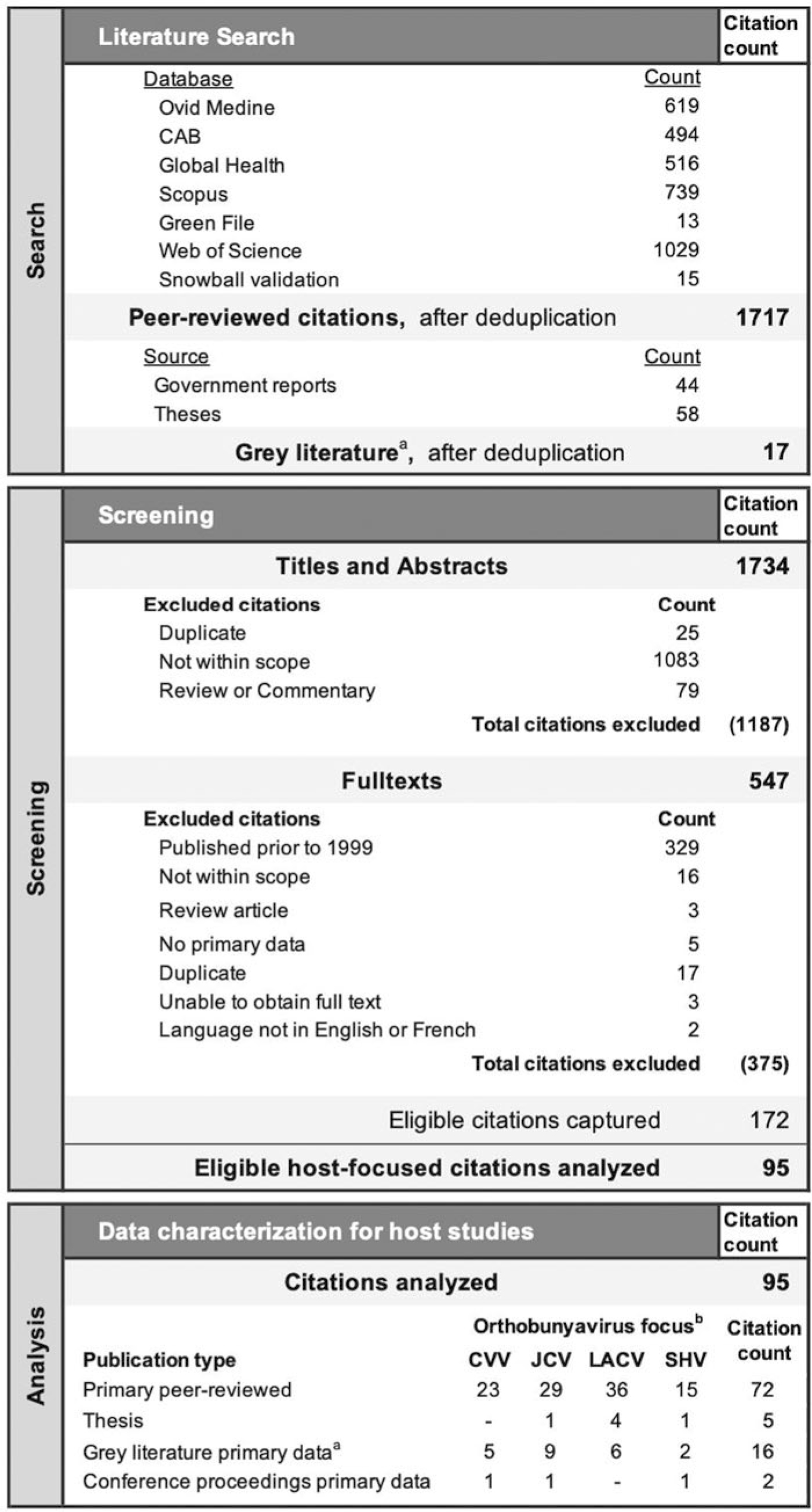
Flow diagram of citations identified throughout the review process that adhered to the Preferred Reporting Items for Systematic Reviews and Meta-Analyses extension for Scoping Reviews (PRISMA-ScR) guidelines. Parentheses indicate ineligible citations that were removed from the count. aGray literature refers to non-peer-reviewed publications that contain relevant primary data. bCitation counts are not mutually exclusive. CVV, Cache Valley virus; JCV, Jamestown Canyon virus; LACV, La Crosse virus; SHV, Snowshoe Hare virus.
The number of viruses investigated per citation varied with 69 studies investigating a single orthobunyavirus, and 26 studies investigating multiple orthobunyaviruses (Fig. 2). Only three studies investigated all four orthobunyaviruses but in very different contexts. The first study conducted seroprevalence analysis on USA National Park Services employees (Kosoy et al., 2016). The second study was a case report of a horse tested for all four viruses before concluding that JCV was the etiologic agent (Sahu et al., 2000). The third study created a public health tool for prioritizing arboviruses in Canada under climate change (Otten et al., 2020).
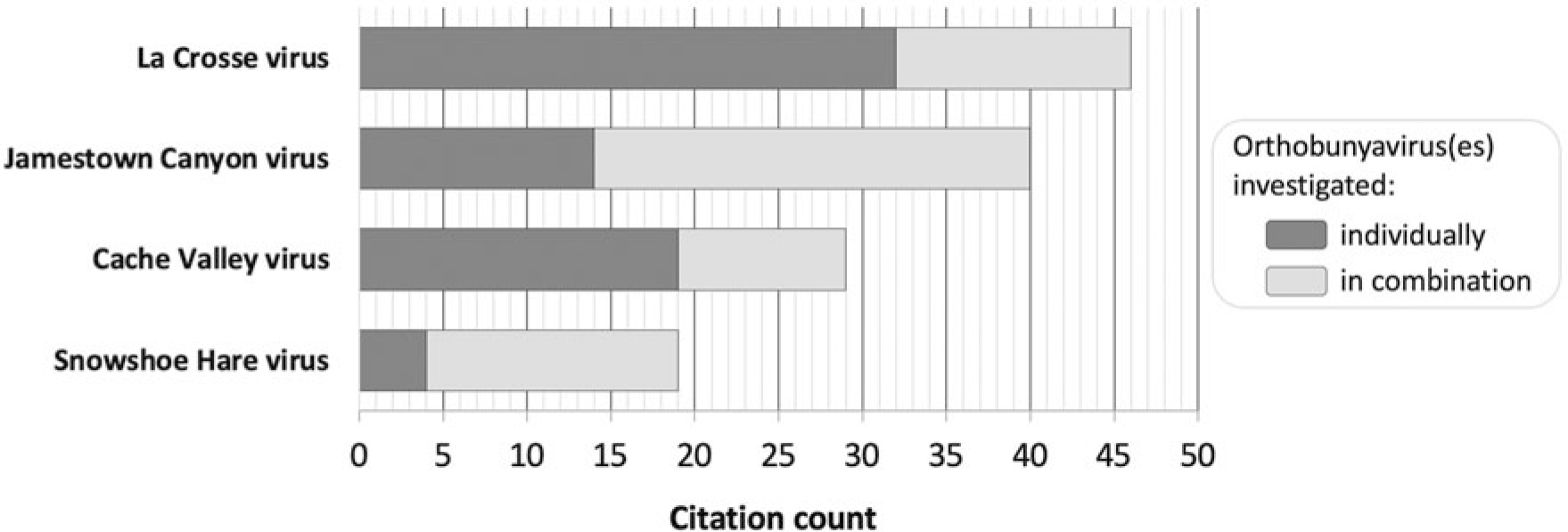
Number of studies that evaluated an orthobunyavirus individually (dark gray) versus in combination with at least one additional orthobunyavirus (light gray) in the context of a host species (i.e., humans, wildlife, domestic animals) (n = 95 citations). Citation counts for the “in combination” category (light gray) are not mutually exclusive, since studies that investigated multiple orthobunyaviruses were represented in the counts for each relevant orthobunyavirus.
Regarding frequency, CVV and LACV were more commonly evaluated in isolation (66% of CVV studies and 70% of LACV studies, Fig. 2). Conversely, JCV and SHV were most evaluated in combination with other orthobunyaviruses, and most often with each other (38% of JCV studies and 79% of SHV studies), particularly when investigated in Canada.
The most common topics explored among host citations (not mutually exclusive) included surveillance or case reports/series (n = 80), spatiotemporal analysis (n = 27), and risk factor analysis (n = 30) (Fig. 3). Additional topics were covered in a subset of papers, including disease transmission (n = 1) (Blackmore and Grimstad, 2008), disease mitigation (n = 2) (Butterworth, 2009; Otten et al., 2020), treatment (n = 2) (McJunkin et al., 2011; Savard et al., 2018), and socioeconomic analysis of orthobunyavirus infections (n = 3) (Butterworth, 2009; Utz et al., 2005; Utz et al., 2003). Regardless of the study focus, the number of host-focused publications uniformly increased with time.
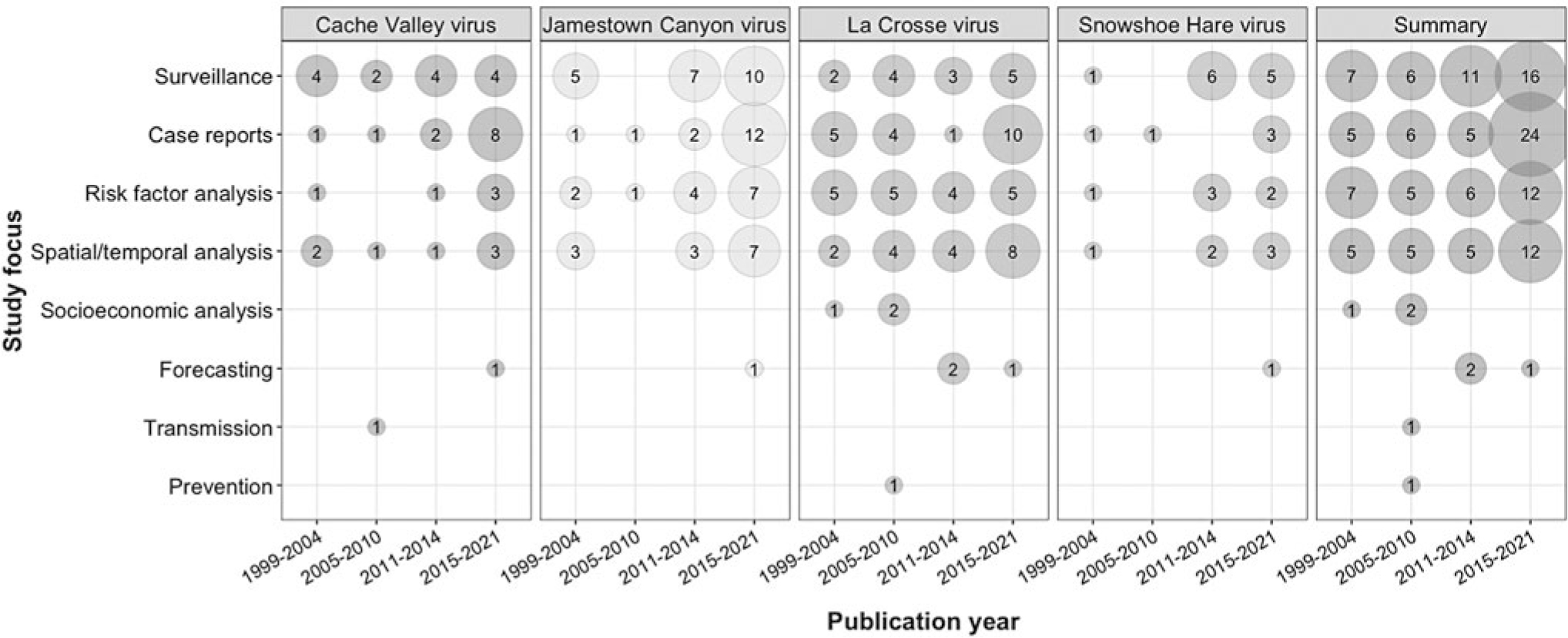
Bubble plot of the epidemiological study focus versus publication year stratified by virus. Categories were not mutually exclusive regarding study focus or virus type. Circle size corresponds to the number of citations. Publications in 2021 captured literature up to March only.
A variety of study designs were implemented, and some studies utilized multiple design types, particularly theses. The majority of citations were observational studies, both descriptive (n = 67) and analytical (n = 27). There were five experimental studies including one randomized control trial (McJunkin et al., 2011), three challenge trials (Blackmore and Grimstad, 2008; Hoffmann et al., 2013; Hoffmann et al., 2012), and one exploratory treatment study (Savard et al., 2018).
One citation performed a prioritization of vector-borne diseases (VBDs) of public health concern in Canada due to climate change effects, and ranked CVV disease (CVVD) as the top priority among endemic VBDs and LACVD as the third top priority among 35 non-endemic VBDs (Otten et al., 2020). Among the eight endemic VBDs evaluated, JCV disease (JCVD) and SHV disease (SHVD) were also prioritized. No studies forecasted the effect of climate change on orthobunyaviruses.
Epidemiology characteristics
Geospatial distribution of field data
Citations that incorporated field data (n = 90) represented regions across North America (Fig. 4), except for three human-related studies in Argentina, Australia, or Japan (Kato et al., 2020; Tauro et al., 2009; Wilson et al., 2017). Testing for CVV exposure was most geographically widespread, representing 45 states or provinces within USA, Canada, and Mexico. JCV was also widely studied across the USA and Canada (35 states or provinces).
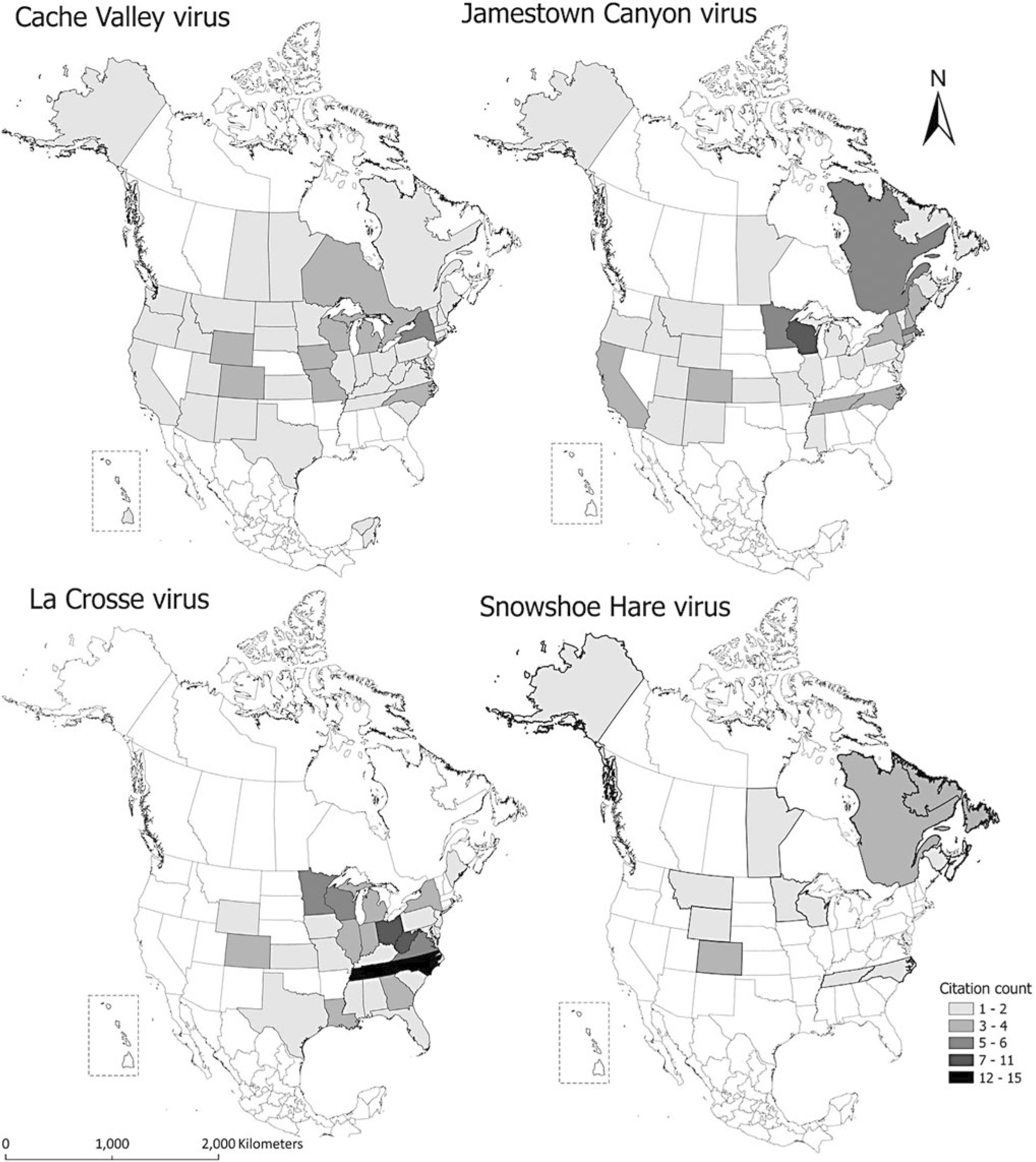
Geospatial representation of field data collected for surveillance or case reporting of an orthobunyavirus infection in host species (n = 90), including humans and animals, per province or state in North America. Citation counts varied across virus (Cache Valley virus = 25, Jamestown Canyon virus = 37, La Crosse virus = 43, Snowshoe Hare virus = 18) and corresponded to the intensity of color per designated region. Shapefiles obtained from Statistics Canada, United States Census Bureau, and Instituto National de Estadística y Geografía.
LACV was only investigated in the USA, predominantly the eastern region (30 states), but contained the most citations per state. SHV was least studied and only investigated in 13 states or provinces. No studies evaluated the northwest region of Canada, including British Columbia, Alberta, or the three territories. In the USA, all but four states were investigated (Arkansas, Nebraska, Nevada, Oklahoma).
Fourteen studies used secondary data collected for other purposes: eight related to general human health screening or diagnostic testing of hospitalized patients with suspect arbovirus infection (Dimitrova et al., 2011, p. 6062; Kato et al., 2020; Kosoy et al., 2016; Makowski et al., 2011; Matkovic et al., 2019; Mayo et al., 2001; Miernyk et al., 2019; Patriquin et al., 2018), and six related to general health monitoring or surveillance in wildlife or livestock species (Hollis-Etter et al., 2019; Meyers et al., 2015; Miller et al., 2000; Nelson et al., 2004; Sahu et al., 2002; Uehlinger et al., 2018).
Human hosts
For studies focused on human exposure, the eastern region of North America represented the majority of orthobunyavirus field research (Fig. 4). JCV testing was most widespread across North America, including 29 states or provinces. However, LACV was most studied in the USA and targeted the eastern region. Only three studies represented regions outside of North America: a CVVD case report of an Australian resident with travel history to the USA (Wilson et al., 2017), and two surveillance studies, which reported CVV seropositive and JCV seronegative individuals in Argentina and Japan, respectively (Kato et al., 2020; Tauro et al., 2009).
Among non-contiguous USA, only Alaska was evaluated, and both studies confirmed populations seropositive for JCV, SHV, and CVV (Miernyk et al., 2019; Walters et al., 1999).
Animal hosts
Studies that researched orthobunyavirus exposure in animals spanned the USA, Canada, and two Mexican provinces (Blitvich et al., 2012). CVV was most geographically widespread, including 41 states or provinces, whereas SHV studies covered the fewest regions (Fig. 4). Similar to human studies, most animal species that were tested for LACV exposure were concentrated in the eastern regions of the USA.
Cases and seroprevalence
Human hosts
Cases of orthobunyaviral disease were reported in Canada and/or the USA for each of the viruses (Table 1 and Supplementary Table S2). Studies that pertained to CVVD and SHVD represented individual case reports, whereas studies that referred to JCVD and LACVD included case reports and national-level arbovirus passive surveillance reports presenting cumulative cases per annum.
Summary of Studies That Analyzed Field Data to Assess Orthobunyavirus Infection via Serology or Virus Isolation in Humans (n = 54 Citations), Domestic Animals, or Wildlife Species (n = 30 Citations)
Parenthetical numbers indicate citations that reported positive findings for respective orthobunyavirus infection. References related to this table are provided in Supplementary Table S2.
The greatest incidence was LACVD, in Tennessee and North Carolina, USA. Human seroprevalence data were presented in 10 citations that assessed subpopulations based on higher levels of outdoor activity (work and/or leisure based), and reported orthobunyavirus exposure in regions of Argentina, Canada, and the USA.
Cache valley virus
Eight studies reported CVVD cases in humans (Baker et al., 2021; Campbell et al., 2006; Dimitrova et al., 2011; Gaensbauer et al., 2014; Krow-Lucal et al., 2017; Nguyen et al., 2013; Wilson et al., 2017; Yang et al., 2018). Three surveillance studies reported populations seropositive for CVV based on outdoor exposure in the USA (Colorado, North Carolina, Tennessee, Wyoming, Alaska) and Argentina (Córdoba) (Kosoy et al., 2016; Tauro et al., 2009; Walters et al., 1999).
Jamestown Canyon virus
Eighteen studies reported JCVD cases in humans (Askar et al., 2020; Curren et al., 2018; Gaensbauer et al., 2014; Kinsella et al., 2020; Krow-Lucal et al., 2017; Lowell et al., 2011; Madigan et al., 2018; Makowski et al., 2011; Matkovic et al., 2019; McDonald et al., 2019; Pastula et al., 2015; Rasool et al., 2012; Rogstad et al., 2015; Savard et al., 2018; Solomon et al., 2021; VanderVeen et al., 2020; Vosoughi et al., 2018; Webster et al., 2017).
Nine surveillance studies reported populations seropositive for JCV that were associated with higher levels of outdoor exposure in the USA (Alaska, Colorado, Connecticut, North Carolina, Tennessee, Wyoming) and Canada (Quebec, Nova Scotia) (Adjemian et al., 2012; Campagna et al., 2011; Kosoy et al., 2016; Mayo et al., 2001; Miernyk et al., 2019; Patriquin et al., 2018; Rocheleau et al., 2017; Sampasa-Kanyinga et al., 2013; Walters et al., 1999). One study explored JCV exposure in residents of Japan but failed to detect seropositivity (Kato et al., 2020).
La Crosse virus
Twenty-two studies reported LACVD cases in humans (Abuhammour, 2005; Balkhy and Schreiber, 2000; Curren et al., 2018; Ding et al., 2020; Kobayashi et al., 2011; Krow-Lucal et al., 2017; McDonald et al., 2019; Mohl and Miller, 2019; Patrick et al., 2010; Teleron et al., 2016; Wurtz and Paleologos, 2000), 11 of which evaluated risk analysis based on case findings predominantly in Tennessee, North Carolina, or West Virginia (Byrd et al., 2018; De los Reyes et al., 2008; Erwin et al., 2002; Gaensbauer et al., 2014; Haddow et al., 2009; Hennessey et al., 2017; Hinckley and Hall, 2009; Jones et al., 2000; Jones et al., 1999; McJunkin et al., 2001; Pastula et al., 2015).
Two descriptive studies surveyed seroprevalence again in populations with higher levels of outdoor exposure, and identified LACV seropositive individuals in North Carolina and Tennessee, but failed to identify LACV seropositive individuals in Colorado and Wyoming (Adjemian et al., 2012; Kosoy et al., 2016).
Snowshoe Hare virus
Four citations reported SHVD cases in humans, all in Canada (Lau et al., 2017; Makowski et al., 2011; Meier-Stephenson et al., 2007; Webster et al., 2017). Seven surveys reported populations seropositive for SHV in the USA (Colorado, Wyoming, Alaska) and Canada (Quebec) (Adjemian et al., 2012; Campagna et al., 2011; Kosoy et al., 2016; Miernyk et al., 2019; Rocheleau et al., 2017; Sampasa-Kanyinga et al., 2013; Walters et al., 1999).
Animal hosts
Only one citation experimentally examined reservoir competency and concluded that Eastern cottontail rabbits (Sylvilagus floridanus) were not efficient amplifying hosts for CVV (Blackmore and Grimstad, 2008). Field data were examined across 24 animal species in 30 citations. Disease was reported in a dog (Tatum et al., 1999), a horse (Sahu et al., 2000), and in multiple goats (Harvey et al., 2019) and sheep (Leboeuf et al., 2017; Shapiro et al., 2012; Spinato et al., 2016; Stalker and Megens, 2021).
The remaining 17 citations conducted serological surveys to assess orthobunyavirus geospatial distribution and identify high-risk regions. Two studies recommended sentinel testing of animals in regions where mosquito surveillance rarely detected orthobunyaviruses (Dupuis et al., 2021; Troyano, 2009). In summary, seven out of 10 domestic species, and 10 out of 14 wildlife species were seropositive for an orthobunyavirus (Table 1 and Supplementary Table S2). Although 17 out of 21 mammal species were found to be seropositive for an orthobunyavirus, none of the three bird species tested seropositive (Blitvich et al., 2012; Pedersen et al., 2014).
Cache Valley virus
Among CVV studies, four (out of seven) domestic species and all five wildlife species tested were CVV seropositive. Domestic sheep were evaluated most often, representing four out of six case reports and the majority of prevalence studies, which were two-fold compared with goats or horses, and four-fold compared with the remaining nine animal species tested for CVV exposure. Cases of CVVD included sheep flocks in Ontario and Quebec, Canada, and a goat herd in Iowa, USA (Harvey et al., 2019; Leboeuf et al., 2017; Shapiro et al., 2012; Spinato et al., 2016; Stalker and Megens, 2021).
Only one of these studies successfully isolated CVV from lamb fetal tissue (Shapiro et al., 2012). Nine studies reported geographic and host species distribution of CVV infection, which comprehensively represented Saskatchewan, Canada, the Yucatán Peninsula, Mexico, and 36 states across the USA (Blackmore and Grimstad, 2008; Blitvich et al., 2012; Dupuis et al., 2021; Johnson et al., 2014; Meyers et al., 2015; Miller et al., 2000; Nagayama et al., 2001; Sahu et al., 2002; Uehlinger et al., 2018).
One of these prevalence studies sampled bovine carcasses from slaughterhouses in 22 states in the USA, including Hawaii and Alaska, and confirmed seropositive bovine in all regions except Hawaii (Sahu et al., 2002).
Jamestown Canyon virus
Among JCV studies, all five domestic species and five (out of 10) wildlife species tested were JCV seropositive. One case report presented a diseased horse in Colorado, USA, and 10 surveillance studies reported JCV seropositivity in 10 animal species that spanned three eastern provinces in Canada and eight states in the USA (Fig. 4) (Bassett, 2014; Dupuis et al., 2021; Goff et al., 2012; Hollis-Etter et al., 2019; Miller et al., 2000; Nagayama et al., 2001; Nelson et al., 2004; Patriquin et al., 2018; Rocheleau et al., 2017; Walters et al., 1999).
The only regions that failed to detect JCV seropositive animals were Kansas, Utah, and Wyoming, but only one citation evaluated these regions and eight or less subjects were evaluated in each of these states (Miller et al., 2000).
La Crosse virus
Among LACV studies, one (out of three) domestic species and three (out of three) wildlife species tested were seropositive for LACV. One report identified the first canine case of LACVD in the state of Florida (Tatum et al., 1999). Seven surveillance studies confirmed LACV seropositivity in four (out of five) animal species evaluated. LACV seropositive animals spanned the Appalachian region of the USA, except for one study that reported seropositive white-tailed deer across 14 states in the eastern USA (Dupuis et al., 2021; Hopkins et al., 2020; Nagayama et al., 2001; Pedersen et al., 2017; Scheffel, 2006; Troyano, 2009). Mute swans were surveyed in six LACV-endemic states spanning the Midwest and Midatlantic USA but tested seronegative (Pedersen et al., 2014).
Snowshoe Hare virus
Among SHV studies, all seropositive findings were from surveillance studies representing six domestic species and two (out of seven) wildlife species from Newfoundland, Quebec, Montana, and Alaska (Bassett, 2014; Carson et al., 2017; Goff et al., 2012; Rocheleau et al., 2017; Sahu et al., 2000; Tyers et al., 2015; Walters et al., 1999).
Characteristics of disease presentation
Twice as many studies investigated humans in comparison to animals, and half of these human-based studies attempted to characterize orthobunyaviral disease signs and symptoms (Abuhammour, 2005; Askar et al., 2020; Baker et al., 2021; Balkhy and Schreiber, 2000; Campbell et al., 2006; Curren et al., 2018; De los Reyes et al., 2008; Ding et al., 2020; Hennessey et al., 2017; Hinckley and Hall, 2009; Jones et al., 1999; Kinsella et al., 2020; Kobayashi et al., 2011; Krow-Lucal et al., 2017; Lau et al., 2017; Lowell et al., 2011; Madigan et al., 2018; McDonald et al., 2019; Meier-Stephenson et al., 2007; Mohl and Miller, 2019; Nguyen et al., 2013; Patrick et al., 2010; Rasool et al., 2012; Rogstad et al., 2015; Savard et al., 2018; Solomon et al., 2021; Teleron et al., 2016; VanderVeen et al., 2020; Vosoughi et al., 2018; Webster et al., 2017; Wilson et al., 2017; Wurtz and Paleologos, 2000; Yang et al., 2018).
Patients unknowingly infected with an orthobunyavirus that presented to hospital all reported fevers, headaches, and/or confusion, and occasionally, dyspnea, nausea, and/or neurological symptoms (e.g., altered mental status and/or seizures). In addition, patients diagnosed with meningitis or encephalitis, particularly those with preexisting medical conditions, were more likely to suffer long-term neurological deficits for months to years following hospital discharge (Hardin et al., 2003; Krow-Lucal et al., 2017; McJunkin et al., 2001; Pastula et al., 2015; Teleron et al., 2016).
Post-infection status was reported in most case studies, and persistent neurological symptoms in recovered individuals was most frequently described (Fig. 5). Eleven studies reported full recovery, whereas nine deaths were reported (Curren et al., 2018; McDonald et al., 2019; Savard et al., 2018; Solomon et al., 2021; VanderVeen et al., 2020; Wilson et al., 2017; Yang et al., 2018).
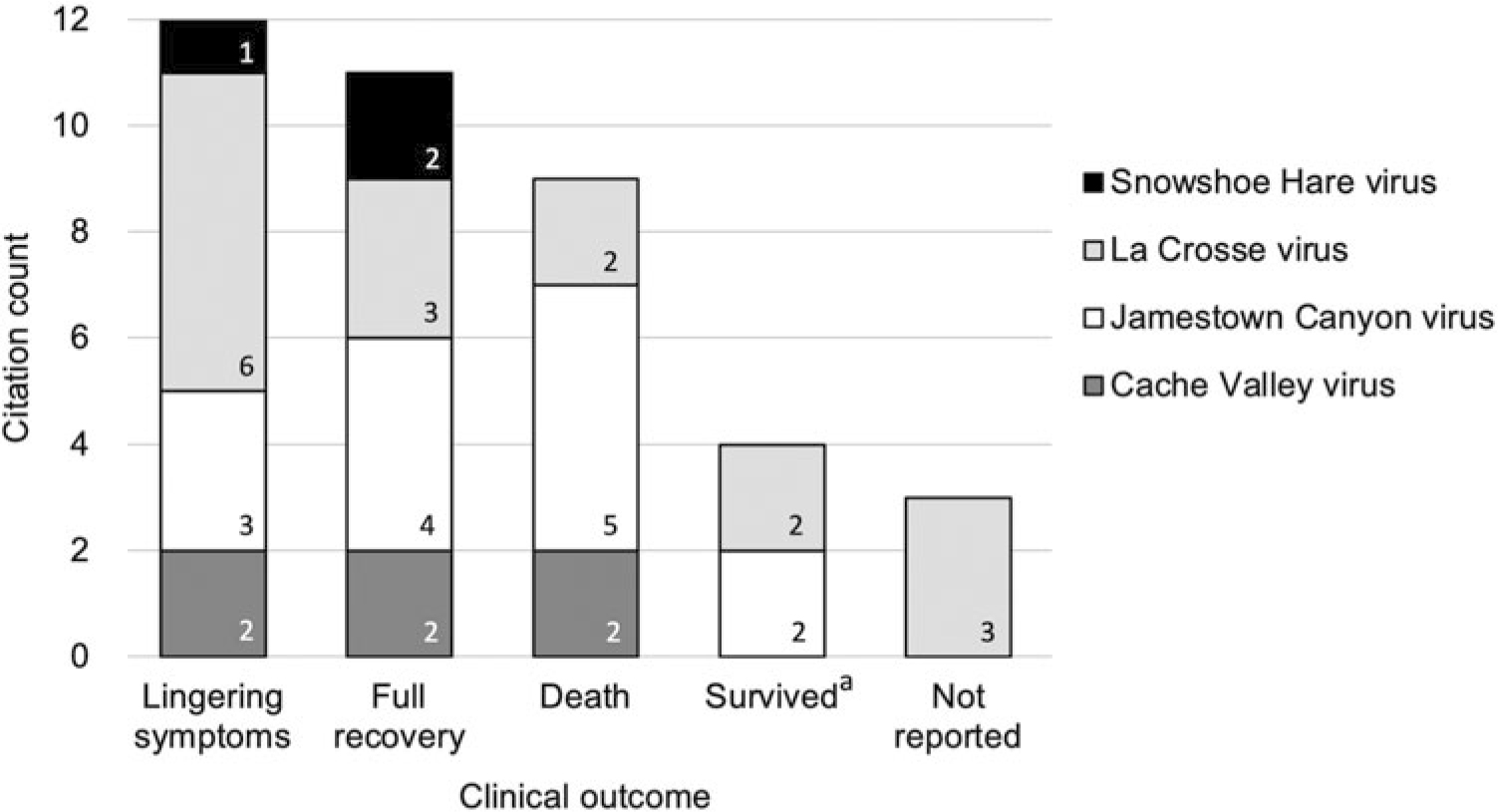
Recovery status of human cases, based on case reports and passive disease surveillance citations (n = 33). Categories are not mutually exclusive, since disease surveillance reports included multiple individuals with varied outcomes. aPatients survived the infection, but no additional details about their health status or recovery were reported.
Six studies did not provide details on the recovery status, although these publications comprehensively represented the majority of human incidence and were based on annual government public health passive surveillance data (De los Reyes et al., 2008; Hinckley and Hall, 2009; Jones et al., 1999; McDonald et al., 2019; Rogstad et al., 2015; Wurtz and Paleologos, 2000).
Risk factors for seropositivity and/or disease
Risk factors associated with orthobunyavirus infection were addressed in 32 citations. Regardless of host type, outdoor exposures and demographic characteristics were identified as the most common risk factors associated with seropositivity (Table 2 and Supplementary Table S3). Risk factors associated with LACVD were most investigated. Studies focused on SHV exposure always investigated JCV exposure as well. CVV was least studied, but still, the findings were consistent with the other orthobunyavirus research.
Risk Factors Examined for Association with Orthobunyavirus Seropositivity (n = 32 Citations) in the Context of Humans (n = 23 Citations), Domestic Animals (n = 7 Citations), or Wildlife Hosts (n = 5 Citations)
The methods used to evaluate risk factors varied greatly across studies, including analytical analysis involving statistical procedures (n = 20, citations in bold in Supplementary Table S3) and descriptive measures (n = 12, citations in Supplementary Table S3). Risk factor categories were not mutually exclusive, and several citations evaluated multiple host types.
Human hosts
Outdoor exposure, demographics, and preexisting medical conditions were associated with orthobunyavirus seropositivity and disease in human populations (Table 2 and Supplementary Table S3). Outdoor exposure risks encompassed many factors that promoted overlap between humans and mosquitoes or wildlife. People were at a greater risk of being seropositive for an orthobunyavirus if they lived near or frequented hardwood forests, spent time near tree holes in regions with high mosquito abundance, or resided in areas cohabitated by wildlife reservoirs (Campagna et al., 2011; Erwin et al., 2002; Miernyk et al., 2019; Morton, 2003; Rocheleau et al., 2018; Wallace, 2015; Walters et al., 1999).
Most studies that investigated human demographic risk factors were in the context of LACV. Age was most commonly studied and found to have a negative association with LACVD (Butterworth, 2009; Gaensbauer et al., 2014; Haddow et al., 2011a; Haddow et al., 2009; Krow-Lucal et al., 2017; Pastula et al., 2015; Wallace, 2015). Counter to the relationship between age and LACVD, increased age was positively associated with JCVD (Krow-Lucal et al., 2017; Pastula et al., 2015) and seropositivity for JCV and SHV (Campagna et al., 2011; Patriquin et al., 2018; Rocheleau et al., 2018; Walters et al., 1999).
Three studies found no difference between males and females (Miernyk et al., 2019; Pastula et al., 2015; Walters et al., 1999), and three studies reported that males were seropositive more often. It was suspected that sex was a proxy for other risk factors (specifically, outdoor lifestyle or occupation) (Campagna et al., 2011; Patriquin et al., 2018; Rocheleau et al., 2018). Individuals residing in rural versus urban settings were also positively associated with viral infections (Haddow et al., 2011b; Matkovic et al., 2019; Patriquin et al., 2018; Wallace, 2015).
Several preventative measures were investigated, including insect repellent, clothing type, and use of window screens, but none were identified as having an impact on exposure or disease (Erwin et al., 2002; Rocheleau et al., 2018).
Animal hosts: domestic
Outdoor exposure, particularly in regions with coniferous forests, appeared to be the greatest risk factor for orthobunyavirus seropositivity in domestic animals, and was seen across age, species, housing, and flock size (Goff et al., 2012; Harvey et al., 2019; Meyers et al., 2015; Nelson et al., 2004; Rocheleau et al., 2018; Troyano, 2009).
Animal hosts: wildlife
Only two out of five studies identified risk factors associated with orthobunyavirus seropositivity in wildlife, including species type, forested habitats, and habitat overlap with roads (Table 2) (Goff et al., 2012; Hollis-Etter et al., 2019).
Spatial patterns
Spatial cluster analysis was explored in 16 citations, but regions and methods varied widely, making it difficult to report summary trends. Only six studies performed exploratory cluster analysis (Haddow and Odoi, 2009; Haddow et al., 2011a; Haddow et al., 2011b; Haddow et al., 2009; Rocheleau et al., 2018; Wallace, 2015); the remainder of studies applied non-spatial statistical techniques. The comprehensive findings implicated LACVD hotspots in the Appalachian and Midwestern regions of the USA, and high-risk regions were specifically identified in rural environments (Gaensbauer et al., 2014; Haddow and Odoi, 2009; Haddow et al., 2011a; Haddow et al., 2009; Kosoy et al., 2016; Wallace, 2015).
Categories to delineate spatial trends varied by geography (Gaensbauer et al., 2014; Haddow and Odoi, 2009; Haddow et al., 2011a; Haddow et al., 2009; Kosoy et al., 2016; Pastula et al., 2015; Patriquin et al., 2018; Pedersen et al., 2017; Sahu et al., 2002; Wallace, 2015), environmental attributes (Goff et al., 2012; Hollis-Etter et al., 2019; Rocheleau et al., 2018; Walters et al., 1999), and demographics (Haddow et al., 2011b).
Studies that compared geographic risk factors demonstrated the importance of scale for identifying disease foci, with a preference for using a finer scale than county level (Haddow and Odoi, 2009; Haddow et al., 2011a; Haddow et al., 2009; Wallace, 2015).
Temporal patterns
Temporal analysis
An increase in annual incidence was observed for JCVD and LACVD (Byrd et al., 2018; Gaensbauer et al., 2014; Matkovic et al., 2019; Pastula et al., 2015), but the authors suggested that trends were likely confounded by changes in testing protocols and frequencies (Matkovic et al., 2019; Pastula et al., 2015).
Seasonal trends
Orthobunyavirus cases occurred throughout the year, but most cases were reported from June through September, corresponding to the mosquito breeding season, and distinct trends were observed for each orthobunyavirus. Human JCVD cases were reported throughout the year, with the majority occurring from July to September (Askar et al., 2020; Curren et al., 2018; Krow-Lucal et al., 2017; Lowell et al., 2011; Madigan et al., 2018; Matkovic et al., 2019; McDonald et al., 2019; Pastula et al., 2015; Rogstad et al., 2015; Savard et al., 2018; Webster et al., 2017).
Peak incidence for LACVD also ranged from July to September (Abuhammour, 2005; Balkhy and Schreiber, 2000; Byrd et al., 2018; Curren et al., 2018; Ding et al., 2020; Gaensbauer et al., 2014; Haddow and Odoi, 2009; Haddow et al., 2011a; Hinckley and Hall, 2009; Jones et al., 1999; Krow-Lucal et al., 2017; McDonald et al., 2019; McJunkin et al., 2001; Pastula et al., 2015; Patrick et al., 2010; Teleron et al., 2016).
Despite fewer reports of CVVD and SHVD, trends were still observed. Human SHVD cases were reported solely in July and August (Lau et al., 2017; Madigan et al., 2018; Meier-Stephenson et al., 2007; Webster et al., 2017). Human CVVD cases, however, were reported late in the mosquito season, from August to October, excluding one June case in a severely immunocompromised adult (Baker et al., 2021; Campbell et al., 2006; Nguyen et al., 2013; Wilson et al., 2017; Yang et al., 2018).
The same seasonal trends reported for JCVD and SHVD in humans were observed in animal species (Carson et al., 2017; Sahu et al., 2000). However, that was not the case for CVVD. In livestock animals, CVVD was consistently reported in early winter (December and January), as to be expected since infection with CVV is known to cause congenital defects in sheep and goats that are in early gestation in late summer/early autumn when viral loads are highest in mosquitoes, but congenital disease is only determined at lambing several months later (Harvey et al., 2019; Leboeuf et al., 2017; Shapiro et al., 2012; Spinato et al., 2016; Stalker and Megens, 2021).
Preventative and treatment measures
There were no effective preventative measures identified, and supportive care remains the only option for diseased individuals (Butterworth, 2009; Hoffmann et al., 2013; Hoffmann et al., 2012; McJunkin et al., 2011; Meyers et al., 2015; Rocheleau et al., 2018; Savard et al., 2018).
Climate change effects
No citations were identified that evaluated the effects of climate change on orthobunyavirus epidemiology in host species.
Discussion
A scoping review focused on orthobunyaviruses of public health importance in Canada, published between 1999 and March 2021, captured 95 studies in the context of host epidemiology. LACV was investigated most often and SHV the least. Regardless of orthobunyavirus, the number of publications increased with time. Most citations were surveillance studies or case reports. Few studies addressed disease forecasting, transmission, or prevention.
Human hosts were evaluated in three times as many citations as domestic or wild animals. Regarding geographic trends, LACV studies concentrated in eastern USA, whereas JCV and CVV studies were most distributed across the USA and Canada.
Orthobunyaviral disease was mostly reported in humans, and LACVD was unique in that it was strongly associated with children under 16 years of age (Gaensbauer et al., 2014; Haddow and Odoi, 2009; Wallace, 2015), although the cause for such was not addressed. However, cases may be underdiagnosed and underreported considering that orthobunyaviruses are not reportable in Canada (Public Health Agency of Canada, 2023).
Further, physicians likely do not see the cases that are subclinical or asymptomatic or may not consider orthobunyaviruses in the differential. In addition, the capacity for diagnostic testing is limited in Canada to the National Microbiology Laboratory in Winnipeg, Manitoba, and in the USA to federal level and a select few state-level health departments (Centers for Disease Control and Prevention, 2021; Mincer et al., 2021; Totten et al., 2019).
Consequently, there is likely a reporting bias in that only cases with severe symptoms are reported to public health agencies (Dimitrova et al., 2011; Drebot, 2015; Makowski et al., 2011). In animals, multiple mammalian species were found to be exposed to orthobunyaviruses, whereas disease cases were only reported in sheep, goats, a dog, and a horse.
Surprisingly, only one study assessed host competency for viral amplification (Blackmore and Grimstad, 2008), despite widespread seroprevalence across animal species and knowledge gaps regarding the roles these animals serve in viral transmission.
Human cases were most commonly reported during mosquito season and in warmer regions, indicating a distinct spatiotemporal pattern in virus circulation (Curren et al., 2018; Gaensbauer et al., 2014; Krow-Lucal et al., 2017; McDonald et al., 2019). However, more analytical research is needed to investigate associations between incidence and climate factors (e.g., precipitation, temperature) over both short- (i.e., within a single mosquito-season) and longer-term (i.e., over multiple mosquito-seasons) timescales.
Disease in livestock (i.e., CVVD) was also associated with breeding during mosquito season, and since the virus infects the fetus during early gestation, cases presented as congenital deformities in the offspring born in winter (Edwards, 1994; Harvey et al., 2019; Leboeuf et al., 2017; Shapiro et al., 2012; Spinato et al., 2016; Stalker and Megens, 2021). Therefore, small ruminant producers may benefit from breeding younger livestock likely not pre-exposed to CVV, outside of this higher risk period, or modifying housing practices during this period to minimize mosquito exposure.
Risk factors for populations seropositive for an orthobunyavirus were commonly associated with exposure to outdoor environments with high mosquito abundance, including forests and tree holes near rural residences. However, only half the studies that examined risk factors utilized analytical techniques to assess associations whereas the remainder were descriptive.
Given that the viruses and relevant host and vector reservoirs are widely distributed across the USA and Canada, but disease cases were restricted to smaller geographic regions, more research is needed to elucidate the risk factors correlated with disease (Giordano et al., 2018; Ogden, 2017; Ogden and Gachon, 2019). Specifically, more population types beyond just those with high outdoor exposure levels should be studied.
Prospective active surveillance specifically for orthobunyaviruses would greatly enhance epidemiologic understanding (Poggi et al., 2023). Collaboration between public, production animal and wildlife health agencies on active surveillance in rural regions where humans, livestock, and wildlife geographically overlap would aid in identifying important sentinel species and forecasting outbreaks, as achieved with WNV surveillance efforts (McLean et al., 2002). For livestock specifically, additional research is needed to examine the association between species, breeding schedule, housing, and exposure to surrounding environmental landscapes.
A gap in literature that studied the impact of climate change on the epidemiology of orthobunyaviruses was also identified, which is concerning due to the spatiotemporal associations with warmer regions and the circulation of the viruses during the warmer months of the year (Bush and Lemmen, 2019; Kulkarni et al., 2015). Further, no disease projections in the context of climate change were researched in host species, which has implications for public and animal health and economics.
This study had several limitations. The selection of databases used for literature searches may have prevented the capture of relevant research, especially studies related to veterinary epidemiology that may not be indexed, potentially biasing the results. However, to mitigate this risk, extensive gray literature searches and validation techniques were implemented. In addition, some knowledge gaps may be due to the exclusion of studies published before 1999, particularly surveillance and reservoir competency studies.
However, related orthobunyavirus scoping reviews indicated similar trends as reported here, including widespread prevalence of orthobunyaviruses in the USA and Canada, and limited research on vertebrate hosts in the epizootic cycle (Harding et al., 2019; Waddell et al., 2019). Lastly, relevant research related to climate effects on host reservoirs may not have been accurately represented here because of inclusion criteria necessitating that the results were reported in the context of an orthobunyavirus rather than the reservoir itself.
Conclusion
The epidemiology of orthobunyaviruses in North America has proven difficult to study in that infection is typically subclinical or nonspecific regardless of host species. In addition, underdiagnosis and underreporting are common in diseased individuals due to limited diagnostic testing and a lack of risk factor knowledge. Surveillance studies in a wide array of vertebrate host species indicate high prevalence for these orthobunyaviruses across the USA and Canada.
Increased orthobunyavirus surveillance and spatial analysis are necessary, particularly in understudied regions across Canada, which could facilitate robust risk factor analysis. In cases where resources are limited, sampling should be conducted during seasonal periods indicated by the literature, particularly when multiple orthobunyaviruses are present, such as late summer. Finally, an increase in epidemiology-related orthobunyavirus research in the context of climate change and risk prevention are greatly needed to guide future public and animal health efforts to mitigate orthobunyaviral disease.
Footnotes
Acknowledgment
The authors wish to thank the Public Health Agency of Canada librarians for assistance with article procurement, Lisa Waddell for sharing expertise on scoping review methodology, and the University of Guelph Data Resource Centre, particularly Teresa Lewitzky, for providing software training.
Authors' Contribution
M.d.B.: conceptualization (lead); data curation (lead); methodology (lead); formal analysis (lead); project administration (equal); visualization (lead); writing—original draft (lead); and writing—review & editing (lead). V.N.: conceptualization (supporting); methodology (supporting), formal analysis (supporting); project administration (equal); resources (equal); writing—original draft (supporting); writing—review & editing (supporting); and funding acquisition (equal). T.S.: data curation (supporting), writing—review & editing (supporting). A.L.: writing—review & editing (supporting). P.M.: writing—review & editing (supporting). S.M.: writing—review & editing (supporting), funding acquisition (equal). K.M.C.: conceptualization (supporting); methodology (supporting), formal analysis (supporting); project administration (equal); resources (equal); writing—original draft (supporting); writing—review & editing (supporting); and funding acquisition (equal).
Author Disclosure Statement
The authors declare no competing financial or intellectual interests that could have influenced the work reported in this study.
Funding Information
This work was supported by the Infectious Diseases and Climate Change Fund of the Public Health Agency of Canada [1920-HQ-000075].
Supplementary Material
Supplementary Data
Supplementary Table S1
Supplementary Table S2
Supplementary Table S3
References
Supplementary Material
Please find the following supplemental material available below.
For Open Access articles published under a Creative Commons License, all supplemental material carries the same license as the article it is associated with.
For non-Open Access articles published, all supplemental material carries a non-exclusive license, and permission requests for re-use of supplemental material or any part of supplemental material shall be sent directly to the copyright owner as specified in the copyright notice associated with the article.
