




Abstract
Background:
The aim of the present study was to describe the presence of co-infection by Toxoplasma gondii and Neospora caninum in goats reared in extensive systems from Mexico.
Materials and Methods:
A cross-sectional study was conducted to determine the frequency of T. gondii and N. caninum, by detecting antibodies to each parasite by mean commercial ELISA kits. A total of 176 blood samples were randomly collected from mature females reared in extensive system herds from 20 municipalities of state of Guanajuato, Mexico.
Results:
The general seroprevalence was 23.9 and 21.0% for T. gondii and N. caninum, respectively, while co-infection rate was 3.6%. For geographic and environmental variables, no differences were observed among T. gondii and coinfection; however, it was observed that altitude, annual precipitation, annual average temperature, and rainy period showed significant differences with N. caninum seropositive goats.
Conclusion:
The seroprevalence of both parasites was appreciated in most of the studied herds. The present study is the first report of T. gondii and N. caninum co-infection in goats from extensive herds in Mexico.
Introduction
Toxoplasma gondii and Neospora caninum are two closely related Apicomplexan protozoan parasites that infect goats (Capra hircus); in this species, both parasites can cause subclinical infections, and they can be transmitted congenitally and produce abortions, fetal death with mummification, stillbirth, and neonatal death, resulting in consequent production and socioeconomic losses (Alvarado-Esquivel et al., 2013; Bartova and Sedlak, 2012; Díaz et al., 2016).
The ingestion of unpasteurized milk and undercooked meat from infected goats with T. gondii has been estimated as possible source of infection in humans (Alvarado-Esquivel et al., 2013; Díaz et al., 2016). In Mexico, goat meat is widely consumed in various traditional dishes, as well as unpasteurized goat milk and its products, mainly as fresh cheeses (Alvarado-Esquivel et al., 2011). Additionally, the prevalence data of these parasitic diseases in goats are scarce, particularly regarding N. caninum (Huerta-Peña, 2012; Vitela-Mendoza et al., 2023). Consequently, these animals are poorly considered as study subjects, thereby minimizing recognition of their role in zoonotic diseases and their negative impact on production systems. Guanajuato is the second most important Mexican province in goat-growing systems, known for its production of milk, meat, and by-products by mean the most common and widely distributed production-reared conditions. Therefore, the objective of the present study was to describe the presence of coinfection by Toxoplasma gondii and Neospora caninum in goats reared in extensive systems in Mexico.
Materials and Methods
The study was conducted in the state of Guanajuato, Mexico (21° 52', 19° 55' N, and 99° 41', 102° 09' W). Guanajuato features a wide range of climatic zones, determined by latitude, distance from the sea, the effects of polar air masses, as well as orographic condensation phenomena. Geographically, there are three climatic zones defined in the state. The dry climate, in general, corresponds to the plateau area, the mild climate to the middle and high parts of the mountains, and the semiwarm climate predominantly to the area known as “El Bajio.” Almost all of Guanajuato has a pleasant climate, with temperatures ranging from a minimum of 11.7° C to a maximum of 24.2° C. In the central and northwest regions, the climate is considered steppe-like, whereas in the remaining territory it is mild, moderate, and rainy (Instituto Nacional de Estadística y Geografía, 2017) (Table 1).
Geographic and Environmental Characteristics of Extensive Goat Farms of the State of Guanajuato
ASA, Arid and semiarid; WSH, Warm and subhumid; SHT, Subhumid Temperature; °C, degrees Celsius; m.a.s.l, meters above the sea level.
A cross-sectional study was conducted to determine the frequency of T. gondii and N. caninum, by detecting antibodies to each parasite. Minimal sample size was calculated according to Thrusfield (2005), assuming a total of goats registered in the state of Guanajuato based on the Official Brucellosis Campaign Livestock Data Census (NOM-041-ZOO, 1995). The study used an expected prevalence of 50%, a desired precision of 5%, and a 95% level of confidence.
176 blood samples were randomly collected from mature females (4–6 years old) in herds from 20 of the 46 total municipalities. Additional data registered from each herd includes geographic and environmental information. Samples were collected by jugular venipuncture, based on the guidelines approved by the Internal Committee for the Care and Use of Animals of Laboratory. Samples were sent to the laboratory for serum separation and stored at −20°C until analysis.
The detection of IgG antibodies against T. gondii was carried out by commercial indirect ELISAs (PrioCHECK® Toxoplasma Ab SR); for antibodies to N. caninum, we used a commercial indirect ELISA kit (IDEXX Neospora Ab Test); for both trials, manufacturer’s instructions were followed, which are designed specifically for small ruminants and ruminants, respectively.
The absorbance values were obtained by reading each plate in a commercial ELISA reader (ELIREAD, Kontrolab®) at 490 nm. The cutoff points were estimated by the calculation of the mean absorbance of negative control samples plus three standard deviations as well based on the frequency distribution of negative sample values (Cedillo-Peláez, 2015). Individual results were expressed as ELISA index (EI) based on the methodology described by Silva et al. (2002). The frequency of coinfection was determined by comparing both agents’ frequencies using a scatter plot (Cedillo-Peláez, 2015). The herd was considered seropositive when at least one animal from the same herd had T. gondii or N. caninum antibodies.
Data registered in the herds were entered in a spreadsheet in electronic format (Excel for Windows). A descriptive analysis was used for the variables included in this study. A Chi-squared test was used to evaluate the association between the seroprevalence of T. gondii, N. caninum, and its coinfection as the dependent variable, whereas climatic elements (annual average temperature, annual precipitation, rainy period) and factors (altitude, latitude, and land relief) were the independent variables. Statgraphics Centurion program version 15.2 was used for analyzing, a p < 0.05 was considered statistically significant.
Results
Anti-T. gondii and N. caninum antibodies were present in 41 (23.3%) and 37 (21.0%) goats, respectively. Only six animals (3.4%) were positive for both parasites (coinfection), 35 goats (19.9%) had antibodies exclusively against T. gondii, and 31 (17.6%) only for N. caninum (Fig. 1).
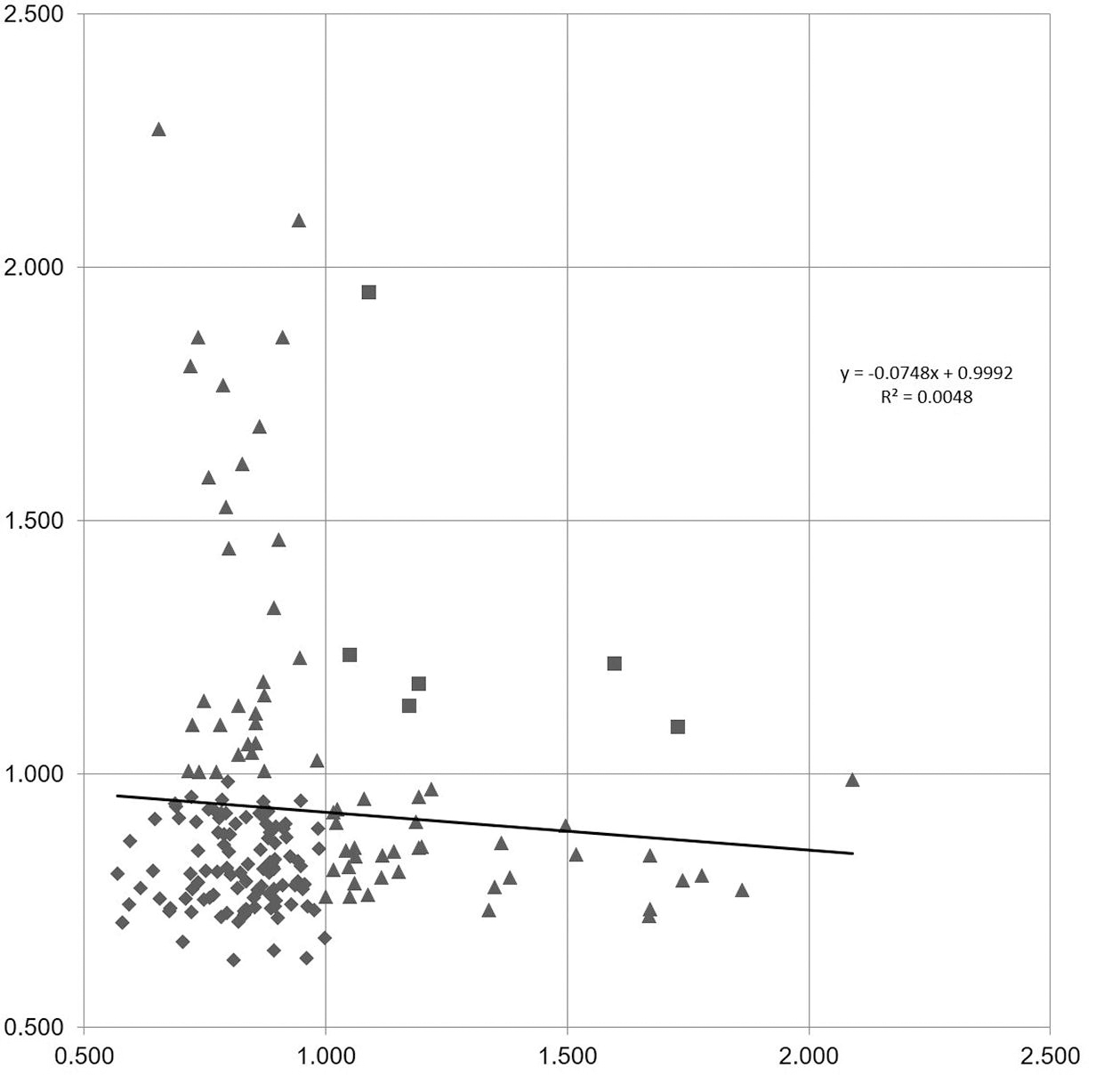
Scatter plot shown the T. gondii and N. caninum seropositivity relationship in goat’s extensive farming systems from Guanajuato, Mexico.
From the 20 herds studied, 12 (60.0%) of them had seropositive animals for T. gondii, 14 (70%) for N. caninum, 8 (40%) had seropositive animals for the two parasites, and 17 (85%) farms showed positive animals for either one or the other pathogen (Fig. 2).

Map shown geographical localization of T. gondii and N. caninum seropositive goats extensive farming systems from Guanajuato, Mexico.
Table 2 shows the distribution of seropositive goats considering the geographic and environmental variables, where no significant differences were found for T. gondii and coinfection-positive animals. However, it was observed that environmental variables such as altitude (>1,720 m.a.s.l.), annual precipitation (>500 mm), annual average temperature (>19.0°C), and rainy period (>60 days) were significant in seropositive animals for N. caninum within selected extensive goat production systems (p < 0.00).
Seroprevalence of T. gondii, N. caninum and Co-Infection in Goats in Extensive Systems, According to Geographic and Environmental Risk Factors.
Variable: Annual Average Precipitation (mm), Milliliters; Annual Average Temperatures (°C), Celsius Grade; Altitude (m.a.s.l), Meters above the Sea Level; Rainy Period.
n: Number of Samples, 176.
p-Value: NS, No Significant (p > 0.05).
Significant (p ≤ 0.00)
Discussion
In Mexico, studies concerning T. gondii and N. caninum, have been developed independently; however, none of them provides seroprevalence data for the coinfection of both parasites, a situation that has been considered and recorded as a hypothesis in the present study. For T. gondii, recorded seroprevalences range from 3.2 to 44% (Alvarado-Esquivel et al., 2013; Alvarado-Esquivel et al., 2011; García-Vázquez et al., 1993; García-Vázquez et al., 1990), which are similar to our results; however, for N. caninum, there is only one study reporting a seroprevalence of 3.6% (Huerta-Peña, 2012), which is significantly lower compared with the prevalence reported in the present study.
In this study, the results for T. gondii fell into the seroprevalence range described. However, it is important to consider that 60% of the selected herds throughout the state were positive for T. gondii, while a similar result was observed for N. caninum with 70.0% seroprevalence. For N. caninum the seroprevalence in the present study was of 21.0%, which is more than five times higher than the unique previously described study of goats in Mexico (Huerta-Peña, 2012). It is important to note that in addition to being the first report of coinfection in Mexico, this seroprevalence is considered low, despite the wide distribution of seropositive herds for both parasites in the region of the study (85%) (Fig. 2).
The widely distributed presence of these two agents in this study with similar seroprevalence contrasts with studies from other countries like Spain (Díaz et al., 2016) or the Czech Republic (Bartova and Sedlak, 2012), where the T. gondii seroprevalence was higher than that of N. caninum. These differences may be given by specific factors such as geographic region (Alvarado-Esquivel et al., 2013), habitat (urban or rural), host characteristics (species, aged, sex), farming system (semiconfined or confined) (Hosseininejad and Hosseini, 2011; Machacova et al., 2016; Yan et al., 2016), warm and humid conditions (Tenter et al., 2000), and diagnostic methodology applied (Faria et al., 2007).
The ability to adapt to several geographic and environmental conditions in different municipalities of the state, maintaining their biological cycles continuously, particularly for T. gondii, could be factors to explain the seroprevalence results; however, for N. caninum, the differences can be influenced by ruminant sharing grazing (cattle or sheep), which is frequent in some regions of the state (Liu et al., 2015; Instituto Nacional de Estadística y Geografía, 2017) or for the modification of the environment because of the widespread placement of agricultural irrigation systems (Instituto Nacional de Estadística y Geografía, 2017). These factors, favored by environmental conditions, are increasing the risk of infection in these areas.
Goats from this study usually spend the nights in small flocks under extremely overcrowded conditions; this management practice increases the risk of infection by both parasites by the exposure to oocysts (Díaz et al., 2016). Later, during the day, the goats graze on areas where sporulated oocyst can be widely disseminated by definitive domestic, feral, or wild hosts (felines and canines) (Alvarado-Esquivel et al., 2011; Díaz et al., 2016; Sánchez et al., 2016), which are found in considerable numbers throughout the state.
Gazzonis et al. (2019), who conducted a spatial analysis of T. gondii and N. caninum infections in small ruminants in northern Italy to identify factors influencing the distribution of these protozoal infections and to find areas at high risk of infection with the aim of establishing preventive measures for their control and dispersion; obtained as results that geographic and environmental conditions were not significant risk factors for the infection of both parasites in goats from the Lombardy region, in Italy. In the case of T. gondii infections, the information of seropositive animals is consistent with our results; however, in the present study, risk factors such as annual mean temperature, altitude, precipitation, and duration of the rainy season were found significant for the infection of N. caninum in goats.
In conclusion, the seroprevalence of both parasites was observed in most of the herds studied, regardless of the geographical or environmental conditions, suggesting a wide distribution and adaptation to the environment where the animals are grazing. In the case of N. caninum, the rainy season, rainfall, and altitude were significant environmental factors. The present study is the first report of seroprevalence and coinfection of T. gondii and N. caninum in goats from extensive herds in Guanajuato, Mexico. More studies are needed to elucidate the real role of goats in the epidemiology of both parasites and their potential risk to public health.
Footnotes
Acknowledgments
G.M-G. thanks CONACYT for a scholarship for their postgraduate studies. Thanks to Dr. J.E. Barboza-Corona and Dra. Ma. Fabiola León-Galván from the Universidad de Guanajuato for their technical support during this study. The authors appreciate the contribution of the producers to this study as well.
Authors’ Contributions
All authors contributed to the study conceptualization. Methodology by G.M-G., E.F-R., S.L-B., and A.J.G-C. Formal analysis by G.M-G., O.A.M-J., M.V-P., and A.J.G-C. Project administration by A.J.G-C. Writing of the original draft of the article by G.M-G., A.J.G-C. Writing, review, and editing by all authors, who approved the final article.
Author Disclosure Statement
No competing financial interests exist.
Funding Information
No funding was received for this article.
Statement of Animal Ethics
The protocol was approved by the Committee Institute of Bioethics in Research of the University of Guanajuato (CIBIUG-P61-2020).