




Abstract
Background:
Ehrlichia canis has been the main hemopathogen affecting domestic dogs in Brazil. Even though tick-infested dogs may lead to household infestation and predispose human exposure and public health concern, no comprehensive study has surveyed humans, dogs, and environmental ticks altogether.
Materials and Methods:
Accordingly, the present study aimed to assess tick-infested households, identify tick species, perform serological (immunofluorescence assay) and molecular (PCR and q-PCR) detection of Ehrlichia in ticks, in the eighth biggest metropolitan area of Brazil.
Results:
Between 2007 and 2020, 233/5973 (3.9%) out of all complaints were from tick-infested households of 200 different addresses. Overall, 370/552 (67.0%) ticks were collected and identified as adult and 182/552 (33.0%) as immature forms of Rhipicephalus sanguineus s.l. complex; a single tick from one owner, a female tick of Amblyomma sculptum; and 395 ticks from dogs, 319/395 (80.8%) adult and 72/395 (18.2%) immature forms of Rhipicephalus spp., and 4/395 (1.01%) female Amblyomma aureolatum. Overall, 2/135 (1.5%) owners and 13/136 (9.6%) dogs were seropositive for E. canis. The DNA of Anaplasmataceae family was molecularly detected in 16/50 (32.0%) R. sanguineus s.l. As expected, the number of monthly tick infestation complaints were directly associated, and mean (p = 0.01), maximum (p = 0.011), and minimum (p = 0.008) temperature were statistically significant and had a low positive correlation (0.24, 0.23, and 0.24, respectively). In addition, complaints were highly associated to all socioeconomic variables (p < 0.001), with the exception of the presence of vacant lots.
Conclusions:
Despite low samplings and human negative results, areas with low-income with adequate temperature and urban agglomerations have been shown to be associated risks for tick infestations, predisposing tick-borne diseases. In conclusion, monitoring should always be conducted in such areas, including One Health approach with serosurvey of owners and dogs, along with identification and molecular screening of ticks.
Introduction
The Ehrlichia genus, order Rickettsiales and family Anaplasmataceae, currently involves seven species, including E. canis, E. chaffeensis, E. ewingii, E. muris, E. ruminantium, Ehrlichia IOE (Ixodes ovatus Ehrlichia) and E. minasensis (Cabezas-Cruz et al., 2016; Dumler et al., 2001; Shibata et al., 2000). Ehrlichia canis has been reportedly the agent of Canine Monocytic Ehrlichiosis (CME) disease, a worldwide hemopathogen distributed in dog populations (Selim et al., 2021), infecting dogs in all regions of Brazil and with prevalence ranging from 0.7% to 92.3% (Paula et al., 2021; da Costa Vieira, 2011).
Although rare, E. canis infection in humans has been reported in Japan (Maeda et al., 2010), EUA (Conrad, 1989), Venezuela (Perez et al., 2006; Perez et al., 1996), Mexico (Beatriz Silva et al., 2014), and Costa Rica (Bouza-Mora et al., 2017). In Brazil, despite only suspected infection by E. chaffeensis in humans has been reported to date (Calic et al., 2004; da Costa et al., 2006a), E. canis should be considered as a potential agent of human diseases in endemic CME areas (de Paiva Diniz et al., 2007; Nicholson et al., 2010; da Costa Vieira, 2011).
E. canis transmission to vertebrate hosts mainly occurs by bacterial inoculation through saliva of infected ticks during blood ingestion, or less often by blood transfusion and ingestion of infected ticks (Massard and Fonseca, 2004). Rhipicephalus linnaei (published as Rhipicephalus sanguineus sensu lato [s.l.] “tropical lineage”) has been the most involved tick species, commonly found parasitizing dogs in urban areas (Šlapeta et al., 2022).
Although considered a single taxon until recently, R. sanguineus had two recognized genetic lineages, named temperate and tropical strains (Moraes-Filho et al., 2011; Nava et al., 2018; Nava et al., 2017; Nava et al., 2012), morphologically similar (Dantas-Torres et al., 2013), but with differences in biology (Sanches et al., 2016; Szabó et al., 2005) and vector competence (Moraes-Filho et al., 2015). Morphological redescription and molecular characterization using neotype designation have redefined the R. sanguineus s.l. temperate strain as R. sanguineus sensu stricto (s.s.) (Nava et al., 2018), and R. sanguineus s.l. tropical strain as R. linnaei (Šlapeta et al., 2022), which has been the most frequent strain worldwide (Šlapeta et al., 2022; Šlapeta et al., 2021).
Only R. linnaei (published as R. sanguineus s.l. tropical strain) proved to be a competent vector of E. canis transmission in dogs (Moraes-Filho et al., 2015), which may explain differences in E. canis prevalence, from <5% found in southern states (Krawczak et al., 2012a) to >5% and up to 69.4% in other Brazilian regions (Tanikawa et al., 2013).
Although owners and their dogs may be exposed to E. canis, particularly in households infested by ticks, no study to date has concomitantly assessed these vulnerable populations. Accordingly, the present study used One Health approach to assess tick-infested households in low-income neighborhoods of Pinhais, metropolitan region of Curitiba, southern Brazil, performing owner-dog Ehrlichia spp. serosurvey by Immunofluorescence Assay (IFA), molecular E. canis detection by qPCR in collected ticks from owners, dogs, and household areas, and identifying potential associated risk factors and risk areas.
Materials and Methods
Ethics
The study herein has been approved by the Ethics Committee on the Use of Animals at the Federal University of Paraná (protocol number 078/2019) and by the National Research Ethics Commission at the Brazilian Ministry of Health (protocol number 34934220.4.0000.0102/2020).
Study design
The present study was a cross-sectional survey of owners, their dogs, and ticks from low-income neighborhoods of Pinhais, metropolitan region of Curitiba, southern Brazil.
This study design was based on official city complaints and inspection reports of tick-infested households by the Pinhais Health Department from January 2007 to November 2020. Tick samplings were also actively carried out in recreation areas, some with capybara presence, as reported by the city environmental surveillance sector. Human and dog blood, and tick samplings were performed by a multidisciplinary team from April 2019 to November 2020, with all addresses georeferenced for the construction of risk maps.
Local of study
The study was carried out in the municipality of Pinhais (25° 25′ 57″ S and 49° 11′ 35″ W), 930 meters of altitude, 61 km2 of extension, 129,445 inhabitants, located in the urban area of the metropolitan region of Curitiba, capital of Paraná state, southern Brazil (Fig. 1). Curitiba was ranked as the eighth biggest Brazilian city population, with 3,731,769 inhabitants, and the second largest metropolitan region nationwide in extension, with 16,581.21 km2 (de Moura et al., 2022). The area presented a Cfb Köppen's climate classification, with annual average temperature of 17°C (20°C in January and 13°C in July), annual rainfall of 1550 millimeters slightly concentrated in summer months, and with dryer winter (Alvares et al., 2013). The municipality was divided into 15 neighborhoods at the time, with four hydrographic regions with different characteristics. In addition, city parks were widely visited by local population along with their pets, with intermittent presence of native capybaras (Hydrochoerus hydrochaeris).

Geographic distribution of tick infestation complaints in Pinhais, Paraná, Brazil (2007–2020) and locations where CO2 traps were installed. Subtitle: The upper left image shows the location of Brazil, with delimitation of its regions and biomes, in relation to South America and the Tropic of Capricorn; the lower left figure represents the location of the city of Pinhais in relation to the state of Paraná and the figure on the right represents the city of Pinhais with the delimitation of its 15 neighborhoods, location of the addresses where there were complaints of tick infestation from 2007 to 2020 (circles), location where CO2 traps were installed (triangles), areas of massive forests (light gray areas), and hydrography (dark gray lines).
Ticks
The tick samplings were officially carried out at the infested households (complaint addresses), following the standard protocols (Ramos et al., 2014). Visits included samplings of fixed ticks on owners and dogs, as well as free-living ticks in the home environment, including on yard walls, floors, and doghouses. In addition, free-living ticks were captured by CO2 traps in areas used for recreation and in areas with known presence of capybaras (H. hydrochaeris), as previously described (De Oliveira et al., 2000). All collected ticks were placed in microtubes with isopropyl alcohol and transported to the Laboratory of Parasitic Diseases (LADOPAR) of the Federal University of Goiás for morphological identification using a stereoscope and standard taxonomic keys and for larvae (Barros-Battesti et al., n.d.; Dantas-Torres et al., 2019; Martins et al., 2010). Ticks collected from dogs were randomly selected after identification and tested by molecular analysis. The remaining specimens were deposited at the LADOPAR's National Collection of Cerrado Ticks—Professor Marcelo Bahia Labruna at the Federal University of Goiás, Brazil.
In addition, tick specimens identified by retrospective reports were gathered from the acarological surveillance database at the National Reference Laboratory on Rickettsial Vectors, Fiocruz, Rio de Janeiro and the Laboratory of Identification and Research in Synanthropic Fauna, São Paulo.
Epidemiological questionnaire
Epidemiological questionnaires were applied for owners and their dogs, and addressed variables associated with tick exposure, eating habits, sanitary access and behavior, animal, and environmental management to assess risk factors for Ehrlichia spp. infection. All volunteer owners signed an informed, explained consent form before any information or ticks and blood samples were obtained.
Human and dog blood samples
Human participants were sampled after signing a consent form and completing an epidemiological questionnaire. Human blood sampling was performed by certified nurses by cephalic venipuncture. Blood samples were obtained from dogs by jugular venipuncture and performed by certified veterinarians, after formal signed consent for dog sampling by owner. Blood samples from humans and dogs (10 mL from each) were placed in sterile vacuum tubes containing a serum separator gel without an anticoagulant. The tubes were centrifuged at 1500 g for 10 min to obtain the serum, which were aliquoted into microtubes, identified and stored at −20°C until the serological analysis.
Serological tests
All human and canine serum samples were tested by IFA for antibodies against crude antigens of the E. canis strain São Paulo (Aguiar et al., 2008), prepared in a cell culture as already described (Aguiar et al., 2008). Briefly, sera were diluted in twofold increments with phosphate-buffered saline, starting with 1:80 dilution. Reactions were achieved with fluorescein isothiocyanate-labeled rabbit anti-dog IgG dilution 1:400 (IgG; Sigma Diagnostics, St. Louis, MO) as conjugate for dog samples and fluorescein isothiocyanate-labeled rabbit anti-human IgG dilution 1:1000 (IgG; Sigma Diagnostics) as testing conjugate for human samples. Sera reacting at the 1:80 dilution were titrated at twofold increases to define the endpoint to E. canis titer. Negative and positive controls were added to each slide, with previously nonreactive serum samples and one very high positive sample with 1280 endpoint titer, respectively.
Molecular tests
DNA extraction from ticks was performed using the guanidine isothiocyanate protocol for adults, as previously described (Sangioni et al., 2005), and stored at −20°C until tested by PCR. DNA extractions were performed with a negative control, which was one of the blank samples without sample addition, processed along with other samples. The number of sequences observed in these controls was used to estimate and filter the cross-contaminations during the DNA extractions and to detect any DNA bacterial contaminants present in the extraction kit reagents.
Quality DNA extraction was validated by negative samples for DNA of Anaplasmatacea family, Anaplasma platys or E. canis, further tested by PCR targeting a 460 bp fragment of the 16S rDNA tick mitochondrial gene (Mangold et al., 1998), to ensure successful DNA extraction. Samples not amplifying PCR amplicons in these PCR assays were discarded.
First, a screening PCR for Anaplasmataceae family (which detects Anaplasma, Ehrlichia, Neorickettsia, and Wolbachia genera) was performed to amplify 360 bp of the 16S rRNA gene, as already established (Almeida et al., 2013).
The 16 positive samples for Anaplasmatacea were submitted to PCR to search 409 bp fragment of the disulfide bond formation protein (dsb) gene of Ehrlichia spp. (Doyle et al., 2005; Labruna et al., 2007) and for 724 bp fragment of the heat shock protein (groESL) gene of A. platys (Inokuma et al., 2002) and a qPCR that amplify 378 bp of the disulfide bond formation protein (dsb) gene, with a TaqMan probe, which exclusively detects E. canis (Doyle et al., 2005).
All reactions were performed in duplicate to ensure assessment of reproducibility and accompanied by negative controls without any DNA extract to estimate and filter out cross-contaminations during PCR preparation and to detect any bacterial DNA contaminants present in PCR reagents. In addition, positive controls with DNA from isolates of known taxa were used to assess taxonomic attribution and to estimate and filter cross-contamination, processed along with all other samples. The resulting amplification from PCR reactions was visualized on 1.5% Agarose Gel stained with SYBR Safe (Invitrogen, Carlsbad, CA, EUA) and examined on the transilluminator with UV (ultraviolet) light.
Data collection
Historical meteorological data of Pinhais municipality, metropolitan region of Curitiba, southern Brazil, were obtained from January 2011 to December 2020 from the Paraná Environmental Technology and Monitoring System. Socioeconomic, populational, and social assistance data of national census in 2010 and 2020 were obtained at the Brazilian Institute of Geography and Statistics (IBGE) and the Pinhais Social Assistance Secretary, while spatial data were obtained at the Pinhais Urban Planning Department.
Statistical analyses
Historical meteorological, socioeconomic, populational, and social assistance data, along with epidemiological questionnaire applied to owners and their dogs were analyzed with the number of tick complaints and the results of serological tests, either positive or negative. Initially, data were descriptively analyzed with simple (n) and relative (%) frequency estimates of all variables in two data sets. Subsequently, association between owners and IFA-positive dogs with questionnaire variables was assessed with the chi-square test and the odds ratio (OR) estimate, with 95% confidence interval (CI). Multiple logistic regression models were produced to obtain the profile of IFA-positive owners and dogs. In the multiple modeling, variables with p < 0.20 were selected to start the models. The method used for input and output of variables was stepwise, starting from the most complex model to the simplest. The criteria used to remain in the final model included changes higher than 10% in OR, improvement in accuracy of 95% CI, statistical significance, degrees of freedom, and adjustment of the model's Akaike information criterion (AIC).
Spearman correlations were performed to verify associations between the number of tick complaints with monthly climatic and socioeconomic variables by neighborhood. The significance level used in all analyzes was 5%. In the spatial analysis, Kernel estimation was used to evaluate the concentration of positive owners and dogs in the IFA based on the behavior of punctual patterns, estimating the punctual intensity throughout the study region. All analyses were performed in the R 4.0.4 environment.
Results
Tick infestation protocols
Out of the total official complaints between 2007 and 2020 received by the Municipal Health Department of Pinhais, 233/5973 (3.9%) of 200 different addresses consisted of tick-infested household complaints (Fig. 1), with tick surveillance and identification performed in 146/200 households (73.0%). An increase in tick infestation complaints was observed from 2.2% per year between 2007 and 2016 to 14.2% in 2017 and reaching 40.95% in 2020 (Supplementary Table S1). January (summer) and October (spring) were the highest months in number of tick infestation complaints, with frequencies of 17.7% and 20.3%, respectively (Supplementary Table S2). Since the first complaints in 2009 and 2014, tick-infestation spread out to all 15 neighborhoods, except Alphaville Graciosa, Parque das Águas, and Parque das Nascentes (Supplementary Table S3).
In addition to tick infestation complaints, 10 in-city park areas used for recreation were selected for tick trapping using CO2 technique, with 51 installed traps (Fig. 1) and ticks sampled in 8/51 (15.69%) CO2 traps of 4 different areas, including Parcão, Parque das Águas, Parque Graciosa, and Casa de Educação Ambiental, with capybara present in the last 3 areas.
Tick identification
Out of the 1006 ticks (86 larvae, 223 nymphs, and 697 adults) obtained during visits, one was from human, 395 from dogs (11 larvae, 61 nymphs, and 323 adults), 552 from households (61 larvae, 121 nymphs, and 370 adults), and 58 (14 larvae, 41 nymphs, and 3 adults) from recreational areas (Table 1). Most ticks with 943/1006 (93.7%) specimens were identified as R. sanguineus s.l. complex, not differentiating between temperate and tropical strains. Exceptions were 63/1006 (6.3%) ticks, including one human tick as female Amblyomma sculptum, four dog ticks as Amblyomma aureolatum, and recreational areas with three Amblyomma dubitatum, 41 A. sculptum, and 14 Amblyomma spp. larvae ticks.
Species and Number of Ticks (L: Larvae; N: Nymphs; M: Males; F: Females) Collected from Dogs, Humans, and Environments from Pinhais City, Southern Brazil from April 2019 to November 2020, and the Historical Tick Data from 2007 to 2020
N° tick tested by PCR = 50.
Historical data obtained from the Municipality of Pinhais.
In addition, information on 526 ticks (one larva, 140 nymphs, and 385 adults) was obtained from the city reports based on historical data from 2015 to 2020, 9 from humans (one nymph and 8 adults), 299 from dogs (61 nymphs and 238 adults), 213 from households (one larva, 74 nymphs, and 138 adults), and 5 from recreational areas (4 nymphs and one adult) (Table 1). Again, ticks were mostly identified as R. sanguineus s.l. complex with 516/526 (98.1%) specimens, with exceptions of 10/526 (1.9%) ticks, one A. dubitatum, and one Amblyomma parkeri ticks in humans, three A. aureolatum in dogs, and five A. dubitatum ticks in recreational areas.
As mentioned, all remaining collected and identified ticks by this study were deposited in LADOPAR's National Collection of Cerrado Ticks—Professor Marcelo Bahia Labruna at the Federal University of Goiás, Brazil accession numbers CNCC 022 and CNCC 025 (Rhipicephalus spp.), CNCC 023 and CNCC 026 (R. sanguineus s.l.), CNCC 024 (A. aureolatum), CNCC 027 (Amblyomma spp. and A. sculptum), and CNCC 028 (A. dubitatum).
Serological detection of antibodies in humans and dogs
A total of 135 humans and 136 dogs were sampled herein. Serological analysis revealed 2/135 (1.5%) seropositive humans for E. canis (strain from São Paulo), both with a titer of 80, a 4-year-old girl and a 61-year-old woman. A total of 13/136 (9.6%) dogs were seropositive, with 3/13 (23.1%) endpoint titers of 80, 6/13 (46.1%) of 160, 2/13 (15.4%) of 320, and 2/13 (15.4%) of 640.
Molecular detection in dog ticks
A total of 50 R. sanguineus s.l. ticks, including 22/50 (44.0%) female and 28/50 (56.0%) males, were randomly selected for the molecular detection of Anaplasmatacea family DNA, Ehrlichia spp., E. canis, and A. platys. Overall, 148 PCR reactions resulted in 16/50 (32.0%) positive ticks for family Anaplasmataceae, 6/16 (37.5%) female and 10/16 (62.5%) male ticks. No tick was positive for E. canis using the dsb by Real-time PCR (qPCR) and no tick was positive for Ehrlichia spp. and A. platys using the dsb and groESL, respectively, by conventional PCR (PCR).
Due to the weak generated bands in the PCR for the Anaplasmatacea Family, no molecular sequencing and identification of the involved bacteria was possible.
Associated risk factors
No statistical significance for the covariates used in the multiple logistic regression model using the stepwise method of input and output of variables (Supplementary Tables S4 and S5).
In the Spearman Correlation analysis between the number of monthly tick infestation complaints versus the monthly climate history, the mean temperature (°C) (p value = 0.01), the maximum (mean) temperature (°C) (p value = 0.011) and minimum (mean) temperature (°C) (p value = 0.008) were statistically significant and had a low positive correlation (0.24, 0.23 and 0.24 respectively). Solar radiation (mean) (W/m2), precipitation (total) (mm) and relative air humidity (mean) (%) were not statistically significant (Supplementary Table S6). The relationship between each combination of variables can be seen in the Scatter Graphs (Fig. 2).

Dispersion chart resulting from the Spearman Correlation between the number of monthly complaints versus the monthly climate history, Pinhais, Brazil (2007–2020).
In the Spearman correlation analysis between the total number of complaints per neighborhood versus socioeconomic data (Supplementary Table S7), all variables (with the exception of the presence of vacant lots) were statistically significant (p < 0.001). Except for the variable “average number of residents in households”, which had a moderate positive correlation (0.55), the other socioeconomic variables had a moderately high to high positive correlation (from 0.79 to 0.91) (Fig. 3).
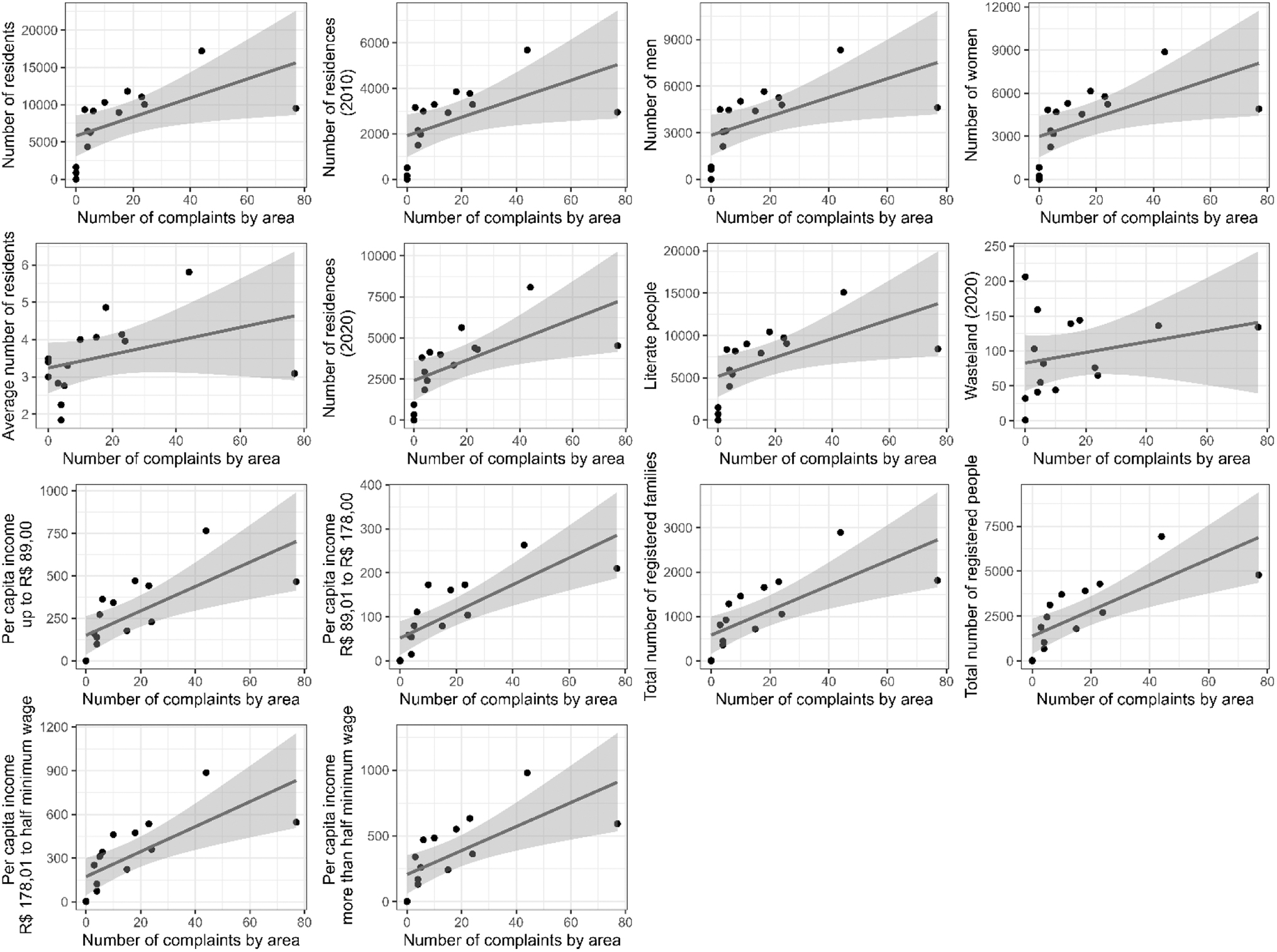
Dispersion chart resulting from the Spearman Correlation between the number of monthly complaints versus demographic and socioeconomic variables, Pinhais, Brazil.
The Kernel Density analysis resulted in a map that has shown an overlapping cluster of positive humans and dogs in the serological analysis (IFA), located in the Alto Tarumã neighborhood (Fig. 4). Smaller clusters of dogs were found in the Emiliano Perneta, Maria Antonieta and Weissópolis neighborhoods (Fig. 4). R. sanguineus s.l. had molecular DNA detection for the Anaplasmataceae family in the Alto Tarumã, Atuba, Emiliano Perneta, Vargem Grande and Weissópolis neighborhoods, larvae of Amblyomma spp. in the Parque das Águas neighborhood and adult forms of A. aureolatum in the Emiliano Perneta and Weissópolis neighborhoods, A. dubitatum in the Parque das Nascentes neighborhood, A. sculptum in Alphaville and Parque das Nascentes neighborhoods and A. parkeri in the Center neighborhoods. Places where capybaras or their traces such as feces including Alphaville, Parque das Nascentes and Parque das Águas neighborhoods were seen during the collection of ticks by CO2 trap were also spatialized.
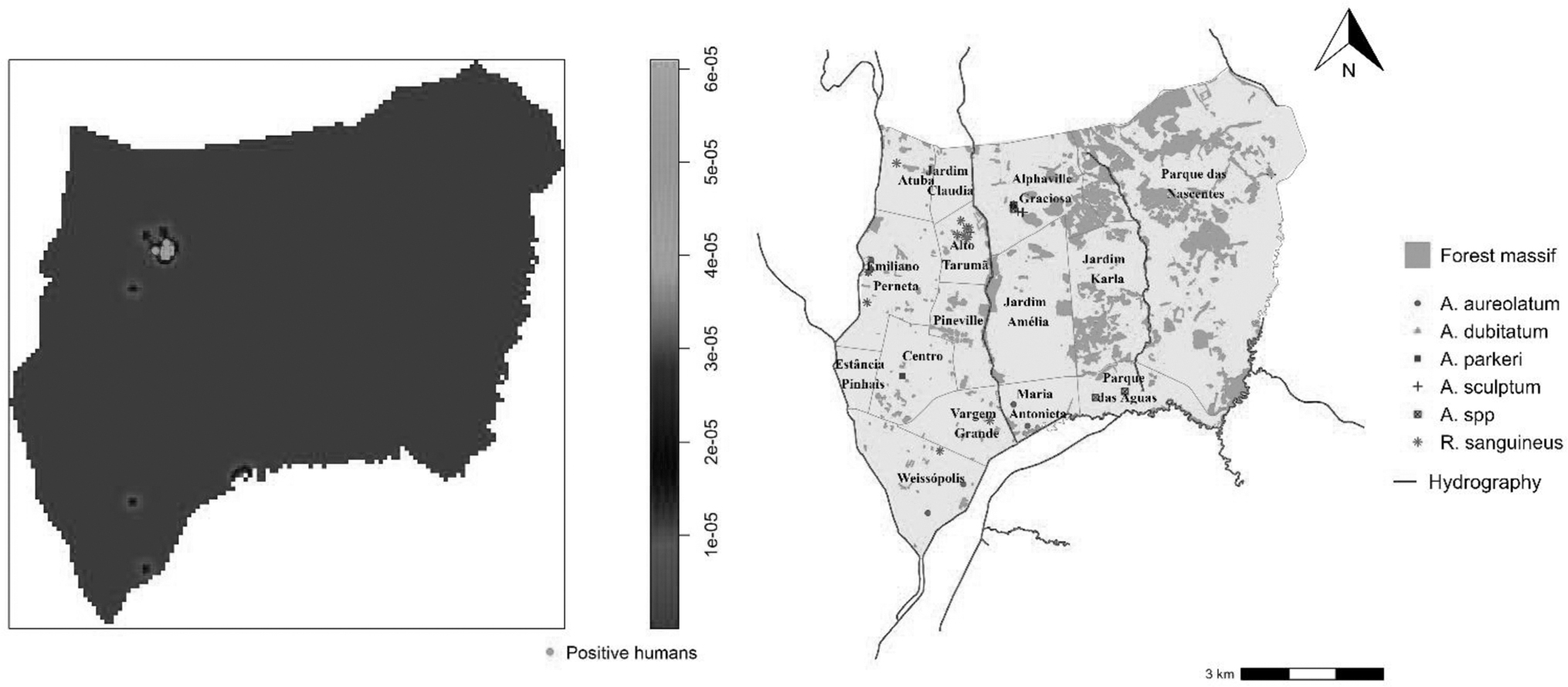
Kernel density of seropositivity in dogs with overlapping seropositivity in humans for Ehrlichia canis and location of sites where Rhipicephalus sanguineus s. l. positive for Anaplasmataceae and Amblyomma spp. (A. aureolatum, A. dubitatum, A. sculptum, A. parkeri) were collected from Pinhais city, southern Brazil (2007–2020).
Discussion
In the present study, One Health approach combining acarological with dog and human health surveillance has provided results for a comprehensive understanding of pathogen infection and monitoring. Human, animal and environmental health approach has been reportedly crucial for effective control and prevention of zoonotic diseases (Krawczak et al., 2023). In addition, dogs may be good sentinels in the context of One Health for environmental circulation of pathogens, particularly vector-borne, as for other zoonotic diseases (Krawczak et al., 2023).
Dog seroprevalence herein (9.6%) was higher than 14/316 (4.43%) dogs attended in a veterinary teaching hospital of Rio Grande do Sul State, southern Brazil (Krawczak et al., 2012b), and lower than 62∕138 (44.9%) dogs from nearby city of Paraná State, southern Brazil (Vieira et al., 2013b).
The seroprevalence of E. canis in dogs has varied in different Brazilian regions, with the highest values mostly in areas located above the Tropic of Capricorn, with 24.8–37.9% up north in the Amazon biome (Aguiar et al., 2007), 36.0–38.4% in the Atlantic Forest Biome of northeastern region (Carlos et al., 2007; Ramos et al., 2010), 6.4%–60.5% in the midwestern region of the Cerrado Biome (Paula et al., 2021).
As observed herein with 13/136 (9.5%) seropositive dogs, the lowest prevalence has been found above the Tropic of Capricorn in the in the southern Brazilian region with 16.4–64.7% (da Silva et al., 2012; Dagnone et al., 2003; Trapp et al., 2006; Vieira et al., 2013a; Vieira et al., 2013b), and below the Tropic of Capricorn, under southern Temperate Zone, ranging from 0% to 4.43% (Krawczak et al., 2012a; Ribeiro et al., 2017). In the present study, all Rhipicephalus spp. were identified as R. sanguineus s.l. complex, not differentiated between temperate and tropical strains. Thus, the low seropositivity in the present may be associated with R. sanguineus s.l. occurrence in this transitional area of two tick strains in southern Brazil (Moraes-Filho et al., 2015).
Although widely used as gold standard for diagnosis, IFA may only show previous exposure of Ehrlichia spp. and may result in false seropositives due to cross-reactivity with other organisms of the genera Ehrlichia, Anaplasma and Neorickettsia (Allison and Little, 2013; da Costa Vieira, 2011).
In the present study, antibodies against E. canis were also detected in 2/135 (1.5%) humans, both with a 1:80 dilution, from a 4-year-old girl and a 61-year-old woman. Despite human exposure has been serologically reported in Brazil since 1980, Ehrlichia species were not molecularly identified at this time (Calic et al., 2004; da Costa et al., 2006b; da Costa Vieira, 2011). Human exposure to Ehrlichia spp. was also reported in Argentina (Ripoll et al., 1999), Chile (López D. et al., 2003), Peru (Moro et al., 2009) and Venezuela (Perez et al., 2006; Perez et al., 1996).
Both households with seropositive humans had dogs; ticks were found only in the child household and PCR amplified Anaplasmataceae DNA in R. sanguineus s.l. ticks from two dogs (but not genus Ehrlichia). Both dogs in the child household were seronegative for E. canis, while the dog sample was reagent with a titer of 160 in the elderly's household, along with a seropositive neighboring dog. Noteworthy, the same street of these 2 households presented 14 tick infestation complaints in 11 different addresses.
The PCR positive results herein were restricted to 148 tick samples that would yield amplicons only, performed by a conventional PCR targeting a small fragment of the 16S rRNA gene, supposedly Anaplasmataceae. None of these ticks yielded amplicons by the remaining PCR protocols, which targeted less conserved genes (dsb, groel) or a larger fragment of the 16S rRNA gene. Therefore, it may be more likely that these positive ticks resulted of unspecific amplification, possibly a free-living bacteria present in the tick midgut or tick cuticle, as previously described (Gofton et al., 2015). Alternatively, it is also possible that PCR-positive results, especially for Amblyomma ticks, was amplification of Midichloria mitochondrii, a former Anaplasmataceae agent that has been amplified from several Amblyomma species by using 16S rRNA-targeted protocols (Cafiso et al., 2016; Wiesinger et al., 2023).
Temperature and urban agglomerations in areas with less financial resources were significantly associated as risk factors for tick infestations.
The main tick species herein associated with human parasitism was R. sanguineus s.l. Also, R. sanguineus s.l. was the most abundant and spatially distributed tick species identified herein parasitizing dogs and present in households. This species complex may be found in all continents, preferentially parasitizing dogs, as well as other mammal and birds (Walker et al., 2000), and humans hosts (Acosta et al., 2017). This tick species has been considered as a pathogen vector for dogs (Hepatozoon canis, Babesia vogeli, and E. canis) and humans (Rickettsia rickettsii) (Dantas-Torres and Otranto, 2015), with human parasitism reported in Cerrado, Atlantic Forest, and Pampa Brazilian biomes (Acosta et al., 2017),
The species, A. sculptum, identified in this study, was parasitizing a child from whom it was not possible to collect blood as the family moved to an unknown location. This tick species has low parasitic specificity, especially in the immature stages, and may parasitize a wide range of hosts, including humans (De Souza et al., 2006; Labruna et al., 2001). This tick has been considered the main vector of Rickettsia rickettsii in Brazil and was recently described by our research group in subtropical climate, parasitizing wild boars in a nearby area of the present study (Kmetiuk et al., 2019). Thus, results have corroborated with this first description and may present significant information, as the metropolitan area herein may harbor a large capybara population, which has been reportedly capable of amplifying A. sculptum tick population and infection rates of R. rickettsii (Ramírez-Hernández et al., 2020). A. dubitatum ticks were also collected in a neighborhood with no tick infestation complaints. This species has not present public health concern (Maués Serra-Freire et al., 2011; Onofrio et al., 2006).
Also, A. aureolatum was identified parasitizing dogs in three sampled neighborhoods. This tick species has been frequently found in domestic dogs and can parasitize humans (Onofrio et al., 2006). In Brazil, A. aureolatum has been acting as Brazilian Spotted Fever vector (Bitencourth et al., 2021; Savani et al., 2019). Finally, A. parkeri was sampled from a resident of the Center Pinhais neighborhood in 2017, positive for the Rickettsia presence, indicated by phylogenetic analysis as Candidatus R. paranaensis (Borsoi et al., 2019).
Complaints should be the first warning, as the Health Department of Pinhais received an increase of protocols from 0% to 2.2% in previous years to 14.2% starting in 2017 and up to 41.0% of protocols in 2020. Although such increase may have reflected an epidemic rise in household infestation, as no ticks were found in previous municipality studies (Martins et al., 2012), population may have perceived the city service and encouraged to register official complaints. As expected, January (17.7%, summer) and October (20.3%, spring) were the months with the highest complaint frequency, and May (0.43%, autumn) and June (0.86%, winter) with the lowest complaint frequency. Such pattern was more wide ranging than Minas Gerais, southeastern state within the Brazilian tropical region (Soares et al., 2012).
No associated risk factor of dogs was statistically significant among covariates in the epidemiological questionnaire at the Multiple Logistic Regression Model. For humans, calculation was not possible to be performed due to only two seropositive individuals. However, monthly complaint and monthly climate history from January 2011 to December 2020 in the bivariate Spearman Correlation analyses presented a positive correlation (p = 0.01) with the average temperatures (maximum 17.88°C, average17.43°C, minimum 17.06°C) and negative (p = 0.061) for average solar radiation (281.69 W/m2). In addition, precipitation (121.89 millimeters, p = 0.301) and relative humidity (86.02%, p = 0.79) showed no statistical significance. Such trend, presented in the scatterplots, corroborated the results obtained in the phylogenetic studies, where R. sanguineus s.s. (published as the temperate species of R. sanguineus s.l.) was present in areas with average annual temperature <20°C, while R. linnaei (published as the tropical species of R. sanguineus s.l.) occupied areas with average annual temperature >20°C (Zemtsova et al., 2016).
R. sanguineus s.s. presented a higher survival rate at lower temperatures under laboratory conditions when compared with the R. linnaei (Labruna et al., 2017). The development time of R. sanguineus may be affected by temperature and R. linnaei ticks developed more slowly than ticks of the R. sanguineus s.s., when the temperature fell below 20°C (Tian et al., 2022). In addition, a higher probability of infestation was observed for R. sanguineus s.s. in Chile (González-Acuña and Guglielmone, 2005) and Uruguay (Venzal et al., 2007), where adult ticks were active mainly during winter and spring, and immature ticks were active mainly during summer, with almost zero dog infestations during autumn and early winter (Tian et al., 2022). Likewise, the study herein has demonstrated higher tick infestation complaints in spring and summer (from September to March, with a top in October), differing from immature and adult R. linnaei active forms, with multiple peaks throughout the year in Mexico and Brazil (Cruz-Vazquez and Garcia-Vazquez, 1999; Louly et al., 2007).
A significant correlation was observed of total complaints per neighborhood with variables related to residents (total, male, and female, all p < 0.001), residents per household (both for 2010 and for 2020, both p < 0.001), literate people (p < 0.001), low-income families (all p < 0.001); the presence of vacant lots in the neighborhood (p = 0.37) was not statistically significant. Findings have indicated that the bigger the population per neighborhood, the higher number of households and residents with less financial resources, the more susceptible to infestations by R. sanguineus s.l. Expectedly, high human density in urban settings may favor growth and dissemination of R. sanguineus s.l. due to facilitated dog access (preferred hosts), adequate nesting conditions, and lack of habits and resources for adequate yard clearness and tick infestation control (Foley et al., 2019).
As limitations, the present study has not differentiated between R. sanguineus sensu stricto and R. linnaei, the two species within the R. sanguineus complex. As such, tick species may present distinct capacity to transmit the bacterium E. canis to dogs, tick species within this complex play a crucial role in the exposure of dogs and humans to the bacterium. As external morphology alone may not always be sufficient to discriminate among ticks within this complex, proper molecular characterization should be applied. Specific tick identification would allow for the association with serology data and a proper comparison with the locations where one species or the other predominates. However, the survey herein was not focused on molecularly pinpointing tick species. Instead, the present study aimed the One Health approach to Ehrlichiosis, which may serve as a model for local protocol on continuous monitoring of tick-borne diseases, including serosurvey in humans and dogs, and molecular detection of ticks found in them and their households.
In addition, due to the weak generated bands in the PCR for the Anaplasmatacea family, no molecular sequencing and identification of the involved bacteria was possible. Thus, future studies should be focused on establishing the specific tick species and Anaplasmatacea bacteria involved in urban transmission. As another limitation, although E. canis may cause chronic or life-long infection in dogs, blood samples of dogs were not molecularly tested. Further studies should address human and dog serological survey along with molecular detection in humans, dogs, and ticks. Also, as no systematic collection and capture efforts of ticks was conducted from all neighborhoods in time and space, comparison among different areas may be limited in the present study.
Finally, the local role of health surveillance in such a scenario, working in a One Health context, has been vital to ensure early disease detection, combined with timely diagnosis and adequate treatment of confirmed cases, as strategic basis for regional, national, and international response, as proposed by the Global Response to Vector Control 2017–2030 (World Health Organization [WHO], 2017).
Conclusions
The study herein, based on citizen complaints, has serosurveyed owners and their dogs for E. canis, identified tick species such as R. sanguineus and Amblyomma spp. and in owners, dogs, and their households. The higher temperature months, urban human agglomerations, and low-income households have been associated with R. sanguineus s.l. infestation. The One Health approach herein may serve as a model for local protocol on continuous monitoring of tick-borne diseases, including serosurvey in humans and dogs, and molecular detection of ticks found in them and their households.
Footnotes
Acknowledgment
The authors are grateful to the Basic Health Units of Pinhais for providing professional support for human blood samplings.
Author Disclosure Statement
No conflicting financial interests exist.
Funding Information
No funding was received for this article.
Supplementary Material
Supplementary Table S1
Supplementary Table S2
Supplementary Table S3
Supplementary Table S4
Supplementary Table S5
Supplementary Table S6
Supplementary Table S7
References
Supplementary Material
Please find the following supplemental material available below.
For Open Access articles published under a Creative Commons License, all supplemental material carries the same license as the article it is associated with.
For non-Open Access articles published, all supplemental material carries a non-exclusive license, and permission requests for re-use of supplemental material or any part of supplemental material shall be sent directly to the copyright owner as specified in the copyright notice associated with the article.
