




Abstract
Background:
Tick-borne diseases are an emerging threat to public health throughout the temperate world, leading to a growing field of research aimed at developing and testing intervention strategies for reducing human-tick encounters or prevalence of infection in ticks. Various wide-spectrum chemical acaricides have proven effective for controlling tick populations, but many of these have potential deleterious side-effects on health and the environment. In addition to chemical acaricides, certain compounds such as diatomaceous earth have been shown to have physical acaricidal properties. We hypothesized that dolomitic lime (CaMg(CO3)2, a corrosive, desiccant mineral that is already used extensively in agricultural and forestry contexts to balance the pH of soils, may affect ticks’ locomotory activity, habitat position, or survival and that this should manifest as a reduction in the number of questing ticks collected by dragging.
Objective:
This study aimed to formally assess this hypothesis in a controlled laboratory setting.
Methods:
We carried out a microcosm experiment, with one control and three treated microcosm trays, each replicating the natural substrate characterizing I. scapularis habitat in northeastern North America. Each tray was infested with 200 living larvae and 50 nymphs, and then treated with 0 (control), 50, 100, or 500 g/m2 of lime powder. Ticks were collected by microdragging 24 and 72 h postliming.
Results:
Efficacy of liming at reducing the number of collected questing ticks ranged from 87% to 100% for larvae and 0% to 69% for nymphs 24 h postliming and from 91% to 93% for larvae and −47% to 65% for nymphs 72 postliming.
Conclusion:
This study provides the first experimental evidence of the potential efficacy of liming for impairing activity of questing immature ticks. Given that lime is a low-cost material, that methods for widespread application in deciduous woodlands already exist, and that it has been documented as having a limited negative impact on the environment, further assessment of lime application as a public health risk reduction intervention for tick-borne diseases is warranted.
Introduction
Tick-borne diseases pose a growing threat to public and animal health across various regions worldwide (Kilpatrick et al., 2017). In response to this emerging challenge, research into interventions aimed at reducing human-tick encounters or the prevalence of infection in ticks has accelerated over the past two decades.
In northeastern North America, the majority of tick-borne pathogens is transmitted and sustained within natural enzootic cycles involving Ixodes scapularis ticks and a range of rodent reservoir hosts (reservoirs of the pathogens) such as the white-footed mice (Peromyscus leucopus) and the eastern chipmunk (Tamias striatus) (Eisen et al, 2017). Birds also contribute to some tick-borne pathogen enzootic transmission (Dumas et al., 2022a). The life cycle of I. scapularis includes four stages (eggs, larvae, nymphs, and adults) and spans 2–4 years, contingent upon climatic and environmental conditions (Eisen et al, 2017; Kilpatrick et al, 2017). Ixodes spp. ticks are primarily found in temperate deciduous and mixed forests where the leaf litter provides the insulation and humidity necessary for their survival within the litter layer (Ginsberg et al., 2020, Johnson et al., 2016; Needham and Teel, 1991). For a tick of a particular stage to molt or lay eggs, it must find and feed on a vertebrate host. Immature stages (larvae and nymphs) mainly feed on small vertebrate hosts (e.g., rodents and birds). These immature stages, which are more susceptible to desiccation than adults, seek hosts within the upper layers of leaf litter or on plant stems near the forest floor to benefit from the humidity found in the litter (Eisen et al, 2017). The adult female ticks mainly feed and mate on deer, which are thus considered the reproductive hosts. Despite various biotic and abiotic factors influencing tick survival in their natural habitats, high estimated interstadial mortality rates significantly impact the density of the subsequent stage (Brunner et al, 2023; Ogden et al, 2005). Considering the enzootic cycle of tick-borne pathogens and the life cycle of Ixodes spp. ticks, interventions influencing the survival of any developmental tick stage or the contact rates between ticks and hosts may potentially reduce public health risks (Eisen and Dolan, 2016).
Consequently, several interventions targeting (1) ticks in the environment [using synthetic and natural acaricides, landscaping, xeriscaping, or controlled burning (Eisen and Dolan, 2016)], (2) reproductive hosts of ticks [four-poster devices, managing deer populations, or fencing (Eisen and Dolan, 2016)], or (3) reservoir hosts of tick-borne pathogens [such as rodent-targeted vaccines (Gomes-Solecki et al, 2020) or with topical and oral acaricides using various technical devices (Jordan and Schulze, 2019)] have been investigated. The success of these interventions has varied widely, and only a few have progressed to commercial deployment and widespread use by the public (Eisen, 2023; Eisen and Dolan, 2016; Eisen and Stafford, 2021; Fischhoff et al, 2019; Hinckley et al, 2021; Niesobecki et al, 2022; Ostfeld et al, 2023). Limitations hindering the large-scale implementation of these interventions could include feasibility, cost, undesirable environmental impacts, inconsistent efficacy, or unresolved technical challenges. These interventions have been extensively described and reviewed in prior publications (Eisen, 2023; Eisen and Dolan, 2016; Eisen and Stafford, 2021).
Spraying synthetic or selected natural acaricides in tick habitats or human-made natural landscapes has proven to be one of the most effective tick-control strategies (Dyer et al, 2021; Eisen and Dolan, 2016). Chemical acaricides usually act by binding cellular receptors, thus interfering with cellular metabolism or neurotransmission (Gupta, 2012). These acaricides typically act indiscriminately, potentially affecting the health and survival of other invertebrates, including pollinators, and may pose threats to human and animal health. Consequently, their usage is often met with low acceptance and is strictly regulated in many jurisdictions. Moreover, documented emergence of tick resistance to chemical acaricides (Burtis et al, 2021; Agwunobi et al, 2021) presents a further challenge. The use of physical acaricides presents an alternative approach that could overcome some of these limitations, particularly in terms of pollinators’ health and resistance management. Although the term physical acaricide has not been formally defined in the literature, known physical, or mechanical, acaricides are thought to act through abrasion, desiccation, or mechanical occlusion and not through molecular binding or chemical alterations of cellular physiology (Gupta, 2012). Recent identification of certain molecules, such as diatomaceous earth, exhibiting such physical acaricidal properties (Richardson et al, 2022; Showler and Harlien, 2023) suggests their potential to cause physical damage to the tick cuticle, facilitating tick desiccation, or impeding respiration through the tick’s spiracles (Richardson et al., 2022).
Lime powder is another well-known chemical substance with potential application as a physical acaricide. Lime has been cited on horticulturist and grower websites as a possible control method for ticks, mites, and fleas. However, to the best of our knowledge, its efficacy and suitability as a strategy for reducing acarological risks from a public health perspective have not been formally evaluated or documented.
Calcite (CaCO3) or dolomitic lime (CaMg(CO3)2) have been utilized in recent decades to balance soil pH in agriculture and in sugar maple forests to promote maple tree growth (Moore and Ouimet, 2021; Reid and Watmough, 2014; van Straaten et al, 2023). Consequently, their application is already common in the primary natural habitats conducive for tick survival. Lime is available commercially as a powder or in granular form in mills and hardware stores, and is an inexpensive (∼15 US$/25 kg) mineral. Its widespread use, including for mitigating the effects of acidic deposition on forest soils, is extensively documented and liming has been conducted in Europe and North America for several decades (Alberti et al, 1989; Jonsson et al, 1999; Kreutzer, 1995; van Straaten et al, 2023).
Considering the inherent chemical and physical properties of lime and the susceptibility of immature I. scapularis stages to desiccation, we hypothesized that the application of dolomitic lime powder on the leaf litter in I. scapularis habitats may affect the locomotory activity, habitat position, or survival of larvae and nymphs (Richardson et al., 2022) and that this should manifest as a reduction in the number of questing ticks collected by dragging in natural environments. This study aimed to formally assess this hypothesis in a controlled laboratory setting.
Material and Methods
Study design
An experimental study with one control and three treatment trays was used, each tray replicating, in the laboratory, the natural substrate constituting I. scapularis habitat in northeastern North America.
Equipment layout
Four 36 cm × 66 cm (∼0.24 m2) plastic trays were filled with 10 cm of commercial gardening soil, covered evenly by 7 cm of natural leaf litter. The four trays were placed in a home-made water basin (water depth and spacing between non immersed components = 5 cm), to avoid ticks escaping in the laboratory and to prevent movement of ticks from one tray to the other. The ambient humidity and temperature were held constant at 50% and 20 degrees Celsius, respectively, for the duration of the experiment.
Substrate
One quarter of the contents of three 25 L bags of gardening soil was distributed in each tray and mixed by hand to ensure that soil composition was identical in each tray. Natural leaf litter was collected in June 2023 from the ground of a deciduous forest adjacent to the protected natural area of mount Saint-Bruno, which is a well-studied endemic area for Lyme disease (Dumas et al., 2022b). The leaf litter was mainly composed of maple tree leaves. The leaf litter collected was left under the direct sun for 8 h on a sunny day with a 27 degrees Celsius maximum temperature for maximizing desiccation and death of ticks that could have been accidentally collected from the field. Two cups of tap water were then poured evenly on the litter of each tray to increase the humidity rate and maximize the survival of the ticks to be introduced as part of the experiment. Each tray was covered with a plastic lid with two 5-cm-diameter mesh-protected holes. Ambient relative humidity and temperature were continuously measured in each tray at the top of the leaf litter using domestic air hygrometer to ensure homogenous microclimate conditions.
Ticks
Ixodes scapularis larvae and nymphs were provided by the Centers for Disease Control and Prevention for distribution by BEI Resources, NIAID, NIH: items NR-44115 (larvae) and NR-44116 (nymphs). Ticks were shipped in mid-May 2023 and incubated in a desiccator as described in (Levin and Schumacher, 2016) for one month under constant humidity (90% RH), light (12 h), and temperature (21°C) conditions to ensure ticks were sclerotized and that they showed optimal questing behavior at the time of the experiment.
Infestations and liming
Before infesting the trays with I. scapularis, we checked the efficacy of the sun-drying treatment against ticks that may have been present in the leaf litter that was collected in the field. This was done by performing mini-dragging (see below for a full description of this methodology) in each tray for 2 min. Ticks were not collected during this control phase of mini-dragging, indicating that the trays were likely free of ticks before experimental infestations. A total of 50 nymphs and 200 larvae were then deposited in each tray by hand by two technicians who ensured that each tick deposited in the tray was alive and moving. Ticks were left in the trays for 60 h without any further handling for acclimatation.
At the end of a 60-h period, hydrated dolomitic lime powder [(Ca(OH)2MgO), Graymont (Qc) inc, Dudswell, Qc, Canada] was evenly distributed on the litter surface of three of the four trays with a flour sieve and the remaining control tray was left untreated. The three treated trays were covered with lime at concentrations of 50, 100 and 500 g of lime powder per m2 (12 g, 24 g, and 120 g per tray), respectively. In the subsequent 24 h, handlers entered the laboratory twice to stimulate the questing behavior of ticks. They opened the lids of the trays to expose ticks to CO2, gently knocked on the tables underneath the trays to generate vibrations, and light from scialytic lamps was moved over each tray for 60 s to simulate light changes related in nature to movements of natural hosts.
Tick collection procedure and time points
Mini-dragging was used to collect ticks from trays at different time points. This mini-dragging reproduces, in the laboratory, the standard dragging technique used in the field to collect questing ticks (Daniels et al, 2000). For this study, a 10x10cm square of flannel cloth was dragged over the surface of the leaf litter following longitudinal transects, repeated at 10-cm intervals so as to cover the entire tray area. Dragging was repeated continuously along these transects for a five-minute period in each tray. The same dragging technique was used for all trays at all time points.
Mini-dragging was conducted 24 h after lime application, with the lime powder still present on the surface of the leaf litter. The larvae and nymphs collected by dragging were counted and returned to their respective trays.
Following the initial mini-dragging, two cups of water were applied to all trays using a watering can, mimicking a light rain, to dissolve the lime powder. Trays were subsequently left open to avoid extreme moisture conditions unrepresentative of the natural environment and that could have favored survival of ticks and questing behavior in the control group. A final mini-dragging was carried out 48 h after water application (72 h after liming).
All mini-drag sampling was carried out by two technicians in rotation, so that each tray was completely dragged by each technician. This method was used to avoid bias related to the potential influence of the technician’s physical characteristics and method on tick questing behavior.
After each mini-dragging round, questing larvae and nymphs were counted and total counts from each tray were compared.
Statistical analysis
The percentage of the 200 larvae and 50 nymphs collected from each treatment tray at each time point was compared to the percentage collected from the control tray, and p-values were computed with z-test for the difference in proportions between treatment and control trays with a significance level of 0.01. Efficacy of lime treatment was defined according to the Abbott formula as (1 − [count in treatment tray/count in the control tray]) × 100, assuming that a reduction in the counts of collected ticks could be explained either by increased mortality or reduced questing activity. Counts of larvae and nymphs retrieved by dragging in each tray for each time point are presented graphically.
Results
Environmental conditions were uniform across the four trays throughout the experiment. Humidity at the level of the leaf litter was 95% on the first day after ticks were deposited in the trays, 99% during each day where the lids were left in place, and 84% during the days when lids were removed. Temperature at the level of the leaf litter was constant at 19°C for the duration of the experiment.
Dolomitic lime powder reduced the number of collected questing larvae at both time points, with an efficacy of 87% to 100% (Table 1). Dolomitic lime powder was less effective at reducing the number of questing nymphs collected. The lowest lime concentration was inefficient at reducing the counts of nymphs collected, and the number of nymphs collected from the low-dose tray (25 nymphs) was even higher than in the control tray 72 h posttreatment (17 nymphs) (Table 1). However, the highest lime concentration was associated with a significant reduction in the counts of nymphs collected at both time points, with a minimal efficacy of 65% (Table 1).
Efficacy of Dolomitic Lime at Reducing the Number of Questing Immature I. scapularis Ticks Recovered through Mini-Dragging in a Laboratory Microcosm
Percentage of the 200 larvae or 50 nymphs deposited in each tray at time 0, which were collected by dragging at each time point.
A negative efficacy represents an increase in the number of collected ticks 72 h after treatment.
Complete data on efficacy for larvae and nymphs at each lime concentration and time point are presented in Table 1 and the counts of collected larvae at each time point is presented graphically in Figure 1.
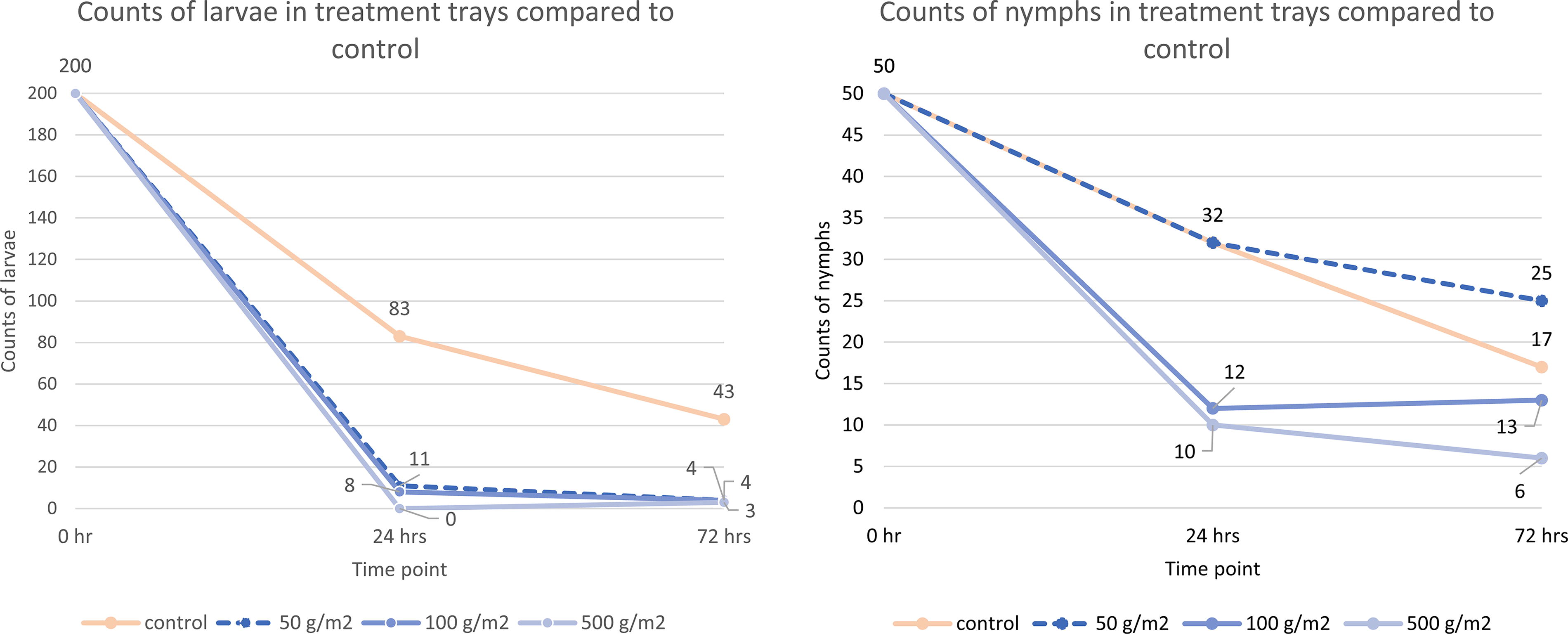
Number of immature ticks deposited in control and treatment trays at time zero and counts of questing ticks collected by dragging 24 and 72 h after liming. Between the two dragging time points, the leaf litter of all trays was moistened with 2 cups of water poured with a fine rain-making watering can to simulate the effect of rain on lime powder dilution.
Discussion
Interpretation of results
The high observed efficacy of dolomitic lime powder for reducing the number of collected questing larvae suggests that lime powder, at the doses used in this study, has a significant impact on the activity of I. scapularis larvae. This impact may result from increased mortality, decreased or impaired locomotory activity, or change in habitat position (Richardson et al, 2022). However, this study does not allow to determine the underlying mechanism explaining the observed changes. It is possible that lime imposes hydric stress on dryness-sensitive immature ticks (Richardson et al., 2022; Showler and Harlien, 2023). It is also possible that lime powder, at the highest concentrations used, mechanically blocks access to the leaf litter surface. However, after water application, almost no trace of lime powder could be seen on the leaf litter in the lowest dose tray and yet lime powder efficacy in this tray remained comparable to the efficacy observed in the medium- and high-dose trays for larvae 72 h postliming. Hence, it is probable that lime powder acts through various mechanisms that should be studied further. Moreover, replication of this study with various substrates and microclimatic conditions would increase the strength of evidence of lime powder’s efficacy.
The efficacy of lime was observed in a laboratory setting mimicking natural conditions highly favorable to I. scapularis survival: high air and soil humidity rate, thick (7 cm) maple tree leaf litter, and absence of direct sun. This suggests that the results observed in this study should also be expected in natural high-risk areas in northeastern North America if liming is conducted during the larval peak, which generally corresponds to the months of July to September in this area. Field studies are required to assess if liming of tick habitats can reduce tick density or tick-host interactions in natural environments.
In this study, efficacy was defined as a reduction in the number of questing immature stages of I. scapularis collected by dragging, rather than as a mortality ratio, given that the methods used in this study cannot distinguish between a reduction in the counts of collected ticks because of mortality from a reduction in these counts, attributable to a modification in their questing behavior. The absence of a difference between the counts of nymphs collected in the low-dose tray compared to the control tray and the increased number of nymphs collected 72 h after treatment in the low-dose tray suggests that nymphs may resist the physical stress induced by the low-dose lime treatment. However, given the relatively high probability that the difference between the 72 h posttreatment counts in the control and low-dose trays was a result of random variation, this hypothesis will need to be explored with further research.
Next steps and operational considerations, from laboratory to field
One interesting characteristic of dolomitic lime powder is its past and current use in maple tree forests for neutralization of acidic soils and for increasing vegetal health in agriculture and horticulture. The doses used in this study were based on application protocols tested for maple syrup farming in North-Eastern America (Moore and Ouimet, 2021) and were similar to the ones used in various liming studies aiming at assessing the impact of liming on forest ecosystems. For example, in a meta-analysis of some 350 liming and wood-ash treatment trials, Reid and Watmough set a low/high liming dose category threshold at 5000 kg/ha (500 g/m2) (Reid and Watmough, 2014), which corresponds to the high-dose treatment in this study. In a field study conducted in Quebec, Canada, Moore and colleagues found no negative impact on forest health with doses up to 5000 g/m2 (Moore and Ouimet, 2021). Although liming is usually recommended for acidified forests soils or lands and although soil chemistry should ideally be assessed before choosing a liming protocol, these studies suggest that doses of 100 to 500 g/m2 could be applied yearly over a 5- to 10-year period without deleterious effects on the vegetation.
However, although liming has few reported negative impacts on tree health, the positive ecological effects of liming are inconsistent (Reid and Watmough, 2014), and some caution must be applied when considering field studies. Studies suggest that liming impacts soil organic matter composition and decomposition through modifications of earthworm abundance, physicochemical properties of soil, microbial community structure, or ecosystem vegetal productivity (van Straaten et al., 2023). These modifications may, in turn and depending on the context, increase or decrease leaf litter abundance and affect invertebrate host communities, which may influence abundance and survival of tick populations (Larson et al., 2022).
Hence, although liming may be an implementable approach for reducing the density of questing larvae in deciduous forests, a number of questions remain, concerning (1) the mechanisms responsible for reduced questing activity of ticks in treated areas, (2) the impact of larval mortality on the density of nymphs and adults and on tick-host interaction, (3) the impact of various liming regimens on natural deciduous forest ecosystems, including vertebrate and invertebrate animals, and (4) the effect of liming on the endpoint metrics of animal or public health risk, namely the frequency of tick-host encounters and incidence of tick-borne diseases in susceptible hosts.
Conclusion
This study provides the first experimental evidence of the efficacy of liming for reducing questing tick densities. Given that liming has been used for decades in maple tree forests and agriculture, its low cost, and available application methods, further field research would be relevant to assess the impact of liming on acarological risk in natural environments. This further research should apply a one health perspective to consider the phenology of ticks, the treatment regimens compatible with ecosystem health, and the environmental and human health hazards associated with lime use in deciduous woodlands.
Footnotes
Acknowledgments
We thank Camille Godin, Martine de Chevigny and Julie Perreault, from Cégep de Saint-Hyacinthe, for their help in creating the research facility and Jean-David Moore for his advice on maple grove liming methods.
Authors’ Contributions
J.-P.R.: Conceptualization (equal), Investigation (lead), original draft preparation (lead), resources (lead), methodology (lead), funding acquisition (lead), and formal analysis (lead). C.A.: Conceptualization (equal) and review and editing (equal). A.D.: Conceptualization (equal) and review and editing (equal). J.P.: Conceptualization (equal) and review and editing (equal). P.L.: Conceptualization (equal) and review and editing (equal). C.B.: Conceptualization (equal), investigation (supporting), and review and editing (equal).
Author Disclosure Statement
No competing financial interest exists.
Funding Information
This study was funded by the Fonds de recherche du Québec, Nature et technologies, grant #306859.