




Abstract
Background:
Female phlebotomine sandflies serve as vectors for the transmission of Leishmania parasites, perpetuating an enzootic cycle by disseminating between sylvatic and domestic animals. Humans form a part of this cycle because the sandflies search for a blood source required for egg development. The present study aimed to identify the feeding preferences of different sandfly fauna from six districts of Kerala, India, using molecular tools.
Materials and Methods:
An entomological survey was conducted during 2021–2023 in Kollam, Kottayam, Thiruvananthapuram, Thrissur, Malappuram, and Palakkad. Both indoor and outdoor habitats were targeted from sandfly collection using different standard tools and methods. Sandflies were identified using standard taxonomic keys, and DNA was extracted from blood meal collected from sandflies.
Results:
A total of 7366 sandfly specimens were collected during the study period, which belonged to three different genera and 19 species. Blood source was successfully identified from 119 sandflies revealing that the Sergentomyia genus preferably fed on small reptiles and amphibians, whereas Phlebotomus genus was found to mainly feed on mammalian and avian blood. Sergentomyia zeylanica was an exception, as it primarily fed on mammalian blood sources. Interestingly, humans were the second feeding source for Phlebotomus species, which are the proven vectors.
Conclusion:
Comprehending the feeding patterns of sandflies is crucial, not just for public health but also for obtaining insights into the ecological dynamics between vectors and hosts, ultimately enabling more efficient strategies for disease control and prevention.
Introduction
Phlebotomine sandflies (Diptera: Psychodidae) are tiny, blood-feeding insects known for their role as vectors of various pathogens, most notably Leishmania parasites (Cecílio et al., 2022). These parasites are responsible for causing a group of neglected tropical diseases known as leishmaniasis, which manifest as visceral leishmaniasis (VL) and cutaneous leishmaniasis (CL). India is a hotspot for leishmaniasis, and the burden of these diseases remains significant, affecting both humans and animals (WHO, 2023). VL predominantly impacts rural regions marked by inadequate sanitation, malnutrition, and conditions linked to poverty (Thakur, 2000). In India, VL/kala-azar is caused by the protozoan parasite Leishmania donovani transmitted by the vector Phlebotomus argentipes. Epidemic outbreaks of VL have been documented in India, Sudan, Bangladesh, and certain regions of Latin America (Khlabus, 2007), with India primarily affected in the eastern states, particularly West Bengal, Bihar, and Uttar Pradesh. Recent studies have also unveiled numerous indigenous cases of VL and CL among the tribal communities residing in the Western Ghats of Kerala, identifying it as an emerging belt of leishmaniasis (Kumar et al., 2015; Simi et al., 2010; Saini et al., 2020; Saini et al., 2024).
Female sandflies have a vital role in the transmission of Leishmania parasites (Cecílio et al., 2022). These hematophagous flies require blood to supply the essential protein for their egg maturation (Cecílio et al., 2022). The transmission of leishmaniasis occurs when a sandfly, while feeding on an infected host during one blood meal, becomes infected with Leishmania parasites and subsequently transmits them during a subsequent feeding event (Garlapati et al., 2012). Identifying the blood ingested by hematophagous insects is crucial for deceiving their preferred reservoir hosts and, consequently, their plausibility as vectors for pathogens (Boakye et al., 1999). Many Leishmania species are zoonotic pathogens, making it crucial to understand the feeding habits of sandflies for discerning the natural transmission of leishmaniasis and for formulating efficient vector control programs (Alexander and Maroli, 2003; Killick‐Kendrick, 1990; Killick-Kendrick, 1999). Several molecular biological techniques have proven effective in analyzing blood meals within various blood-sucking insects, contributing to the understanding of their innate host-feeding preferences and feeding behaviors (Abbasi et al., 2009; Humair et al., 2007; Mukabana et al., 2002a).
The identification of blood sources in blood-feeding arthropods has evolved over time. Early methods involved serological tests such as precipitin tests, hemagglutination inhibition assays, and enzyme-linked immunosorbent assays (ELISA) (Gomes et al., 2001; Ogusuku et al., 1994; Rossi et al., 2008; Svobodová et al., 2003). In specific regions of India, sandfly blood meals were identified using counter-current immune electrophoresis and tests such as precipitin ring test (Dhanda and Gill, 1982). Other regions used techniques such as Ouchterlony and agarose gel diffusion (Mukhopadhyay and Chakravarty, 1987; Srinivasan and Panicker, 1992) to establish blood meal preferences in sandflies. However, serological approaches have limitations, including the need for comparatively fresh blood meal and the necessity of having species-specific antibodies against each conceivable animal host (Blackwell et al., 1994). The introduction of molecular techniques, such as polymerase chain reaction (PCR), has overcome many of these limitations, enhancing the sensitivity and accuracy of bloodmeal identification (Mukabana et al., 2002b). These PCR-based approaches have allowed for the identification through the amplification and sequencing of genetic markers like mitochondrial or nuclear markers (Abbate et al., 2020; Bennai et al., 2018; Garlapati et al., 2012; Kushwaha et al., 2018; Valinsky et al., 2014).
A notable PCR-based method involves amplifying the mitochondrial gene, followed by sequencing, which has been used to ascertain the blood meals in sandflies (Abbasi et al., 2009, Bennai et al., 2018; Townzen et al., 2008).
Despite these global advancements in determining sandfly blood source (Abbate et al. 2020; Leonel et al., 2024; Sales et al. 2015; Yared et al., 2019), there is a lack of extensive studies on blood meal source identification in wild-caught sandflies from Kerala, India. This information is essential for vector control programs, as understanding the host preferences of sandflies in their natural environment is crucial for implementing effective control measures as Western Ghats, Kerala, being an emerging endemic belt of leishmaniasis.
In the present study, we report the sources of blood meals from wild-caught sandflies collected in the Central and Southern Districts of Kerala, India, using molecular techniques. By elucidating the host preferences of these sandflies, we contribute to the knowledge base required for targeted and evidence-based strategies in the fight against leishmaniasis by managing sandfly population. Understanding the feeding behavior of sandflies is not only vital for public health but also offers insights into the ecological interactions between vectors and hosts, paving the way for more effective disease control and prevention efforts.
Material and Methods
Study area
An entomological investigation was carried out in six districts within the Western Ghats region of Kerala (Kollam, Kottayam, Thiruvananthapuram, Thrissur, Malappuram, and Palakkad) during the period 2021–2023 (Fig. 1) (regional map prepared using QGIS 3.36.0 software). The Western Ghats mountain ranges are distinguished by their significant geomorphic attributes, as well as distinctive ecological and biophysical processes. The capture points for entomological collection of sandfly specimens included in this study mainly lie within the mid (foothills) to high (highlands) altitude ranges of the Western Ghats. These high mountainous forest ecosystems in the region play a crucial role in shaping the weather pattern. The area exhibits a tropical climate and is noteworthy for its unique and rich biological diversity and endemism, earning it a place among the world’s eight most significant hotspots of biodiversity. This biodiversity hotspot is home to various globally threatened flora and fauna (UNESCO World Heritage, 2023). Factors such as forest vegetation, ambient temperature, rainfall, relative humidity, and humus soil with leaf litter can create favorable conditions for sandfly proliferation (Ranganathan and Swaminathan, 2015). In addition to this, Kerala has emerged to be endemic foci of leishmaniasis in the last decade with indigenous case reports of both VL and CL (Saini et al., 2020).
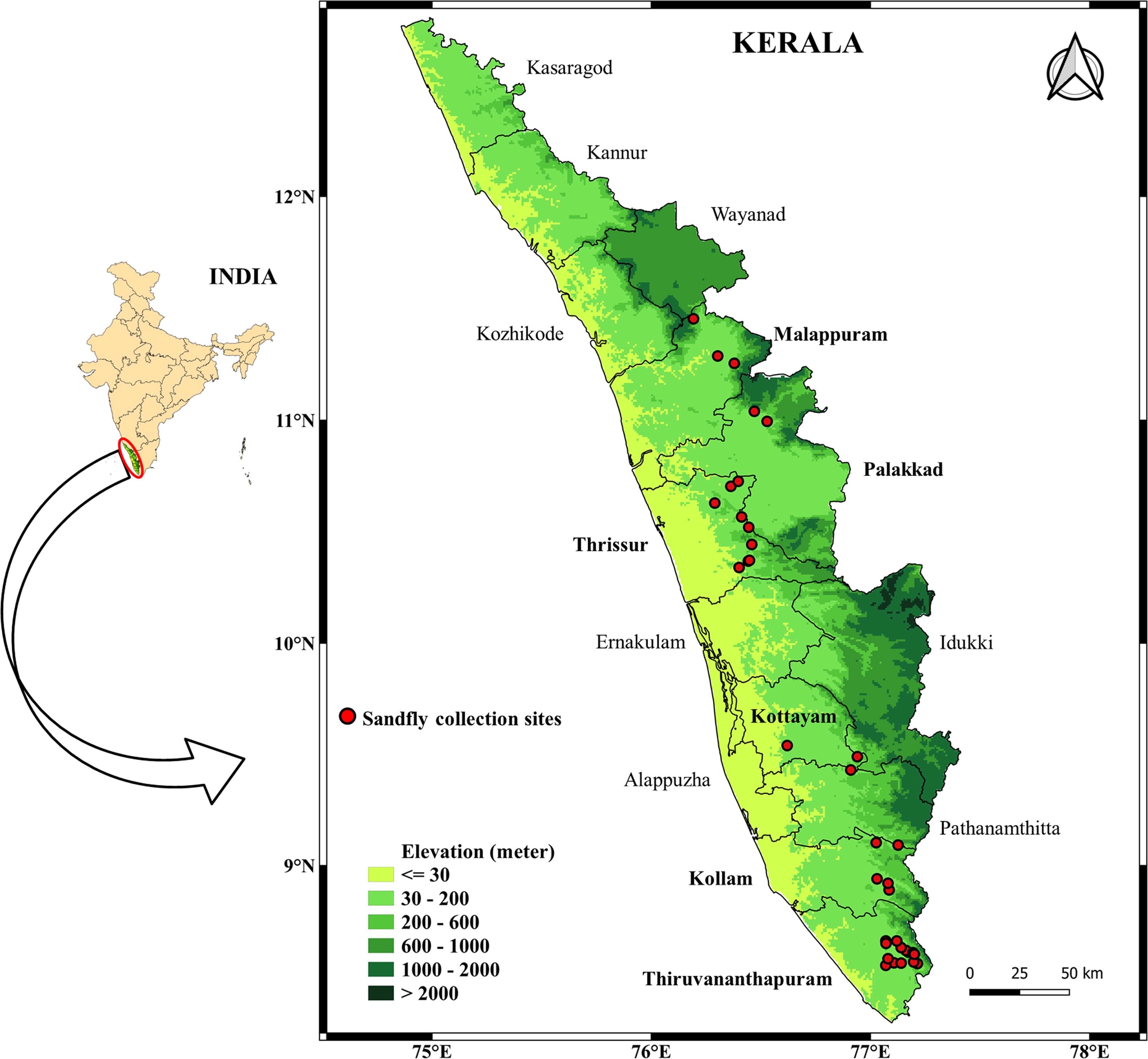
Study area for entomological collection of sandflies in Kollam, Kottayam, Thiruvananthapuram, Thrissur, Malappuram, and Palakkad districts of Kerala state during 2021–2023.
Sandfly collection and taxonomic identification
Sandfly collections were conducted in both indoor and outdoor habitats. Sandflies were collected from dark and humid locations within the intradomestic (inside households) and peri-domestic (cattle sheds, bathrooms) areas. Outdoor resting habitats, such as tree holes, termite mounds, rock crevices, tree buttresses, wasp nests, rodent burrows, firewood stacks, and piles of coconut shells, were also surveyed. Entomological collections were conducted fortnightly during the months of peak sandfly density, i.e., the premonsoon season, from 2021 to 2023. Kerala experiences two monsoons, the southwest (June to August) and the northeast (October to November) (Pai and Nair 2009). Sandfly collection was carried out from April to June and August to October, resulting in a total capture period of 18 months. Multiple collection methods, including handheld mechanical aspirators (Clarke®, USA), Center for Disease Control (CDC)-modified light traps, and sticky traps, were used to gather sandflies from all the collection sites (Alexander 2000). Indoor resting collections were carried out during the daytime using a mechanical aspirator, while evening collections were conducted using CDC-modified light traps and sticky traps, especially in cattle sheds. All captured sandflies were placed into a freezer for immobilization and then preserved in 70% ethanol for further analysis (Alexander 2000). Sandflies were dissected, and the head, posterior abdominal segments, wings, and forelegs were mounted in Hoyer’s media (Karla and Bang, 1988). The blood from engorged female sandflies was carefully extracted during dissection and transferred into a microcentrifuge tube for further analysis. Taxonomic identification was established using the standard characters outlined in taxonomic keys by Lewis (1978) and (Karla and Bang, 1988).
DNA extraction and identification of blood meal
The whole genomic DNA (gDNA) was isolated from blood extracted from those wild-caught sandfly samples using the Sigma Genelute mammalian miniprep kit following the manufacturer’s protocol. The gDNA, as a template, was subjected to mitochondrial cytochrome c oxidase subunit I (COI) barcode PCR (highly conserved across species and can delimit diverse animal species, indicating the high rates of sequence change at species level) (Hebert et al., 2003a; Hebert et al., 2003b; Ivanova et al., 2012) using the primer sets described by Ivanova et al., 2007 (Table 1). The PCR products were visualized on 1.5% agarose gel, and bands were visualized using a gel documentation system. PCR products were sequenced by the Sanger sequencing method, and chromatograms were visualized and trimmed using Chromas 6.0. The trimmed sequences were aligned, and contigs were prepared in the MEGA 11. Finally, the sequences were compared with the available sequences in the GenBank database using BLAST software (www.ncbi.nlm.nih.gov/BLAST).
Primer Sequence Details Used for COI Gene-Based Blood Meal Detection PCR in This Study
COI, cytochrome c oxidase subunit I; PCR, polymerase chain reaction.
Leishmania DNA detection
Female Phlebotomus sp. specimens were assessed for the presence of Leishmania DNA using real-time quantitative PCR (qPCR). They were categorized based on their abdominal conditions as described in Table 2. Samples were then grouped (8–10 sandflies per pool) according to the area of collection and abdominal condition. Genomic DNA was extracted from each pool following manufacture’s protocol. The pooled DNA was subjected to real-time detection of Leishmania kinetoplast minicircle DNA (kDNA), along with DNA blood samples extracted previously. The qPCR targeted kDNA was carried out using the primers LEISH-1 (5′-GGCGTTCTGCGAAAACCG-3′), LEISH-2 (5′-AAAATGGCATTTTCGGGCC-3′), and TaqMan probe (5′ FAM-TGGGTGCAGAAATCCCGTTCA-3′-BHQ1) (Castelli et al., 2021).
Species Composition and Collection Details of Sandflies Collected during 2021–2023 from Kollam, Kottayam, Thiruvananthapuram, Thrissur, Malappuram, and Palakkad Districts of Kerala, India
FF, full fed; G, gravid; UF, unfed; n, number of specimen.
Results
Sandfly species composition
Sandflies were found to be present in all the investigated habitats. A total of 7366 phlebotomine sandflies were captured and identified to the species level based on their morphology following taxonomic keys. The collected sandflies were composed as follows: 2339 (31.75%) unfed females, 2423 (32.89%) gravid females, 312 (4.24%) partially or fully blood-fed females, and 2292 males (31.12%), with a sex ratio (male: female) of 0.45. The phlebotomine species found in the studied area comprise a total of 19 species. Fourteen species belonged to the Sergentomyia genus, i.e., Sergentomyia babu (1146; 15.56%), S. baghdadis (459; 6.23%), S. bailyi (123; 1.67%), S. dhandai (191; 2.59%), S. eadithae (4; 0.05%), S. himalayensis (154; 2.09%), S. hospitii (2; 0.03%), S. insularis (333; 4.52%), S. jerighatiansis (541; 7.34%), S. linearis (19; 0.26%), S. monticola (847; 11.50%), S. punjabensis (52; 0.71%), S. shortii (80; 1.09%), and S. zeylanica (604; 8.20%). Three species were grouped under the Phlebotomus genus, i.e., Phlebotomus argentipes (2502; 33.97%), P. colabaensis (250; 3.39%), and P. stantoni (50; 0.68%). Only one species belonging to the genus Grassomyia and Idiophlebotomus was recorded during the survey, i.e., Grassomyia indica (4; 0.05%), and Idiophlebotomus tubifer (5; 0.07%) respectively (Table 2, Fig. 2) [pie chart prepared using Microsoft 365 (office) version 18.2311.1071.0].

Species composition of phlebotomine sandflies collected during 2021–2023 from Kollam, Kottayam, Thiruvananthapuram, Thrissur, Malappuram, and Palakkad districts of Kerala, India.
P. argentipes was the most prevalent and predominant species among all the phlebotomine samples collected during this study followed by other species, i.e., S. babu, S. monticola, and S. zeylanica.
Blood meal analysis
A total of 312 full-fed sandflies were collected from different capture points of study districts during 2021–2023. Among these, blood meal sources from 119 sandflies were successfully determined by the sequencing of COI gene. It was identified that sandfly species belonging to the genus Sergentomyia primarily fed on amphibians, and small reptiles including Crytodactylus sp. (5.88%), Ebenavia inunguis (1.68%), Hemidactylus sp. (24.36%), Boana sp. (0.84%), and Nactus multicarinatus (2.52%) (Table 3). Sergentomyia zeylanica was an exception, with a major blood meal source from mammals such as Bos indicus (2.52%), Felis catus (5.88), and Homo sapiens (0.84%).
Host Blood Feeding Preference of the Sandflies Identified in the Study from Kollam, Kottayam, Thiruvananthapuram, Thrissur, Malappuram, and Palakkad Districts of Kerala, India during 2021–2023
The Phlebotomus genus, on the other hand, was found to mainly feed on mammalian and avian blood sources, including Bos indicus (31.09%), Bos taurus (0.84%), Bubalus bubalis (4.20%), Canis lupus (0.84%), Capra hircus (3.36%), Felis catus (2.52%), Felis silvestris (0.84%), Gallus gallus (0.84), Rattus rattus (1.68%), and Rusa unicolor (5.88%). Interestingly, in the current investigation, human blood was the second preferred feeding source for genus Phlebotomus, with an account for 2.52% (Table 3).
Detection of leishmania DNA
None of the pooled samples of Phlebotomus sp. or blood samples tested positive for kDNA of the Leishmania parasite.
Discussion
Sandflies, small blood-feeding insects, are distributed globally (old and new world) (Akhoundi et al., 2016), serving as disease vectors and nuisance biters to vertebrates, including humans (Shimabukuro et al., 2017). Leishmaniasis, a neglected tropical disease, is primarily spread by female phlebotomine sandflies, significantly impacting global health (WHO, 2023). These flies are crucial in transmitting Leishmania parasites (Cecílio et al., 2022), requiring blood meals for egg maturation. Identifying their blood meals is vital for determining preferred reservoir hosts and their role as pathogen vectors (Boakye et al., 1999). Reservoir hosts are pivotal in disease transmission, linking outbreaks within these areas (Jambulingam et al., 2017).
Traditionally, the identification of blood meals in hematophagous arthropods relied on serological techniques such as ELISA, latex agglutination, and precipitin tests (Gomes et al., 2001; Rossi et al., 2008). However, these methods were deemed time-consuming and relatively less sensitive. In recent years, molecular techniques have emerged as promising alternatives, offering higher sensitivity and reliability (Abbate et al., 2020; Bennai et al., 2018; Leonel et al., 2024; Sales et al., 2015; Townzen et al., 2008). In the present study, we conducted an entomological survey across six districts in Kerala, India, employing PCR and sequencing methodologies to identify the sources of blood meals in sandflies.
Total of 7366 sandflies were collected from different habitats from the study sites adapting different collection methods. Nineteen sandfly species belonging to three different genera were recorded during this study. P. argentipes was found to be the most predominant and prevalent species among the collected phlebotomine sandflies from different study sites in the present survey. Sergentomyia species i.e., S. babu followed by S. monticola, S. zeylanica, and S. jerighatiansis were the next most prevalent species.
Out of 119 blood meals analyzed in the present study, majority of host identified by sequence analysis was Bos indicus (31.09%) from Ph. argentipes. The current data revealed that mainly Sergentomyia sp. fed on non-mammalian hosts for blood sources. Studies from other parts of the globe also reported the similar findings (Remadi et al., 2023). Hemidactylus sp. was the most preferred blood source for these Sergentomyia sandflies followed by other amphibians, and small reptiles such as Crytodactylus sp., Ebenavia inunguis, Boana sp., and Nactus multicarinatus. In contrast, mammalian blood was traced back from Bos taurus, Bos indicus, Bubalus bubalis, Capra hircus, Canis lupus, Felis catus, Felis silvestris, Rattus rattus, and Rusa unicolor identified from those Phlebotomus sp. Similar findings were observed in studies conducted in different regions of the world, implying that the Phlebotomus sp. prefers feeding on mammalian hosts (Leonel et al., 2024; Poché et al. 2018; Pareyn et al., 2020; Yousefi et al., 2023). Gallus gallus was the only avian blood detected from Phlebotomus genera. P. argentipes, being the only proven vector of leishmaniasis in India, surprisingly showed human blood as its second feeding preference (2.52%), suggesting a more zoophilic than anthropophilic nature (Yousefi et al., 2023). This information on the zoophilic nature of P. argentipes could be manipulated in zooprophylaxis (Senanayake et al., 2015; Yousefi et al., 2023). Interestingly, major blood meal source from mammals such as Bos indicus, Felis catus, and Homo sapiens was identified from S. zeylanica, which was in contrast with blood detected from other Sergentomyia sandflies. Similar findings were observed in Sri Lanka, where S. zeylanica demonstrated anthropophilic behavior (Senanayake et al., 2015) and later was suspected to be involved in leishmaniasis transmission (Dammini Premachandra et al. 2012). Therefore, a xenomonitoring study is warranted for the detection of Leishmania parasites, especially targeting the Sergentomyia sp., as they might also be involved in disease transmission (Rêgo et al., 2015; Senghor et al., 2016; Owino et al., 2021). The current study has limitations, including the primers not being able to produce a good amplicon for sequencing multiple hosts’ blood ingested by sandflies, and the Sergentomyia sp. were not processed for presence of Leishmania DNA.
The blood meal identification of sandflies collected from diverse habitats has provided insights into the host preference of sandflies. The study revealed the affinity of the proven vector P. argentipes toward the mammalian hosts. In this regard, Leishmania infection surveillance must be extended to these mammalian hosts to understand the complete transmission cycle in epidemiologically active areas. Therefore, understanding the sandfly feeding behaviors is of utmost significance, not only for safeguarding public health but also for acquiring valuable insights into the complex ecological relationships between vectors, parasites, and hosts. This knowledge serves as the cornerstone for the development of more effective disease control and prevention measures.
Footnotes
Acknowledgments
The authors expresses their deep gratitude to the Director of ICMR-VCRC for his unwavering support, guidance, and encouragement throughout the survey. The authors are also appreciative of the Director, Directorate of Scheduled Tribe Development Department, as well as the Chief Conservator of Forest and Chief Wild Life Warden, Government of Kerala for granting us the necessary permissions to conduct the survey in the tribal hamlets of the Western Ghats. The authors’ sincere thanks go out to all the dedicated staff at the ICMR-VCRC Field Station in Kerala for their invaluable assistance during the course of this study.
Authors’ Contributions
P.S. conceived the idea for the study and corrected the article. H.K.S., P.A.F., and P.M.A. executed the work, analyzed the data, and wrote the initial draft of the article. J.S.M. collected the samples. All authors read and approved the final article.
Author Disclosure Statement
The authors declare that there is no conflict of interest involved in this study.
Availability of Data and Material
The datasets generated and/or analyzed during the current study are available from the corresponding author on request.
Funding Information
This study was supported by the ICMR-Vector Control Research Centre intramural funding (Project grant no.: