




Abstract
Background:
Leech bites have long been a persistent problem for individuals engaged in outdoor activities, particularly in environments such as moors, jungles, and grasslands. Methods to prevent leech bites are anecdotal and individual, highlighting the need for the development of universal and effective repellent formulations. This study developed a novel approach for repelling leeches using combined repellent agents and a film-forming material (polyvinyl butyral), to enhance efficiency in multi-scenario applications.
Material and methods:
This study demonstrates that citronellal, icaridin and DDAC (didecyl dimethyl ammonium chloride) showcasing active avoidance and contact toxicity on leeches. the optimized repellent formulation (MSRS, containing citronellal, icaridin and DDAC as repellent agents) enables specific sustained release properties of constituents in both air and water conditions.
Results:
MSRS could effectively achieve the purposes of “proactive repelling”, “contact repelling”, and “bite detaching”. The effectiveness could last for several hours. Additionally, the hydrophobic polyvinyl butyral membrane reduced the transdermal absorption of repellent agents. Moreover, the formulation is biocompatible and environmentally friendly.
Conclusions:
This study provides a new feasible strategy for the prevention and removal of leech bites.
Introduction
The leeches were invertebrate animals that belong in the phylum Annelida and the class Hirudinea (Bolotov et al., 2023; Joslin et al., 2017). They have a worldwide distribution, occurring commonly in warm climates (Adamiak et al., 2016). The mountain leeches mainly distribute on trees and bushes in forest area, and they also exist in mountainsides, greenery areas, as well as humid spots that receive little sunshine (Utevsky et al., 2010). When sensing movement from people or animals, they can suddenly shrink their bodies, fall from the branches, or move forward alternately from head to tail (Rastogi et al., 2011). Water leeches live in paddy fields, ditches, shallow water, and filthy ponds. Their movements are agile, exhibiting wave-like swimming and inchworm-like migration (Urbisz et al., 2020). Outdoor enthusiasts, farmers, and border patrol agents have long been plagued by leeches. The leech bites are vectors for a variety of bacterial and viral infections (Al et al., 2011; Kaya et al., 2011), causing complications such as bleeding, poor wound healing, infection, and, in rare cases, even death (Majidi et al., 2019; Slesak et al., 2011; Sando et al., 2019). Furthermore, people often experience significant psychological fear when bitten by leeches.
When leeches attach to human skin, traditional methods of removal include flame burning, beating the surrounding tissue, or the application of salt water (Adams, 1989). However, these methods are often inefficient and less active (Kirton, 2005). Besides, several pesticides have been used to control leeches, yet most of them are highly toxic and unsuitable for use on humans. As a result, new repellent formulations with safe and universal applicability are needed. Common insect repellents can be divided into synthetic and natural agents (Abenaim et al., 2022). Chemical synthetic repellent agents, such as icaridin, N,N-diethyl-m-toluamide (DEET), and N,N-diethyl phenylacetamide (DEPA), have been developed as repellents for insect (Pedreira et al., 2022; Leclercq et al., 2016), the chemical formula is shown in Figure 1. Natural repellent agents, such as essential oils and citronellal, are extracted from plants, possessing effective activity and high safety (Yang et al., 2023; Antwi et al., 2008). However, only a few literatures have reported the repellent effect against leeches. Moreover, previous studies have shown that leeches are sensitive to quaternary ammonium salts, such as didecyl dimethyl ammonium chloride (DDAC) (Ambrosio et al., 2019; Lin et al., 2017), which is a double-chain quaternary ammonium salt compound and used as a disinfectant and bactericide in the field of medicine and health.
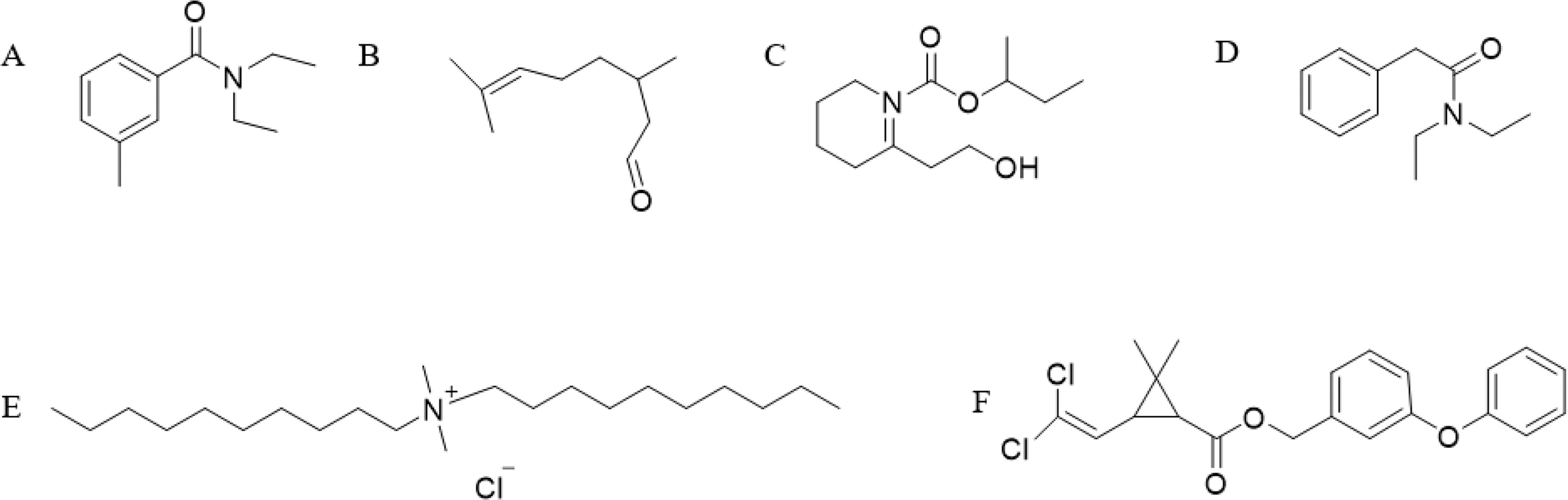
The chemical structures of DEET
In this study, the leech-repelling activities of several agents were evaluated, and subsequently, the preferred ones were selected as a composite leech repellent for application. Meanwhile, to achieve efficient multiscenario performance, polyvinyl butyral was used as a film-forming material because of its good safety profile; this hydrophobic film can be used as a depot for the repellent agents, resulting in waterproof and sustained release properties, besides, the hydrophobicity of polyvinyl butyral can reduce repellent transdermal diffusion. This compound system aimed to achieve “proactive repelling” (avoid leech attaching by the volatilization of repellent), “contact repelling” (prompt leech to escape from the membrane-protected area when attachment occurred), and bite detaching (detach/kill the leech when it is biting). The screening process and activities were evaluated in both air and underwater conditions. The physicochemical properties, repellent agents releasing profile, effectiveness, and biocompatibility, were assessed.
Material and Methods
Animals
Leeches were obtained from the wild near Xindong town, Gaozhou city, Guangdong province, China. Rats, mice, and rabbits were purchased from the Beijing Experimental Animal Center (Beijing, China). Operational procedures were carried out in accordance with the standards established in the Guide for the Care and Use of Laboratory Animals published by the Institute of Laboratory Animal Resources of the National Research Council, USA. This study was approved by the animal care and use committee of the Beijing Institute of Pharmacology and Toxicology (IACUC-DWZX-2023-P573). Best efforts were made to minimize the number of animals used and their suffering.
Materials
Isopropyl alcohol and ethyl alcohol were obtained from Sinopharm Chemical Reagent Co., Ltd (Shanghai). Polyvinyl butyral, DEET, and citronellal were obtained from Macklin Co., Ltd (Shanghai). Icaridin (97%) was obtained from Yuan Ye Co., Ltd. (Shanghai). DEPA was obtained from Teng Zhun Co., Ltd. (Shanghai). Permethrin was obtained from Wo Kai Co., Ltd. (Beijing). DDAC was obtained from ACMEC Co., Ltd. (Shanghai).
Preparation of the MSRS formulation
Polyvinyl butyral is well known for its safety and efficacy as a film-forming material. In this work, polyvinyl butyral was chosen to serve as the depot for the repellent agents. Taking into account factors such as solubility, spray ability, safety, and loading capacity, the solvent consisted of ethanol, isopropanol, and water. The repellent agents, citronellal, icaridin, and DDAC, were added at a concentration of 1% each. This formulation was designated as MSRS.
The specific experimental steps are as follows: 0.3 g of polyvinyl butyral was introduced into 10 mL of a solvent mixture (ethanol:7.5 mL, isopropyl alcohol:1.5 mL, and distilled water:1 mL). The suspension was agitated at ambient temperature for a duration of 2 h to facilitate complete dissolution of the polymer. Subsequently, 0.1 g of citronellal, 0.1 g of icaridin, and 0.1 g DDAC were sequentially incorporated into the solution. The mixture was further stirred for an additional 1 h to yield a homogenous and translucent solution.
Contact-killing test for repellent screening
Leeches (1.25 ± 0.25 g) were divided into six groups, with six leeches in each group. For each of the agents (DEET, citronellal, icaridin, DEPA, DDAC, and permethrin), a dose of 500 μmol was, respectively, added to the back of the leeches. The time of death was recorded for each group.
Proactive repellency test for repellent screening
The centrifuge tube with dimensions of 10 cm in length and a radius of 1.5 cm was horizontally positioned. Simultaneously position five leeches approximately 2 cm from the orifice of the tube. When the leeches rest or have little activity, put back the bottle cap coated with repellent agents and observe the movement of the leeches. If more than half of the leeches eventually move away from the centrifuge cap within 2 min, it regard as the agent have proactive repellency to leeches. The amount of each repellent agent was 2 μL, and the experiment was repeated three times.
Film forming test
Twenty microliters of MSRS solution was applied onto glass coverslips measuring 2 cm in diameter. The film formation after the addition was then observed.
Stability of MSRS
MSRS solution (5 mL) was dispensed into a centrifuge tube, which was then sealed. The total mass of the tube and MSRS was determined to be 5.6 g. Subsequently, the sample was incubated at room temperature for a duration of 6 months. Samples were monitored weekly for any changes in color or evidence of curing. Each experiment was performed in triplicate.
Water vapor transmission test
MSRS solution (100 μL) was carefully dropped onto circular filter paper pieces with a diameter of 1.7 cm. After the solvent volatilization, the filter paper was placed at the end of an open cylindrical container with a specific mass of deionized water, which also had a diameter of 1.7 cm. The initial weight of the sample, denoted as m0, was recorded. To ensure a tight seal, Vaseline was applied between the container and the filter paper. The entire setup was then placed in a constant temperature gas bath set to 37°C for a duration of 24 h. After which, the cylindrical container was carefully removed from the gas bath and weighed again, and this weight was recorded as m1. The weight loss during the 24-h period can be calculated as m = m0 − m1, representing the amount of water vapor transmission. The rate of water vapor transmission can be calculated by dividing the weight loss (m) by the time (s).
Test of mechanical properties
According to GB/T 9431-2000, the flexibility of MSRS sample was assessed with the three-point bending method. This method involves applying a force to the material at two points along its length, whereas a third force is applied to the center to bend it. The tensile and tearing properties of MSRS were evaluated using a universal testing machine (CMT6103, ZWICK, China). This type of machine applies a controlled force to the material in a specific direction, typically either pulling it apart (tensile) or causing a tear to propagate across the material. This allows the maximum force or stress that the material can withstand to be measured, as well as its elongation or deformation under the applied force. The strain curve of MSRS sample was obtained following the guidelines outlined in GB/T 1040.
In vitro repellent release test
The amount of citronellal, icaridin, and DDAC released from the MSRS membrane was detected with the standard curve method utilizing high-performance liquid chromatography (HPLC) or UV-visible photometer analysis system. Glass substrates with a diameter of 2 cm were used to prepare samples. About 100 μL MSRS was added to glass at each group. In the air condition, after the solvent evaporated, the resulting films were placed in a constant temperature oscillator to make the repellent agents volatilize. For the release of underwater condition, the resulting films on glasses were placed into a centrifuge tube containing 20 mL water and then these were taken into constant temperature oscillator. All samples incubated at 37°C with continuous shaking (60 rpm, SHZ-82A, Fintan, China), samples were collected at predetermined intervals (0–7 h), and the percentage of repellent agents released was tested. The HPLC conditions were as follows: icaridin: water–methanol (35/65, v/v), flow rate of 1 mL/min, detection wavelength 260 nm; citronellal: water–acetonitrile (20/80, v/v), flow rate of 1 mL/min, and detection wavelength 203 nm. DDAC uses an UV spectrometer with an absorption wavelength of 203 nm.
Scanning electron microscopy test
MSRS (20 μL) was applied onto a support glass (20 × 20 mm). After the solvent volatilization, the scanning microscope (ZEISS, Ltd., Gemini) was used to analyze the polymer surface structure. Samples deposited at 37°C after 24 h to evaporate repellent agents were also analyzed.
Proactive repellent test of MSRS in air
The operations are the same as section “proactive repellency test for repellent screening”. The experiment was divided into three groups: MSRS group, solvent group, and distilled water group. The amount of agent was 200 μL, and each test was performed in triplicate.
Contact repelling test
Spray 1 mL of the solution evenly over the area of the container, after which six leeches were placed in each dish. If more than half of the leeches managed to escape from the dish within 2 min, it was considered as contact escape behavior. The escape rate for each group was then calculated. Distilled water and solvent were established as control groups, and each test was performed in triplicate.
Underwater repelling test
Fifteen male Sprague–Dawley (SD) rats were depilated (8% Na2S solution) and randomly divided into three groups. The rats’ legs were smeared with 100 μL MSRS. Distilled water or polyvinyl butyral alone was set as controls. Rats were intermittently placed in a tank with 200 mL fresh water at different time points (0–7 h) to observe whether leech bites occurred within 2 min. The water in the tank was changed after each time point to maintain consistency. The experiment was repeated three times.
Bite detaching test on a rat model
The experiment included 15 male SD rats, each with an average weight of 220 g. After the rats’ legs were bit by leeches. About 100 μL MSRS (equivalent to five sprays) was sprayed onto the leech body. Distilled water and solvent were used as control groups. The leech reactions were recorded.
In vitro transdermal release experiment
The transdermal repellent release test was conducted using fresh rat skin. The skin was prepared by removing the fat layer and cutting it into a circular shape with a diameter of 2 cm. The test was performed using a transdermal diffuser (TK-6H, Jiekai, China). In the test setup, the sample receiving tank containing PBS with a diameter of 1.7 cm was covered by the rat skin. An even application of 20 μL of MSRS was applied to the exposed area of the skin. Six parallel samples were set up for each group. The test was conducted at a temperature of 37°C, an agitator was set at 100 rpm, and samples were collected from the receiving pool at various time points to assess the transdermal release of the repellent agents. The amount of repellent agents released was determined with HPLC, with the same conditions as those used in the in vitro repellent agents release section.
Skin irritation test
Male white New Zealand rabbits (n = 16) weighing 2.0–0.2 kg (8 weeks) were anesthetized with 10% chloral hydrate. Dorsal hair was removed, and rabbits were divided into two groups. In the MSRS group, 20 μL MSRS was applied onto the exposed skin. Saline was used as a control. The skin erythema, edema reaction, and irritation intensity were evaluated at 1, 24, and 72 h according to the technical guiding principles for the study of irritation, anaphylaxis, and hemolysis of chemical repellent agents (second draft) issued by the State Drug Administration of China.
Acute toxicity test
The procedure outlined in the National Standards of Food Safety (GB 15193.3-2014), and the experiments were conducted using the maximum concentration and volume of the extracted substances. The study involved a total of 40 KM (Kunming) mice, with 20 male and 20 female mice; these mice were divided into two groups, with 10 male and 10 female mice at each group: the experiment group, receiving 50 mL/kg of the MSRS liquid, and the normal saline group, which was used as control. Before administration, both groups of mice fasted for 12 h to eliminate any remaining food in their gastrointestinal systems. They had access to free drinking water during this fasting period, and 3 h after administration, the mice resumed their normal diet, and their body weights, general state, developmental indicators, and any signs of toxic reactions were continuously monitored and recorded.
Antimicrobial efficacy of MSRS
The antibacterial activity of MSRS was tested by antibacterial zone test. E. coli and S. aureus were used as test strains, method (Huang et al., 2013) were used to test inhibition zone diameter (IZD). Distilled water and solvent were used as controls.
Wound healing assay
The experiment revolved around evaluating the impact of MSRS on wound healing in the rat model. Fifteen male SD rats were used for this study and were randomly allocated into three distinct groups. Prior to the experiment, the rats were anesthetized using 7% chloral hydrate. Subsequently, legs of rats were subjected to depilation and cleansing with an 8% Na2S solution. A scissor was then used to create a 1 cm incision across the leg, inducing an injury. To assess the wound healing process in rats, 0.2 mL MSRS solution was topically applied to the wound and continuously gently wiped for a period of 7 days. In order to ascertain the efficacy of the MSRS treatment, distilled water and solvent were used as control groups.
The impact of MSRS on the environment
In this study, both woody and herbaceous plants were procured for experimentation. One milliliter of MSRS solution was uniformly sprayed onto the surface of the plants to evaluate the potential environmental impact. The growth of these plants was monitored and recorded over a period of 7 days. Special attention was given to observe any signs of withering or death among the plants.
Statistical analysis
Significant differences were calculated by a two tailed Student’s t-test, and a p-value of <0.05 was statistically significant.
Result
Repellency effect of agent to leeches
Five commercially available agents (DEET, citronellal, DEPA, icaridin, and permethrin) with known mosquito repellent effects, along with DDAC, were evaluated for their efficacy in repelling leeches.
In a contact-killing test, with the exception of permethrin, most repelling agents ultimately led to the demise of the leeches within 12 min (Table 1). Icaridin and DDAC exhibited superior activity compared with the other groups, as all leeches in these two groups died within a span of 6 min.
Contact Toxicity of Repellent Agents to Leeches
DDAC, didecyl dimethyl ammonium chloride; DEET, N, N-diethyl-m-toluamide; DEPA, N,N-diethyl phenylacetamide.
The results of the proactive repelling experiment display that leeches in the citronellal and icaridin groups exhibited a pronounced reversal in movement (Table 2), indicating the proactive repellent effect of citronellal and icaridin. However, under our experimental conditions, leeches in other groups did not exhibit any clear responsive movement.
Proactive Repelling Efficacy of Repellent Agents Against Leeches
According to the aforementioned results, icaridin, DDAC, and citronellal were selected as the preferred agents. Given that a combined formula always has enhanced potency of the repellent effect and is conducive to universal application, a composite repellent containing these three agents was subsequently formulated and tested.
Characterization of MSRS
The MSRS formulation was clear and transparent, indicating complete solubility for both repellent agents and polyvinyl butyral in the solvent. Besides, the solution displayed remarkable stability when stored in a hermetic container at room temperature for 6 months, with no observable changes in color or precipitate (Supplementary Fig. S1).
Upon application through spraying or smearing on the skin or clothes, the solvent evaporates within 60 s, forming a transparent and dense film. This film possesses certain adhesive property, making it suitable for outdoor activities. In addition, the film exhibits resistance to tap water washout, ensuring long-lasting protection in wet condition. Moreover, when it is no longer needed, the film can be removed by gentle rubbing.
According to the standard YY/T 0148-2009, it can be observed that the membrane in MSRS group exhibited a water vapor permeability value of 730 g/m2 per 24 h (Table 3), which met the requirements of the national standard. This indicates that the film allows for moisture evaporation when applied to human skin or clothes.
Water Vapor Transmission Rate of MSRS
The results of mechanical properties of the MSRS polymer are shown in Fig. 2. The tensile stress reached a maximum of 12.57 MPa, whereas the maximum tear strength reached 125N and three-point bending reached 1.44 MPa. Compared with traditional film-forming materials such as ethyl cellulose, these results indicate that the film formed by MSRS has favorable mechanical properties, ensuring both comfort and resistance to damage during regular activities.

Tensile stress
Release of repellent agents
An in vitro release test was conducted to investigate the release behavior of repellent agents in air condition. As shown in Fig. 3, both free citronellal and icaridin exhibited burst release behavior, almost 100% within 2 h (the free group serves as the control for the respective MSRS group). In contrast, when incorporated into the film formed by MSRS, citronellal and icaridin exhibited varying degrees of sustained release over time. The release of these agents appeared to follow a two-stage pattern: an initial stage characterized by smooth release rates and a subsequent stage characterized by slower rates as time progressed. In addition, DDAC, being a nonvolatile compound at room temperature, exhibited no release in air.

Release curves of citronellal
We also studied the release behavior of the repellent agents in water condition (Fig. 4). It was found that all three free agents showed a burst release pattern. However, when incorporated into the MSRS film, the agents exhibited slower release rate, with citronellal and icaridin reaching approximately 80% after 6 h and DDAC demonstrating 78.46% after 2 h.

Release curves of citronellal
Scanning electron microscopy was used to examine the surface morphology of MSRS before and after repelling application. The initial solid film of MSRS (following solvent evaporation) displayed a compact and homogeneous surface morphology. After repellent agents evaporated, a wide gap was observed (Supplementary Fig. S2).
MSRS reduced the transdermal absorption of repellent agents
To evaluate the barrier effect of polyvinyl butyral on repellent transdermal absorption, an in vitro transdermal release test was conducted, and the results are depicted in Fig. 5. The MSRS-citronellal and MSRS-icaridin groups showed a significantly reduced transdermal amounts compared with the free citronellal and icaridin control groups at each time point. Besides, no transdermal release of DDAC was observed in both the MSRS-DDAC group and the free DDAC control group.

Transdermal absorption of repellent agents. *p < 0.05, ***p < 0.001 versus citronellal, icaridin, and DDAC. Data are mean ± standard deviation (n = 3).
Effectiveness of MSRS against leeches
The results of proactive repelling efficacy in air condition are shown in Table 4. In the distilled water and polyvinyl butyral control groups, the leeches did not move or only slightly moved, indicating a lack of proactive repellent effect. In contrast, in the MSRS group, all leeches exhibited distinct reverse movement at 0 h and 0.5 h. The proactive repellent rate was found to be 46.7% at 2 h. The efficiency decreased with increased time.
Proactive Repellency in Air Condition
p < 0.01 versus control. Data are mean − standard deviation (n = 5, repeated three times).
The effectiveness of MSRS against leeches in underwater condition was evaluated using a rat model. The results are presented in Table 5. Rats in the distilled water and polyvinyl butyral control groups were continuously attacked by leeches upon immersion in water. In contrast, rats in the MSRS group exhibited a sustained protection against leeches, with no leeches attaching to them for up to 3 h. However, the repelling effect gradually diminished over time, and by the end of 4 h, the MSRS group had a bite incidence rate of 46.7%.
Percentage of Rats Bitten by Leeches in Underwater Condition
p < 0.01 versus control. Data are mean − standard deviation (n = 5, repeated three times).
The contact repelling experiment was conducted to evaluate the escape behavior of leeches when contacting MSRS film. The results are shown in Table 6. Leeches in both the distilled water and polyvinyl butyral groups did not exhibit any contact escape behavior. Conversely, in the MSRS group, all leeches managed to escape from the film surface at the first hour. However, as time progressed, the efficiency gradually decreased.
Contact-Repelling Efficacy
p < 0.01 versus control. Data are mean − standard deviation (n = 6, repeated three times).
The bite detaching activity was evaluated with a leech biting rat model. Spraying MSRS solution to the leeches could immediately make them shrink and shed from the animal body and caused leeches death within 5 min.
Biosafety evaluation of MSRS
Through evaluations conducted at 1 h, 24 h, and 72 h postapplication, no symptoms of erythema or edema were observed in the experimental area (Supplementary Table S1). These findings indicate that the MSRS did not cause any skin irritation on rabbits.
An acute toxicity test was conducted in a mice model. There was no significant difference in body weight between the MSRS group and the normal saline group in Fig. 6. This suggests that the MSRS has no significant impact on the overall growth of the mice during the 14-day administration period.
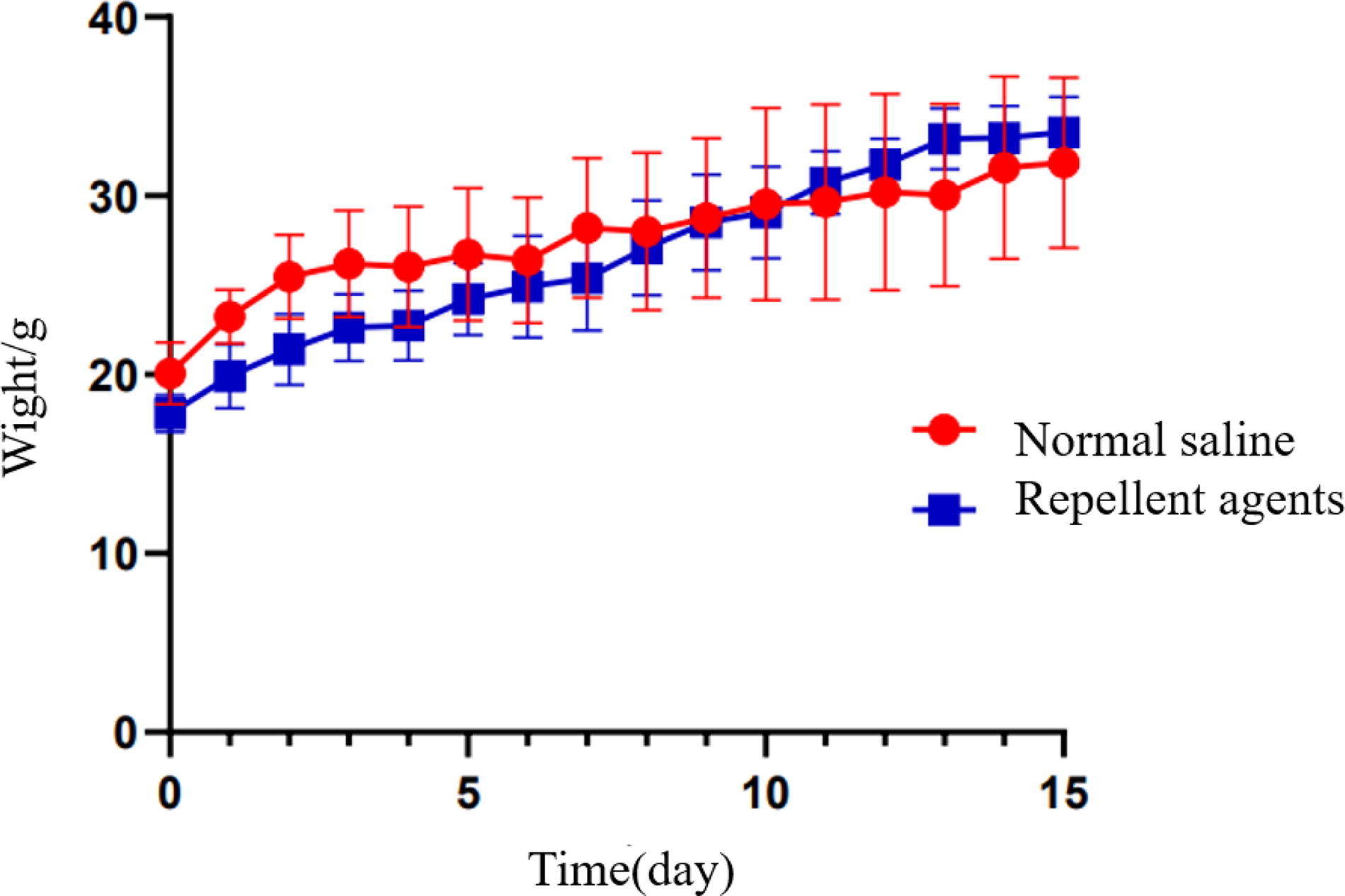
Body weights of rats in the acute toxicity test.
The antibacterial performance of MSRS
A bacteriostatic zone experiment was performed to verify the antibacterial property of MSRS. In comparison to the distilled water and polyvinyl butyral groups, which displayed no bacteriostatic effect (Fig. 7), MSRS exhibited notable antibacterial activity. The inhibition zone diameters for E. coli and S. aureus were measured at 4 mm and 9 mm, respectively, indicating a definite antibacterial effect.

The antibacterial effect of MSRS.
Moreover, MSRS showed improved wound healing than distilled water and polyvinyl butyral groups in a rat wound recovery test (Supplementary Fig. S3). This phenomenon is attributed to the antibacterial effect of MSRS.
Environmental friendliness of MSRS
Based on the 7-day observation period (Fig. 8), it can be observed that both plants did not wither and die and remained in good growth condition after being sprayed with MSRS.

Plant growth state at different times.
Discussion
Previous studies have suggested that certain repellent agents, such as icaridin, citronellal, and DEPA, have specific repellent effects against mosquitoes, flies, bees, ticks, and fleas. However, there are limited data available regarding their potential repellent effects on leeches.
In this study, some agents were initially evaluated individually for their repellent effects on leeches. Icaridin and DDAC exhibited superior activity compared with the other groups in the contact-killing test (refer to Table 1). The citronellal and icaridin groups showed definite behavior in the proactive repelling test (refer to Table 2). Given that a combined formula has enhanced potency of the repellent effect and is conducive to universal application, a combination of citronellal, icaridin, and DDAC was proposed as potential composite repellent agents. The MSRS formulation was prepared by dissolving these three repellent agents with hydrophobic polyvinyl butyral in a mixed solvent. The MSRS formulation observed great storage stability. The physicochemical properties of MSRS membrane were analyzed and showed good mechanical properties, indicating comfort and integrity when attached to the skin surface.
The repellent agents release experiment demonstrates that MSRS has the capability to sustainably release agents in both air and underwater conditions. In the air environment, citronellal exhibits superior volatility compared with other agents, thereby enabling an effective proactive repellent effect. Icaridin has lower volatility and leads to an extended duration of the proactive repellent effect. DDAC is nonvolatile and serves as a contact escape mechanism. In water environments, DDAC exhibits high solubility, making it an efficient agent for release; besides, citronellal and icaridin also exhibit sustained release manner. Generally, most of the repellent formulations comprise single repellent agent, which is difficult to meet the application in multiple environments. Relatively, a combination of repellent agents in MSRS exhibited diversified and sustained release in multiple environments, thus making the protection of the skin from being bitten possible. Besides, the hydrophobic film material serves as an efficient reservoir for loading the repellent agents, it exhibited favorable slow-release characteristics and greatly prolong the protection time for the skin. Experimental results also demonstrate that polyvinyl butyraldehyde reduced the permeation of repellent agents on rat skin, and this may be attributable to the hydrophobicity of polyvinyl butyral that decreased the contact area of repellent agents at the skin surface. The barrier effect of polyvinyl butyral on repellents’ transdermal diffusion can help reducing potential safety risks of acute and subchronic exposure.
The repellent efficiency experiments have proved significant practical value. The effectiveness of MSRS against leeches was evaluated for effect of “proactive repelling,” “contact repelling,” and “bite detaching,” which achieves the purpose of multiple defenses to the skin. The results demonstrate that the MSRS formulation effectively prevents skin from being bitten by leeches for several hours, either in air or in underwater condition (we define the effective repellent effect as surpassing 50% efficacy against leeches). Besides, as these three repellent agents exhibited diverse release behavior over time under different conditions (Figs. 3 and 4), the amalgamated release patterns resulted in distinct repellent efficacies in water and air environments. Moreover, even in cases when the skin is bitten, MSRS can rapidly detach the leech, causing it to bleed to death, and no regurgitation occurred in our tests.
Leeches are known to carry a variety of bacteria and viruses, thereby posing a risk of wound infection after bleeding from leech bite. In the bacteriostatic zone and wound healing experiment, MSRS proved certain antibacterial effect and consequently contribute to wound healing. This antibacterial effect is attributed to the presence of DDAC, which belongs to the class of quaternary ammonium salts, which is commonly used as a disinfectant and bactericide in the field of medicine and health.
Skin irritation and acute toxicity tests have demonstrated that MSRS possesses excellent biosafety properties. Besides, MSRS is an environmentally friendly formulation. These results support that MSRS has great biocompatibility and can be applied to human skin.
Conclusion
This study presents evidence supporting the development of a sustained releasing system comprising polyvinyl butyral loaded with citronellal, icaridin, and DDAC. The system aims to release its three repellent components in both air and water conditions. The system exhibits fast film formation, enabling “proactive repelling,” “contact-escaping,” and “bite-detaching” for several hours. Moreover, the system also reduces the penetration of repellent agents into the body, and the formula possesses wound disinfection capability. In addition, the system is biocompatible and environmentally friendly. This work offers a potentially applicable formulation for repelling leeches and other aquatic worms or pests.
Footnotes
Author Contributions
Jia Wang is responsible for methodology development and design, Wei Zhang is responsible for data collection, Junhao Shi is responsible for data analysis, Quan Zhang, Junjie Tan and Liang Xu are responsible for supervision and consultation.
Author Disclosure Statement
No conflicting financial interests exist.
Funding Information
This research project has been made possible thanks to the support from the Beijing Nova Program (20220484229) and Foundation of Western Theater Command General Hospital (Grant Number: 2021-XZYG-B23).
Supplementary Material
Supplementary Figure S1
Supplementary Figure S2
Supplementary Figure S3
Supplementary Table S1
References
Supplementary Material
Please find the following supplemental material available below.
For Open Access articles published under a Creative Commons License, all supplemental material carries the same license as the article it is associated with.
For non-Open Access articles published, all supplemental material carries a non-exclusive license, and permission requests for re-use of supplemental material or any part of supplemental material shall be sent directly to the copyright owner as specified in the copyright notice associated with the article.
