




Abstract
Background:
Triatomines (Hemiptera: Reduviidae: Triatominae), which are the vectors of Chagas disease in Brazil, are associated with forested areas. This study analyzed triatomines and their natural infection by Trypanosoma cruzi in an Atlantic Forest remnant in the state of São Paulo, Brazil.
Materials and Methods:
Thirty-five triatomines were captured and identified as Triatoma tibiamaculata and Panstrongylus megistus. The study included direct trypanosome research and isolation in Balb/c mice.
Results:
Fifteen isolates were obtained from seven triatomines representing both species. Protein sequences from the V7-V8 SSUrDNA region were obtained from the isolates and positive triatomines and were analyzed using maximum parsimony and Bayesian methods for phylogenetic positioning. All sequences obtained were identified as T. cruzi; the isolates were classified as TcII, whereas a direct sample was typed as TcIV.
Conclusion:
The results demonstrated the occurrence of active transmission cycles and the risk of vector transmission to the population in these regions.
Introduction
Currently around 6 million people are infected with Chagas disease, and approximately 10,000 deaths occur every year in Latin America due to its complications (de Sousa et al., 2024).
Trypanosoma cruzi (Chagas, 1909), the etiological agent of Chagas disease, is categorized in seven discrete typing units (DTUs), all of which have the potential to be pathogenic to humans. These DTUs are designated as TcI through TcVI and TcBat. They exhibit variable epidemiological cycles and inhabit different ecotopes, demonstrating significant diversity. For instance, TcI is well-documented in its relationship with wild hosts, predominantly in arboreal ecotopes, and it has a widespread distribution throughout the Americas. In contrast, TcII, along with other DTUs such as TcV and TcVI, is considered rare in sylvatic cycles, and little is known about its primary vectors (Zingales et al., 2012).
Triatomines (Hemiptera: Reduviidae: Triatominae) known as kissing bugs, are associated with the vectorial transmission of T. cruzi, and three genera are primarily associated with natural infection and transmission: Rhodnius (Stål, 1859), Panstrongylus (Berg, 1879), and Triatoma (Laporte, 1832). The geographical distribution of some species in the epidemiological context of Chagas disease in Brazil is strongly correlated with environmental variation and specific biomes but species such as P. geniculatus and P. megistus have occurred in several Brazilian states and in at least three different Biomes, showing great potential for adaptation to different environmental conditions (Carcavallo et al., 1999; Leite et al., 2007 ). The last two genera have been recorded in the state of São Paulo, and P. megistus exhibits high rates of natural infection by T. cruzi, which are due to its high capacity to adapt to domestic environments, despite its wild origin. (Silva et al., 2020).
This study isolated and conducted phylogenetic positioning of T. cruzi obtained from triatomines captured in an Atlantic Forest region in Vale do Ribeira, São Paulo, Brazil.
Materials and Methods
Triatomines were captured using active search and luminous lures at Legado das Águas Reserve, Vale do Ribeira, in southern São Paulo, between 2018 and 2020 (Fig. 1A). The specimens were identified (Galvão and Dale, 2014), dissected, and examined for the presence of trypanosomes in the digestive tract through a light microscope.
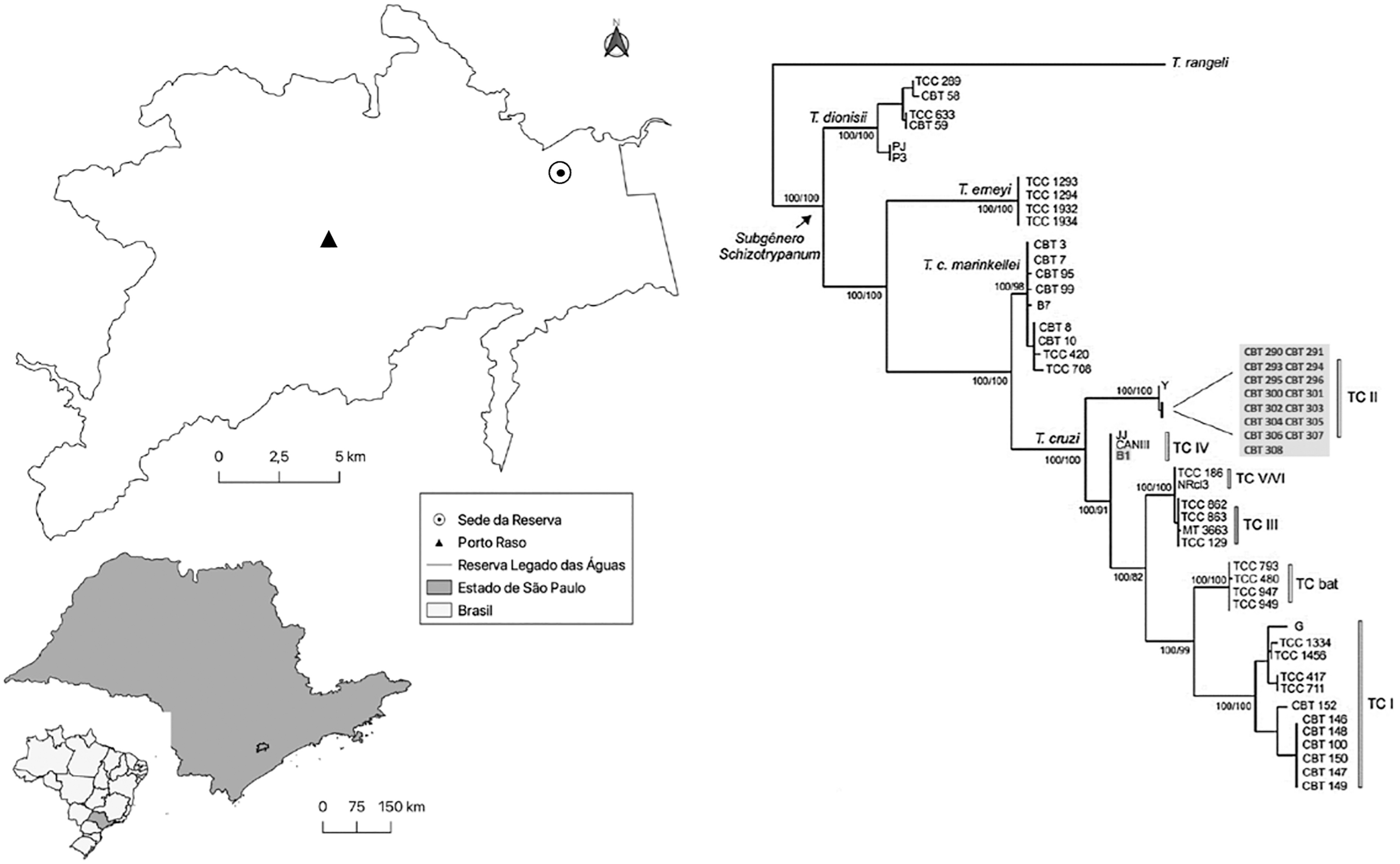
Geographic location of the Reserva Legado das Águas-Votorantim in the state of São Paulo and Brazil, with triatomine capture areas
The intestinal contents of triatomines identified as positive after direct examination were inoculated in Balb/c mice. After 20 days, the mice were euthanized; their blood was inoculated into biphasic blood agar base augmented with liver infusion tryptose and 10% fetal bovine serum and kept at 28°C. The resulting isolates were cryopreserved in the Brazilian Trypanosomatids Collection of the Preventive Veterinary Medicine and Animal Health Department (FMVZ-USP).
DNA was extracted using the PureLink® kit (ThermoFisher). The SSUrDNA gene was amplified following the conditions and primers already described (Maia da Silva et al., 2004) and sequenced by an ABI 3500 Series Genetic Analyzer® (Applied Biosystems) automated sequencer.
The alignments were generated with ClustalW and refined manually (Supplementary Table). Phylogenetic inferences were conducted using the maximum parsimony (MP) and Bayesian analysis (BA) methods. MP analysis was performed with PAUP* version 4.0b10 (Swofford, 2002), while BA was performed with MrBayes v.3.1.2®. (Ronquist and Huelsenbeck, 2003). Bootstrap support was assessed with 100 replicates, following the method described above.
This study was approved by the Research Ethics Committee of Faculdade de Medicina Veterinária e Zootecnia da Universidade de São Paulo n° 7717280119.
Results and Discussion
Thirty-five triatomines specimens were captured and examined: 10 P. megistus and 25 P. tibiamaculatus. Of this total, 31.4% (11/35) had positive parasitological results: P. tibiamaculatus presented 36% (9/25) positivity, and P. megistus presented 20% (2/10).
Fifteen isolates were obtained from seven triatomines: three from P. megistus and the others from P. tibiamaculatus. Phylogenetic positioning based on the triatomine barcode (V7-V8 SSUrDNA) grouped the sequences of all isolates into a monophyletic branch with the T. cruzi reference strain Y (TcII). A sequence obtained directly from the intestinal contents of a triatominae of the species P. megistus was associated with the reference strain CANIII (TcIV). (Fig. 1B).
Epidemiological surveillance in the state of São Paulo since the 1970s has recorded a notable increase in the natural infection of P. tibiamaculatus and P. megistus, the latter having the highest infection rate in the period (1.1–27.3%) among the species collected. In comparison, the infection rate observed for T. sordida, another species with alarming adaptation potential, decreased steadily (Silva et al., 2019). The capacity and advance of P. megistus colonization in the state is also being demonstrated by sampling in parks and urban areas in the capital city (Silva et al., 2020; Ribeiro et al., 2016).
T. cruzi IV is traditionally the cause of sporadic human cases in the Amazon region associated with Rodnius sp., and T. cruzi II is common in domestic cycles in various regions of South America, often causing severe cases of Chagas disease in humans, transmitted by species of Panstrongylus and Triatoma adapted to colonize these domestic areas (Gaunt and Miles, 2000; Zingales et al., 2012). Despite this, T. cruzi II has already been registered in areas of the coastal Atlantic Forest of the state of Rio de Janeiro, being maintained for at least 11 years with high infection rates in primates of the genus Leontopithecus sp., as well as generating clinical symptoms and antibody response (Lisboa et al., 2015). This strain has also been described in rural properties in the Atlantic Forest of the state of Espírito Santo, predominantly over other strains in Triatoma vitticeps and P. geniculatus (Dario et al., 2018).
This study provides an important record of the wild circulation of T. cruzi DTU II in the Atlantic Forest region in the south of the state of São Paulo. Since it is a strain that causes severe forms of Chagas’ disease and is associated with triatomines with good colonization capacity, this finding reinforces the need for greater attention and surveillance in the region.
Footnotes
Supplementary Material
Supplementary Table
References
Supplementary Material
Please find the following supplemental material available below.
For Open Access articles published under a Creative Commons License, all supplemental material carries the same license as the article it is associated with.
For non-Open Access articles published, all supplemental material carries a non-exclusive license, and permission requests for re-use of supplemental material or any part of supplemental material shall be sent directly to the copyright owner as specified in the copyright notice associated with the article.
