




Abstract
Background:
Anaplasmosis, caused by Anaplasma species, poses significant threats to public health and livestock productivity. Understanding the distribution and genetic diversity of these pathogens in tick vectors across China is critical for risk assessment and disease control.
Materials and Methods:
From April to June 2023, 875 ticks were collected across three Chinese provinces: Jiangxi, Yunnan, and Shaanxi. The collected ticks comprised Rhipicephalus microplus (from Jiangxi and Yunnan) and Haemaphysalis longicornis (from Shaanxi). Pathogen detection was performed using PCR, followed by phylogenetic analysis of the obtained sequences to determine genetic relationships.
Results:
Anaplasma capra was detected predominantly in R. microplus from Yudu County, Jiangxi (4.95%), and in H. longicornis from Meixian County (3.16%), Long County (5.99%), and Zhenba County (0.83%) in Shaanxi, exhibiting regional genetic variations. The detection rate of Anaplasma marginale was 6.59% in Yudu County, Jiangxi; significantly higher rates were found in Yunnan province: 41.75% in Nanjian County, 40.38% in Weishan County, and 52.04% in Yongsheng County. Phylogenetic analysis revealed that A. marginale isolates from Lijiang (Yongsheng), Yunnan, were highly homologous (99.63%–100%) to those from Yudu County, Jiangxi, while isolates from Dali (Nanjian and Weishan), Yunnan, formed a distinct clade.
Conclusion:
The findings demonstrate the widespread distribution of A. capra and A. marginale in ticks across the surveyed regions of China, with notable variations in prevalence and genetic characteristics. These pathogens represent potential threats to local residents and livestock. Future research should expand the geographic sampling range to fully understand their distribution patterns and explore effective prevention and control strategies to safeguard public health and safety.
Introduction
Ticks (Ixodidae) are obligate ectoparasites of vertebrates, serving as vectors for diverse pathogens, including bacteria such as spirochetes, and rickettsiae; parasites like Babesia and Theileria; and viruses such as flaviviruses and nairoviruses (Djiman et al., 2024). Their dual role as natural reservoirs within endemic foci and bridge vectors for interhost transmission underscores their significance in both public health and veterinary medicine. During blood feeding, ticks not only acquire pathogens but also inoculate them into hosts, a process facilitated by their ecological adaptability and biological traits, which collectively drive the perpetuation and geographic expansion of infectious disease foci (de la Fuente et al., 2008). Clinical manifestations of tick-borne infections vary widely, with severe cases potentially leading to host mortality (Ginsberg, 2008). Notably, tick bites are the primary transmission route for Anaplasma infections, highlighting the critical need for vector control strategies (Yan et al., 2021).
The genus Anaplasma (family Anaplasmataceae, order Rickettsiales) comprises Gram-negative, obligate intracellular alphaproteobacteria that are primarily transmitted by hard ticks (family Ixodidae) to vertebrate hosts (Rar et al., 2021). There are six Anaplasma species (A. bovis, A. ovis, A. marginale, A. centrale, A. phagocytophilum, and A. platys) according to the classification based on 16S rRNA and groEL genes, which can cause disease in humans and a wide range of domestic animals. Human granulocytic anaplasmosis is an emerging infectious disease caused by A. phagocytophilum, first identified in the United States in 1990 (Chen et al., 1994). In China, Anaplasma infections in humans were initially detected in Anhui Province in 2006 (Zhang et al., 2008a). Subsequently, cases have been identified in other regions of the country, including Inner Mongolia, Tianjin, and Hainan (Gaowa et al., 2018; Xie et al., 2024; Zhang et al., 2008b).
A. capra is a newly emerging tick-borne zoonotic pathogen. In 2012, A. capra was first discovered in goats in China, and in 2015, human cases were reported in Heilongjiang Province, China (Li et al., 2015). Subsequently, a study conducted in Malaysia in 2018 reported the presence of A. capra outside of China for the first time (Koh et al., 2018). Infections caused by A. capra can result in flu-like symptoms such as fever, headache, fatigue, dizziness, and chills, along with gastrointestinal symptoms (e.g., nausea, vomiting, or diarrhea), rash, eschar, and regional lymphadenopathy (Li et al., 2015). Research indicates that A. capra has been detected in humans, livestock, wildlife, and ticks, demonstrating the global distribution and broad host range (Sahin et al., 2022; Yang et al., 2017).
A. marginale is the primary causative agent of bovine anaplasmosis, leading to clinical manifestations such as fever, weight loss, abortion, lethargy, and jaundice, and often results in fatal outcomes in cattle over 2 years old (Kocan et al., 2003). This disease poses a serious threat to the health of affected animals, impacting their growth and productivity and leading to high mortality rates in adult cattle. The brown ear tick (R. microplus) is a vector of A. marginale and one of the most widely distributed and economically damaging hard ticks globally (Kazim et al., 2024). R. microplus primarily infests cattle but can also parasitize sheep, goats, horses, and other livestock (Mahlobo-Shwabede et al., 2022), warranting further investigation to determine the risk of tick-borne Anaplasma infections in these species.
In light of the significant impact of tick-borne pathogens on public health, understanding their distribution across different regions is crucial for implementing effective disease management measures. To this end, we selected several representative regions in China for tick collection, including Jiangxi Province, located in the southeastern part of China and in the middle-lower reaches of the Yangtze River Plain; Yunnan Province, situated in the southwestern part of China on the Yunnan-Guizhou Plateau; and Shaanxi Province, positioned in the northwestern part of China near the Qinling Mountains. By conducting surveys and research on tick-borne pathogens in these specific regions, our study aims to provide scientific evidence for the development of more precise and effective control strategies.
Materials and Methods
Collection of tick samples
From April to June 2023, we collected ticks from cattle and sheep (≤10 per cattle; ≤5 per sheep) and their surrounding environments at seven locations in mountainous regions of Jiangxi province (Yudu County), Yunnan province (Nanjian, Weishan, and Yongsheng Counties), and Shaanxi province (Mei, Long, and Zhenba Counties). We selected these regions as they have a history of Anaplasma infections, contain habitats favorable for ticks, and are representative of east, southeast, and north China, respectively. Fully engorged adult ticks were manually removed from host predilection sites (ears, necks, and groins) using forceps, while free-living ticks were captured by dragging a standard 90 × 60 cm white flannel flag along a transect ≥500 meters in length, sampled daily for three consecutive days with 10 m interval checks (≥30 min/session). Specimens were preserved in coded vials, preliminarily identified through stereomicroscopic morphological analysis (palp, scutum, anal groove, and basis capituli) (Barker and Walker, 2014), and stored at −80°C for further studies.
DNA extraction
Tick samples were washed three times with bromogeramine (0.1%), and then were soaked in 75% ethanol for sterilization and washed with phosphate-buffered saline for 15 min. The ticks were homogenized individually, and the total DNA was extracted using the QIAamp DNA Mini Kit (Qiagen, Hilden, Germany) according to the manufacturer’s instructions. The DNA samples were eluted in 80 μL elution buffer and stored at −20°C until they were subjected to molecular analysis.
Tick species identification and molecular detection of tick-borne pathogens
The morphological species identifications were confirmed by amplification and sequencing of the cytochrome oxidase subunit I (COI) gene (Smit et al., 2023). Each extracted DNA sample was preliminarily screened for the presence of Anaplasma and Ehrlichia through nested PCR amplification of a 500 bp fragment of the 16S rRNA gene (Jafar Bekloo et al., 2018). To further identify the species of Anaplasma, we performed nested PCR or seminested PCR on the positive samples to amplify two overlapping fragments, thereby obtaining nearly complete sequences of the 16S rRNA, gltA and groEL genes (Guo et al., 2018; Guo et al., 2016; Remesar et al., 2022). The primers were custom-synthesized by Sangon Biotech Co., Ltd. (Shanghai, China). The PCR products were electrophoresed on a 1.0% agarose gel and stained with GoldView I (Solarbio, Beijing, China). PCR products of expected size were excised and purified using the DNA Fragment Purification Kit (Takara, Dalian, China) and sequenced bidirectionally by Dia-Up Biotech Company (Beijing, China) using the amplification primers.
Genetic and phylogenetic analysis
The sequences obtained in this study were edited and assembled using SeqMan software (DNAStar, version 7.0, DNAStar Inc., Madison, WI, United States) to generate nearly complete gene sequences. The obtained sequences were submitted to GenBank for sequence comparison and analysis. Phylogenetic analysis was conducted using the neighbor-joining method in MEGA version 7.0 software. The confidence values for each branch of the phylogenetic tree were determined through a bootstrap analysis with 1,000 replicates. All representative sequences were deposited in GenBank.
Results
Collection of ticks and identification of tick species
A total of 875 ticks were collected from April to June 2023 at seven locations across three provinces in China: Jiangxi, Yunnan, and Shaanxi (Fig. 1). All the collected ticks were adults. Specifically, in Jiangxi Province, 190 ticks were collected from Yudu County. In Yunnan Province, tick collections amounted to 103 from Nanjian County in Dali City, 52 from Weishan County, and 98 from Yongsheng County in Lijiang City. In Shaanxi Province, 95 ticks were collected from Meixian District and 217 from Long County in Baoji City, with an additional 120 ticks collected from Zhenba County in Hanzhong City. We excluded eight tick specimens where the COI gene PCR was negative. The COI gene data confirmed all the morphological identifications. The result of COI gene sequencing confirmed that two tick species were identified: R. microplus (50.17%, 435/867) was found in both Jiangxi and Yunnan Provinces, while H. longicornis (49.83%, 432/867) was identified in Shaanxi Province. Tick species and distribution information are summarized in Table 1.

Distribution map of sample collection sites for May–July, 2023.
Prevalence of Anaplasmataceae Bacteria in Different Tick Species in Jiangxi, Yunnan and Shaanxi Province, China
Detection and phylogenitic analyses of Anaplasma in ticks
Phylogenetic analysis based on the 16S rRNA (704 bp), gltA (802 bp), and groEL (801 bp) genes revealed the presence of two distinct Anaplasma species in this study: A. capra and A. marginale.
A. capra was detected in R. microplus ticks from Yudu County, Jiangxi Province, and H. longicornis ticks from Meixian, Long County, and Zhenba County in Shaanxi Province, with positivity rates of 4.95% (9/182), 3.16% (3/95), 5.99% (13/217), and 0.83% (1/120), respectively. Phylogenetic analysis based on the 16S rRNA gene indicated that all A. capra-positive sequences from Shaanxi and Jiangxi provinces were closely related to the strain JZT12 (OQ135109) identified in Anhui Province, China. Further analyses of the gltA and groEL genes revealed that A. capra isolates from Jiangxi and Shaanxi Provinces formed two distinct clades. The positive sequences from Jiangxi showed 100% identity with the tick-XA74 strain (MG869337) from Xi’an and the AK-Rm-380 strain (MH716412) in R. microplus ticks from Ankang City. In contrast, the gltA gene sequences from Shaanxi shared 100% identity with strain JZT12, while the groEL gene exhibited a high similarity of 99.88%–100%.
A. marginale was also detected in R. microplus ticks from Jiangxi and Yunnan Provinces, with positivity rates of 6.59% (12/182) and a substantially higher rate of 45.45% (115/253) in Yunnan. Notably, no coinfections were found in the R. microplus ticks collected from Jiangxi Province. Phylogenetic tree analysis demonstrated that the A. marginale strains identified in this study were highly homologous (99.63%−100%) to the WHBMXZ-130 strain (KX987367) found in Wuhan, China. Notably, the A. marginale isolates from Yudu County, Jiangxi, and Lijiang, Yunnan, clustered within the same branch and were closely related to strains from South Idaho (AF304139) and Florida (AF304140), USA, showing homology of 99.59%−100%. However, the isolate from Dali, Yunnan, formed an independent branch and exhibited two nucleotide differences compared to the aforementioned strains (Fig. 2).
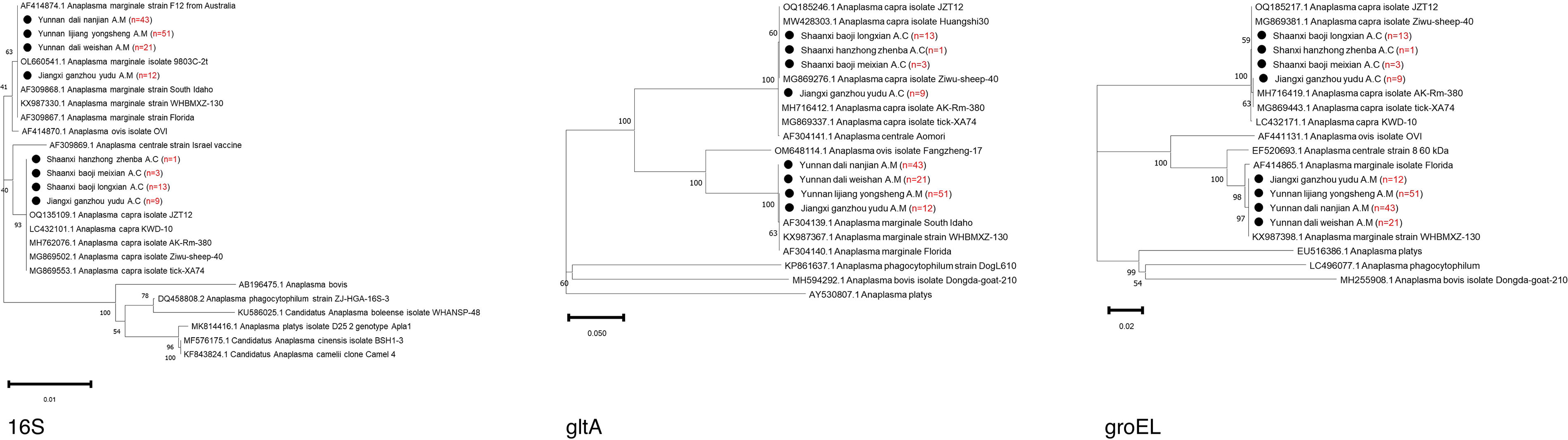
Phylogenetic trees constructed by the MEGA 7.0 software based on the nucleotide sequences of 16S rRNA (704 bp), gltA (802 bp), groEL (801 bp) genes of Anaplasma strains. The bootstrap values were shown on the nodes.
The representative sequences obtained in this study for phylogenetic analysis have been deposited in GenBank under the accession numbers PQ812570 to PQ812577 for the 16S rRNA gene, PV167200 to PV167207 for the gltA gene, and PV207846 to PV207871 for the groEL gene.
Discussion
This study identified two Anaplasma species: A. capra and A. marginale. A. capra was detected in R. microplus from Jiangxi Province and H. longicornis from Shaanxi Province, while A. marginale was found in R. microplus from both Jiangxi and Yunnan Provinces. This represents the first detection of A. capra and A. marginale in ticks from Jiangxi Province, significantly expanding their known geographical distributions and highlighting their potential as disease vectors. These findings necessitate updates to current risk maps for tick-borne diseases in southern China. Previous studies documented A. capra initially in Ixodes persulcatus, with subsequent identification in eastern China’s H. longicornis populations (Lu et al., 2023a). Our detection of A. capra in H. longicornis from Shaanxi Province (northwestern China) aligns with the prevalence rates reported by Zhang et al. for the same tick species in this region, confirming the pathogen’s persistent presence and epidemiological significance (Zhang et al., 2023).
A. marginale, primarily transmitted to cattle through ticks, utilizes infected male/female ticks and bovine hosts as reservoirs. It induces anaplasmosis ranging from subclinical to severe hemolytic disease, causing substantial economic losses in dairy and beef industries (Heylen et al., 2023). Notably, our study revealed remarkably high A. marginale prevalence rates in Yunnan Province (40.38%−52.04%), contrasting with the 6.91% previously reported in local R. microplus populations (Lu et al., 2022). This discrepancy may stem from our sampling strategy focusing on fully/partially engorged ticks collected from animal hosts, leaving uncertainty about whether detected Anaplasma DNA originated from blood meals or established tick infections. Nevertheless, these findings suggest persistent A. marginale exposure risks for livestock in these regions, warranting heightened surveillance of its zoonotic potential in human and animal health.
The codistribution of H. longicornis and R. microplus with Anaplasma pathogens reveals complex ecological interactions facilitating pathogen maintenance. Notably, populations of H. longicornis exhibit parthenogenetic capabilities within portions of their distribution range (Oliver et al., 1973). This characteristic may contribute to the extensive global distribution of this tick species and potentially facilitate vertical transmission in A. capra. While tick-mediated transovarial transmission mechanisms for Anaplasma species require further investigation, experimental evidence confirms this pathway for A. marginale in R. microplus (de la Fournière et al., 2023). Should A. capra exhibit similar transmission dynamics in H. longicornis, this mechanism could sustain pathogen populations across tick generations without vertebrate hosts, particularly critical in high-density tick habitats. Consistent with previous reports (Lu et al., 2023b), R. microplus serves as a key vector for A. marginale across multiple Chinese provinces. As a cattle-adapted species with secondary infestations reported in sheep, horses, cats, and dogs (Ali et al., 2019), R. microplus plays a pivotal role in interspecies transmission of zoonotic Anaplasma pathogens. These findings collectively emphasize the urgent need for integrated tick-control strategies and pathogen surveillance programs to mitigate economic impacts on livestock industries and emerging public health threats. (Yan et al., 2021).
Our results indicate that A. capra and A. marginale are present in H. longicornis and R. microplus from three provinces of China separated by >1,000 km from each other, suggesting broad regional distribution and a potential threat to residents and livestock. Jiangxi is characterized by hilly terrain and intricate river networks under a subtropical monsoon climate; Yunnan features complex topography spanning the Hengduan Mountains and the Yunnan-Guizhou Plateau, accompanied by pronounced vertical climatic zonation; while Shaanxi displays a distinct climate-landform gradient transitioning from the temperate semiarid Loess Plateau in the north to the northern subtropical humid southern foothills of the Qinling Mountains. Despite significant geographical disparities among Jiangxi, Yunnan, and Shaanxi provinces, their tick populations and associated Anaplasma infections exhibit notable similarities. Firstly, biological migration plays a crucial role. Seasonal movements of birds and other mammalian hosts across regions enable ticks and their pathogens to disperse, thereby reducing population differentiation among geographically distinct tick groups (Cohen et al., 2015). Additionally, global climate warming has driven certain tick species to expand their ranges into higher latitudes or elevations, further promoting ecological niche overlap between previously isolated tick populations (Ogden et al., 2021). This expansion contributes to the homogenization of Anaplasma distribution. Although these regions differ in topography and climatic conditions, analogous microhabitats—such as forest edges and grasslands—provide suitable ecological niches for ticks. Similar vegetation cover and humidity levels within these microhabitats can sustain comparable tick species, even across distant geographical locations (Iijima et al., 2022). While higher biodiversity often mitigates pathogen transmission via the dilution effect (Keesing and Ostfeld, 2015), certain ticks and Anaplasma strains exhibit broad adaptability to multiple hosts, allowing them to maintain relatively stable infection rates across diverse ecosystems (Levi et al., 2016). Human activities profoundly influence tick and pathogen distribution (de Souza and Weaver, 2024). Agricultural expansion and urbanization, for instance, modify natural habitats to create tick-friendly environments, such as shrublands formed after deforestation. Concurrently, globalization and advanced transportation networks accelerate the movement of humans and goods, indirectly facilitating the spread of ticks and their pathogens. These factors explain the observed consistency in tick-borne infections even among geographically remote areas. In conclusion, the convergence of biological migration, climate change, analogous microhabitats, and anthropogenic activities collectively contribute to the similarities in tick ecology and Anaplasma infection patterns across these regions. Understanding these complex ecological processes is critical for developing effective prevention and control strategies against tick-borne diseases.
The broad distribution of A. capra and A. marginale across three provinces raises questions about the ecological drivers of pathogen homogenization. Phylogenetic analysis based on the 16S rRNA gene sequence and further analysis of the gltA and groEL genes demonstrated that the positive samples of A. capra from Shaanxi and Jiangxi Provinces exhibited extremely high homology, or similarity, to the known strains. This suggests that despite geographical distances, A. capra strains may share a common ancestor or close ecological connections but also exhibit regional genetic variations. Additionally, the A. marginale strains identified in this study from Yunnan Province belong to the same clade as previously reported strains from the same region (with 99.63%−100% homology), indicating stable genetic evolution or ongoing transmission cycles locally (Jiao et al., 2021). This finding further underscores the significance of Yunnan as a natural habitat for A. marginale, highlighting the necessity for targeted surveillance and monitoring of tick vectors and host animals in this area. Such continuous monitoring is crucial for understanding the dynamics of pathogen spread and ensuring effective public health measures.
Tick sampling was conducted during a limited timeframe from June to August 2023, which did not capture potential interannual or seasonal variations in tick populations and pathogen prevalence. Consequently, our findings may not fully represent the long-term dynamics of tick-borne diseases. Moreover, the two tick species analyzed in this study, R. microplus and H. longicornis, primarily feed on livestock; this feeding preference limits the direct medical implications of our findings but underscores the importance of focusing on disease prevention within agricultural settings. Future research should address these gaps by conducting longitudinal studies across seasons and expanding the diversity of tick species studied, particularly those more commonly associated with human habitats. Notably, since most ticks collected from livestock were fully engorged, any detected pathogens could originate from either the tick or the host animal, thus complicating the precise identification of their source.
Further investigation is required to elucidate the specific origins of these pathogens. This uncertainty not only poses a limitation for pathogen detection in engorged ticks but also underscores the need to integrate such considerations into future monitoring and control strategies. Given the role of ticks as vectors, it is critical to enhance surveillance of host-seeking ticks and their associated pathogens to better determine disease risk. Standardized sampling over time and across broader geographic regions (with higher spatial resolution) will improve our understanding of the distribution patterns, evolutionary history, and ecological relationships among Anaplasma species in China and East Asia. Additionally, targeted research is needed to develop prevention and control strategies that safeguard the health of both livestock and humans in endemic areas. By deepening insights into these ecological and epidemiological dynamics, the challenges posed by tick-borne diseases can be more effectively addressed.
Conclusion
A. capra and A. marginale are widely present in ticks across multiple provinces in China, posing potential threats to both local residents and livestock health. Given the transmission potential and genetic conservation of tick-borne pathogens, enhancing surveillance and control measures for these diseases is critical. Future research should focus on developing effective prevention strategies to address the public health challenges posed by tick-borne diseases. Particularly, considering the significant potential of ticks as vectors for livestock diseases, we recommend implementing integrated control measures: breeding tick-resistant livestock varieties, establishing Anaplasma-free herds through rigorous quarantine and testing protocols, using acaricides to prevent tick infestations, identifying and controlling reservoir hosts, modifying habitats to reduce suitable environments for ticks, employing biological control methods such as introducing natural predators of ticks, and using acaricides judiciously to avoid resistance development. In summary, a multifaceted approach to integrated control measures is essential, not only to protect the health of livestock but also to mitigate potential risks to human health. This comprehensive strategy will provide a scientific basis for more effective public health policies and underscore the importance of international cooperation and data sharing in combating tick-borne diseases.
Footnotes
Acknowledgments
The authors are very grateful to the National Key Laboratory of Intelligent Tracking and Forecasting for Infectious Diseases, National Institute for Communicable Disease Control and Prevention, Chinese Center for Disease Control and Prevention for providing samples and experimental facilities and conditions.
Authors’ Contributions
Y.C.: Writing—review and editing, writing—original draft, visualization, methodology, data curation, conceptualization. Q.Y. and M.Y.: Resources, methodology, and conceptualization. J.L: Methodology, data curation, conceptualization, and funding acquisition. Z.T.: Writing—original draft, visualization, methodology, and conceptualization. Q.H.: Visualization, methodology, and conceptualization. M.L.: Visualization, supervision, and software. T.Q.: Writing—original draft, supervision, project administration, funding acquisition.
Author Disclosure Statement
No competing financial interests exist.
Funding Information
This project was supported by grants from the Tengfei initiative (grant nos. 2024NITFID504) by the National Key Laboratory of Intelligent Tracking and Forecasting for Infectious Disease, Youth Fund for Enhancing Capability of Infectious Disease Surveillance and Prevention (No. 102393240020020000003) and the Comprehensive Innovation Capability Support of Intelligent Tracking and Forecasting for Infectious Diseases (grant number 102393240020020000004).