




Abstract
Background:
Intracellular bacteria such as Rickettsia spp., Borrelia spp., Coxiella spp., and Bartonella spp. cause febrile illnesses similar to malaria and arboviruses, leading to under-reporting in sub-Saharan Africa.
Methods:
Following Preferred Reporting Items for Systematic Review and Meta-Analyses guidelines, we included studies on these bacteria in humans, animals, and vectors in West Africa (2000–2023). Case reports, editorials, studies on other pathogens, and coinfections were excluded. Data was retrieved from African Journals Online, Google Scholar, and PubMed (last search: December 31, 2023). The risk of bias was assessed using an adapted Cochrane RoB 2.0 tool. Data were analyzed using Excel 2016 and QGIS. A random-effects model estimated prevalence, with subgroup analysis based on country, detection method, period, and host type. Heterogeneity was measured via the I 2 index (>50% indicating moderate heterogeneity). Publication bias was assessed by stratifying studies by risk of bias.
Results:
Out of 27 articles included, 10 covered studies on Rickettsia spp., 5 Borrelia spp., 6 Coxiella spp., 3 Bartonella spp., and 3 both Rickettsia spp. and Coxiella spp. Among them, 10 studies focused on vectors, 5 on animals, 5 on humans, and 7 on One Health. The prevalence of Rickettsia spp. was the highest in humans, 19.46%, 95% confidence interval: [19.42–19.50]. Bartonella spp. had the highest prevalence in animals, 82.57%, 95% CI: [82.46–82.69], and vectors 37.62%, 95% CI: [37.53–37.71]. Prevalence increased significantly post 2010 (81.4%). PCR-based detection showed a higher prevalence (63%). In the risk-of-bias analysis, the quality of the studies, which were included, did not affect the results and overall validity of findings.
Conclusion:
Intracellular bacteria spread widely among humans, animals, and vectors. One Health approach is essential for managing zoonotic bacterial diseases in Africa. Variation in prevalence underlines the need for methodological standardization and future research should focus on harmonizing methods by integrating molecular methods.
Introduction
Vector-borne diseases are caused either by parasites, viruses, or intracellular bacteria and transmitted to humans or animals by hematophagous arthropod vectors (Parola and Raoult, 2001). Although these arthropods exist in the majority of the regions of the world, they are more frequently found in tropical and subtropical regions, particularly in areas where there are poor hygiene conditions (Mediannikov and Fenollar, 2014). Bacterial diseases spread by widespread arthropods are recognized as zoonoses, with bacteria maintained in natural cycles involving ticks, lice, fleas, and mites (Fang et al., 2017; Parola et al., 2013).
These bacteria are mainly Rickettsia, Borrelia, Coxiella, and Bartonella, which are parasites of blood and/or endothelial cells causing infectious diseases with unspecific clinical signs. In general, there is a predominance of febrile syndrome followed by pain, locomotor disorders, and hematological signs (Iguedad et al., 2012). These infections are referred to as “fevers of unknown origin because their etiologies are barely confirmed in resource-limited countries.” This results from the limited diagnostic capacity in resource-limited countries, where concerns about medical practices are growing daily (Brah et al., 2015). Indeed, they are often indistinguishable from other endemic acute febrile infectious diseases such as malaria, influenza-like infections, or emerging and re-emerging arboviruses because of their nonspecific clinical manifestations in tropical and subtropical regions (Roch et al., 2008; Wormser et al., 2004). Their diagnosis mostly relies on clinical data as the basis for suspicion, in addition to epidemiological arguments such as the risk of exposure to hematophagous vectors. As a result, there is under-reporting of cases of these infections, and hence, less importance is given to these bacteria as an etiology of infectious disease in sub-Saharan Africa (Weinert et al., 2009).
However, there are simple diagnostic methods for these infections, in particular serological techniques, which allow the detection of antibodies specific to bacterial antigens (Talagrand-Reboul et al., 2020). Serological techniques include indirect immunofluorescence (IFI) and enzyme-linked immunosorbent assay (ELISA), which have high sensitivity and specificity for the detection of IgM antibodies. The latter are detected between 2 and 3 weeks after the onset of a disease. However, these techniques have limitations in determining species within a serogroup due to extensive cross-reactivity (Gillespie et al., 2007, 2008). In recent years, more specific and sensitive molecular methods have been developed to overcome the limitations of serological techniques. These include polymerase chain reaction (PCR) and sequencing methods, which are used for accurate detection and identification of pathogens in blood and skin biopsies or inoculation eschar. They also have the capacity and advantage of detecting DNA in the early phase of infection. The combination of immunological and molecular techniques has recently made it possible to better estimate the burden of these arthropod-borne bacterial diseases (Paris and Dumler, 2016; Springer et al., 2020). The results of this review will clarify the shortcomings of existing studies, notably, the lack of up-to-date data on the prevalence and distribution of Rickettsia spp., Borrelia spp., Coxiella spp., and Bartonella spp. in West Africa, highlight the diagnostic challenges encountered in this region, the role of arthropods (ticks, fleas, and lice) in the transmission of these bacteria and also point to the absence of an integrated One Health approach in many studies, despite the fact that these pathogens affect humans, animals, and the environment.
Materials and Methods
Data sources and search strategy
This review was conducted using African Journals Online (AJOL), Google Scholar, and PubMed databases in accordance with Preferred Reporting Items for Systematic Review and Meta-Analyses (PRISMA) guidelines for studies on Rickettsia spp., Borrelia spp., and Coxiella spp. (Page et al., 2021). This review was conducted from July 30, 2021, to December 31, 2023. Search keywords included (“Rickettsia spp.” OR “Borrelia spp.” “Coxiella spp.” OR “Bartonella spp.” AND “Prevalence” OR “Rickettsia spp.” OR “Borrelia spp.” OR “Coxiella spp.” OR “Bartonella spp.”) AND (“Diagnosis” OR “Rickettsia spp.” OR “Borrelia spp.” OR “Coxiella spp.” OR “Bartonella spp.”) AND (“Benin” OR “Burkina Faso” OR “Republic of Côte d’Ivoire” OR “Cape Verde” OR “Gambia” OR “Ghana” OR “Guinea-Bissau” OR “Guinea” OR “Liberia” OR “Mali” OR “Mauritania” OR “Niger” OR “Nigeria” OR “Senegal” OR “Sierra Leone” OR “Togo”), and their respective Medical Subject Heading terms on PubMed and Google scholar databases. For the African Journal Online database, the terms Rickettsia spp., Borrelia spp. Coxiella spp., and Bartonella spp. followed by the country were searched separately. Articles were published by language or publication date. We gave priority to open-access databases such as PubMed, Google Scholar, and AJOL, which cover a significant proportion of the biomedical and regional literature, as well as much of the literature available on our subject. However, the nonuse of Scopus and Web of Science is a potential limitation of our study. It is possible that some relevant publications were not included due to this restricted selection of databases. However, our research methodology was designed to minimize these biases by applying rigorous inclusion criteria. We encourage future studies to consider a wider exploration of these databases in order to enhance understanding of this topic.
Eligibility criteria
We have included in our review original cross-sectional articles on Rickettsia spp., Borrelia spp., Coxiella spp., and Bartonella spp. as well as epidemiological studies on the prevalence of these bacteria in humans, animals, and vectors in West African countries. We also included articles dealing with diagnostic methods for these pathogens in order to assess the approaches used for their detection. Finally, only full-text articles, written in English or French and published between 2000 and 2023, were included in this review. The eligibility of articles was first checked on the basis of title and abstract, before an in-depth evaluation of the full text.
Exclusion criteria
We excluded from our review case reports, case series, editorials, letters to the editor, reviews, and commentaries, as well as articles for which the full text was not available. In addition, we did not include studies conducted outside the West African region, nor articles on pathogens other than Rickettsia spp., Borrelia spp., Coxiella spp., and Bartonella spp. including viruses, parasites, and other bacteria. Studies on Rickettsia spp., Borrelia spp., Coxiella spp., and Bartonella spp. carried out on plants were also excluded, as were articles dealing with coinfections involving these bacteria in association with viruses or parasites. Finally, we excluded studies of Rickettsia spp., Borrelia spp., Coxiella spp., and Bartonella spp. in arthropods, notably mosquitoes.
The review was reported according to the PRISMA guidelines (Fig. 1).
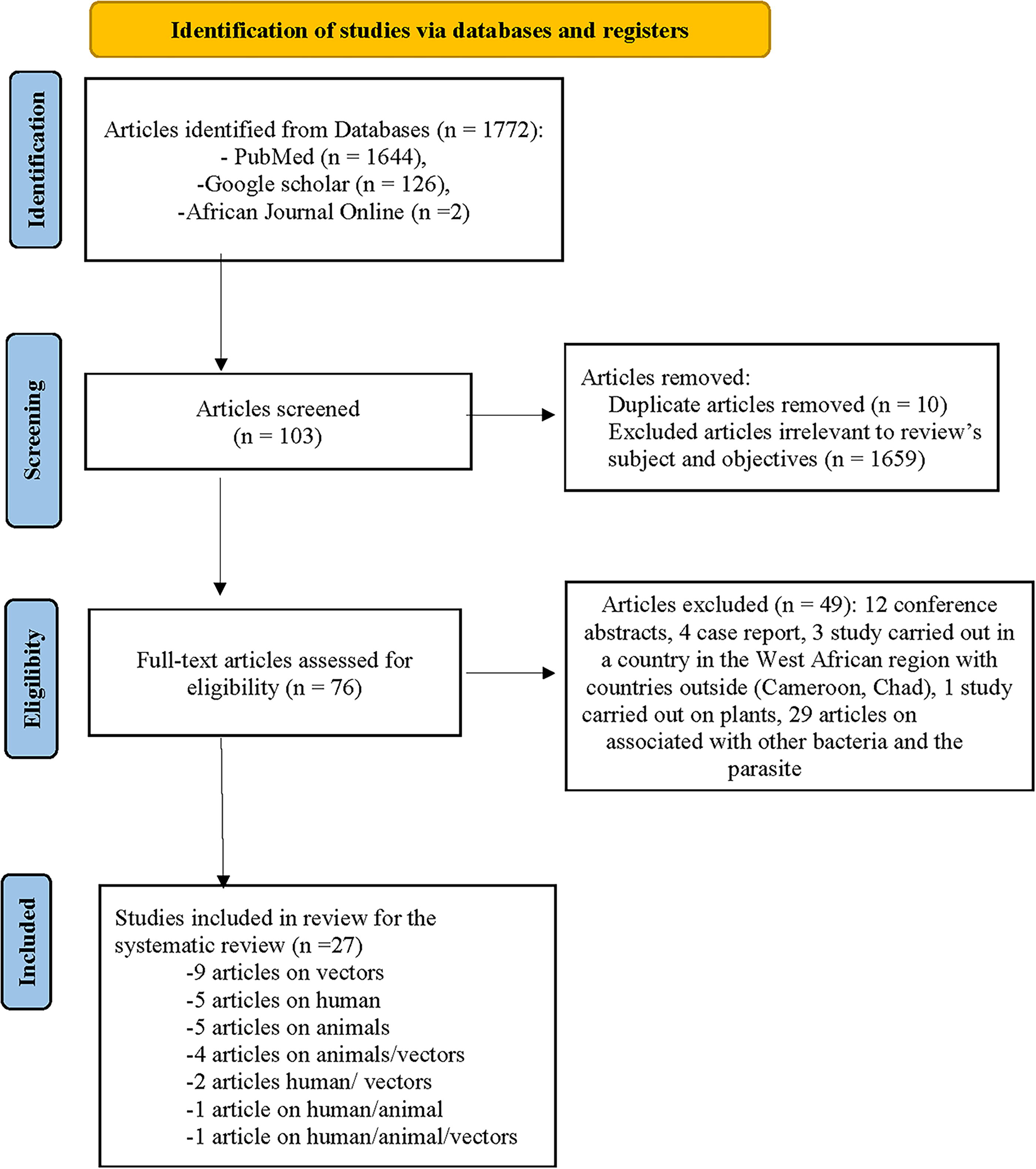
Steps of systematic reviews and meta-analysis (PRISMA) used in the present study.
Selection process
Authors of the articles were contacted as recommended based on predefined eligibility criteria such as for each eligible article identified during the initial screening stage title, abstract, and method screening. Reference lists of all potentially eligible articles and review papers were also looked up in different databases. Eligible studies were approved by M.M., N.G., E.B., A.S., and A.-S.O. Duplicate articles were removed, and they were reviewed by the author (M.M.), with potential eligibility determined by consensus with a second author (A.S.) when eligibility criteria were unclear. All journal articles were exported and duplicates were removed using the Zotero citation manager (https://www.zotero.org/, last accessed December 13, 2023). In this review, the term “study” refers to the document (article) containing an outcome measure of interest. The characteristics of the articles included in this review are shown in Supplementary Table S1.
Outcomes
The main objectives of this review were: To estimate the prevalence of Rickettsia spp., Borrelia spp., Coxiella spp., and Bartonella spp. in humans in West Africa from 2000 to 2023. To estimate the prevalence of Rickettsia spp., Borrelia spp., Coxiella spp., and Bartonella spp. in animals in this region and over the same period. To estimate the prevalence of Rickettsia spp., Borrelia spp., Coxiella spp., and Bartonella spp. in vectors (e.g., ticks, lice, or fleas) in West Africa. To estimate the combined prevalence of Rickettsia spp., Borrelia spp., Coxiella spp., and Bartonella spp.
Secondary objectives were related to the methods used for the detection and identification of these intracellular bacteria, with emphasis on molecular, serological, and phenotypic approaches, and their implications for regional epidemiology.
Data extraction and synthesis
Data was extracted by two people independently (M.M. and A.S.) using a predefined data collection from Microsoft Excel 2016 (Supplementary Data), and a third person (N.G.) to resolve conflicts. Data were extracted based on the author’s name, year of publication, countries, sample size, study population, and other available socio-demographic variables (for human studies), animal species (for animal studies), and prevalence for Rickettsia spp., Borrelia spp., Coxiella spp., and Bartonella spp. by assay type. Eligible studies were approved by M.M., N.G., E.B., A.S., and A.-S.O. Duplicate articles were removed and studies were reviewed by two authors (M.M. and A.S.), with potential eligibility determined by consensus with a third author (N.G.) when eligibility criteria were unclear.
Articles were compiled by country and organized by year, using separate tables for studies in humans, animals, and vector infection rates. The proportion of studies was stratified as follows (1) studies on acute Rickettsia, Borrelia, Coxiella, and Bartonella infections, assessing the prevalence of laboratory-confirmed Rickettsia, Borrelia, Coxiella, and Bartonella infections in people presenting with undistinguishable acute febrile illness (AFI); (2) studies assessing the prevalence of laboratory-confirmed Rickettsia, Borrelia, Coxiella, and Bartonella in animals; and (3) studies assessing the prevalence of laboratory-confirmed Rickettsia, Borrelia, Coxiella, and Bartonella in vectors. This classification was made because of the different study objectives and the likelihood of obtaining laboratory evidence of Rickettsia, Borrelia, Coxiella, and Bartonella infection in each of these populations. Finally, the geographical distribution of studies on prevalence was mapped according to the country in which each study was conducted.
Study quality assessment
To better understand the quality of the studies included in this systematic review, the risk of bias was assessed for each study using the Cochrane approach (Sterne et al., 2019). Although the original RoB 2.0 tool is designed for randomized controlled trials (RCTs), an adapted version was used to assess the cross-sectional studies included in this review. The evaluation criteria were adjusted to reflect the specificities of observational studies, based on the Risk Of Bias In Nonrandomized Studies of Interventions (ROBINS-I) guidelines (Sterne et al., 2016). The methodology used for this evaluation was the ROB assessment, a quality assessment scale for RCTs (adapted to cross-sectional studies). The evaluation was carried out by two authors (M.M. and A.S.) to guarantee reliability with the involvement of a third author (N.G.) when there was disagreement. Each prevalence measure for Rickettsia, Borrelia, Coxiella, and Bartonella was classified as having a low, high, or uncertain ROB in specific domains: domain 1 bias due to potential confounding factors, domain 2 bias in selection of participants, domain 3 bias in intervention classification, domain 4 bias due to deviations from planned interventions, domain 5 bias due to missing data, domain 6 bias in outcome measurement and domain 7 bias in selection of reported outcome (Supplementary Table S2). The details of the risk-of-bias analysis are shown in the Excel file in Supplementary Data.
Data analysis
Statistical analysis
We have used Excel version 2016 to present the tables. The meta-analysis was carried out with Microsoft Excel (version 2016), using built-in statistical formulas to calculate weighted prevalence estimates, intervals of confidence, and heterogeneity (I 2). Pooled prevalence (PP) heterogeneity was calculated using the chi-square test. p Values below 0.05 were considered statistically significant, and 95% confidence intervals (CIs) were calculated. Meta-regression was performed using Excel-based linear regression formulae to explore factors influencing the heterogeneity of results. Variables tested included year of publication, geographical region, host studied, and pathogen detection method. Risk-of-bias assessment: The risk of bias was assessed using an adapted assessment grid based on the ROBINS-I tool. Studies were classified according to their level of risk (low, moderate, or high).
Results
General characteristics of all studies included in systematic reviews
The selection process based on PRISMA guidelines is illustrated in Figure 1 (Page et al., 2021). The preliminary database search displayed 1772 results. Seventy-six articles were eligible for further review. After this analysis, 48 studies were excluded for the following reasons: 12 conference abstracts, 4 case reports, 3 studies conducted outside West Africa (Central and West Africa), 1 study carried out on plants, 29 articles on Rickettsia spp., Borrelia spp., Coxiella spp., and Bartonella spp. associated with other bacteria and the parasite. After deleting articles that did not meet the inclusion criteria, 27 articles were selected for data extraction and qualitative analysis. Out of these 27 articles, 10 were related to Rickettsia spp., 5 to Borrelia spp., 6 to Coxiella spp., 3 to Bartonella spp., and 3 to the combination of Rickettsia spp. and Coxiella spp. Ten articles were on vectors, 5 on animals, 5 on humans, and 7 studies were related to the One Health concept (Fig. 1).
Prevalence of Rickettsia spp., Borrelia spp., Coxiella spp., and Bartonella spp. in humans in West Africa from 2000 to 2023
The overall prevalence of Rickettsia spp. was the highest (19.46%) in humans in all studies included with a CI: [19.42–19.50] (Table 1).
Prevalence Combined of Rickettsia spp., Borrelia spp., Coxiella spp., and Bartonella spp. in Humans, Animals, and Vectors in West Africa
I 2 is index measuring heterogeneity.
Prevalence of Rickettsia spp., Borrelia spp., Coxiella spp., and Bartonella spp. in animals in West Africa from 2000 to 2023
Bartonella spp. had the highest overall prevalence (82.57%) in animals in all the studies included in this review with a CI: [82.46–82.69] (Table 1).
Prevalence of Rickettsia spp., Borrelia spp., Coxiella spp., and Bartonella spp. in vectors in West Africa from 2000 to 2023
Bartonella spp. had the highest overall prevalence (37.62%) among vectors in all the studies included in this review with a CI: [37.53–37.71] (Table 1).
Prevalence of Rickettsia spp., Borrelia spp., Coxiella spp., and Bartonella spp. according to the method of detection
Molecular biology was the most widely used method. PCR technique was used to detect Rickettsia spp., Borrelia spp., Coxiella spp., and Bartonella spp., with a prevalence of 60.38%. In this method, Rickettsiae spp. was the predominant species, with a prevalence of 11.32%. (Table 2).
Prevalence of Rickettsia spp., Borrelia spp., Coxiella spp., and Bartonella spp. According to the Method Detection
ELISA, enzyme-linked immunosorbent assay; IFI, indirect immunofluorescence; PCR, polymerase chain reaction.
The values in bold represent the total number and prevalence of pathogens identified by each diagnostic method. * 2 and 3.77 (%) = totat total number and prevalence of pathogens identified by culture method* 10 and 18.87 (%) = totat total number and prevalence of pathogens identified by ELISA method* 8 and 15.09 (%) = totat total number and prevalence of pathogens identified by IFI method* 1 and 1.89 (%) = totat total number and prevalence of pathogens identified by IMMUNOLOT method* 32 and 60.38 (%) = totat total number and prevalence of pathogens identified by PCR method.
Distribution of studies from 2000 to 2023 according to pathogen
Analysis of studies by publication period from 2000 to 2023 showed significant trends in research on intracellular bacteria (Rickettsia spp., Borrelia spp., Coxiella spp., and Bartonella spp.) in West Africa. We have divided this period into four subperiods: 2000–2005, 2006–2010, 2011–2015, and 2016–2023, depending on the pathogen.
The distribution of studies by period according to pathogen showed a frequency of 51.8% of studies conducted from 2016 to 2023 with the detection of the four zoonoses (Rickettsia spp., Borrelia spp., Coxiella spp., and Bartonella spp.). On the other hand, only one study was carried out from 2000 to 2005 detecting a single pathogen, Rickettsia spp. (Table 3).
Distribution of Studies from 2000 to 2023 According to Pathogen
Identification of factors influencing the prevalence of
Variations in prevalence over time showed that the average reported prevalence was on the rise over the last two periods (2011–2015, 2016–2023) giving 81.4%. Regarding the prevalence by host group (human, animal, vector), the highest prevalence was observed among vectors amounting to 33.3%. PCR showed a higher prevalence of 63% based on the methodological approaches (Table 4).
Identification of Factors Influencing the Prevalence of Rickettsia spp., Borrelia spp., Coxiella spp., and Bartonella spp.
PCR, polymerase chain reaction.
Analysis qualitative of risk of bias
A total of 27 articles were included in this review. The methodology used to assess the risk of bias was the ROB assessment scale for RCTs, adapted to cross-sectional studies. The qualitative analysis revealed that domains 3, 4, 5, and 7 exhibited a risk of bias ranging from low to 100% across all 27 studies included. In domain 1, 24 studies (88.89%) exhibited a moderate risk of bias, while only one study had a high risk of bias. Domain 6 bias in outcome measurement had a single study for which the information was considered unclear (Table 5). A summary of the risk of bias for each study could be found in Supplementary Data.
Qualitative Analysis of Risk of Bias
Distribution of studies on intracellular bacterial pathogens across West African countries
Twenty-seven studies were analyzed as part of this review. These studies were conducted in 10 West African countries: Senegal, Nigeria, Mauritania, Burkina Faso, Ivory Coast, Benin, Ghana, Mali, Guinea, and The Gambia. Among them, Senegal and Nigeria recorded the highest number of studies, with 10 studies for Senegal and 7 for Nigeria. Regarding the distribution of the studied bacteria, Rickettsia spp. and Coxiella burnetii were the most frequently detected, reflecting their widespread circulation in the region (Table 6 and Fig.2).
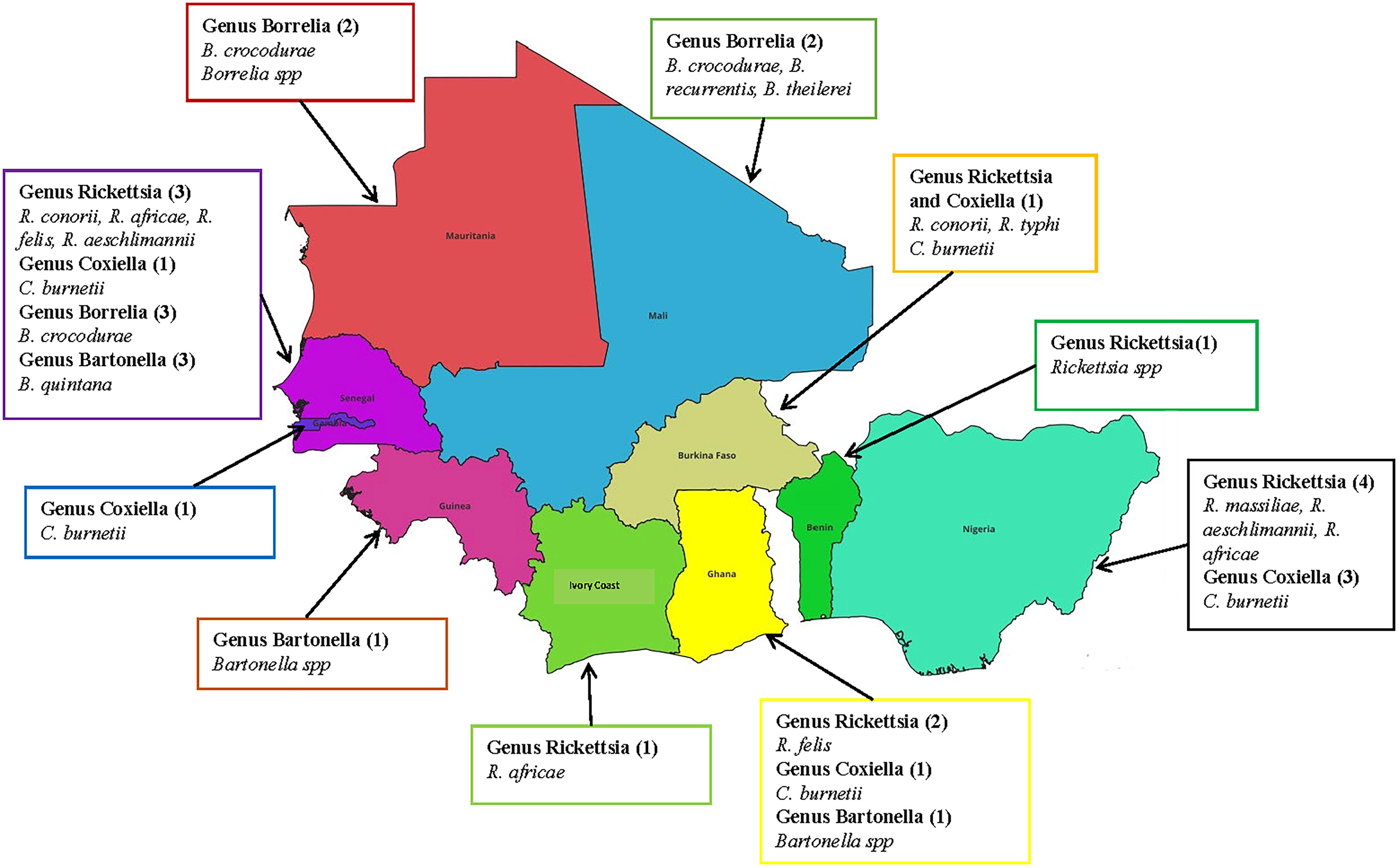
Distribution of Rickettsia, Borrelia, Bartonella, and Coxiella spp. in West Africa. Each country is highlighted according to the absolute number of studies investigated. These four bacterial zoonoses in that country. The number of studies also includes all studies that included at least one of these pathogens Rickettsia, Borrelia, Bartonella, and Coxiella spp.
Distribution of Rickettsia spp., Borrelia spp., Coxiella spp., and Bartonella spp. Across West African Countries
Discussion/Research Findings
Prevalence of Rickettsia spp., Borrelia spp., Coxiella spp., and Bartonella spp. in humans, animals, and vectors in West Africa from 2000 to 2023
Twenty-seven studies were included in this review, 10 of which were on Rickettsiae. Rickettsioses are globally widespread and significantly contribute to febrile illnesses in sub-Saharan Africa, where they are endemic in certain regions (Civen and Ngo, 2008). The main Rickettsia species in West Africa were R. conorii, R. africae, R. aeschlimannii, R. sibirica, R. massiliae, R. felis, R. typhi (Parola, 2006). African tick-bite fever, caused by R. africae, is transmitted by Amblyomma hebraeum and Amblyomma variegatum in sub-Saharan Africa. R. africae has been identified in ticks of the genera Amblyomma, Rhipicephalus, and Hyalomma in Benin (Adjou Moumouni et al., 2016), Senegal (Mediannikov et al., 2010a), Ivory Coast (Diobo et al., 2021). Consequently, it is a frequent cause of illness in travelers from sub-Saharan Africa (Delord et al., 2014). Rickettsia felis has been independently reported to be associated with 4–5% of febrile illnesses in Senegal (Mediannikov et al., 2010a). In Ghana, its prevalence was 1.5% among febrile children in a study on Rickettsia felis infections in febrile children (Billeter et al., 2012). Mediterranean spotted fever caused by R. conorii is transmitted by Rhipicephalus sanguineus. In Burkina Faso, Ki-Zerbo et al. reported the incidence of R. conorii to be between 4% and 36% in their study of the seroprevalence of rickettsial diseases in febrile patients at Bobo-Dioulasso Hospital (Ki-Zerbo et al., 2000). In Nigeria, the prevalence of R. conorii was 71% among zoonotic pathogens in peridomestic rodents and their ectoparasites (Kamani et al., 2018). Murine typhus, caused by R. typhi, is also known as endemic typhus in much of the world, particularly in tropical and subtropical coastal regions where Rattus spp. serves as the main reservoir (Azad et al., 1997). In the study of Ki-Zerbo et al. on the seroprevalence of rickettsial diseases in febrile patients in Burkina Faso, the prevalence of R. typhi ranged from 1% to 4.5% (Ki-Zerbo et al., 2000). Rickettsia massiliae has been reported in a number of sub-Saharan African countries. Elelu et al. in Nigeria also reported a prevalence of 40% of R. massiliae in ticks (Elelu et al., 2022). Rickettsia aeschlimannii has been associated with six tick species in West Africa. These are Am. variegatum, H. impeltatum, H. m. rufipes, H. truncatum, Rh. evertsi evertsi and Rh. Annulatus from Nigeria (Kamani et al., 2015).
Five articles were related to Borrelia spp. in this study. Borrelia spp. is responsible for relapsing fever, a major public health problem in Africa. Tick-borne relapsing fever caused by Borrelia crocidurae is frequently reported in West Africa, where it is responsible for 36% of meningoencephalitis cases (Biggs et al., 2016; Brouqui, 2011; Parola et al., 2016). Cases of human infection with B. crocidurae were reported in rural Senegal. Some studies showed prevalences ranging from 7% to 73% in Senegal (Ndiaye et al., 2021; Vial et al., 2006a). This infection is also a major cause of fever in rural clinics where the Sahelian climate is conducive to the distribution of Ornithodoros tick vectors. Borrelia crocidurae transmitted by Ornithodoros ticks was responsible for around 19% of fever seen in rural clinics in Senegal (Vial et al., 2006b). Meanwhile, in the study by Vial et al., the presence of B. crocidurae was confirmed in rodents with prevalences of 31% in Mali, Senegal, and Mauritania (Vial et al., 2006b). A case of 0.5% B. theileri was detected in ticks from a cattle market in Mali (McCoy et al., 2014). These studies showed the diversity of Rickettsia species circulating in West Africa. This underscores the importance of increased efforts in detection and epidemiological surveillance to better understand the transmission dynamics of these pathogens and their impact on public health.
With regard to bartonellosis, its prevalence was reported in four articles. Bartonella spp. has a worldwide distribution, given the variety of vertebrate hosts (canids, felids, and rodents) and vectors (mainly fleas and ticks), they can infect. In the study conducted by Boutellis et al. in Senegal, the prevalence of Bartonella spp. was 6.9% in head lice (Boutellis et al., 2012). Other studies on bartonellosis showed that the prevalence of B. quintana ranges from 61% to 87% in Senegal (Demoncheaux et al., 2022; Hammoud et al., 2023). Billeter et al. detected Bartonella spp. in bat flies in Ghana and Guinea (Billeter et al., 2012). Given the diversity of vectors (fleas, ticks, lice) involved in Bartonella, these results highlight the importance of increased surveillance to highlight the potential impact of these bacteria on public health in West Africa.
Regarding Q fever, six articles on Coxiella burnetii were included in our review. These studies showed that the epidemiology of Q fever was complex, and infection by species closely related to Coxiella could add to this complexity. In West Africa, Q fever is widespread, as repeatedly demonstrated by serological studies and studies on humans and reservoirs (domestic animals) (Biggs et al., 2016). In studies on Q fever in Senegal, the prevalence of C. burnetii ranged from 14% to 37.6% (Mediannikov et al., 2010b). A study on the Coxiella burnetii (Q fever, 2025) prevalence in associated populations of humans and small ruminants in The Gambia was 9.7% in humans and 25% in animals (Bok et al., 2017). Klaasen et al. also reported a C. burnetii seroprevalence of 21% in small ruminants in Gambia (Klaasen et al., 2014). In the study conducted by Ki-Zerbo et al. in Burkina Faso, the incidence of C. burnetii was 4.3% in hospitalized patients with AFI (Ki-Zerbo et al., 2000). A study of animal exposure to C. burnetii in Ghana showed a C. burnetii seroprevalence of 22.29% (Folitse et al., 2020). Other surveys on animal seroprevalence showed C. burnetii levels in cattle ranging from 2% to 23% in Nigeria (Elelu et al., 2020) revealing regional disparities and the need to strengthen integrated One Health surveillance to better understand transmission dynamics and improve prevention and control of Q fever.
Out of the 27 studies included in our review, 23 involved studies on vectors (arthropods) followed by 11 studies on humans. R. africae was identified in ticks of the genera Amblyomma, Rhipicephalus, and Hyalomma in Benin (Adjou Moumouni et al., 2016) and Senegal (Sambou et al., 2014). R. aeschlimannii was associated with six tick species in West Africa. These are Am. variegatum, H. impeltatum, H. m. rufipes, H. truncatum, Rh. evertsi evertsi and Rh. annulatus from Senegal, Nigeria, and Mali (Elelu et al., 2022; McCoy et al., 2014; Mediannikov et al., 2015; Parola and Raoult, 2001a; Sambou et al., 2014) R. sibirica mongolitimonae is an important H. truncatum tick-borne disease in sub-African countries (Parola et al., 2013b). Other Borrelia species were also reported in West Africa. Among them, Borrelia theileri, the agent of bovine borreliosis, was identified in 0.5% of Rh. geigyi ticks in Mali (McCoy et al., 2014). It appeared that these two Candidatus formed a new group of Borrelia that was phylogenetically distant from both the relapsing fever group and the Lyme disease group (McCoy et al., 2014).
Prevalence of Rickettsia spp., Borrelia spp., Coxiella spp., and Bartonella spp. according to the method of pathogen detection
PCR was the diagnostic method widely used in studies for detection of these four (04)bacterial zoonoses (Addo et al., 2023; Adjou Moumouni et al., 2016; Civen and Ngo, 2008; Elelu et al., 2022; Ndiaye et al., 2021; Nimzing et al., 2008; Nnabuife et al., 2023; Parola, 2006; Sambou et al., 2014; Schwan et al., 2012; Sothmann et al., 2017; Vial et al., 2006b). PCR and sequencing techniques are useful, sensitive, and rapid tools for detecting and identifying Rickettsia spp., Borrelia spp., Coxiella spp., and Bartonella spp. in blood and skin biopsies or inoculation eschar (Paris and Dumler, 2016; Springer et al., 2020). For pathogen identification in arthropod vectors, real-time PCR is commonly used (Springer et al., 2020). Arthropods can also be tested by molecular biology techniques for epidemiological purposes (Lv et al., 2014). Indeed, molecular methods have proved to be useful tools in the study of the spread of arthropod-borne diseases.
While minimal DNA amounts can be detected through PCR techniques, the low concentrations of Rickettsia spp., Borrelia spp., Coxiella spp., and Bartonella spp. in blood limit the clinical sensitivity of PCR when performed on whole blood or serum. Direct PCR diagnosis from blood is of limited relevance for patients with low bacteremia rates, while analysis of tissue samples (e.g., biopsies) requires invasive procedures that physicians often seek to avoid (Fournier et al., 2009).
Other techniques such as immunofluorescence assay (IFA) (Ki-Zerbo et al., 2000; Mediannikov et al., 2010a, 2010b) and ELISA were also used (Adamu et al., 2021; Bok et al., 2017; Elelu et al., 2020; Folitse et al., 2020; Klaasen et al., 2014; Nimzing et al., 2008). IFA and ELISA tests were commonly used for serological diagnosis of infections caused by Rickettsia spp., Borrelia spp., Coxiella spp., Bartonella spp. These methods are mainly used as screening methods (e.g., in epidemic situations). Indeed, ELISA has the advantage over IFA of eliminating subjective assessment, since the absorbance of the enzymatic reaction is measured using a spectrophotometer, and appears to be more sensitive than IFA in the early phase of the disease (Dangel et al., 2020; Hunfeld et al., 2002). The main limitation of serological tests is the cross-reactivity that could be present between antigens of pathogens in the same genus and also in different genera (La Scola and Raoult, 1996; Wormser et al., 2005). Moreover, IFA result interpretation can vary by operator, making this method less reproducible across laboratories compared with ELISA (OIE, 2018).
Distribution of studies from 2000 to 2023 according to pathogen
Between 2000 and 2005, research was limited (one study), with a focus on vector-borne infections caused by Rickettsia spp. Serological techniques were mainly used for pathogen detection. Since 2010, the number of studies significantly increased (eight studies from 2011 to 2015), corresponding with the adoption of molecular tools like PCR for detecting several pathogens, including Rickettsia spp., Borrelia spp., Coxiella spp., and Bartonella spp. The 2016–2023 period (14 studies at 51.8%) demonstrates a diversification of pathogens detection techniques, including genomic and multipathogen approaches, highlighting shifts in research priorities and capacities. Evolving methodologies and topics illustrate the influence of scientific advancements and regional health requirements. However, some periods and pathogens are still under-represented, revealing gaps in surveillance and epidemiological research in West African countries.
Identification of factors influencing the prevalence of Rickettsia spp., Borrelia spp., Coxiella spp., and Bartonella spp
The prevalence reported in the first period (2000–2010) was 33.8%. The average reported prevalence has increased over the last two periods (2011–2015, 2016–2023) to 81.4%. The increase in reported prevalence over time may reflect improvement in diagnostic tools and better recognition of pathogens. The emergence of multiplex PCR and affordable genomic techniques presents opportunities to address these gaps. PCR and sequencing methods are useful, sensitive, and rapid tools for detecting and identifying Rickettsia spp., Borrelia spp., Coxiella spp., and Bartonella spp. in blood and skin biopsies or inoculation eschar (Paris and Dumler, 2016; Springer et al., 2020a). For pathogen identification in arthropod vectors, real-time PCR is commonly used (Springer et al., 2020). Arthropods can also be tested by molecular biology techniques as epidemiological tools (Lv et al., 2014).
Concerning prevalence by host group (humans, animals, and vectors), the highest prevalence (33.3%) was observed in vectors. The differences among hosts highlight the crucial role of vectors in the transmission and epidemiology of Rickettsia spp., Borrelia spp., Coxiella spp., and Bartonella spp. in Western Africa. These arthropods are widespread, with a higher prevalence in tropical and subtropical regions, especially where sanitation is poor (Mediannikov and Fenollar, 2014). Bacterial diseases transmitted by cosmopolitan arthropods are currently recognized as zoonoses and bacteria are maintained in natural cycles involving ticks, lice, fleas, and mites (Fang et al., 2017; Parola et al., 2013).
Higher prevalence rates (63%) in the overall study population were found through the PCR method, likely due to its greater sensitivity, whereas serological methods varied based on the agents studied. Recent years have seen the development of more specific and sensitive molecular methods, such as PCR and sequencing, to address the limitations of serological techniques. These methods allow for accurate detection and identification of pathogens in blood, skin biopsies, and inoculation eschars. They can detect DNA in the early stages of infection, and the integration of immunological and molecular techniques has recently improved our ability to assess the burden of these arthropod-borne bacterial diseases (Paris and Dumler, 2016; Springer et al., 2020).
Arthropod-borne bacteria from the genera Rickettsia, Borrelia, Bartonella, and Coxiella are obligate intracellular pathogens with unique biology that is still not well understood at the molecular and genetic levels. To address numerous neglected and emerging human pathogens globally, it is vital to deepen our understanding of their biology and virulence strategies. Since their discovery over a century ago, these bacteria have been challenging to study due to their obligate intracellular nature. A significant hurdle in understanding their complex biology has been the limited availability of molecular tools. However, recent advancements in targeted inactivation and transposon mutagenesis are helping to overcome this issue. Additionally, vaccine development may help in preventing and mitigating these pathogens. (Supplementary Table S3).
Study quality assessment/risk of bias
The assessment of the risk of bias in the 77 (27) studies included in this review provided insights into their methodological quality. All the studies were low risk, with a proportion of 100% for domains 3, 4, 5, and 7. For domain 1, 88.9% of studies revealed a moderate risk. Generally, the findings showed a low occurrence of significant bias in most areas, enhancing the reliability of the conclusions regarding the epidemiology of Rickettsia spp., Borrelia spp., Coxiella spp., and Bartonella spp. Nonetheless, it is essential to discuss specific aspects and contextualize these observations. This homogeneity suggests methodological rigor in data collection and analysis. This is particularly relevant in cross-sectional studies of zoonotic pathogens, where established methodologies like exposure classification and data collection seem to be correctly implemented. This could be attributed to difficulties inherent in cross-sectional observational studies, including a lack of statistical adjustment or insufficient control for confounding variables (e.g., environmental or socioeconomic differences that may influence infection prevalence). Although the risk is considered moderate, it should be noted that this type of bias is often unavoidable in observational studies and could impact estimates of association or prevalence. The lack of significant bias in key areas, such as outcome measurement and selection, is reassuring, suggesting that the identified biases are unlikely to impact the overall validity of our findings. However, the moderate biases observed in the control of confounding factors underline the need to interpret the results with caution, taking into account the methodological limitations of the studies, which are included in this review.
Conclusion
Bacterial zoonoses spread by arthropods remain under-notified in low-resource countries due to limited access to diagnostic tools. For a long time, most diagnostic tools have enabled the detection of a limited number of infectious agents at a time due to methodological limitations. This systematic review described situations in which these zoonotic bacteria (Rickettsia, Borrelia, Bartonella, and Coxiella) were detected, the tools used for their diagnosis, and the performance of the techniques. Our findings highlighted the effective circulation of all four intracellular bacteria in humans, animals, and vectors (arthropods). Given the complex interdependence between humans, animals, and the environment, it is crucial to implement One Health components in resource-limited African countries to combat and reduce the growing threats of bacterial zoonotic infectious diseases. The “One Health” approach aims to enhance the collaborative and cooperative efforts of clinicians, veterinarians, environmentalists, and agricultural and public health officials to develop effective holistic and integrated surveillance techniques, accompanied by appropriate diagnostic and therapeutic interventions.
Limitations of molecular tools include the low clinical sensitivity of PCR when used on whole blood or serum for patients with a very low rate of bacteremia, whereas the use of tissue samples (e.g., biopsies) requires invasive medical procedures, which is often avoided by physicians. The main limitations associated with the use of serological tests are the cross-reactivity that may be present between antigens of pathogens of the same genus and different genera, and the divergent interpretation of results according to the operators.
The advent of multiplex PCR, particularly genomic techniques at an affordable cost, offers opportunities to fill these gaps. Moreover, pathogen identification with molecular techniques is mainly at a species- or genus-specific level, which limits the detection of other unexpected or novel infectious agents. As a result, the epidemiological understanding of pathogens continues to evolve, influencing medical understanding and modes of transmission in animals and humans.
The lack of disease surveillance studies and control programs at the national level in most countries results in a knowledge gap. This makes it difficult to estimate the burden of disease in a representative way, and to study pathogen transmission dynamics in depth. Thus, more epidemiological studies at the national level should be undertaken to fill this knowledge gap. The epidemiology of zoonotic diseases on the African continent is dynamic. The prevalence of zoonotic diseases presented in this review should be interpreted cautiously and not extrapolated to the general population due to the focus of many studies on specific geographical and occupational contexts.
Despite moderate biases in some areas, the methodological quality of the studies included in this review is generally acceptable, allowing for reliable conclusions to be drawn about the epidemiology of the pathogens studied. These results emphasize the strengths of existing methodologies while also identifying improvements in future research. Methodological differences among studies could limit the comparative analysis of the results.
Footnotes
Acknowledgments
Authors would like to officially express there gratitude to the African Centre of Excellence in Biotechnology Innovations for the Elimination of Vector-Borne Diseases (CEA/ITECH-MTV), based at Nazi Boni University (Burkina Faso).
Authors’ Contributions
Conceptualization: M.M. and A.-S.O. Data analysis: M.M., A.S., and Y.S.S. Methodology: M.M., N.G., E.B., A.S., N.F., and A.-S.O. Visualization: M.M., G.N., E.B., S.A., and A.-S.O. Writing—original draft: M.M., G.N., E.B., and A.-S.O. Writing—review and editing: M.M., A.S., G.N., E.B., N.F., A.D., and A.-S.O.
Author Disclosure Statement
The authors have no conflicts of interest to declare for this study.
Funding Information
No funding was received for this article.
Supplementary Material
Supplementary Data
Supplementary Table S1
Supplementary Table S2
Supplementary Table S3
References
Supplementary Material
Please find the following supplemental material available below.
For Open Access articles published under a Creative Commons License, all supplemental material carries the same license as the article it is associated with.
For non-Open Access articles published, all supplemental material carries a non-exclusive license, and permission requests for re-use of supplemental material or any part of supplemental material shall be sent directly to the copyright owner as specified in the copyright notice associated with the article.
