







Abstract
Borrelia miyamotoi is a relapsing fever spirochete, first identified in Japan and later detected in various Ixodes species across the northern hemisphere. The pathogen was linked to human infections in North America, Europe, Asia, and Russia, causing symptoms ranging from flu-like illness to severe neurological damage. This study aimed to assess the presence of B. miyamotoi in Ixodes ricinus ticks collected from wildlife, dogs, and humans in Lombardy, Northern Italy, between 2020 and 2023. A total of 3,886 ticks were sampled, with a 1% positivity rate. The spirochete was detected in all life stages of ticks, with sequences 100% identical to European strains. The pathogen was found mostly in northern mountain regions. Although no human cases have been reported in Italy, these areas pose a potential risk due to high tourist activity.
Keywords
Introduction
Borrelia miyamotoi is a relapsing fever spirochete transmitted by hard ticks of the genus Ixodes, the same vector that transmits Lyme disease group spirochetes and other tick-borne pathogens of medical and veterinary importance. B. miyamotoi was first identified in Ixodes persulcatus ticks in Japan (Fukunaga et al., 1995) and, in recent years, has been detected in several Ixodes species across the temperate zone of the northern hemisphere, revealing a broad geographic distribution.
Transovarial transmission is a characteristic of B. miyamotoi, which can also be transmitted transtadially and acquired horizontally from a vertebrate reservoir host.
B. miyamotoi has been linked to human infections in North America, Europe, Asia, and Russia. It is the causative agent of hard tick relapsing fever, also known as Borrelia miyamotoi disease. B. miyamotoi does not cause a typical relapsing fever; symptoms range from mild flu-like illness to severe neurological damage, including meningoencephalitis, particularly in immunocompromised patients (Hoornstra et al., 2022).
B. miyamotoi consists of three main human-pathogenic genotypes: the European, American, and Asian/Siberian types, and a recent study also identified a fourth clade in Japan (Crowder et al., 2014; Cutler et al., 2019; Iwabu-Itoh et al., 2017). Each genotype is primarily transmitted by specific Ixodes tick species: I. ricinus (European), I. scapularis and I. pacificus (American), and I. persulcatus (Asian/Siberian). These genotypes often coexist geographically, such as the Asian and European types both occurring in Russia (Platonov et al., 2011). Initially thought to be nonpathogenic, all strains are now recognized to cause human disease. The genetic differences among B. miyamotoi isolates are likely linked to variations in pathogenicity, vector competence, and host range rather than to their geographic origins (Krause et al., 2015).
In Italy, the presence of B. miyamotoi was first described in 2018 in I. ricinus nymphs collected via blanket dragging in the mountainous regions of the north of the country (Ravagnan et al., 2018). However, no confirmed autochthonous cases of human infections were reported across the entire country, although it may be underdiagnosed.
Following a suspected clinical case, in which we were specifically asked to test the tick that had bitten the patient for B. miyamotoi, and given the widespread presence of the tick vector Ixodes ricinus in Northern Italy, a study was conducted to assess the potential exposure to B. miyamotoi in the Lombardy region, an area endemic for tick-borne pathogens. The study investigated the presence of the spirochete in I. ricinus ticks collected from various hosts (wildlife, dogs, and humans) between 2020 and 2023, using ticks as sentinels to detect the presence of the pathogen.
Materials and Methods
Between 2021 and 2023, ticks were collected from wildlife animals, either found dead or hunted as part of the population control plan of the regional wildlife surveillance program, as well as from domestic animals during diagnostic activity conducted by the Experimental Zooprophylactic Institute of Lombardy and Emilia Romagna (IZSLER). Ticks were also collected from citizens and from individuals with tick bites who sought medical attention at the hospitals or their general doctor in the Lombardy Region, following the patient’s informed consent, as a part of collaboration with the local health institutions in a One Health approach. The procedure for safely removing ticks from humans was performed in accordance with the ethical standards of the hospitals of the Lombardy region.
Ticks were identified at the species level under a stereomicroscope according to their morphological characteristics using specific keys (Manilla, 1998). All ticks belonging to the species I. ricinus were tested for B. miyamotoi by targeting the glpQ gene with real-time PCR (Vayssier-Taussat et al., 2013). Each run included a negative extraction control, as well as negative and positive amplification control. Prior to implementation, we validated the method for specificity and reproducibility, including tests with DNA of different pathogens and with B. miyamotoi-positive samples. These had been amplified by an end-point PCR and subsequently sequenced. The amplification cycle followed the standard real-time PCR protocol with annealing and extension at 60°C. Samples were tested without replicates.
Samples that tested positive were submitted to conventional PCR amplification (Hovius et al., 2013), and positive amplicons were purified and sequenced. The obtained sequences were manually verified using BioEdit software (v. 7.2.5) and compared with those available in the NCBI GenBank database using the BLAST tool (http://blast.ncbi.nlm.nih.gov/). A maximum likelihood phylogeny was inferred using PhyML with 100 bootstrap pseudo-replicates.
Results and Discussion
A total of 3,886 I. ricinus ticks were collected from 2,019 hosts, including wild and domestic animals and humans (detailed in Table 1), originating from 243 municipalities. The majority were nymphs (53.5%), followed by adult females (33%), adult males (10.4%), and larvae (3.2%). Our findings showed a 1% positivity rate (39 positive ticks out of 3,886), consistent with the low prevalence (0.74%) detected in questing ticks in Northern Italy and similar to other endemic areas in Europe (Cleveland et al., 2023; Kubiak et al., 2021). However, the variety of methods used for tick collection and sample analysis makes reliable comparisons challenging.
Borrelia miyamotoi Infection Rate in Ixodes ricinus Ticks Collected from Various Wild and Domestic Hosts, as Well as Humans, in Relation to Vertebrate Hosts and the Tick Life Stage
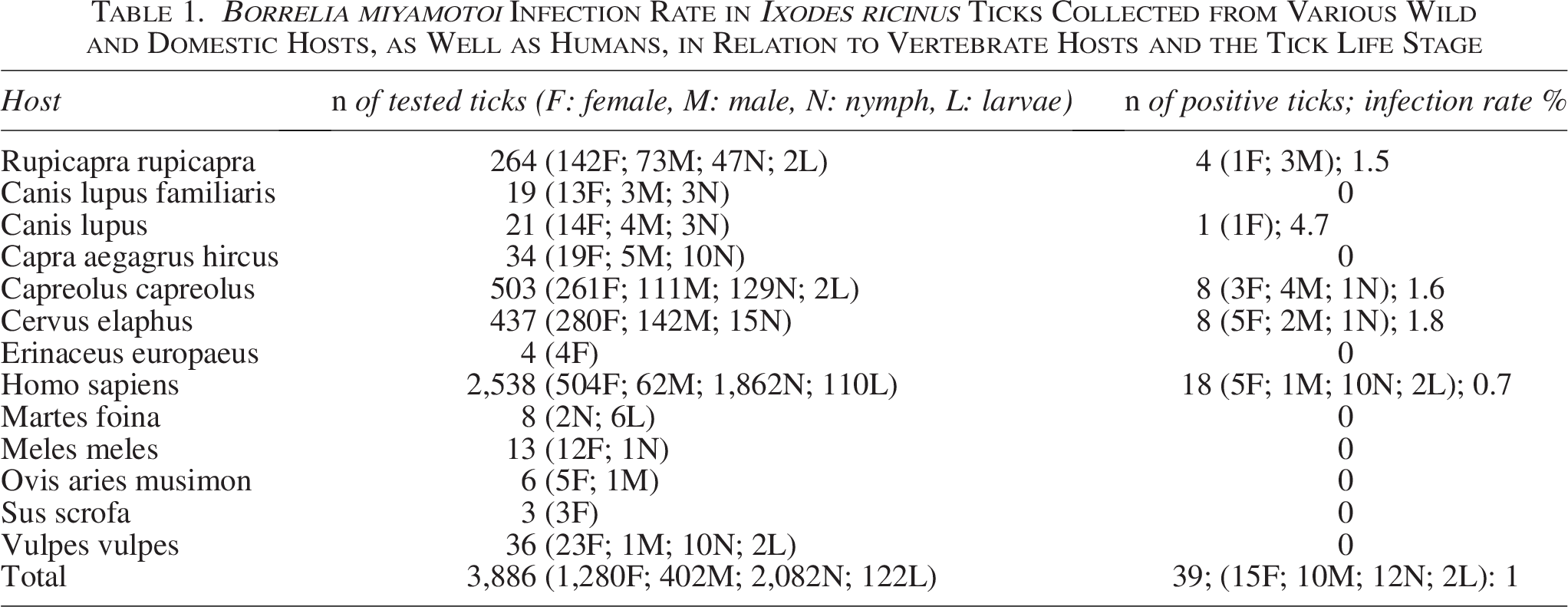
The spirochete was detected in all life stages (15 adult females, 12 nymphs, 10 adult males, and 2 larvae). The overall prevalence was 1.6% in larvae, 0.5% in nymphs, and 1.5% in adults. Additional information is listed in Table 1. All active developmental stages of I. ricinus can be infected and transmit B. miyamotoi throughout their entire life cycle. However, in our study, the infection rate in nymphs, the stage most commonly parasitizing humans in Europe, was slightly lower compared to other developmental stages. Positive ticks were found on humans (n = 18), deer (n = 8), roe deer (n = 8), chamois (n = 4), and a wolf (n = 1).
In this study, none of the ticks removed from dogs tested positive, in contrast to a recent study conducted in Poland, where a prevalence of 1.9% was found in female I. ricinus ticks from dogs (Liberska et al., 2023). This could be explained by differences in ecological conditions, tick population dynamics, or the small sample size used in our study from dogs.
The sequences obtained were 100% identical (GenBank accession numbers: OP006111- OP006116). BLAST comparison with NCBI GenBank databases resulted in 100% identity with several sequences of B. miyamotoi from Europe. As expected, the phylogenetic analysis showed that the novel sequences were nested within the fully supported European group (95% bootstrap) (Supplementary Fig. S1).
B. miyamotoi was detected in a limited number of municipalities (24/243), most of which (22/24) are concentrated in the northern mountain part of the region, in three neighboring provinces (Bergamo, Lecco, and Sondrio). These localities share similar ecological conditions, including a cold alpine climate and diverse habitats ranging from broadleaf and coniferous forests to alpine meadows. These ecosystems support various animal species, including reservoir hosts such as the bank vole (Myodes glareolus) and yellow-necked mouse (Apodemus flavicollis), which play a key role in the persistence of B. miyamotoi in the environment, as well as the tick vector I. ricinus.
Although cases of B. miyamotoi in humans have not yet been reported in Italy, alpine areas could pose a likely risk for the transmission of B. miyamotoi to humans. This is particularly concerning, as these regions attract tourists for hiking and trekking, especially during the warmer months, thereby increasing the likelihood of exposure to tick bites.
Our finding of infected I. ricinus larvae confirms transovarial transmission from infected females to their offspring, a strategy typical of relapsing fever spirochetes such as B. miyamotoi, posing a potential risk of infections to hosts from the early stage of the tick’s life cycle.
Authors’ Contributions
E.O.: Writing—original draft, conceptualization, data curation, investigation, visualization, writing—review and editing. S.R.: Investigation, methodology, validation, writing—review and editing. N.V.: Conceptualization, methodology, validation, writing—review and editing. A.G.: Investigation, writing—review and editing. I.K.: Investigation, writing—review and editing. I.B.: Conceptualization, writing—review and editing. A.B.: Conceptualization, writing—review and editing. C.M.L.: Investigation. G.P.: Investigation. G.M.: Funding acquisition, supervision, writing—review and editing. P.P.: Conceptualization, supervision, writing—review and editing.
Footnotes
Author Disclosure Statement
No conflicting financial interests exist.
Funding Information
This study was partially supported by the Italian Ministry of Health, Directorate—General for animal health and veterinary medicinal products (DGSAF), grant number 2022/011.