Abstract
Introduction:
Vaginal pull-through is the technique of choice for management of severely virilized patients with disorders of sexual development and a high insertion urogenital sinus. Typical techniques involve either mobilization of the entire urogenital complex, or more recently, the anterior sagittal transrectal technique. 1,2 Proximal surgical exposure and sufficient vaginal mobilization are two of the limiting factors required to achieve separation of the vagina from the urethra with tension-free anastomosis to the perineum. We describe a new robot-assisted, laparoscopic procedure that provides an unparalleled degree of exposure to the urogenital confluence as well as access to proximal vaginal attachments.
Methods:
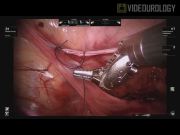
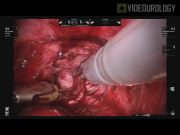
Transperitoneal, laparoscopic pull-through vaginoplasty was performed using the da Vinci Si™ robot with children positioned in low lithotomy. Vaginal mobilization and division of the urogenital sinus were accomplished with initial retrovesical dissection, followed by posterior mobilization from the rectovaginal pouch. Perineal dissection was then performed at the future site of the introitus, to reach the mobilized vagina. After repair of the urethrotomy and vaginal pull-through, feminizing genitoplasty or revision genitoplasty were performed.
Results:
Two children, aged 4 and 6 years have undergone robot-assisted laparoscopic pull-through vaginoplasty. One patient had undergone a previous failed attempt at urogenital mobilization. There was minimal blood loss and patients were discharged from hospital at 2 and 3 days, respectively. In both cases, tension-free anastomosis of the vagina to the perineum was achieved without total urogenital mobilization. At 11 months of follow-up, there have been no reported complications and both girls are continent.
Conclusion:
Robot-assisted pull-through vaginoplasty provides excellent access and exposure of the high insertion urogenital sinus. This technique allows for direct vision of paravaginal neurovascular structures, exact urogenital separation and repair, and tension-free mobilization of the vagina to the perineum. This technique also avoids the pitfalls of other techniques, including injury of the urethral or anal sphincters, while preserving native tissues and cosmesis compared with bowel vaginoplasty. Multisurgeon experience and long-term outcomes are needed to go forward.
Janelle A. Fox: “I am a military service member (or employee of the U.S. Government). This work was prepared as part of my official duties. Title 17, USC, §105 provides that ‘Copyright protection under this title is not available for any work of the U.S. Government.’ Title 17, USC, §101 defines a U.S. Government work as a work prepared by a military service member or employee of the U.S. Government as part of that person's official duties.”
Disclaimer: The views expressed in this article are those of the author and do not necessarily reflect the official policy or position of the Department of the Navy, Department of Defense, or the United States government.
No competing financial interests exist for Francis X. Schneck or Glenn M. Cannon, Jr.
Copyright clearance for reproduction of high confluence urogenital sinus illustration provided by Elsevier; May 31, 2013. Reproduced from: Rink RC, Metcalfe PD, Cain MP, Meldrum KK, Kaefer MA, Casale AJ. Use of the mobilized sinus with total urogenital mobilization. J Urol, 2006; 176: 2205–2211.
Running time: 6 mins 58 secs