




Abstract
It has been recently reported that CD8+ T cells from healthy human peripheral blood express the tolerogenic HLA-G molecule originally described in trophoblasts. The majority of these CD8+HLA-G+ cells exhibit a naïve phenotype and are FoxP3 negative, and they have been classified as a novel subset of regulatory T cells based on their potent suppressive function. We have investigated if this new cell population is expanded during HIV-1 infection. The results presented here show an increase in the percentage of CD8+HLA-G+ cells within the total CD8 T-cell population in HIV-1+ patients. As in healthy controls, these CD8+HLA-G+ are mostly naïve T cells. However, we have also observed that only in HIV-1-infected patients are there effector and effector memory cells that express HLA-G.
Introduction
Materials and Methods
In HIV-1 infection, a vigorous CD8+ T-cell response has been associated with better control of the disease in certain circumstances (6,10,11). Also, a loss of HLA-A and HLA-B molecules, and an increase in HLA-G (12) have been observed in HIV-1-infected patients. This HLA-G overexpression has been described in monocytes and also in lymphocytes (7), and it has been associated with poor outcome in HIV-1-infected patients (11). With these observations in mind, we have recently been studying the distribution of the HLA-G molecule on different CD8+ T-cell subsets in HIV-1-seropositive individuals with undetectable viral load, nine of whom were receiving highly active antiretroviral therapy (HAART), while nine had a CD4+ lymphocyte level higher than 500 cells/μL, and were asymptomatic and antiretroviral naïve.
Eighteen HIV-1-seropositive individuals with undetectable viral load were analyzed, nine of whom had been receiving HAART for at least 2 y, with HIV-RNA levels lower than 50 copies/mL in at least three determinations in the course of 6 mo, with more than 500 cells/μL CD4+ lymphocytes during the previous 12 months, were clinically asymptomatic, and were classified in group A of the CDC classification. The other nine had CD4+ lymphocyte levels higher than 500 cells/μL, and were asymptomatic and antiretroviral naïve. Eight healthy volunteers served as controls (HC). PBMCs were subjected to inmunostaining using the following conjugated mAbs: anti-CD3-PE, anti-CD8-FITC (Becton Dickinson, Biosciences, San José, CA), and anti-HLA-G MEM-G/09 (Exbio, Prague, Czech Republic), plus Cy5-conjugated goat anti-mouse. CD8+HLA-G+ T-cell frequencies were analyzed in healthy controls and untreated and treated HIV-1-infected patients in CD3+ gated cells. Student's t-test (Kolmogorov-Smirnov) was used for the statistical analysis.
Results
The results we obtained showed an expansion of the CD8+HLA-G+ subset in HIV-1-infected treated (8.65 ± 0.86%; p < 0.001) and untreated patients (4.09 ± 0.28%; p < 0.001), compared with healthy individuals (1.06 ± 0.54%) (Fig. 1). In this expanded CD8+HLA-G+ population, we have also analyzed the maturation stages using the CD45RA surface marker and the CCR7 chemokine receptor marker. The results show that cells with a naïve phenotype (CD45RA+CCR7+) are the major subset within the CD8+HLA-G+ T cells in HIV-1-positive patients in both treated and untreated individuals. But importantly, only in HIV-1-infected individuals were there CD8+HLA-G+ cells with an effector memory phenotype.
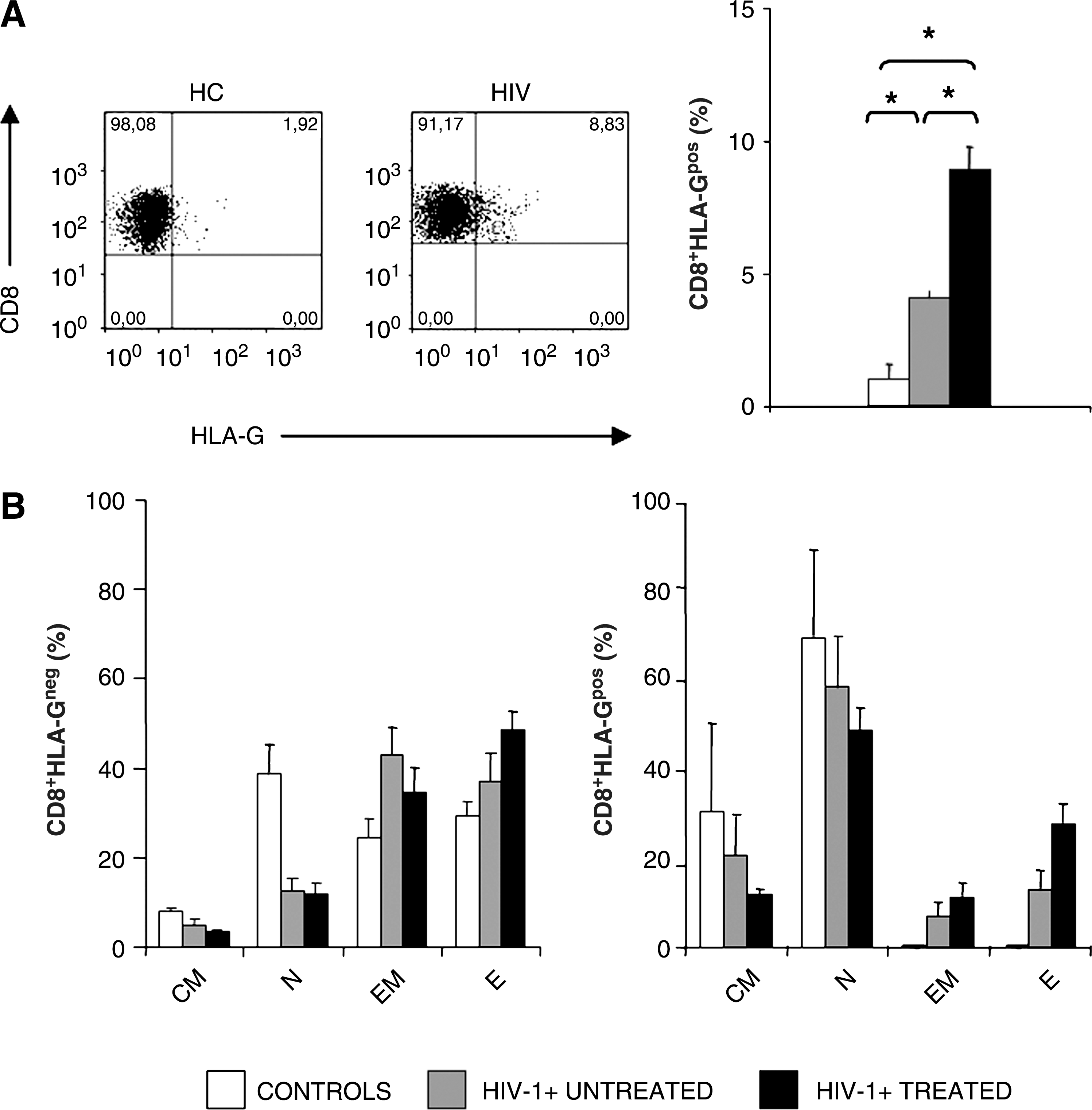
HLA-G-expressing CD8+ T cells in HIV-1 infected patients. (
Discussion
These results showing an expansion of the CD8+HLA-G+ subset point toward their involvement in the regulation of the immune response, and appear to be of the same regulatory T-cell subset as that described by Feger et al. (4). The reasons for this expansion of the CD8+HLA-G+ naïve T-cell subset in HIV-1 infection are unknown. Nevertheless, one important issue may be that IL-10 levels in HIV-1-positive patients are increased, and this cytokine has been shown to upregulate HLA-G expression (1,8,9). The elevated frequency of this suppressive subset observed in untreated, and even more obviously in treated HIV-1+ patients, might partially suppress the HIV-specific CD8 T-cell response. This regulatory function could also be mediated by other regulatory T cells induced by HLA-G (4). It may be that ILT2, which is a ligand of HLA-G and is upregulated in HIV-1 infection (2,3,5), could boost the inhibitory effects of this regulatory subset in these patients. Thus these results indicate an expansion of an HLA-G-expressing CD8+ T-cell subset in HIV-1-infected patients that may be associated with the impaired CD8+ response seen in HIV-1-infected patients.
Footnotes
Acknowledgments
This work was supported by grants from the Spanish Ministry of Science (SAF 2005/06984), Foundation for Research and Prevention of AIDS in Spain (FIPSE) (ref. 36536/05), Health Research Fund of the Ministry of Health (FIS) (PI 04/1356), and the Andalusian Department of Health (SAS 2006/0050).
Author Disclosure Statement
No conflicting financial interests exist.