




Abstract
Cytokines play key roles in modulating disease progression in simian immunodeficiency virus/human immunodeficiency virus (SIV/HIV) infection. There are a few studies on the relationship between early cytokines and HIV disease prognosis. In this study, we first report the relationship based on two groups with clearly different disease progression. We found that IP-10 was the only cytokine among the 26 cytokines tested that was always positively correlated with disease progression, and was associated with the time for CD4 counts to fall below 200 cells/μL during Fiebig stages III–V in HIV-1 infection. This suggests that high IP-10 levels in the blood are associated with rapid disease progression during Fiebig stages III–V in HIV-1 infection.
Introduction
As immune activation during early HIV infection is known to influence subsequent disease progression (6,7), and cytokines are central for the maintenance of immune activation (2), it is important to study the relationship between plasma cytokines in acute infection and disease progression. However, the relationship between early cytokines and HIV disease progression is still poorly understood.
In this study, we concentrated on the relationship between cytokines in acute HIV-1 infection and disease progression based on patients with clearly different disease progression. Twenty-two patients progressed rapidly, and their CD4 counts fell below 200 cells/μL within 2 y (CD4 low group), while the other 29 patients maintained CD4 counts above 500 cells/μL (CD4 high group). We found that IP-10 was the only cytokine among the 26 cytokines tested that was associated with rapid disease progression during Fiebig stages III–V in HIV-1 infection.
Patients and Methods
Patients
From 2007 to 2011, there were a total of 250 consenting patients recently infected (from Fiebig stage I to Fiebig stage V) with HIV-1 from a cohort of HIV-1-negative high-risk MSM (men who have sex with men) who were screened every 2 mo for HIV-1 infection in Beijing You'an Hospital. Of the 250 cases, we recruited two groups of patients with significant disease progression: one group (CD4 low group) progressed to CD4 counts <200 cells/μL within 2 y, while the other group (CD4 high group) maintained CD4 counts higher than 500 cells/μL. There were 22 subjects meeting the CD4 low group conditions, and 29 subjects meeting the CD4 high group conditions. The progression of early HIV-1 infection can be depicted in six discrete stages, as proposed by Fiebig et al. (8,9). The average ages of those in the CD4 high group and the CD4 low group was 28 and 29 y, respectively. All of the enrolled patients were Chinese, none were intravenous drug abusers, and none were co-infected with Treponema pallidum. During the study, none of the patients received highly-active antiretroviral treatment (HAART). Samples of all patients were collected at the first positive point, and 1, 2, 4, 8, 12, 24, 36, 48, 60, 72, 84, 96, and 108 wk after the first positive point.
This study was reviewed and approved by the Beijing You'an Hospital Research Ethics Committee.
Markers of HIV-1 disease progression
Absolute blood CD4+ T-cell counts (cells/μL) were measured using a FACSCalibur flow cytometer at each follow-up point. Viral load was measured by the Amplicor HIV-1 monitor ultrasensitive method, with a detection limit of 40 copies/mL of plasma.
Measurement of plasma cytokines
Twenty-six cytokines/chemokines (Table 1) were measured using a high-sensitivity human cytokine/chemokine Milliplex map kit (Millipore, Billerica, MA). Each sample was assayed in duplicate, and the cytokine standards supplied by the manufacturer were run on each plate. Data were acquired using a Luminex-100 system, and analyzed using Bio-PlexManager software, v4.1 (Bio-Rad, Hercules, CA). If a patient had multiple follow-up points in the same Fiebig stage, the average value was taken for the analysis.
p<0.05 considered significant.
CD4 high group, CD4 counts above 500 cells/μL for 2 years after HIV infection; CD4 low group, CD4 counts below 200 cells/μL for 2 years after HIV infection.
Non-parametric Mann-Whitney U test was used to compare medians between groups.
IQR, interquartile range; SE, standard error.
Statistical analysis
All data were analyzed using SPSS version 16.0 for Windows software. The correlation between two parameters was determined using Spearman's correlation coefficient. The nonparametric Mann-Whitney U test was used to compare medians between the groups. A log-rank (Mantel-Cox) test was used to compare the survival between groups. A value of p<0.05 was considered statistically significant.
Results
IP-10 was the only cytokine with a significant difference between groups in both Fiebig stages III–IV and Fiebig stage V
Plasma cytokines of the CD4 high group and the CD4 low group in Fiebig stages III–IV and Fiebig stage V were compared using the nonparametric Mann-Whitney U test. There was a significantly higher level of IP-10 in the CD4 low group than in the CD4 high group in both Fiebig stages III–IV and V. As shown in Table 1, there were no statistically significant differences in the other 25 cytokines between the two groups.
Early IP-10 was the only cytokine that was positively correlated with disease progression and associated with the time for CD4 counts to fall below 200 cells/μL
We analyzed the correlation between 26 cytokines in Fiebig stages III–IV and V and disease progression using Spearman's correlation coefficient. The data showed that IP-10 was the only cytokine that was negatively correlated with CD4 counts (Fig. 1a and b), and positively correlated with viral load set point (Fig. 1c and d), in both Fiebig stages III–IV and V. We next determined acute cytokines that were significantly associated with the time taken for CD4 counts to fall below 200 cells/μL using a log-rank (Mantel-Cox) test. The first detection of CD4 counts of <200 cells/μL after Fiebig stage V was regarded as the time of occurrence. We found that only early IP-10 could predict the time taken for CD4 counts to fall below 200 cells/μL (Fig. 1e and f).
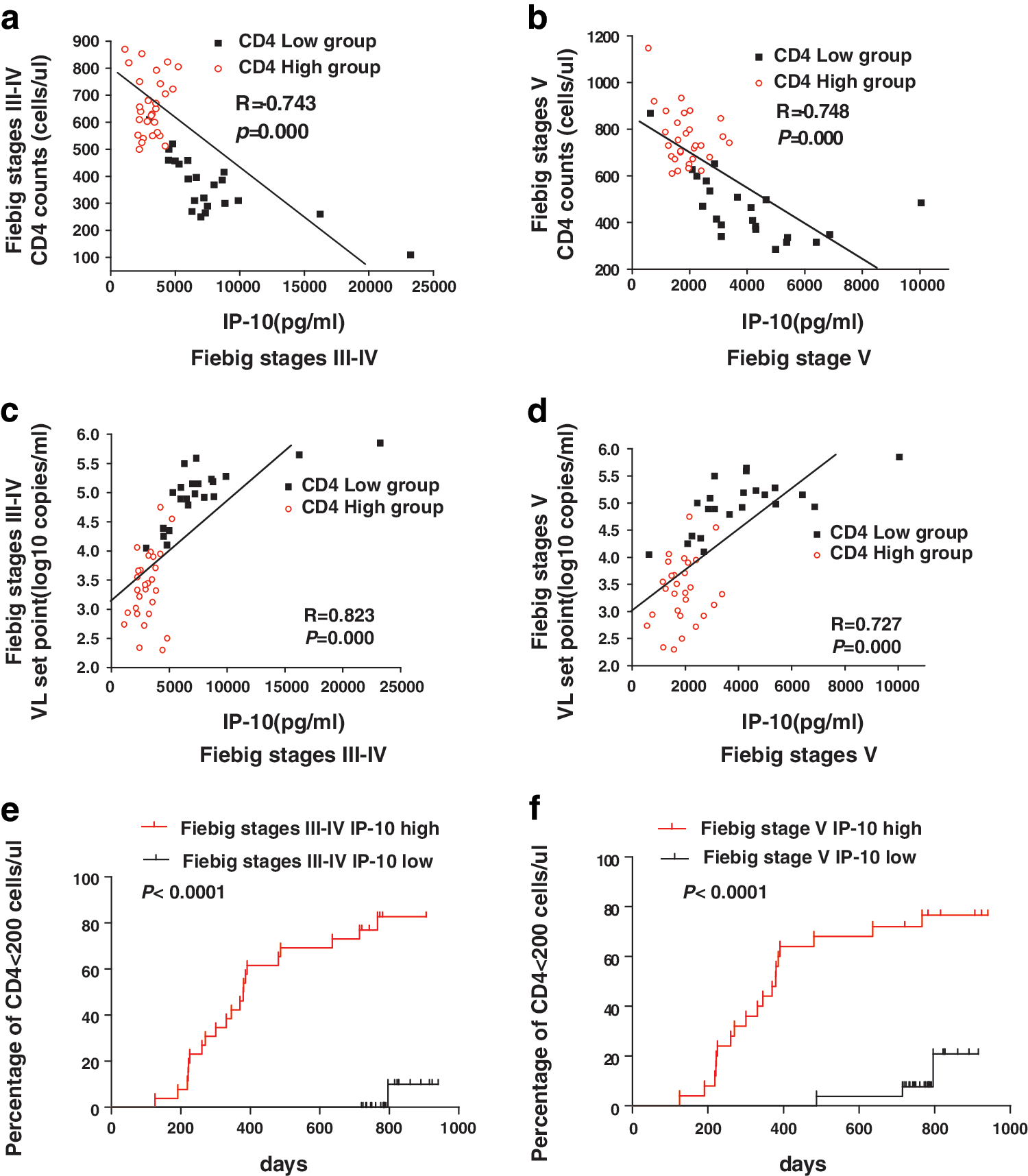
Early IP-10 was the only cytokine that was positively correlated with disease progression. IP-10 was negatively correlated with CD4 counts in both Fiebig stages III–IV (
Discussion
Cytokines play an important role in the pathogenesis of HIV infection. However, the role of cytokines in early HIV infection is only now being elucidated. Here our studies focus on cytokines in early HIV infection and their association with disease progression. We found that IP-10 was the only cytokine among the 26 cytokines tested that was positively correlated with disease progression in both Fiebig stages III–IV and V. Plasma IP-10 was also the only cytokine during acute HIV-1 infection that could predict the time taken for CD4 counts to fall below 200 cells/μL. The reason for this may be that IP-10 could be secreted by many cells, including leukocytes, neutrophils, eosinophils, monocytes, epithelial cells, endothelial and stromal cells, and keratinocytes, and many cytokines can induce the secretion of IP-10. The results are also consistent with other reports. There is evidence that the increase in viremia in primary HIV infection was found to be associated with a large increase in IP-10 levels (4). Durudas et al. reported that increased expression of OAS and IP-10 in the peripheral blood of SIV-infected macaques was observed among the more rapidly progressing macaques (10). In addition, Sarkar et al. found that SIV macaques with high viral loads had higher numbers of IP-10-producing cells compared with animals with low viral loads, and IP-10 production was inversely correlated with peripheral CD4 T-cell numbers (11). Chimpanzees infected with SIV, which subsequently progressed to acquired immunodeficiency syndrome (AIDS), consistently demonstrated increased levels of IP-10 in plasma, whereas the levels were undetectable in nonprogressing chimpanzees (12). Persistently high levels of IP-10 have been reported to be associated with immunological treatment failure following HAART in HIV-infected patients (13,14). Furthermore, co-infections with HIV and other pathogens upregulated IP-10. In HCV/HIV co-infected patients, IP-10 was significantly more elevated than in mono-infected ones (15). These results, along with our findings, may warrant the use of IP-10 as a diagnostic marker of rapid disease progression in early HIV-infected individuals.
HIV RNA levels and CD4 counts in the early phase of infection are more variable, which undermines their predictive value for rapid disease progression. Thus early IP-10 as a diagnostic marker of rapid disease progression in HIV-infected individuals has obvious clinical significance. If there is a high IP-10 concentration in early HIV infection, it means that the disease progression of the patient may be rapid.
Why does a high IP-10 level indicate rapid disease progression? It has been reported that IP-10 is a pleiotropic molecule capable of exerting potent biological effects, including promoting the chemotactic activity of CXCR3+ cells, inducing apoptosis, and increasing cell proliferation in infectious and inflammatory diseases (13). This would result in a decrease in CD4 cells in HIV-1 infection. Lane et al. demonstrated that IP-10 stimulates HIV-1 replication in monocyte-derived macrophages and peripheral blood lymphocytes, and that neutralization of endogenous IP-10 or blocking the function of its receptor, CXCR3, reduces HIV-1 replication in these same cells (16). Thus high IP-10 levels might promote HIV-1 virus replication.
An association of acute infection cytokines with the viral set point was recently suggested in HIV infection. Higher plasma IL-7 and IL-15 levels during acute/early HIV infection appear to be detrimental and correlate with higher viral set points (7). These results are different from ours. This discrepancy may be due to differences in patient selection.
In conclusion, our findings demonstrate that high plasma levels of IP-10 in early HIV-1 infection were associated with rapid disease progression. Considering the small number of cases, it is important to verify this conclusion in a larger number patient sample.
Footnotes
Acknowledgments
This work was supported by The National 12th Five-Year Major Projects of China (2012ZX10001-003 and 2012ZX10001-006), and the Beijing Municipal of Science and Technology Major Project (D09050703590901).
Author Disclosure Statement
No competing financial interests exist.