




Abstract
Data from successful attenuated lentiviral vaccine studies indicate that fully mature Env-specific antibodies characterized by high titer, high avidity, and the predominant recognition of conformational epitopes are associated with protective efficacy. Although vaccination with a DNA prime/recombinant vaccinia-vectored vaccine boost strategy has been found to be effective in some trials with non-human primate/simian/human immunodeficiency virus (SHIV) models, it remains unclear whether this vaccination strategy could elicit mature equine infectious anemia virus (EIAV) Env-specific antibodies, thus protecting vaccinated horses against EIAV infection. Therefore, in this pilot study we vaccinated horses using a strategy based on DNA prime/recombinant Tiantan vaccinia (rTTV)-vectored vaccines encoding EIAV env and gag genes, and observed the development of Env-specific antibodies, neutralizing antibodies, and p26-specific antibodies. Vaccination with DNA induced low titer, low avidity, and the predominant recognition of linear epitopes by Env-specific antibodies, which was enhanced by boosting vaccinations with rTTV vaccines. However, the maturation levels of Env-specific antibodies induced by the DNA/rTTV vaccines were significantly lower than those induced by the attenuated vaccine EIAVFDDV. Additionally, DNA/rTTV vaccines did not elicit broadly neutralizing antibodies. After challenge with a virulent EIAV strain, all of the vaccinees and control horses died from EIAV disease. These data indicate that the regimen of DNA prime/rTTV vaccine boost did not induce mature Env-specific antibodies, which might have contributed to immune protection failure.
Introduction
A series of studies on a successful attenuated EIAV vaccine (EIAVD9) demonstrated that a combination of fully mature Env-specific antibodies (with high titer, high avidity, and the preferential recognition of conformational epitopes), and cellular-targeting Env epitopes, is associated with protective efficacy (4,14,28). These studies suggested that EIAV vaccine candidates should be capable of inducing both mature humoral and potent cellular immune responses to Env to achieve effective protection. In contrast to recombinant subunit or inactivated whole-virus vaccines, DNA vaccines and viral vector vaccines have been proven to induce potent humoral and cellular immune responses to encoded viral proteins by expressing antigens with authentic conformation and utilizing major histocompatibility complex (MHC) class I and class II pathways to present antigens in host cells (1,6). Moreover, vaccinations using a regimen of DNA vaccine prime/viral vector vaccine boost have been observed to elicit stronger humoral and cellular immune responses than vaccination with either vaccine alone, thus offering better protection by the vaccinees in both human and animal models (13,22,27). However, so far, there are no data to confirm whether this vaccination strategy can induce potent protection-associated immune responses in horses, thus conferring effective protection against EIAV infection and disease. Therefore, in this pilot study we constructed recombinant DNA (rDNA) and recombinant Tiantan vaccinia (rTTV)-vectored vaccines encoding the EIAV env or gag genes, vaccinated horses with a DNA prime/rTTV vaccine boost strategy, and compared the induction of Env-specific antibodies in horses vaccinated with this set of vaccines with an attenuated Chinese EIAV vaccine, FDDV (EIAVFDDV). Finally, we evaluated the protective efficacy of the vaccine strategies by challenging vaccinees with a wild-type EIAV strain (EIAVLNV).
Materials and Methods
DNA vaccine construction
PLGFD3V is an infectious clone derived from EIAVFDDV. The env and gag genes of pLGFD3V (patent no. CN99105852.6 and US6987020B1) were codon optimized for horse expression and synthesized as oligonucleotides (Sangon, Shanghai, China). Both gene sequences were confirmed by sequencing double strands of sense and antisense gene DNA, and subsequently cloned into the expression vector pDRVI-SV1.0 (SV1.0) to generate two DNA vaccines, pDRVI-SV1.0-Env-Syn (SV1.0-Env-Syn) and pDRVI-SV1.0-Gag-Syn (SV1.0-Gag-Syn). An additional two plasmids, SV1.0-Env-Wild and SV1.0-Gag-Wild, which encoded the wild-type env and gag genes of pLGFD3V in SV1.0, respectively, were constructed as controls for in vitro expression. The properties of the expression vector pDRVI-SV1.0 have been previously described (18,29).
Comparison of the in vitro expression of synthetic EIAV env and gag genes with their corresponding wild-type genes
The in vitro expression of synthetic EIAV genes and their corresponding wild-type genes was compared through Western blotting (WB). Briefly, 3 μg of SV1.0, SV1.0-Env-Syn, SV1.0-Gag-Syn, SV1.0-Env-wild, or SV1.0-Gag-wild, was transfected into 293T cells or horse dermal fibroblast cells in 12-well tissue culture plates. After 48 h, the cells were collected and lysed. Then 30 μg of total cell lysates was subjected to a standard WB procedure (Fig. 1). EIAV-positive horse serum (1:100) and mouse anti-human or anti-horse β-actin monoclonal antibody (1:5000 or 1:1000) served as the primary antibodies. Horseradish peroxidase (HRP)-conjugated goat anti-horse IgG (1:1000)/goat anti-mouse IgG (1:1000), and FITC-conjugated goat anti-horse IgG (1:200)/goat anti-mouse IgG (1:2000) were used as the secondary antibodies. Finally, the protein bands were visualized using enhanced chemiluminescence or a fluorescence scanner.
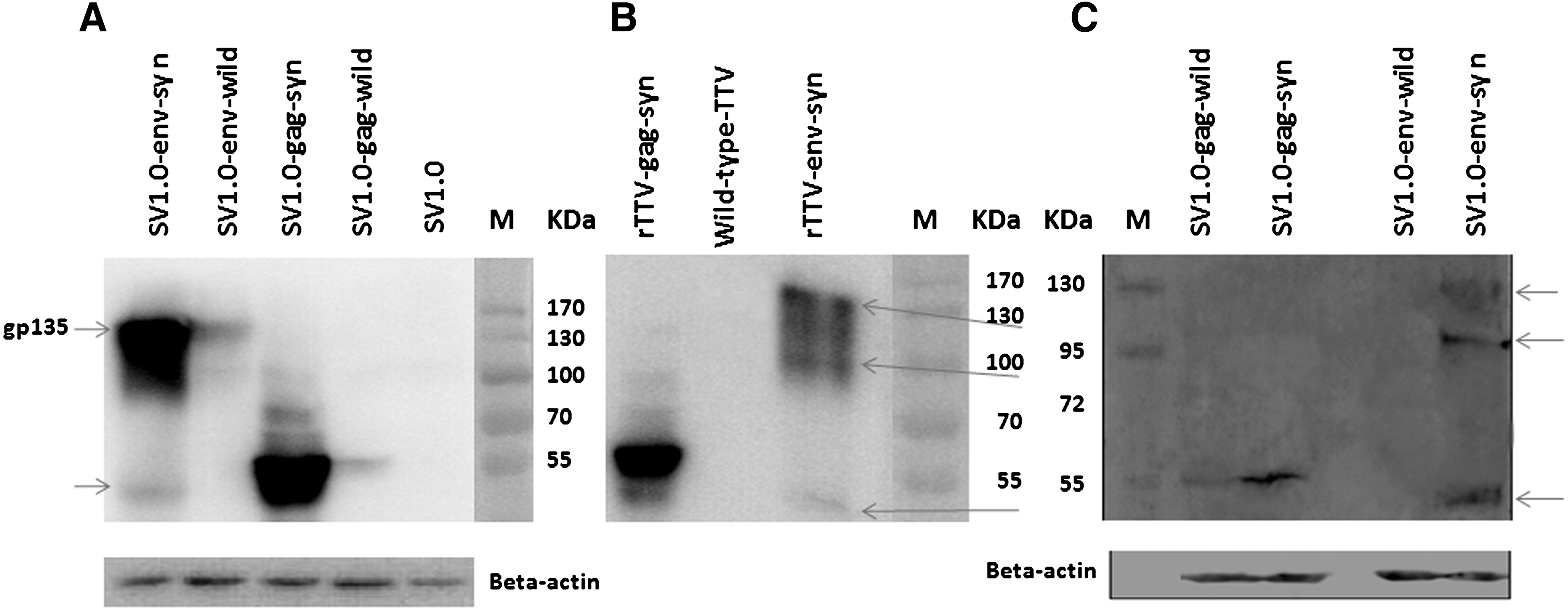
Confirmation of DNA vaccines and recombinant Tiantan vaccinia vaccines encoding codon-optimized env or gag gene with Western blotting. (
Construction and confirmation of recombinant TTV-vectored vaccines
Codon-optimized EIAV env and gag genes were transferred to a pSC65 shuttle plasmid (with the Lac z gene as a selection marker), which was specifically designed to recombine with the TK gene of the TTV. Subconfluent monolayers of 143TK− cells were grown in Eagle's medium containing 10% fetal bovine serum and 1% penicillin–streptomycin–L-glutamine. Then the cells were washed with Eagle's medium containing glutamine and antibiotics in the absence of fetal bovine serum. Wild-type Tiantan vaccinia virus was inoculated at a multiplicity of infection (MOI) of 0.1, and incubated for 1 h at 37°C and 0.5% CO2. Subsequently, the vaccinia-infected cells were transfected with recombinant shuttle plasmids using lipofectamine 2000 (Invitrogen, Carlsbad, CA). After 48 h of incubation, the transfection medium was removed, and all of the wells were covered with 2% melted low melting temperature agarose mixed with an equal volume of 2×Eagle's medium containing 100 μg/mL x-gal. The blue Lac Z-positive colonies were picked and further purified in 143TK− cells under the selective pressure of Eagle's medium containing 50 μg/mL BuDR. The purified recombinant TTV was confirmed by PCR amplification of the inserted EIAV env and gag genes. The generated vaccines were designated as rTTV-Env-Syn and rTTV-Gag-Syn. All of the rTTVs were expanded in primary chicken embryo fibroblast cells and confirmed with WB as described above.
Cell lines and EIAV stocks
Fetal donkey dermal (FDD) cells and equine monocyte-derived macrophages (eMDMs) were cultured as previously described (19,26). EIAVLNV is a high-virulence EIAV strain and was used as the challenge strain in this study. PLGFD3V was used in the neutralizing antibody assays as a homologous vaccine strain. PLGFD3Mu12V and DLV34 are two relatively heterologous virulent variants of EIAVLNV, and their virulence and env sequences have been described previously (19). The mean divergences of the deduced SU polypeptide between EIAVFDDV and pLGFD3V, pLGFD3Mu12, DLV34, and EIAVLNV, were 3.6%, 4.2%, 5.1%, and 6.2%, respectively. PLGFD3V, PLGFD3Mu12V, and DLV34 were prepared, titrated, and stored as previously described (19,26).
Experimental subjects, vaccination, challenge, sample collection, and clinical evaluation
The four horses used in this study were thoroughbreds. Prior to the experiment, serum samples collected from all horses were tested twice with an agar gel immunodiffusion test (AGID, VMRD) to ensure that they were seronegative for EIAV infection. The horses were housed in screened box stalls to exclude hematophagous insects. All of the animal handling protocols were approved by the Animal Management Committee of the Chinese Harbin Veterinary Research Institute. Horses rD/V1, rD/V2, and rD/V3 were vaccinated with 10 intramuscular injections of 4 mg of SV1.0-Env-Syn (2 mg)/SV1.0-Gag-Syn (2 mg) at 5 sites on each side of the neck at weeks 0, 8, 13, 18, 22, and 36, and vaccinated with 10 intradermal injections of 2×10⁹ pfu of rTTV-Gag-Syn/rTTV-Env-Syn at 5 sites on each side of the neck at weeks 69 and 90 (Fig. 2). Horse D/V1 was inoculated with empty vectors (SV1.0 and wild-type TTV) at the same doses, route, and schedule as rD/V1, rD/V2, and rD/V3. All of the horses were challenged through the hypodermal injection of 1 mL of virus stock (1000 copies/mL of viral RNA) of EIAVLNV at week 104 and observed until death. Sera were collected at weeks 0 (just prior to the first DNA vaccination), 2, 10, 15, 20, 24, 38, 69 (just prior to the first rTTV vaccination), 71, 75, 90 (just prior to the second rTTV vaccination), 92, 96, and 104 (on the day of and just prior to EIAVLNV challenge). Whole blood and plasma were collected at weeks 0, 38, 69, 90, and 104. During the challenge phase, the sera, plasma, and whole blood of all surviving horses were collected on days 11, 15, 21, and 26 post-challenge. rD/V3 died from an accident in week 94, so samples were not collected from that horse subsequently. AV1, AV2, AV3, and AV5 were 4 horses who had been hypodermally vaccinated with 1 mL of 4×10⁵ TCID50 of EIAVFDDV for 6 mo, and C1 was a naïve control horse (19). They were challenged together with D/V1, rD/V1, and rD/V2 on the same day by the same dose of EIAVLNV. After a 253-day observation period post-challenge, AV2, AV3, and AV5 did not present detectable infection. AV1 developed an EIA febrile episode, and C1 died from an acute EIA infection (19). The sera of horses vaccinated with EIAVFDDV were collected at months 0, 1, 2, 3, 4, 5, and 6 post-vaccination. Serum samples were stored at −20°C for antibody assays. Plasma samples were stored at −80°C for the quantitative and qualitative analysis of EIAV in the plasma. Whole blood samples were used for platelet enumeration. The rectal temperature and clinical status of all surviving horses were recorded twice per day throughout the trial. Clinical episodes of EIA were defined as thrombocytopenia (<100,000 platelets/μL whole blood), occurring with fever (rectal temperature ≥39°C), and a concurrent high level of plasma viral RNA. The quantitative and qualitative analyses of plasma viral genomes were performed as previously described (15).

Development of Env-specific antibodies, neutralizing antibodies, and p26-specific antibody responses to the attenuated vaccine EIAVFDDV and the DNA/recombinant TTV-vectored vaccines. The longitudinal characterization of the quantitative and qualitative properties of EIAV envelope-specific antibodies was conducted with Con A ELISAs for end-point titer (
Quantitative and qualitative serological assays
Serum immunoglobulin G antibody reactivity to EIAVFDDV envelope glycoprotein was quantitatively (end-point titer) and qualitatively (avidity index and conformation ratio) assayed using a standard ConA ELISA procedure as previously described (9), except that the coated EIAVPV was replaced with gradient-purified EIAVFDDV. The end-point titer of core p26-specific IgG was detected using a standard ELISA. P26pLGFD3V was expressed in E. coli and purified with SDS-PAGE. The purity was 95% (data not shown). Samples were considered positive if the sample's optical density exceeded the mean optical density value of the corresponding negative samples (pre-immunization bleeding) plus two times the standard deviation at the same dilution.
Neutralizing antibody assay
All of the sera were heat inactivated (56°C for 30 min) before the neutralization assay to inactivate infectious virus and labile serum proteins. The serum neutralizing activity against homologous (pLGFD3V), or relatively heterologous (pLGFD3Mu12V) virus strains, was assessed with a modified indirect cell ELISA-based infectious center assay method using a constant amount of pLGFD3V or pLGFD3Mu12V, and sequential twofold dilutions of serum, as previously described (9). The serum neutralizing activity against DLV34 was assessed with an RT assay as previously described (19).
Statistical analysis
Statistical analyses were performed with GraphPad Prism version 5.0 (GraphPad Software Inc., San Diego, CA). The Mann-Whitney U test was used to compare the end-point titer, avidity index, and conformation ratio of Env-specific antibodies, and pLGFD3V neutralizing activity between serum samples from horses vaccinated with rDNA/rTTV vaccines and the attenuated vaccine EIAVFDDV. A two-tailed p value <0.05 was considered to be significant.
Results and Discussion
In a previous study researchers demonstrated that codon optimization dramatically increases the in vitro expression and immunogenicity of the EIAV env gene in a DNA vector (3). Therefore in this study, we constructed DNA and Tiantan vaccinia-vectored vaccines encoding codon-optimized EIAV env or gag genes. As shown in Fig. 1A, B, and C, both SV1.0-Env-Syn and rTTV-Env-Syn expressed the Env (gp135) protein, which was approximately 130 kDa. Both SV1.0-Gag-Syn and rTTV-Gag-Syn expressed the Gag (p55) protein, which was approximately 55 kDa, while the DNA vector SV1.0 and the Tiantan vaccinia vector did not present any protein expression. In lanes with samples of vaccines encoding the env gene, the main band was located at approximately 130 kDa (for the samples from transfected 293T cells/infected primary chicken embryo fibroblast cells), or 95 kDa (for the samples from transfected equine dermal cells), and one dimer band located slightly below 55 kDa could be observed in all samples. On the other hand, the bands were markedly thicker in the lanes with samples of the DNA vector encoding codon-optimized env or gag genes than in the lanes with samples of DNA vectors encoding the wild-type env or gag gene, while the housekeeping gene β-actin presented comparable expression in all of the samples from transfected 293T and equine dermal cells (Fig. 1A and C). These data indicate that the constructed DNA and vaccinia-vectored vaccines correctly expressed the encoded EIAV env or gag genes, and codon optimization significantly increased the in vitro expression of encoded genes in the DNA vector SV1.0. Moreover, most of the full-length precursor gp135 may be further processed into SU (gp90) and TM (gp45) in DNA vaccine-expressing cells, and rTTV vaccine-infected cells.
To determine whether the vaccination strategy using DNA prime/vaccinia-vectored vaccine boost could induce protection-associated immune responses, we vaccinated 3 horses with SV1.0-Env-Syn plus SV1.0-Gag-Syn at 6 time points to prime them, and boosted them twice with rTTV-Env-Syn plus rTTV-Gag-Syn. We then compared the induction of Env-specific antibodies and neutralizing antibodies in these vaccinees to 4 horses vaccinated with the attenuated EIAV vaccine EIAVFDDV during the vaccination phase. In the 4 EIAVFDDV-vaccinated horses, 3 were protected from infection and 1 was protected from death after challenge with EIAVLNV, as shown in our recent report (19). Fig. 2A, D, G, and J summarize the development of Env-specific antibodies and neutralizing antibodies against the homologous strain pLGFD3V in horses immunized with DNA and rTTV vaccines. Env-specific antibodies and neutralizing antibodies against pLGFD3V did not appear until 2 wk after the third and the fifth DNA vaccinations, and then gradually increased, respectively. Two weeks after the sixth DNA vaccination, the mean end-point titer, avidity index, and conformation ratio of Env-specific antibodies, and the mean neutralizing titer against pLGFD3V were 1:70, 26%, 0.29, and 1:10, respectively. After the first boost vaccination with rTTV vaccines, the mean of those four parameters increased markedly, to 1:700, 34%, 0.95, and 1:190, at week 2, and gradually decreased, to 1:7, 11%, 0.16, and 0, at week 21 (on the day of and just prior to the second boost with the rTTV vaccines). Although Env-specific antibodies and neutralizing activity against pLGFD3V peaked quickly 2 wk after the second rTTV vaccine boost, these activities were comparable to week 2 following the first rTTV vaccine boost. In addition, the activities gradually decreased again, to 1:70, 33%, 0.68, and 1:10 at week 14 (on the day of and just prior to challenge with EIAVLNV). In contrast, neutralizing antibodies against the heterogeneous virulent strains (pLGFD3Mu12V and DLV34) were not observed during the entire vaccination phase (data not shown).
As shown in Fig. 2B, E, H, and K, Env-specific antibodies and neutralizing activity against pLGFD3V were detectable by 1 mo post-vaccination with EIAVFDDV in each vaccinated horse. The end-point titer, avidity index, and conformation ratio of Env-specific antibodies gradually increased to a plateau after 4 or 5 mo post-vaccination, and reached 1:4200, 52%, and 1.83 (mean of 4 samples) at 6 mo post-vaccination (on the day of and just prior to challenge with EIAVLNV). Serum pLGFD3V-neutralizing activity peaked at month 2 or 3, and remained constant until the day of challenge. In addition to inducing a high level of neutralizing antibodies against pLGFD3V, EIAVFDDV also elicited neutralizing antibodies against pLGFD3Mu12V and DLV34 in most of the vaccinated horses (AV2, AV3, and AV5), which was demonstrated in our recent report (19). On the day of the challenge, the mean neutralizing activity against pLGFD3V, pLGFD3Mu12V, and DLV34 in all EIAVFDDV-vaccinated horses was 1:3540, 1:1000, and 1:270, respectively.
In contrast to the development of Env-specific antibodies, vaccination with DNA vaccines rapidly induced Gag-specific antibodies (anti-p26) in each vaccinee, and the mean end-point titer of p26-specific antibody increased to 1:3000 2 wk after the first rTTV vaccine boost (Fig. 2M). Although the second rTTV vaccine boost did not further improve the end-point titer, the activity of the p26-specific antibody was longer lasting than the Env-specific antibody in horses vaccinated with DNA and rTTV vaccines (Fig. 2A and M). On the day of the challenge, the mean end-point titer of p26-specific antibodies was still as high as 1:300. In horses vaccinated with EIAVFDDV, the end-point titer of p26-specific antibodies plateaued between 1 and 3 mo post-vaccination, and then quickly declined and remained at low levels (approximately 1:40) or was undetectable on the day of challenge (Fig. 2N).
We further compared the activities of Env-specific antibodies between horses vaccinated with EIAVFDDV and horses vaccinated with DNA/rTTV vaccines during the period required to achieve relatively mature Env-specific antibodies using the respective immunization regimens. Generally, approximately 6mo are necessary for the development of mature Env-specific antibodies for attenuated EIAV vaccines (4,25). In this study, we found that each parameter of Env-specific antibodies plateaued after 4 to 5mo post-vaccination with EIAVFDDV, and peaked 2wk after each rTTV vaccine boost. Therefore, 6 serum samples collected from 3 vaccinees at week 2 post-rTTV boost, and 8 serum samples collected from 4 vaccinees at months 5 and 6 post-vaccination with EIAVFDDV were selected and compared. As shown in Fig. 2C, F, I, and L, the end-point titer, avidity index, and conformation ratio of the Env-specific antibodies, and the neutralizing titer against pLGFD3V were significantly lower in samples from horses vaccinated with the DNA/rTTV vaccines than samples from horses vaccinated with EIAVFDDV. However, the end-point titer of the p26-specific antibodies was higher in the former samples than the latter samples. These data indicate that the immunization strategy of EIAV DNA prime/rTTV vaccine boost did not induce mature Env-specific antibodies or high levels of broadly neutralizing antibodies. Moreover, the Env-specific antibodies and neutralizing antibodies induced by this strategy lacked durability compared to those induced by the attenuated vaccine EIAVFDDV.
Finally, to evaluate the protective efficacy conferred by the DNA/rTTV vaccines, we challenged two vaccinees and one empty vector control horse with EIAVLNV. On the same day, the 4 horses vaccinated with EIAVFDDV and one naïve control horse were also challenged with EIAVLNV using the same dose and route. All of the serum and plasma samples collected at 5 (for rD/V1, rD/V2, and D/V1) or 4 (for rD/V3) time points before challenge were AGID- and viral RNA-negative (data not shown). These results indicate that these vaccinees and the empty vector control horse were not infected by the wild-type or the vaccine EIAV strain. Vaccinee rD/V3 was not enrolled in the challenge trial because the horse died from an accident involving a broken spine. The possibility of death from EIAV or other equine infectious diseases was ruled out through extensive pathological diagnosis (data not shown). Supplemental Fig. S1A, B, C, and D depict the clinical and virological profiles of the vaccinees and control horses during the post-challenge observation period (see online supplementary material at
Studies of lentiviral attenuated vaccines have indicated that sustained low levels of antigen presentation and consistent stimulation of the host immune system are required to achieve and sustain adequate immune maturation, thereby effectively protecting vaccinees against exposure to lentiviruses (2,4). These results suggest that other EIAV vaccines, such as DNA vaccines or live viral vector-based vaccines, might also be effective if they are based on regimens of multiple antigen exposure and/or sustained antigen presentation. However, in this study we found that a regimen using EIAV DNA vaccine prime and rTTV vaccine boost did not induce mature EIAV Env-specific antibodies or broadly neutralizing antibodies, in contrast to vaccination with the attenuated vaccine EIAVFDDV. The induced immune responses failed to protect vaccinees from death after challenge with a virulent EIAV strain.
Cook et al. reported that DNA encoding codon-optimized EIAV gp90 did not induce detectable Gp90-specific antibody in ponies until after 4 to 5 vaccinations, and the induced Gp90-specific antibody did not present any neutralizing activity, even to a homologous EIAV strain (3). Similarly in this study, we observed that 6 successive vaccinations with DNA induced low titer, low avidity, and low recognition of conformational epitopes and transient IgG responses to Env, although the induction of p26-binding antibodies was high. Consistent with these data from EIAV DNA vaccines, a previous study comparing the immunogenicity of HIV Env and influenza virus hemagglutinin glycoprotein in a DNA vector demonstrated that multiple DNA priming vaccinations only achieved low titer and a transient antibody response to HIV Env, while high titer, high avidity, and persistent IgG responses to influenza virus H1 were seen after the first DNA vaccination (21). These data suggest that compared to specific antibodies against other encoded proteins, mature specific antibodies against lentiviral Env may be more difficult to induce using DNA vectors, even after multiple subsequent immunizations. These data also suggest that other mechanisms may be involved in the induction of mature Env-specific antibodies by attenuated lentiviral vaccines, in addition to the sustained presentation of Env antigen.
Although the first rTTV vaccine boost rapidly increased the titer, avidity, and recognition of conformational epitopes of Env-specific antibodies in each vaccinee, no further enhancement of Env-specific antibody maturation was observed after the second TTV-vectored vaccine boost. Pre-existing anti-vaccinia vector neutralizing responses are thought to most likely inhibit the induction of neutralizing antibody against the encoded SARS-CoV S glycoprotein after the subsequent inoculation of mice with wild-type TTV and recombinant TTV-vectored vaccines (10). However, this inhibitory effect resulting from the pre-exposure of wild-type TTV via the intradermal route was largely overcome by subsequent vaccination with recombinant TTV-vectored vaccines via a heterologous intraoral or intranasal route (10). In fact, in the present study, the neutralizing antibody titers against wild-type TTV were found to range from 1:90 to 1:200 in serum samples from all vaccinees and the control horse at 2 wk after the second boost, but we did not observe any serum neutralizing activity against the TTV vector before the second boost vaccination (data not shown). These results suggest that a rapidly induced but not pre-existing neutralizing antibody response to the TTV vector might contribute to the inhibition of further maturation of Env-specific antibodies after the second boost with rTTV vaccines. In this context, immunization with the recombinant TTV-vectored vaccines via a heterologous mucosal route may be a more effective way to reduce this inhibitory effect and improve the maturation of Env-specific antibody than increasing the interval between boost vaccinations delivered via the same route.
The data from our previous study indicated that EIAVFDDV induced broadly neutralizing antibodies, which might confer enhanced protection of vaccinees against infection by the challenge virus EIAVLNV (19). Additional results indicated that the infectious molecular clone-derived EIAV strain pLGFD3V did not induce broadly neutralizing antibodies, while the level of steady in vivo replication of pLGFD3V was comparable to that of its parent vaccine strain EIAVFDDV. Less diversity in immunogen composition has been suggested to be a major cause of pLGFD3V failing to elicit broadly neutralizing antibodies (16). In agreement with our previous data, in this article we found that the DNA vaccine and the rTTV vaccine encoding the env gene of pLGFD3V did not induce broadly neutralizing antibodies. Our results suggest that other or additional env sequences in EIAVFDDV may be necessary to induce broadly neutralizing antibodies. More work on the identification of possible env sequences capable of eliciting broadly neutralizing antibodies, and examination of those identified sequences using the DNA prime/recombinant TTV vaccine strategy, may aid in elucidating the mechanism underlying the induction of broadly neutralizing antibodies by attenuated Chinese EIAV vaccines.
In this pilot study, we found that a vaccination regimen based on EIAV DNA vaccine priming and recombinant TTV vaccine boost failed to protect vaccinees from death following wild-type EIAV challenge, and immature Env-specific antibodies and the lack of broadly neutralizing antibodies may partially account for this protection failure. These data may provide valuable information for future work on antibody-oriented lentiviral vaccines.
Footnotes
Acknowledgments
This work was supported by grants from the Ministry of Science and Technology of China (grants no. 2007DFC30230 and 2008ZX10001-010) to Dr. Yiming Shao, and the National Science Foundation of China (grants no. 30371319 and 30671941) to Dr. Xiaoyan Zhang. We sincerely appreciate the critical comments on the article provided by Dr. Jianqing Xu.
Author Disclosure Statement
No competing financial interests exist.
References
Supplementary Material
Please find the following supplemental material available below.
For Open Access articles published under a Creative Commons License, all supplemental material carries the same license as the article it is associated with.
For non-Open Access articles published, all supplemental material carries a non-exclusive license, and permission requests for re-use of supplemental material or any part of supplemental material shall be sent directly to the copyright owner as specified in the copyright notice associated with the article.
