




Abstract
This study investigated measles infection in vaccinated and unvaccinated children presenting with fever and maculopapular rash during measles outbreaks in the southern and western states of Nigeria. Measles, an acute viral illness caused by a virus in the family Paramyxoviridae, is a vaccine-preventable disease. Measles outbreak is common in Nigeria, despite the national immunization program. Children presenting with symptoms of measles infection in general hospitals and health centers in the states of southern and western Nigeria were recruited for this study. Vaccination history, clinical details, and 5 mL of blood were obtained from the children. Their sera samples were screened for specific immunoglobulin M antibodies to measles virus. Of 234 children tested (124 [53.2%] female), 133 (56.8%) had previously been vaccinated against measles virus, while 93 (39.7%) had not been vaccinated. Vaccination information for eight children could not be retrieved. One hundred and forty-three (62.4%) had measles IgM antibodies. Of these, 79 (55.3%) had been vaccinated for measles, while 65 (44.7%) had not. Despite the ongoing vaccination program in Nigeria, a high number of children are still being infected with measles, despite their vaccination status. Therefore, there is need to identify the reason for the low level of vaccine protection.
Introduction
I
Measles infection is an acute, highly contagious viral infection caused by the measles virus (15). The virus is a spherical, enveloped, single-stranded RNA virus with six identified structural proteins; three protein complexes with viral RNA—namely, nucleoprotein (N), polymerase (P), and the large protein (L)—and three proteins in the envelope—hemagglutinin (H), matrix(M), and fusion (F) proteins (15). All of these proteins are antigenic and capable of stimulating an antibody response. Until the introduction of a live-attenuated vaccine in the early 1960s, measles was a worldwide epidemic with more than 130 million cases occurring annually (4). The infection was also a leading cause of death, deafness, blindness, and brain damage worldwide among children younger than 5 years old (6). With the advent of potent vaccines, the number of measles cases has reduced globally, with a 78% drop in measles infection between 2000 and 2012 (14). Despite this success, there were an estimated 122,000 deaths from measles in 2012 alone, the majority of these being from developing countries, mainly Africa and Southeast Asia (10). In these countries, the infection is among the leading cause of vaccine-preventable morbidity and mortality in children. There were also an estimated 370,500 deaths due to measles in 2011, with 87% of these occurring in African and southeastern regions (10).
There have been several reports in the northern and southern parts of Nigeria on the prevalence and incidence of measles infection, especially during outbreaks. However, there is limited information on the vaccination status of the infected children and the level of severity of their infection in the country. Thus, this study investigated measles infection and its severity in vaccinated and unvaccinated children between January 2011 and December 2012 in selected states of southern Nigeria.
Methods
Study design and case definitions
This study is a cross-sectional investigative study. Children presenting with fever and rash, cough, or redness of the eyes were recruited. Children were tested for HIV antibodies, and seropositive children were excluded from the study. Cases were stratified into severe and mild. A severe case of measles infection includes any case of pneumonia, encephalitis, severe diarrhea, and related dehydration, based on World Health Organization (WHO) guidelines (16).
Study population
Two hundred and thirty-four children aged 10 years or younger presenting with symptoms of measles infection (fever, maculopapular rash with or without cough) in general hospitals and health centers in the southern and western states of Nigeria were recruited for this study. Informed consent was obtained from the children's caregivers or parents.
Sample collection
About 2 mL of blood was collected from each child by venipuncture into sterile labeled bottles containing an anticoagulant. Using a semi-structured questionnaire, demographic details as well as a vaccination history of the children were obtained. Information on the severity of the infections was also obtained from the children's hospital case notes.
Laboratory analysis
The blood collected was transported to the laboratory in a cold box with ice packs. While in the laboratory, plasma from the blood was separated by centrifugation at 500 g for 5 min and stored in sterile cryovials at −20°C until processing. The plasma was then tested for measles-specific immunoglobulin M (IgM) antibodies using a measles IgM enzyme-linked immunosorbent assay test kit (DIA PRO™; Diagnostic Bioprobes, Milan, Italy), according to the manufacturer's instructions, with each plate having its own controls. The optical density of the wells was read by an ELISA reader (BioTek Instruments, Inc., Winooski, VT). Results were calculated according to the manufacturer's instructions. The samples with equivocal results were retested, and if still equivocal were regarded as negative.
Statistical analysis
The data obtained were grouped and tabulated. Variables were tested for association using the chi-square test. The level of significance was set at p<0.05 for all analyses. SPSS for Windows v12.0 (SPSS, Inc., Chicago, IL) was employed for analysis.
Results
A total of 234 children (109 male) were recruited for this study. The children's age ranged from 5 months to 10 years, with a mean age of 2.45 years (SD=0.976 years). One hundred and thirty-three (56.8%) children had evidence of vaccination from their vaccine record, while 93 (39.7%) children had not been vaccinated. Vaccination information for eight (3.4%) children could not be obtained. Table 1 shows the characteristics of the study population.
Of the 234 children tested for measles IgM, 146 (62.4%) tested positive for measles IgM antibodies, while 88 (37.6%) tested negative. Of the 146 children that tested positive, 66 (45.2%) were male.
Children in the 1–3 years age group had the highest positivity rate to measles antibodies (26.4%), followed by those aged 3–5 years (13.4%), and lastly those aged 0–1 year (10.4%). Male and females had about the same rate of positivity across all age groups: males 59.6% (n=65) and female 64.8% (n=79). Thus, there was no significant difference in the prevalence of measles among male and female children (p=0.467).
Table 2 shows the severity of measles infection among vaccinated and unvaccinated children in the study population. A total of 78 (54.5%) of the tested children who had measles IgM antibodies had been vaccinated, while 65 (45.5%) had not been vaccinated. In addition, 44.1% of unvaccinated children who tested positive for measles to measles IgM had a very serious infection compared with 18.9% of vaccinated children. Tables 3 and 4 show the severity of measles infection in relation to sex and age, respectively.
p<0.001; it represents the statistical significance between disease severity and vaccination history.
Ogun and Lagos states had the highest population of children tested and those positive for measles IgM antibodies. Figure 1 shows the state-wide distribution of measles infection in southern Nigeria. The highest prevalence rate was recorded in Ogun State, with 87% (n=29). The lowest prevalence rate was recorded in Ekiti State, with 28.6% (n=2). Higher prevalence rates were recorded in the south-southern and southeastern states, as majority of the states recorded rates >60%.
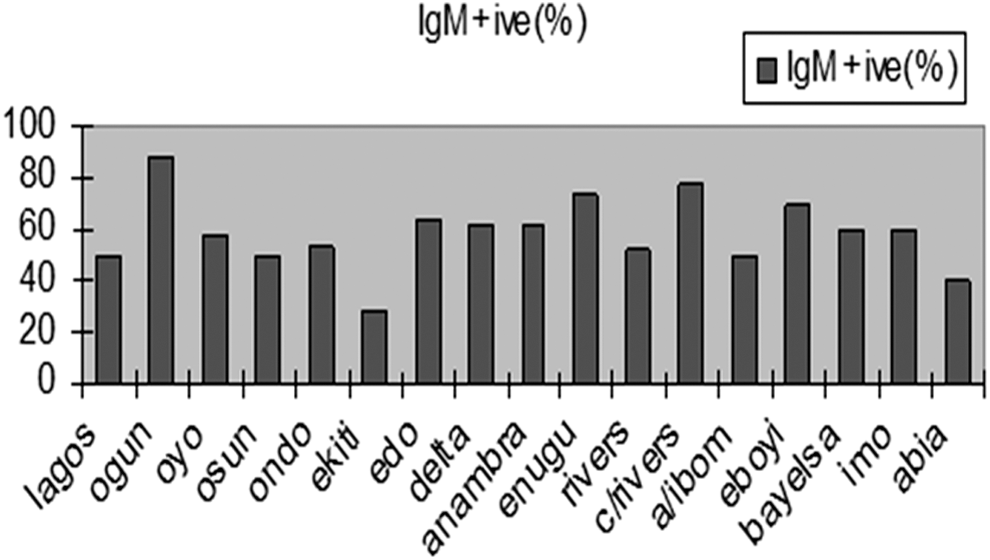
Distribution of measles virus infection in different states in southern Nigeria.
Discussion
This study investigated measles infection among vaccinated and unvaccinated children presenting with fever and maculopapular rash in Nigeria using a measles-specific IgM detection ELISA test kit. Detection of measles IgM remains the gold standard for diagnosing measles, as recommended by the WHO (16).
It is important to note that the total samples collected may not give the true picture of maculopapular rash infections occurring during this period, as many rash infections go unreported in several parts of the country and only those who presented at hospitals and health centers were recruited for this study. However, the number of samples collected gives a picture of measles infections happening in these communities. The high prevalence of recent measles infection (62.4%) recorded in this study corroborates the fact that the burden of the disease in the country is still very high (9,13,20). Measles vaccination in Nigeria is part of the EPI, with the measles vaccine included in the routine vaccination campaigns given to children at 9 months of age. A supplemental measles vaccination campaign is also organized by the Ministry of Health using the existing framework of the polio surveillance program. In this campaign, children are vaccinated at homes, schools, and other social institutions. Nonetheless, other causes of rash infections among children such as rubella virus, dengue virus, parvovirus B19, and herpesvirus 6, among others, also need to be investigated (5,16,23).
Many of the children (54.5%) who tested positive to measles-specific IgM had received at least one dose of measles vaccination. In Nigeria, the measles vaccine used is the Edmonston-Zagreb strain; it is imported in lyophilized form, and reconstituted just before vaccination. After reconstitution, the vaccine is stored at 4°C and is administered within a day of reconstitution. Measles infection among previously vaccinated children has been attributed to vaccine failure. It is not known from this study whether primary or secondary vaccine failure was the major cause, as there were no data available on the seroconversion status of the children after vaccination. Causes of primary vaccine failure could be failure in the cold-chain system, inadequate viral dose, or host immune factors such as persistence of maternal immunity (2,9). The nutritional status of the children as well as presence of other underlying diseases such as malaria and HIV, among others, could be responsible for secondary vaccine failure. Malaria is endemic in Nigeria, and the infection is known to interact with EPI vaccines. Treatment with drugs known to interact with measles vaccines may also cause vaccine failure (22). Hence, further studies on the interactions between HIV treatment and measles vaccination in the country are needed. All these interactions may increase the chance of vaccine failure, thereby reducing herd immunity and aiding the endemicity of measles in the country.
Sex distribution was not significant (p=0.497), although a higher percentage of female children (64.8%) were infected compared to males (56.9%). This is in line with previous reports where significant association was found among female children having higher infection rates compared to their male counterparts (3,7).
The infection rate for measles rose across the age groups up to the age of 5 years, after which there was a sharp decline in the number of infected children. This is in agreement with other findings that measles infection majorly affects children younger than 5 years of age in Africa (3,5,11,13,14,17). In this age group, children have a high probability of being exposed to the virus due to the endemic nature of the virus in this part of the world. In children older than 5 years of age, lifelong immunity would have been conferred in most children, thereby making those younger than 5 years old the target population for measles infection (15). It was also noted that 1–3 years age group had the highest rate of positivity. This could be because at this age, most children start attending daycare and crèche and thus mix with other children, thereby become exposed to the infection. A considerable number of children younger than 9 months old, which is the age for measles vaccination, were found to be infected with measles (10.4%) in this study. This may be due to early waning of maternal antibodies. The early clearing of maternal antibodies could be because many nursing mothers in present-day Nigeria would be protected from measles infection by vaccination rather by natural infection. Vaccination is not known to confer lifelong immunity (12). Therefore, it is likely that maternally acquired antibodies would wane faster compared to those protected through natural infection. Since the infection is endemic in Nigeria, vaccinating earlier than 9 months may not make much difference, as the children are likely to be exposed to the virus very soon after vaccination.
State-wide distribution (Fig. 1) reveals a higher distribution of measles virus infection in the southeastern, and south-southern states. For instance, Enugu, Cross River, and Ebonyi recorded a prevalence rate of >70%, while Ogun state in southwest Nigeria was the only state with a rate >60% (Table 4). This observation was not independently investigated, but might be attributable to more aggressive control and prevention methods by the southwestern state government health authorities.
This study also investigated the severity of measles infection among vaccinated and unvaccinated children. Infection without any complication was classified as mild, while those presenting with complications such as pneumonia, encephalitis, severe diarrhea, and related dehydration were classified as severe. It was observed that infection was more severe (p=0.01) in unvaccinated children. Overall, there was no significant difference in the severity of measles infection across sexes (p>0.05), but when their vaccination status was related to the severity of their infection, it was observed that unvaccinated female children seem to have a more severe infection (p=0.01) compared with unvaccinated male children (p=0.064). Overall, there was also no significance difference in the severity of infection across age groups. When the vaccination status of the children was related to the severity of their infection, it was observed that unvaccinated children in the 0–1 year and 3–5 years age groups had more severe infection (p=0.041 and 0.024, respectively; Table 4).
It has been reported that measles vaccination may not prevent the development of symptoms with wild type measles virus, but studies have shown that vaccination protects children, especially those in endemic regions, from severe measles infection, thereby reducing the chances of measles-related deaths (8,17 –20). Although studies have reported low protective antibodies in the target population after vaccination in Nigeria, these reports may not give the true picture of immune memory and readiness after reinfection, since only HA antibodies were measured (4,24). The protective roles of other antibodies and cell-mediated immune response to measles infection need to be considered when measuring vaccine efficacy, especially in a country such as Nigeria where other infections are likely to be present at the time of vaccination.
Conclusion
In conclusion, results from this study indicate that the measles infection burden is still high among vaccinated and unvaccinated children in Nigeria, although the infection in vaccinated children is not as severe as it is in unvaccinated children. A significant limitation of this study was the inability to determine the neutralization titer of the study samples, as this would have shed more light on geometric mean titer in vaccinated and unvaccinated measles-positive children. However, qualitative measles IgM ELISA was used to detect infection, as stipulated in WHO protocols. Whether titers were similar among vaccinated and unvaccinated children may not change the fact that vaccinated children were infected, and will solely not determine the severity of infection. The development of a sustainable framework for achieving high vaccination coverage among children younger than 5 years of age in the country is therefore recommended. Supplemental immunization among target groups during outbreaks as well as a second routine vaccination schedule is also recommended.
Acknowledgments
Data analysis and writing of this paper was supported by the Medical Education Partnership Initiative in Nigeria (MEPIN) project funded by Fogarty International Center, the Office of AIDS Research, and the National Human Genome Research Institute of the National Institute of Health, The Health Resources and Services Administration (HRSA) and the Office of the U.S. Global AIDS Coordinator under Award Number R24TW008878. The content is solely the responsibility of the authors and does not necessarily represent the official views of the funding organizations.
Footnotes
Author Disclosure Statement
No competing financial interests exist.