




Abstract
Rotavirus is the major etiologic factor of severe diarrheal disease. Natural infection provides protection against subsequent rotavirus infection and diarrhea. This research presents a new vaccine designed based on computational models. In this study, three types of epitopes are considered—linear, conformational, and combinational—in a proposed model protein. Several studies on rotavirus vaccines have shown that VP6 and VP4 proteins are good candidates for vaccine production. In the present study, a fusion protein was designed as a new generation of rotavirus vaccines by bioinformatics analyses. This model-based study using ABCpred, BCPREDS, Bcepred, and Ellipro web servers showed that the peptide presented in this article has the necessary properties to act as a vaccine. Prediction of linear B-cell epitopes of peptides is helpful to investigate whether these peptides are able to activate humoral immunity.
Introduction
D
Retroviruses have three antigenic indexes, based on group, subgroup, and serotype. The group is determined by the VP6 protein and is divided into seven groups (A–G). Groups A, B, and C have been found in both humans and animals, and groups D, E, and F have been found only in animals (7). Rotaviral group A is a common cause of rotavirus diarrhea in humans, and it is the first-choice candidate for vaccine development. Serotype is determined by the VP4 and VP7 proteins. These two proteins are the main target for neutralizing antibodies. Rotaviruses are divided to G genotypes (glycoprotein VP7) and P (protease sensitive, VP4) based on the antigenic structure of the outer capsule; there are 24 G genotypes and 33 P genotypes. Of the genotypes described to date, 12 G and 15 P genotypes are known to be involved in human infections (9,16,32,38). Genotypes P [8] G1, p [4] G2, P [8] G3, and P [8] G4 are common rotavirus strains in human infections in many countries (21,37). Despite high diversity among the subgroups, VP6 protein is stringently conserved and very immunogenic among all group A rotaviruses. However, capsid proteins VP7 and VP4 have very high diversity among strains (17,23).
Studies indicate that natural infection provides protection against subsequent rotavirus infection and diarrhea (36). On August 31, 1998, the first rotavirus vaccine (RotaShield) was licensed by Witt et al. from the American Food and Drug Administration, and finally entered the market. The tetravalent rotavirus vaccine (RotaShield) based on attenuated virus was produced and was given orally three times a month to 2-, 4-, and 6-month-old infants. However, because of the correlation with intussusception and other intestinal diseases, as well as poor affectivity in children with poor health, RotaShield was taken off the market (43). RotaTeq and Rotarix are two live oral vaccines already available worldwide. They have been licensed in more than 85 countries and are part of the routine vaccination programs in many countries, including America, Brazil, Panama, Venezuela, Australia, and Belgium (12,22). RotaTeq is a live attenuated pentavalent vaccine isolated from five distinct human-bovine reassortant virus strains, which together express the human rotavirus G1, G2, G3, G4, and P antigens (11,52). In July 2004, a new rotavirus vaccine (51) composed of the live rotavirus strain RIX4414 was licensed in Mexico by GlaxoSmithKline. Rotarix is a monovalent live attenuated vaccine with G1P genotype (51). Yet, there is no effective vaccine program in many developing countries. Global vaccination could prevent 43% of the 527,000 rotaviral deaths in children. The World Health Organization (14,44,49) has included rotavirus vaccination in the global vaccination program (39). This study proposes a new generation vaccine against rotavirus designed using in silico analyses. In this study, three types of epitopes are considered—linear, conformational, and combinational—in a synthetic protein.
Materials and Methods
Based on epidemiological studies and previous findings (9,16,32,38), serotype A rotaviruses were selected as a good model for antigenic epitope prediction study. The sequence of VP4 and VP6 proteins (GenBank accession number GQ225829.1 and GQ496209.1, respectively) belonging to rotavirus common strains were retrieved from the NCBI database (
NH3+-ANYVETARNTIDYFVDNVCMDEMVRESQRNGIAPNIFPYSKTSLWKEMQYNRDIIIRFKIDFKTLKNLNDNACTEYINNGLPPIQNTRNVVP-COOH
Physical and chemical properties of the peptide were analyzed with ProtParam (
Prediction of B-cell epitopes
In order to identify linear epitopes, the primary sequence of the peptide was submitted to ABCpred (
Prediction of conformational B-cell epitopes:
Ellipro (
Prediction of T-cell epitopes
To predict T-cell-specific epitopes, primary sequence of the model antigenic peptid was submitted to CTLPred)
Results
Epitopic motifs of a model were predicted. This peptide comprised 95 amino acid residues with 1,169.6 kD molecular weight. Based on the algorithm ProtParam, the peptide is stable and hydrophobic (GRAVY: −0.529) and its PI (isoelectric pH) is 5.30. As shown in Figure 1, the 2D structure of this peptide included 28.4% α-helix, 10.5% β-sheet, 4.2% turn, and 66.5% coil.
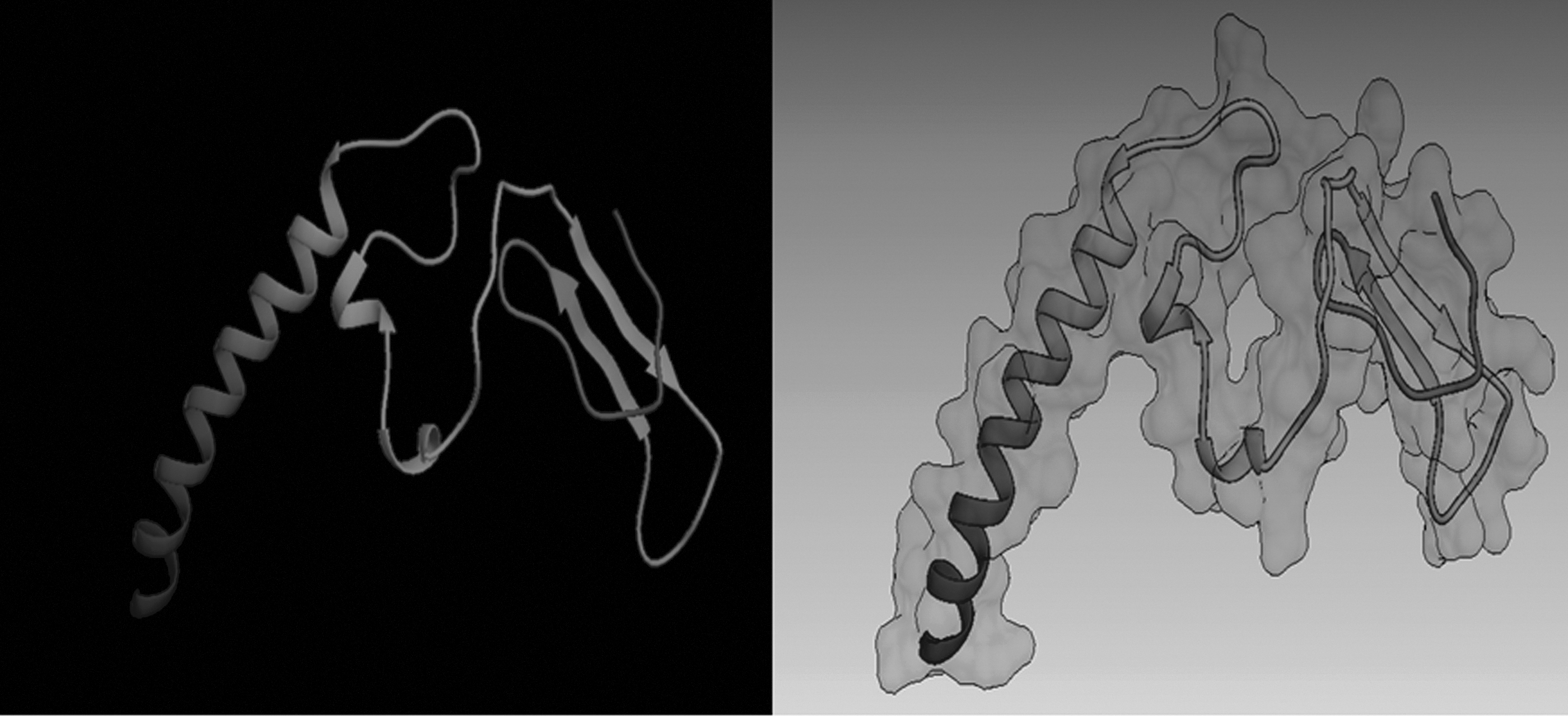
Tertiary structure of fusion peptide. The results were prepared by Pyre2 and displayed with Hex. This peptide includes 28.4% α-helix, 10.5% β-sheet, 4.2% turn, and 66.5% coil.
In addition to linear epitopes (Table 1), conformational B-cell epitopes were predicted with Ellipro, as shown in Table 2 and Figure 2. Analyses with Discotope 1.2 r showed more details of tertiary structure (Fig. 3).
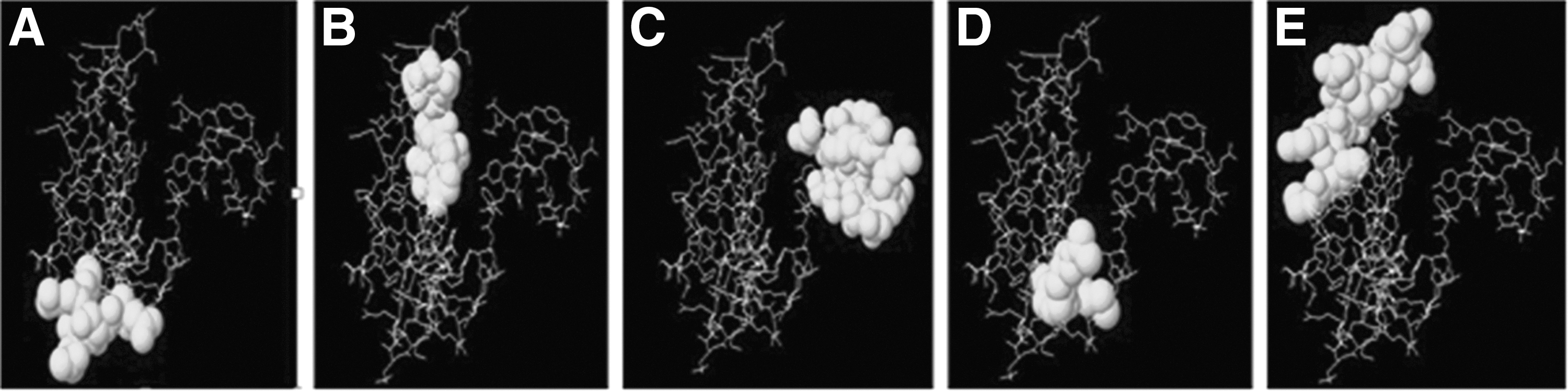
Tertiary structure and position of conformational B-cell epitopes. These structures were predicted by ElliPro as shown in Table 2. (

Epitopic residues colored by binary code. Threshold=1.900. Light, predicted epitope residues. Residues colored by DiscoTope score >1.9 (0.17 sensitivity; 0.95 specificity). Dark gray, high score; darker gray, low score. DiscoTope predicts discontinuous B-cell epitopes from protein three-dimensional structures. The method utilizes calculation of surface accessibility (estimated in terms of contact numbers) and a novel epitope propensity amino acid score. The final scores are calculated by combining the propensity scores of residues in spatial proximity and the contact numbers. A specificity of 0.95 means that 5% of the nonepitope residues were predicted as part of epitopes. A sensitivity of 0.17 means that 17% of the epitope residues were predicted as part of nonepitopes.
Antigenic motifs were confirmed by different programs; hydrophilic motifs are marked with an asterisk. Servers used for prediction are shown as number described as follows: Bcepred, 1; ABCpred, 2; BCPred, 3; and Ellipro, 4. For each peptide, sequence, position, molecular weight, isoelecteric pH, and GRAVY score are indicated. The GRAVY index indicated the hydrophobicity of the peptide and was calculated as the sum of the hydropathy values of the composing amino acids divided by the number of residues in the sequence. Peptides with a negative GRAVY index are hydrophilic, whereas peptides with a positive GRAVY index are hydrophobic.
GRAVY, grand average of hydropathy.
ElliPro associates each predicted epitope with a score, defined as a PI (Protrusion Index) value averaged over epitope residues. For each residue, a PI value is defined as percentage of the protein atoms enclosed in the ellipsoid, which approximates the protein surface, at which the residue first becomes lying outside the ellipsoid; for example, all residues that are outside the 90% ellipsoid will have PI=9 (or 0.9 in ElliPro).
Motifs E29, _:S30, _:Q31, _:R32, _:N33, _:G34 and K62, _:I63, _:D64, _:F65, _:K66, _:T67, _: L68 were identified as both linear and conformational B cell epitopes by the different programs.
Different programs were used to predict T-cell epitopes in the proposed peptide (Table 3). The various programs detected identical motifs.
Antigenic motifs were confirmed by different programs; hydrophilic motifs are marked with an asterisk. Programs used for prediction are shown as number described as follows: Bcepred, 1; ABCpred, 2, BCPred, 3; and Ellipro, 4. For each peptide, sequence, position, molecular weight, isoelecteric pH, and GRAVY score was indicated.
Furthermore, MHC-I binding motifs were predicted and similar results were found in both programs. Interestingly, this motif (IDFKTLKNL) is identified by seven MHC_I in both programs, but the exact molecules vary. Five types of HLA (HLA-B*3701 HLA-B40, HLA-B60, HLA-B61, HLA-Cw*0602) were shared between both programs. RFKIDFKTL was identified by HLA (HLA-B*0702, MHC-Kb, MHC-Kd, HLA-Cw*0401) in ProPed I rand HLA-G in nHLAPred. Ten T-helper epitopes were identified by HLA-DR4Pred. The results are shown in Table 4.
The HLA-DR4Pred is a support vector machine (SVM) and artificial neural network (ANN)–based HLA-DRB1*0401 (MHC class II alleles) binding peptides prediction method. The accuracy of the SVM- and ANN-based methods is ∼86% and ∼78%, respectively. The performence of the methods was tested through five-set cross-validation.
Discussion
The fusion antigenic protein introduced here may be a starting point for designing effective rotaviral vaccines. Rotavirus infection results in high child mortality rates and is a significant economic burden in the developing world. Improvements in healthcare have not had a great impact on the incidence of rotavirus infection; vaccination is the best and most effective way to control this infection (39).
The role of humoral immunity against rotavirus has been demonstrated in multiple studies (33,50,53). Prediction of linear B-cell epitopes is helpful to investigate whether these peptides are able to activate humoral immunity. Bcpred (55), Bcepred (8), ABCpred (47), Ellipro (40,42,54), and Discotope 1.2 server (30) scored the peptide in this study high for humeral immunity.
NetCTL 1.2 (20), EpiJen (41), nHLAPred (28), CTLPred (44), TAPpred (29), and HLA-DR4Pred (25) confirmed the possibility of the peptide in this study stimulating cellular immunity as well.
One of the biggest complications in producing powerful vaccines against retroviruses is the variability of their genome. In developing countries, human rotavirus strains include different combinations of G/P types. This is due to rearrangement of different rotavirus strains, including animal-specific types, and this results in diversity in strains from area to area (58). This diversity results in variable efficacy of present vaccines in different countries (59). In this study, conserved regions of the rotavirus genome were considered as a vaccine target, as rapid genomic changes may have less impact on its effectiveness.
Another advantage of the model peptide presented in this research as a vaccine is the absence of motifs that may promote an autoimmune response. The current live vaccines have side effects such as bowel obstruction, restlessness, fever, and nausea in infants (60,61). Production, transportation, and storage of current vaccines are very expensive (62). In addition, this vaccine was designed for production in a prokaryotic expression system that is simpler and cheaper than a eukaryotic system. Practical studies are needed to validate the model peptide, but this type of vaccine could improve health in developing and underdeveloped countries.
Footnotes
Acknowledgments
This study was supported by research funding of Shahrekord University.
Author Disclosure Statement
No competing financial interests exist.