




Abstract
Dengue cases were reported to undergo platelet activation and thrombocytopenia by a poorly understood mechanism. Recent studies suggested that Carica papaya leaf extract could recover the platelet count in dengue cases. However, no studies have attempted to unravel the mechanism of the plant extract in platelet recovery. Since there are no available drugs to treat dengue and considering the significance of C. papaya in dengue treatment, the current study aimed to evaluate two research questions: First one is to study if the C. papaya leaf extract exerts its action directly on platelets and second one is to understand if the extract can specifically inhibit the platelet aggregation during dengue viral infection. Sixty subjects with dengue positive and 60 healthy subjects were recruited in the study. Platelet-rich plasma (PRP) and platelet-poor plasma were prepared from both the dengue-infected and healthy control blood samples. Effect of the leaf extract obtained from C. papaya leaves was assessed on plasma obtained as well as platelets collected from both healthy and dengue-infected individuals. Platelet aggregation was significantly reduced when leaf extract preincubated with dengue plasma was added into control PRP, whereas no change in aggregation when leaf extract incubated-control plasma was added into control PRP. Upon direct addition of C. papaya leaf extract, both dengue PRP and control PRP showed a significant reduction in platelet aggregation. Within the dengue group, PRP from severe and nonsevere cases showed a significant decrease in aggregation without any difference between them. From the study, it is evident that C. papaya leaf extract can directly act on platelet. The present study, the first of its kind, found that the leaf extract possesses a dengue-specific neutralizing effect on dengue viral-infected plasma that may exert a protective role on platelets.
Introduction
D
DV infection causes thrombocytopenia in both mild and severe diseases (14). The precise mechanism accounting for thrombocytopenia in dengue infection remains unclear. However, an increased platelet destruction and bone marrow suppression are touted to be the causes for the decrease in the platelets (8). Platelet destruction may happen due to activated platelets mediated by DV-infected plasma.
Recent studies on alternative medicine have reported that the juice from the leaves of the Carica papaya plant could help to increase the platelet levels in DV-infected patients (17). C. papaya, a member of the Caricaceae family, is predominant in most tropical and subtropical countries of the world, where dengue is highly endemic (2). The membrane stabilization property of C. papaya leaf extract ascertained its therapeutic value (12). Leaf extract of C. papaya was reported to maintain the normal level of hematocrit and accelerates the number of platelets in dengue-infected cases, thereby resuming the platelet number among dengue-infected cases (1,6,13,17). However, no reports are available on the mode of action of C. papaya leaf extracts in recovering platelet counts. Considering the significance of C. papaya in the treatment of dengue, the present study was undertaken to find if C. papaya leaf extract exerts its action directly on the platelets and can the juice extract of the study plant specifically recover the platelets in dengue viral-infected plasma.
Materials and Methods
Study participants and dengue classification
The study was carried out in Jawaharlal Institute of Postgraduate Medical Education and Research (JIPMER), a tertiary care hospital and research center, South-Eastern India.
Dengue-infected cases that show positivity for NS1 antigen or IgM anti-dengue antibodies were recruited in the study after obtaining written informed consent from each participant. Dengue cases were diagnosed and confirmed by the commercially available dengue-specific NS1, anti-dengue IgM and IgG pan bio ELISA kit method (PanBio Pty Ltd., Brisbane, Australia) according to the manufacturer's instructions. Cases that were positive for dengue NS1 antigen or anti-IgM dengue antibodies (n = 60) and equal number of healthy volunteers as control subjects were included. Patients with inherited platelet disorders or on medications that interfere with platelet function were not enrolled in the study. Dengue-positive cases were further classified into severe (n = 10) and nonsevere dengue (n = 50) based on the WHO 2009 criteria (20).
Analysis of ADP-stimulated platelet aggregation
Venous puncture was performed with strict aseptic precautions as per the standard protocol by the specialist. Five and 10 mL of blood samples from dengue patients during admission into hospital and normal individuals were collected, respectively, into the 3.2% sodium citrated tubes (anticoagulant: blood 1:9). Immediately, the blood samples were centrifuged at 700 rpm for 10 min for platelet-rich plasma (PRP) separation and further centrifuged at 3,000 rpm for 15 min to yield platelet-poor plasma (PPP). Platelet aggregation was induced by the addition of ADP (10 μM) and measured in a Chrono-log platelet aggregometer (model 700) under constant stirring (1,000 rpm) at 37°C within 3 h of collection of blood (as per the Chrono-log manufacturer's protocol).
Preparation and concentration of C. papaya leaf extract
The plant authentication and extraction procedure was verified by Dr. Navasakthi, a qualified doctor in naturopathy (JIPMER). Mature fresh leaves of C. papaya were thoroughly washed with water; the leaves were then grounded into paste after removing the petiole, veins, and leaf blades. The filtrate was collected by straining the paste using gauze. Further, the filtrate was lyophilized and used for further experiments.
Assessment of baseline platelet aggregation in dengue and control cases
To assess the baseline platelet aggregation levels, PRP of both control and cases was preincubated with or without plasma (30 min at room temperature), and further, the ADP-stimulated aggregation procedure was carried out (7). (For standardization details see Supplementary Data; Supplementary Data are available online at
Assessment of the effect of leaf extract on dengue-infected plasma (PPP)
To determine the effect of leaf extract on plasma, dengue-infected plasma was preincubated with or without C. papaya leaf extract for 30 min. The preincubated plasma was added to control PRP and then the ADP-stimulated aggregation procedure was carried out (7).
Assessment of the direct effect of leaf extract on platelets (PRP)
To determine the direct effect of leaf extract on platelets, PRP of both dengue and control cases was directly added with leaf extract, and further, the ADP-stimulated aggregation procedure was carried out (7).
Statistical analyses
Platelet aggregation values were expressed as median with interquartile range. The Kolmogorov–Smirnov test was used to determine whether samples followed a normal distribution. Between-group comparisons were made by using the independent t-test and Mann–Whitney U-test. Within-group comparisons were made by using the paired two-tailed t-test and Wilcoxon signed-rank test. All statistical analyses were carried out at the 5% level of significance and p-value <0.05 was considered as significant. Data were analyzed using SPSS software version 21.
Results
Dengue diagnosis and classification
In this study, 60 patients were confirmed for dengue by Dengue NS1 antigen enzyme-linked immunosorbent assay tests. Among these dengue confirmed patients, 10 cases were classified as severe dengue and 50 cases as nonsevere dengue.
Baseline platelet aggregation in control PRP
Baseline platelet aggregation assay showed 70% aggregation in control PRP and 9% in dengue cases. Addition of control plasma to control PRP showed 62.5% aggregation, whereas the addition of dengue-infected plasma to control PRP showed an aggregation of 67.5%. Thus, a decrease in platelet aggregation was observed without any significant change (Table 1 and Fig. 1).
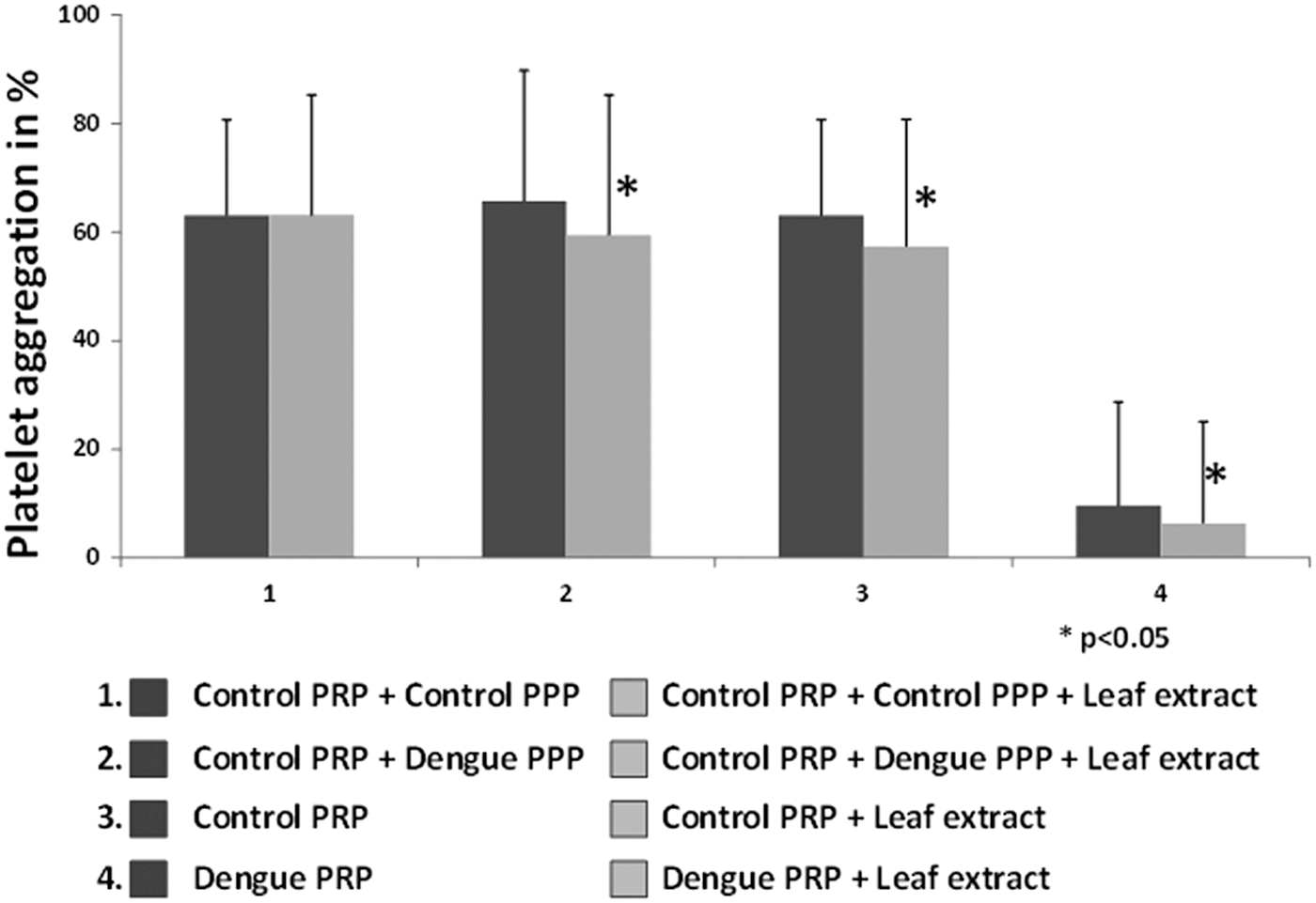
In vitro effect of Carica papaya leaf extract on platelets of both healthy controls and dengue patients. PPP, platelet-poor plasma; PRP, platelet-rich plasma.
Values are expressed as median (interquartile range) and mean ± standard deviation.
Indicates p < 0.05 using independent Student's t-test and Mann–Whitney U-test.
PPP, platelet-poor plasma; PRP, platelet-rich plasma.
Effect of C. papaya leaf extract on dengue-infected plasma (dengue PPP)
Platelet aggregation was significantly decreased (from 67.5% to 56.0%) when leaf extract preincubated dengue plasma was added into control PRP (Table 2 and Fig. 1). Within the dengue group, both the severe and nonsevere dengue plasma (leaf extract preincubated) showed a decrease in platelet aggregation, however, no significant difference was noted (Table 2). In contradiction, the platelet aggregation level remained unchanged when leaf extract-incubated control plasma was added into control PRP (Table 2 and Fig. 1).
Values are expressed as median (interquartile range) and mean ± standard deviation.
Indicates p < 0.05 using paired t-test or Wilcoxon signed-rank test for parametric and nonparametric data, respectively.
Effect of direct addition of C. papaya leaf extract on platelets (PRP)
A significant reduction in platelet aggregation was seen upon direct treatment of C. papaya leaf extract on platelets. Within dengue cases, a significant reduction of platelet aggregation was observed in both severe and nonsevere form, although no statistical significance was obtained between them (Table 3). Similarly, platelet aggregation was also significantly decreased in control platelets (70–53%) when leaf extract was added directly into control PRP (Table 3 and Fig. 1).
Values are expressed as median (interquartile range) and mean ± standard deviation.
Indicates p < 0.05 using Wilcoxon signed-rank test.
Discussion
DV is known to alter the behavior of platelets and decreases the circulating platelet count, a condition known as thrombocytopenia. This diminished platelet production can occur either during megakaryopoiesis or due to exaggerated platelet activation during the onset of dengue viral infection (9) by some mechanism that is not completely understood. DV is reported to directly infect the platelets that cause platelet aggregation (19) and the dengue serum was shown to abnormally activate platelet and inhibit platelet aggregation (11,18). Key mediators that activate platelets and induce thrombocytopenia are not well defined yet. Platelet transfusion has been used as a strategy to treat severe bleeding in patients with dengue, however, recent WHO guidelines do not recommend platelet transfusion for hemodynamically stable patients with thrombocytopenia. Thus, it becomes important to identify other modes by which the number of platelets could be restored during dengue viral infection.
The leaf extracts of C. papaya are reported to aid for better recovery of dengue in terms of clinical symptoms and platelet counts (5). A computational study predicted that the compound quercetin, a flavonoid present in the leaves of C. papaya, would be responsible for anti-dengue viral replicative properties (15). However, the actual mechanism by which C. papaya leaf extracts exert action in platelet recovery is not known. The present study attempted to characterize if the leaf extract has any effect on platelet aggregation.
The study initially attempted to find the effect of dengue-infected plasma on control platelet aggregation. From Table 1, it was inferred that the decrease in platelet aggregation was more prominent when control plasma was added to control platelet than when dengue-infected plasma was added to healthy platelets. This difference may be because of the activation of resting platelets by the factors present in dengue-infected plasma. To assess the influence of the leaf extract in recovering dengue-infected cases, we incubated the extract with dengue-infected plasma and control plasma separately for 30 min and then added the mixture to normal control platelets. On ADP-stimulated aggregation, the study recorded a significant decrease in the platelet aggregation in the control platelets that were mixed with dengue-infected plasma pretreated with leaf extract. Within dengue cases, a significant reduction in platelet aggregation was observed both in severe and nonsevere forms, although there was no statistical significance between them. Whereas no inhibition in platelet aggregation was recorded in control platelets that were added with normal plasma preincubated with leaf extract (Table 2); thus, the plant extract could specifically regulate the factors released in plasma because of DV infection. This shows that the leaf crude extracts possess a neutralizing effect on dengue-infected plasma, which supports the available reports on “C. papaya decoction—a treatment for dengue” (1,13).
On treating the extract on control PRP and dengue viral-infected PRP individually, both the healthy control and dengue-infected cases showed a significant reduction of platelet aggregation (Table 3). This demonstrates that the extract can play a protective role on platelets thus preventing them from activation and aggregation. This is further supported by an earlier finding that reported the membrane stabilization properties of the C. papaya leaf extract that protects the plasma membrane from stress-induced destruction (12).
However, the activity of the extract on follow-up samples and the characterization of active principle present in the crude extract that exerts the membrane stabilization activity need further studies.
Thus, in conclusion, although previous studies have reported the effect of C. papaya leaf extracts in improving platelet counts in dengue-infected individuals, the present in vitro study found that the leaf extract is directly acting on all platelets and prevents platelet aggregation thus confirming the membrane stabilization properties of the plant material. For the first of its kind, the present study found that the leaf extract could possess a dengue-specific neutralizing effect on dengue viral-infected plasma that may exert a protective role on platelets.
Footnotes
Acknowledgments
The authors thank Dr. Smitha Koshy, who helped in designing the study methodology. The authors are grateful to the study subjects and JIPMER Intramural Research Fund for supporting the study.
Author Disclosure Statement
No competing financial interests exist.
References
Supplementary Material
Please find the following supplemental material available below.
For Open Access articles published under a Creative Commons License, all supplemental material carries the same license as the article it is associated with.
For non-Open Access articles published, all supplemental material carries a non-exclusive license, and permission requests for re-use of supplemental material or any part of supplemental material shall be sent directly to the copyright owner as specified in the copyright notice associated with the article.
