




Abstract
Mutations and recombination events have been identified in enteroviruses. Point mutations accumulate with a frequency of 6.3 × 10⁻⁴ per base pair per replication cycle affecting the fitness, the circulation, and the infectivity of enteroviral strains. In the present report, the serological status of the Central and Western Greek population (Larissa and Ioannina, respectively) in the 1–10-year, 11–20-year, 21–30-year, and 31–40-year age groups against six non-polio enterovirus strains, their respective echovirus prototypes, and Sabin 1, 2, and 3 vaccine strains was evaluated, through serum-neutralization assay. In the Western Greek population, antibody levels were detected only for clinical isolates of E30 serotype in all age groups, and for environmental isolate LR61G3 (E6 serotype) only in the 31–40 age group, whereas an immunity level was observed in the Central Greek population, against all strains, except for EIS6B (E3 serotype). Amino acid substitutions were encountered across the structural region of the capsid, between the prototypes and the respective isolates. These substitutions may alter the antigenicity of each strain and may explain the variations observed in the neutralization titers of the different strains. As a consequence, these substitutions severely affect antibody binding and increase the ability of the virus to escape the immune response. It is tempting to assume that changes in the antigenic properties observed in circulating echoviruses represent a selection of viral variants that are less prone to be neutralized by human antibodies. These facts argue for the need of immunological studies to the population to avoid epidemics due to the circulation of highly evolved derivatives.
Introduction
E
Although most enterovirus infections are asymptomatic, EVs can cause a wide range of clinical diseases such as aseptic meningitis, meningoencephalitis, myocarditis, acute hemorrhagic conjunctivitis, hand, foot, and mouth disease. EVs have also been implicated in chronic diseases such as dermatomyositis and polymyositis (20).
Nucleotide substitutions that occur due to the high-frequency error rate of RNA-dependent RNA polymerase (RdRp) (10), and recombination events, are the main mechanisms of EV evolution (5,21,25). Recombination events accelerate viral evolution through the exchange of genomic regions between strains of the same serotype (intraserotypic) or different serotypes (interserotypic) by creating strains with an increased fitness enhancing the aptitude of these strains to replicate in the gastrointestinal tract compared with their parental strains (14,16).
In the present report, a serum-neutralization assay was performed. More specifically, the immunity level of the Central and Western Greek population in the 1–10, 11–20, 21–30, and 31–40-year age groups, against 6 recombinant non-polio EVs with regard to their respective prototype strains (echovirus 3, 6, 7, and 30) and Sabin 1, 2, and 3 vaccine strains, was evaluated. Furthermore, we tried to figure out, whether the amino acid substitutions, which were found in the capsid region between circulating isolates and their respective prototype strains, reflect the observed differences to the neutralization titers leading to different immune responses against the circulating non-polio EV strains.
Materials and Methods
Investigated enterovirus strains
Six circulating enterovirus strains were used in this report. These strains were identified in our laboratory, in previous studies. Two of them (Han and Gior) were clinical isolates, whereas the other four strains (LR11F7, LR61G3, LR31G7, and EIS6B) were environmental strains. Details about the origin of these strains, their serotype, the probable donor, the recombination site, the year of isolation, the corresponding accession number, and the related references are presented in Table 1.
Cell cultures
The cell line Rd was used for the viral propagation in plastic test tubes, containing 2 mL of Dulbecco's modified Eagle's medium (D-MEM). The inoculated tubes were incubated in a rotating rolling rack at 37°C for a period of 1–6 days, until complete cytopathogenic effect (CPE) was observed. As negative control, uninfected Rd cells were used.
Serum collection
Sera were collected from two regions of Greece (Western and Central). Specifically, 120 individual sera/regions were used in the study. For each region, four different pools of sera were made and each pool consisted of 30 individual sera. These serum pools represented the four different age groups 1–10, 11–20, 21–30, and 31–40-year olds.
Serum neutralization assay
The immunity level of the Central and Western Greek population in the 1–10, 11–20, 21–30, and 31–40-year age groups, against six recombinant non-polio EVs with regard to their respective prototype strains (echovirus 3, 6, 7, and 30) and Sabin 1, 2, and 3 vaccine strains was evaluated. Neutralizing antibody titers were determined by serum neutralization, according to the World Health Organization (WHO) guidelines (29). Pooled sera, collected from Central (Larissa) and Western Greece (Ioannina) in the years 2008 and 2014 (30 individual sera/age group/population), were used for this neutralization assay. The sera were derived from blood donors.
Serum pools were diluted 1:10 in DMEM, inactivated for 50 min at 56°C, diluted twofold from 1:10 to 1:1,280, and incubated in duplicate for 1 h at 37°C with 100 50% cell culture infective dose (CCID50) with each one of the six circulating strains, the four echovirus prototype strains, as well as with the Sabin vaccine strains (Sabin 1, 2, 3). Then, a cell suspension containing 104 Rd cells/0.1 mL was added. A 96-well plate was used for each strain, which included virus, cell, and serum controls, and was daily observed.
Virus controls consisted of Rd cells infected with 100 CCID50 with each one of the six circulating strains, the four echovirus prototype strains, as well as with the Sabin vaccine strains (Sabin 1, 2, 3). Cell and serum controls consisted of noninfected Rd cells in the presence of the respective pool of sera from each age group. When the virus controls showed complete CPE, the final results were read 24 h later and the higher dilution of serum pool protecting the cell cultures was recorded. Results were expressed as log10 reciprocal titers (log10 titer 1:10 = 1).
Biostatistical and bioinformatics analyses
To assess if there is any difference in antibody levels between the prototype strains (echovirus 3, 6, 7, and 30) and the respective circulating isolates (Han, Gior, LR11F7, LR61G3, LR31G7, and EIS6B) in Central (Larissa) and Western Greece (Ioannina), 30 individual sera were pooled and this has be done for the age groups of 1–10, 11–20, 21–30, and 31–40-year olds. We performed that pooling for four age groups, thus generating 4 different pools of 30 individuals each and tested the antibody levels against the prototype strains as well as against the circulating isolates in each of these 4 age pools via serum dilutions (1/1, 1/10, 1/20, 1/40). These dilution values were converted to log values of base 10. For example, the serum dilutions for the four age groups (log10) for E30 in Larisa were 1.3, 1.6, 1.6, and 1.6, and the four serum dilutions for the four age groups for Han were 1.3, 1.3, 1.3, and 1.6, respectively.
Next, an average serum dilution for the four age groups as one group was calculated for each virus strain in each geographic region. For example, the average serum dilution for E30 in Larissa was 1.52 and the average serum dilution for Han in Larissa (average of the four age groups) was 1.37, respectively. Next, their difference in average values was calculated as well (0.15).
To investigate if the difference in average serum dilution between an isolate (e.g., Han in Larissa) and its prototype (E30 in Larissa) in a geographic region was statistically significant, the four dilution values (corresponding to the four age groups) for a certain isolate/prototype were considered as one population and compared to another population for another isolate/prototype of the same geographic location.
Student's t-test is not suitable for this analysis due to the small population size of four dilution values of each group. To assess whether this observed difference (E30 Larissa–1.52, Han Larissa–1.37, difference–0.15) was statistically significant, Monte Carlo simulations were performed based on the observed frequencies (multinomial distribution) of the dilutions (1/1, 1/10, 1/20, 1/40) for each prototype strain and the respective circulating isolates, in each geographic region (9). The simulation process randomly sampled four dilution values for each of the two virus strains and the average dilution difference was calculated. This simulation was performed 10,000 times, thus generating an empirical distribution of average differences of dilutions between any two strains.
This generated distribution was used to assess the p-value of each observed difference between any two strains. In addition, p-values were corrected for multiple testing with the Benjamini–Hochberg false discovery rate (FDR) method (4), while all the above statistical analyses were performed with the MATLAB software. p-Values, followed by FDR correction, of <0.05 indicated statistically significant results.
Amino acid sequence alignment between the prototype strains and the recombinant isolates was achieved using Mega-BLAST. Visualization of amino acid substitutions identified in the capsid region was based on the capsid protomer structure of E11, using the PyMOL as it is the most related sequence available (
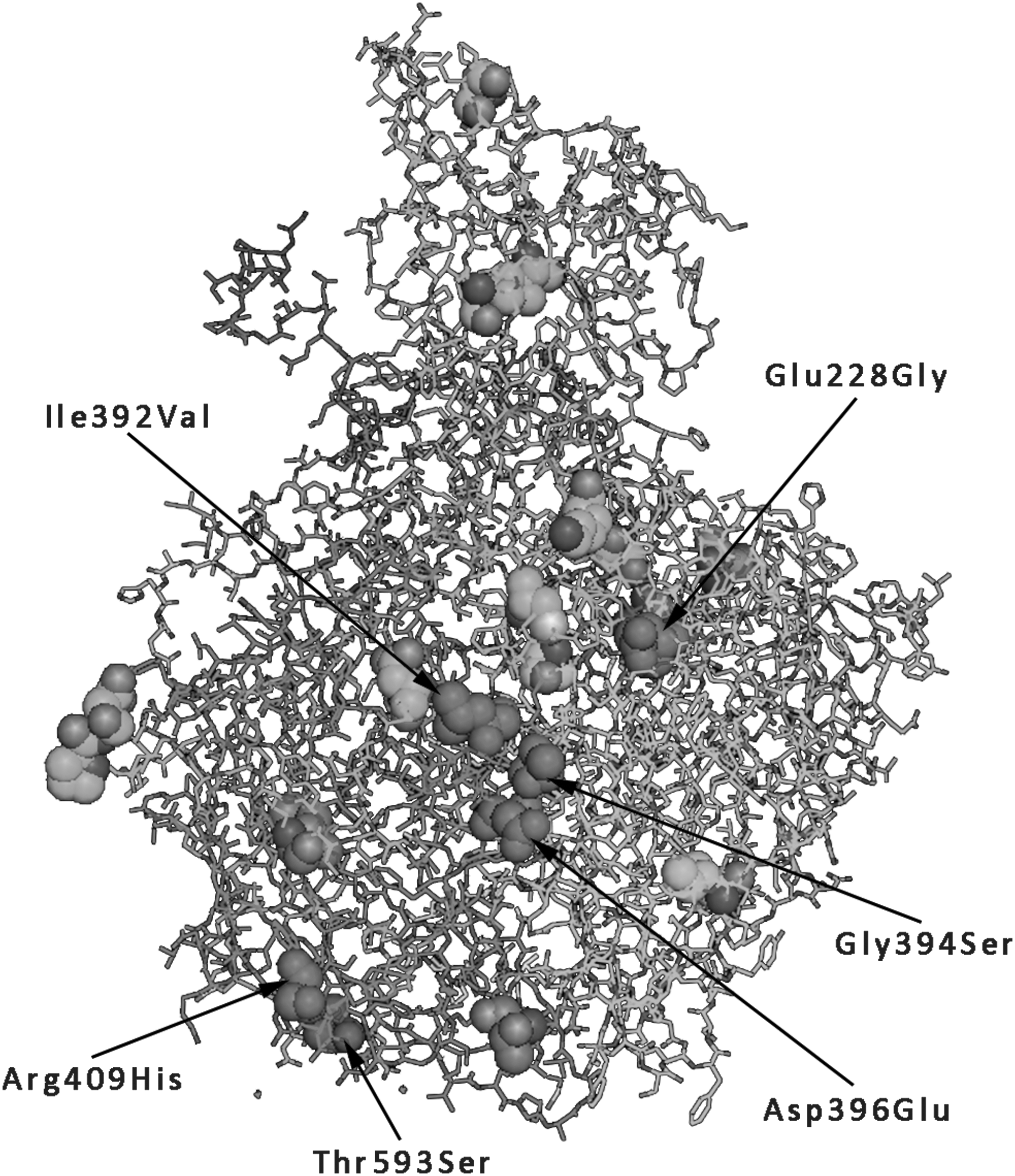
Illustration of amino acid substitutions between the recombinant strain EIS6B and the prototype strain of E3 in capsid region. Figure was made with PyMOL. Spheres correspond to amino acid differences between these two strains, whereas the dark spheres are related to differences in antigenic sites of CAV9, used as a guide structure (6,22). Substitutions and their nucleotide position to the capsid are illustrated in the context. For visualization reasons, the promoter structure of E11 was used (DOI:10.2210/pdb1h8t/pdb). E, echovirus; CAV, coxsackie A virus.
BLOSUM matrices (BLOSUM62) were used to score alignments between evolutionarily divergent protein sequences. More specifically, this program counted the relative frequencies of amino acids and their substitution probabilities, after scanning of the conserved regions of proteins. This procedure was performed to discern the importance of each substitution. Substitutions with negative or zero score are not favored and lead to important changes of physicochemical properties of residues in the capsid region. More particularly, the higher the value (positive score), the more favored is the respective amino acid substitution in nature. On the contrary, the lower the value (negative score), the less favored is the amino acid substitution in nature (11). These substitutions might be liable for the effect on antibody binding.
Results
Table 2 shows the results of serum neutralization between the two populations (Western and Central Greece), expressed as log10 units, and the statistical analysis according to the Monte Carlo test. As observed, there was a significant difference at the antibody levels between the E3 prototype and the environmental isolate EIS6B in Central Greece ([pFDR = 0.00036] p-value <0.05). In contrast, in the population of Western Greece, borderline significant differences were only observed in the antibody levels between the E3 reference strain and isolates LR31G7 and EIS6B ([pFDR = 0.047] p-value <0.05).
The underlined means presented significant differences according to Monte Carlo test.
The first column contains the recombinant strains and the prototype strains in parenthesis. p-Values show the statistical significance of average log10 titers' difference between the recombinant and prototype strain in each geographic region. This statistical significance is based on Monte Carlo simulations. p-Values were also corrected with the FDR multiple testing correction method.
FDR, false discovery rate.
Table 3 depicts the observed amino acid substitutions in the capsid region, which correspond to the possible antigenic sites between prototype strains and recombinant isolates (antigenic sites of CAV9). Although a lot of substitutions were identified, only a few of them were related to changes to physicochemical properties of amino acids.
Parentheses indicate the structural protein, where substitutions took place. Values, according to BLOSUM62 analyses, are described by square brackets. The higher the value, the more favored is the respective amino acid substitution in nature. On the contrary, the lower the value, the less favored is the amino acid substitution in nature. The underlined amino acid positions show the substitutions, which lead to changes of residue's properties.
These substitutions were detected between E30/Han and E30/Gior at positions, 227 and 573, whereas an additional position was found at 388 between Han and E30. Regarding the prototype strain E6 and LR61G3, only one amino acid substitution, which causes substantial change to the nature of residue, was noted at position 230. Concerning E3 and the respective environmental isolates, EIS6B and LR31G7, three substitutions were revealed, in which essential changes of amino acid residues were held. These changes were located at 228, 394, and 409 amino acid positions in the capsid region. Moreover, numerous substitutions were observed between the prototype E7 and the environmental isolate LR11F7. Compared with the other strains, a large number of these substitutions were associated with changes to physicochemical properties. Their positions in the capsid region were situated at 225, 226, 229, 389, 394, and 573.
Different or similar neutralizing titers were observed between the prototypes and their respective isolates. These differences were related to amino acid substitutions in the capsid region and especially to possible antigenic sites between these strains (Table 3). For instance, amino acid substitutions in the capsid region, between the recombinant strain EIS6B and the prototype strain of E3, are shown in Figure 1.
As pointed, a number of substitutions were visualized across the structural region of the capsid. From the changes, which are illustrated and correspond to possible antigenic sites (red spheres), three of them show significant changes in residue's properties. More specifically, change of glutamic acid residue to a conformationally different glycine residue, change of glycine to serine residue, and shift of arginine to aromatic histidine were identified at positions 228, 394, and 409, respectively. Nevertheless, several substitutions take place in regions, close to antigenic sites, for instance, in VP1, Asp841Thr, Thr855Met, and Glu856Gly that constitute substitutions, leading to physicochemical changes of residues.
Concerning the Sabin vaccine strains, the immunity level was higher than those of the investigated circulating strains for both populations. As was expected, the 1–10 age group exhibited elevated levels of antibodies due to the relatively recent vaccination with Sabin vaccine strains.
Discussion
EVs are responsible for a number of aseptic meningitis epidemics worldwide. In Greece, two outbreaks have occurred in 2001 and 2007. Previous studies have revealed that echoviruses played a dominant role with the most prevalent serotypes being E30 and E6 (12,26).
In the present report, the immunity level of Western and Central Greek population was evaluated. Antibody levels in the Western and Central Greek population were higher against the circulating clinical isolates of E30 serotype, compared to those levels of the four other environmental isolates. More specifically, antibody levels against Han and Gior were much higher than those of LR11F7, LR61G3, LR31G7, and EIS6B strains in Western Greece, where no antibody levels were observed, except for LR61G3 in the age group of 31–40. In Central Greece, only the LR31G7 strain presented similar antibody levels with Han and Gior, but still those levels were lower than those of clinical isolates of E30. The lower neutralization test titer, observed in the age group of 1–10, was due to the time difference between the burst of the epidemic and the birth date of this age group.
Concerning the environmental isolate, LR61G3, a low immunity level was detected in the 31–40 age group in the Central and Western Greek population and in the age group of 1–10 only for Central Greece. This strain, even though was released during the epidemic of 2007, was not the main strain of the epidemic, since it was isolated from a limited number of patients (18).
Low levels of antibodies were detected against the environmental strain LR11F7 in the population of Central Greece, while no antibody level was encountered for the population of Western Greece, since this strain was isolated in 2005 from Central Greece. This finding argues for the local circulation of LR11F7 strain in Central Greece.
Concerning the environmental isolates, EIS6B and LR31G7, antibody levels in the Western and Central Greek population were undetectable for EIS6B, whereas immunity protection against LR31G7 was only encountered in the population of Central Greece in all age groups. This may be explained by the fact that LR31G7 and EIS6B were isolated in 2005 and 2009, respectively, from Central Greece, and thus, LR31G7 has circulated for a longer time period resulting in the infection of more individuals.
E30 constitutes a serotype with a wide temporal and spatial isolation range. In the last decades, repeated outbreaks and nationwide epidemics of E30 have occurred in Europe (19), Asia (28), and the United States (7). These facts explain why immunity protection against E30 was higher than that against the other serotypes in both populations. These results are also in accordance with previous studies (3).
Although E6 is one of the most frequent serotypes, it has been suggested that after some years of circulation, the virus follows a silent transmission in the population, leading to re-emerging E6 outbreaks (27). To our knowledge, no large outbreaks of E3 have been recorded in Greece, since E3 is a rare serotype in Europe (13). Finally, there are not enough details about the epidemiological pattern of E7.
The neutralizing titers against the prototype strains were higher than against the circulating isolates except for clinical strains Han and Gior of E30 serotype, which presented almost the same antibody levels with their respective prototype E30. Four of six investigated strains were environmental strains that showed lower antibody levels than their respective prototypes. A reasonable explanation could be the isolation year of each strain, since these strains were isolated in 2005, 2006, and 2009 and have not circulated for a long time in the investigated population. Substitutions in the capsid region of these strains may affect the antibody binding and as a consequence cause different immune responses reflecting the differences in the neutralization titers.
As observed from Table 3, a number of significant changes were observed between the environmental isolates and their respective prototypes, leading to different neutralization titers. Concerning clinical isolates and their respective prototype E30, similar antibody levels were observed since these strains were isolated in 2001, and later, E30 constitutes a serotype that gave the last decades, repeated outbreaks and nationwide epidemics in Europe (19). Substitutions, especially in the VP1 capsid region, were detected in clinical and environmental isolates compared to their respective prototype strains. These substitutions may alter the antigenicity of each strain.
Although many substitutions lead to amino acid changes in the capsid region, only a few of them are located on the antigenic sites of the capsid. These substitutions severely affect antibody binding and perhaps increase the ability of the virus to escape immune response (8). This was confirmed with the difference observed in the antibody levels between the prototype and the investigated strains. Only the Gior clinical strain showed similar antibody levels with its prototype (E30). This is justified, because E30 represents one of the most frequently circulating serotypes worldwide. Perhaps amino acid changes, which were observed between Gior and E30 in the capsid region, do not have a serious effect on antibody binding, leading to similar responses from the immune system.
In conclusion, environmental surveillance is of great importance as it highlights the circulation of enteroviral strains in the population regardless of any clinical symptom. It is tempting to assume that changes in the antigenic properties observed in circulating echoviruses represent a selection of viral variants that are less prone to be neutralized by human antibodies (e.g., EIS6B). These facts argue for the need of immunological studies for the population to avoid epidemics due to the circulation of highly evolved recombinant derivatives. These findings also emphasize the importance of long-term, continuous environmental surveillance and genetic analysis to monitor circulating EVs.
Footnotes
Acknowledgment
This study was funded by a research grant of the Post-Graduate Programme “Applications of Molecular Biology-Genetics. Diagnostic Biomarkers,” of the University of Thessaly, School of Health Sciences, Department of Biochemistry & Biotechnology, grant number 3817.
Author Disclosure Statement
No competing financial interests exist.