




Abstract
Rabbit hemorrhagic disease virus (RHDVb) is the new variant of the classical RHDV, a virulent pathogen responsible for an acute disease in young rabbits. The virus invades internal organs, especially the liver, spleen, kidneys, and gut; prevents coagulation; and causes liver necrosis. This eventually leads to quick death of the animal because of hemorrhage. In this study, we evaluated the effects of a new vaccine against RHDVb in rabbits at a young age, after experimental infection using four different viral isolates. Our findings show that the vaccine had a protective effect with survival rates reaching 80–100% against the different isolates. These results suggest that this vaccine, when applied to young animals, is an effective tool to protect against the disease caused by RHDVb in rabbitries.
Introduction
R
Materials and Methods
All animal experimentation was performed in accordance with Spanish legislation on animal experiments and approved by the Animal Experimentation Committee of the Universidad Complutense de Madrid, Ethics Committee of Veterinary Health Surveillance Centre, and Animal Protection Division of the Government of Madrid.
The vaccine, elaborated from livers of infected animals recovered in Spain, is inactivated and has an aluminum hydroxide adjuvant. The four RHDVb isolates used were recovered from recent outbreaks in Spain. The viral inocula were prepared by suspending pieces of liver from infected animals in 10% phosphate-buffered saline. They were then centrifuged at 500 g for 20 min and then at 6,000 g for 30 min. The inocula were titrated by hemagglutination (10) using human blood-B (3) and stored at −80°C until infection.
The rabbits selected were farm-bred, nonvaccinated, and 28 days old females. At this age, rabbits are susceptible to infections because they have lost maternal immunity, but are able to mount an immune response. Upon arrival, the rabbits were identified, and monitoring of their health status, weight, and temperature began. After a quarantine period of 4 days, a total of 54 rabbits (calculated using Statgraphics software) were randomly distributed among 9 cages as follows: 4 “Challenge groups” (7 animals each) challenged with viral isolates 1, 2, 3, and 4, respectively; 4 “Control groups” (5 animals each) for the 4 viral isolates; and a “Vaccine group” (6 animals) that were only vaccinated. They were fed hay, commercial feed, and water ad libitum. The study took place in a level 3 biosafety facility where external parameters (temperature, humidity, and air flow) were controlled.
At day 0, all the “Challenge” and “Vaccine” rabbits were vaccinated subcutaneously with 1 mL of the vaccine. One milliter of sterile physiological saline was injected into the “Control” rabbits. After injection, the animals were monitored daily. Their temperature slightly increased 24–48 h postvaccination with an average of 0.4°C at 24 h and 0.6°C at 48 h. Afterward, the temperature stabilized. All of the vaccinated animals had a subcutaneous nodule measuring about 1 cm at the injection site that is often reported as a temporary result of the adjuvant (9).
At day 7, all the “Challenge” and “Control” animals were infected with 1 mL of the respective viral isolate intramuscularly. One milliliter of sterile physiological saline was injected into the “Vaccine” animals group. In the following days, 10 animals died while showing symptoms of RHD (fever, lethargy, anorexia, apathy, and/or objective pain). Two of them were anesthetized and then euthanized by barbiturate overdose after reaching a humane endpoint. The surviving animals were monitored for 10 days postinfection. None of them showed symptoms of the disease nor died during the experimental period and they were euthanized as previously described.
Results and Discussion
Necropsies of all the animals were performed. None of the surviving animals showed signs suggestive of infection. The animals that died during the first 96 h postinfection showed signs suggestive of RHDVb infection. These findings include epistaxis, conjunctival hyperhemia (Fig. 1), opisthotonos, ascites, pale liver, enlarged congestive spleen, congestive kidneys, visceral petechiae, serosanguineous fluid in cavities, and general vessel congestion.
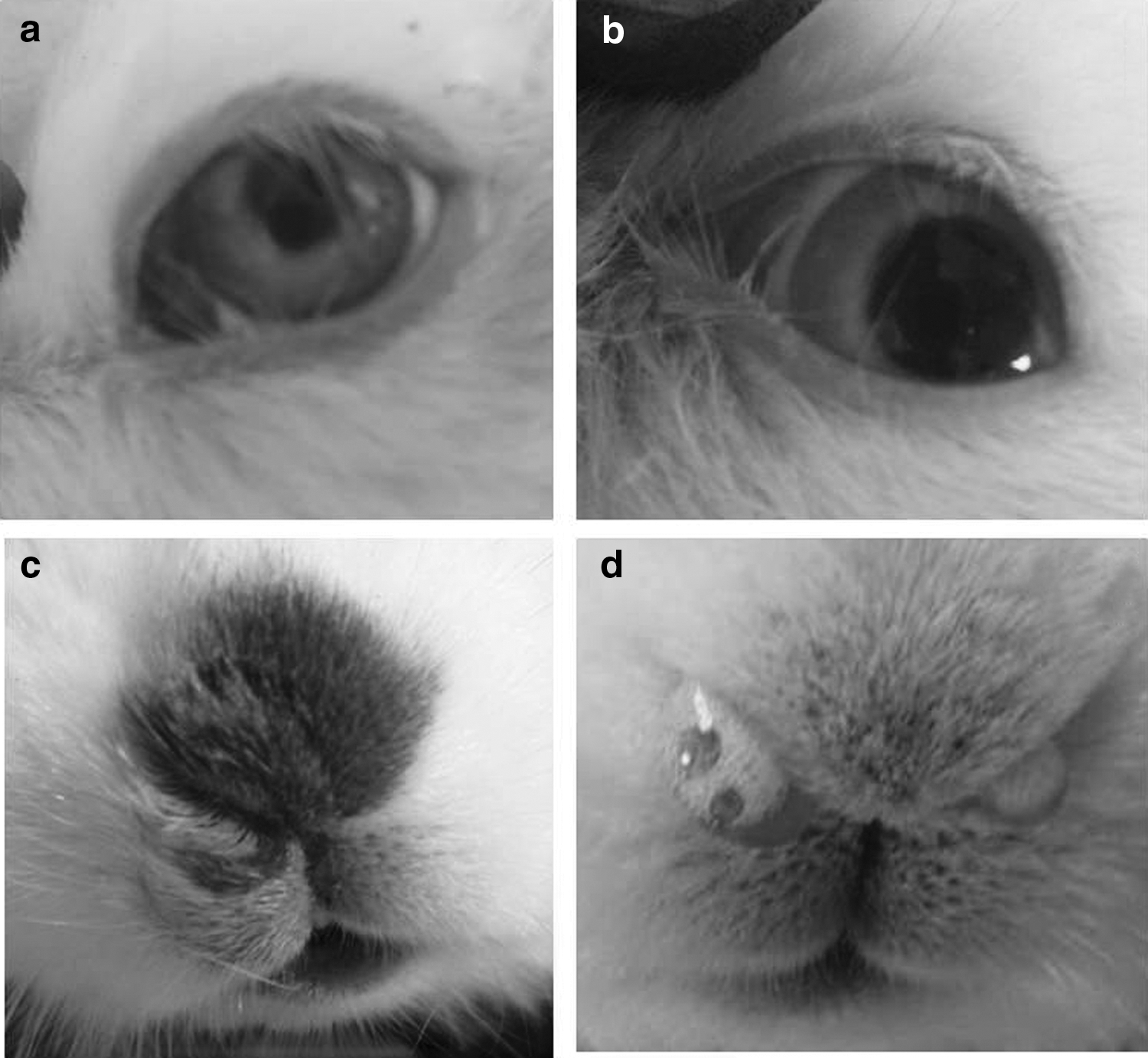
Frequent external clinical findings encountered among animals that died after RHDVb infection.
To assess the efficacy of the vaccine, the preventable fraction (PF) was calculated (Formula 1), where “CD” corresponds to the number of dead control animals and “VD” corresponds to the number of dead vaccinated animals.
PF values that are at least 80% are needed as an indication of appropriate vaccine efficiency (13). Six out of seven animals of “Challenge” groups 1 and 4 survived the challenge (Table 1) and none of them showed signs suggesting RHD after necropsy. The PF for variants 1 and 4 was 86%, indicating good efficiency. The “Challenge” groups 2 and 3 had 100% survival rate with no signs of RHD. This indicates a high-protective effect of the vaccine against these isolates. The “Vaccine” group was not experimentally infected, but could have been exposed to the virus infection by natural routes (oronasal, direct contact, or through fomites) (1). These animals did not show any sign of RHD pre- and postnecropsy.
“CD” corresponds to the number of control animals that died and “VD” corresponds to the number of vaccinated animals that died.
PF, preventable fraction.
Our findings show that the vaccine is efficient in protecting young rabbits against the four different RHDVb isolates used in this study. This vaccine could be a valid option for controlling outbreaks. In future studies, the duration and intensity of the immune response, the effect of the multiple injections over time, and any possible vertical transmission of immunity would be interesting to investigate.
Footnotes
Acknowledgments
This work was funded by the project 129/2015 of the University Complutense of Madrid and Laboratory Ovejero S.A. We thank Juan Pablo Ovejero for his help and for providing the vaccine and the viral isolates used in this study. Furthermore, we thank VISAVET for the assistance in personnel and expertise.
Author Disclosure Statement
No competing financial interests exist.