




Abstract
Hepatitis C virus (HCV) is a major health concern worldwide as a leading cause of liver-related mortalities and morbidities. Pakistan ranks second among countries with endemic HCV infection; ∼11 million cases are reported so far. HCV burden is continuously rising in Pakistan, mainly because of unsafe blood transfusions, surgical procedures, dental procedures, untrained clinicians, reuse of syringes, barbers, and ear/nose piercing tools. Lack of awareness about HCV transmission routes among the general and high-risk population is a major hurdle in disease management. HCV prevalence in the general population and healthy blood donors ranges from 3.13% to 23.83% and from 1.05% to 20.8%, respectively; whereas in the high-risk groups, HCV prevalence is up to 66%. Genotype 3 is most prevalent in Pakistan followed by genotypes 1 and 2 along with an alarming number of untypable viral genotypes in the local community. Mainly interferon-based antiviral regimens are used in Pakistan and are quite effective, because the major prevalent genotype (genotype 3) showed the best sustained virological response (SVR) with it. But a large number of individuals did not show SVR either because of infection with nonresponder genotypes or because of side effects. Due to these reasons, there was a need for interferon-free direct acting antivirals (DAAs). Recently, Sovaldi (Sofosbuvir: NS5B inhibitor) is approved on a heavy discounted rate for Pakistan; it is currently in effective use and showed good SVR. Sovaldi plus ribavirin is used alone or along with interferon to treat different viral genotypes. Sovaldi will be the future treatment regime for Pakistan, because genotype 2 and genotype 3 infected individuals achieve the best SVR with it. For the treatment of other prevalent viral genotypes, approval of some other DAAs such as Ledipasvir on discounted price is required for better disease management.
Introduction
H
HCV seroprevalence in Pakistan
Pakistan ranked second in the world in terms of HCV burden, with about 11 million infections (59). Due to poor socioeconomic situation and lack of awareness among the general population of the country, viral burden is increasing. In Pakistan, the major HCV infection routes include unsafe dental and general surgery procedures, re-use of syringes, unsafe blood transfusions, unsafe barbers' tools/beauty salon equipment/ear-nose piercing guns, and so on (8). Above all, unawareness among the infected and general population about the transmission routes is further escalating the viral burden in the society. Being a cirrhotic state, the information about the prevalence of HCV in the general population is very less and is confined to urban areas only (3). A comprehensive review of previous data (2010–2016) about HCV prevalence in the general population, healthy blood donors, and high-risk groups is carried out (Table 1) (10 –15,17 –27,29 –35,37,39 –45,47,49,51 –54,57–58,60 –68,70), which showed that the prevalence of HCV in the general population ranged from 3.13% to 23.83%. In healthy blood donors, the prevalence of HCV is from 1.05% to 20.8%. Analysis of published reports on HCV prevalence in high-risk groups indicated very high seroprevalence of the virus. The investigated high-risk groups include hepatocellular carcinoma, pregnant women, multi-transfused population, prisoners, homosexual community, urological patients, surgery patients, type II diabetes patients, intravenous drug users, healthcare workers, and end-stage renal disease. The prevalence range of HCV in these high-risk groups ranged from 2.9% to 66%. The details of HCV seroprevalence in different risk groups can also be found from recent review articles (69).
HCV genotype seroprevalence in Pakistan
HCV polymerase (NS5B) is error prone and due to the error-prone nature of viral polymerase, HCV has many genotypes and subtypes. Viral genotyping is done from 5′UTR, core and NS5B region of the genome (7). Determination of the viral genotype is important for the proper management of the disease, as the antiviral therapy is genotype specific. The interferon-based and direct acting antivirals (DAAs) response is genotype dependent, and different viral genotypes showed a different sustained virological response (SVR). There are 26 reports from Pakistan regarding the HCV clade seroprevalence in Pakistan; the analysis of the available data showed that genotype 3 (GT-3) (63%) is the most common genotype in the country followed by untypable genotype (14%), GT-1 (9%), and GT-2 (8%), whereas the prevalence of GT-4 (2.5%), mixed genotype (2.25%), GT-5 (0.75%), and GT-6 (0.5%) is negligible (Fig. 1).
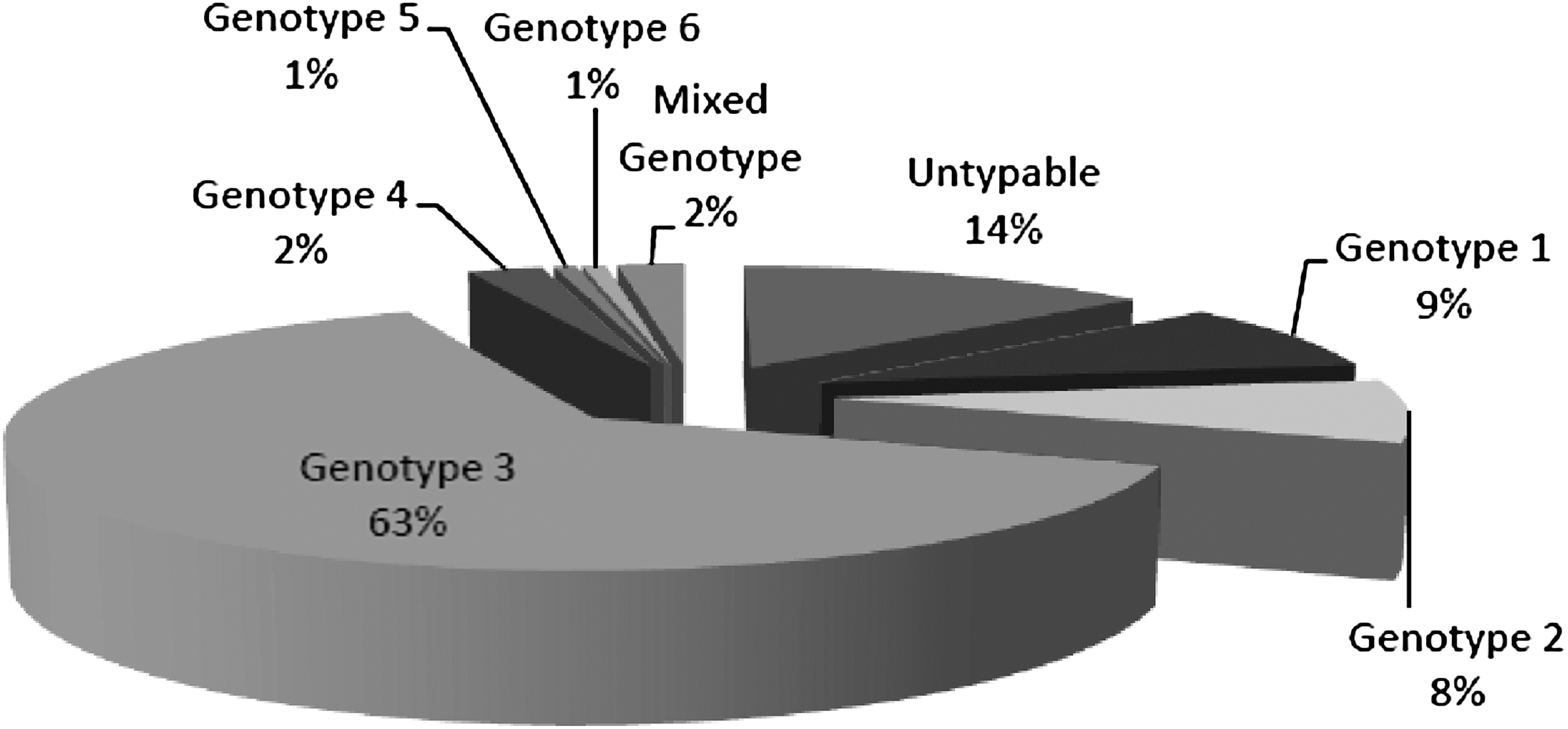
A comprehensive review of HCV prevalent genotypes in Pakistan. HCV, hepatitis C virus.
HCV Treatment Guidelines for Pakistan
The main purpose of chronic HCV treatment is to achieve high SVR rate and to avoid the development of liver-related complications. Previously, interferon plus ribavirin-based antiviral therapy played an important role in HCV management across the world and showed about 50–80% SVR in patients infected with HCV GT-1/GT-4 or HCV GT-2/GT-3, respectively (38). The response can vary according to the interleukin-28B (IL-28B) genotype. With the advancements of DAAs development, a combination of interferon/ribavirin and DAAs resulted in about 90% SVR in IL-28B favorable genetic makeup and also shortened the therapy duration (72). But interferon-based antivirals have many side effects and have resulted in discontinuation of therapy in a large number of individuals. Recently, the Asian Pacific Association for the Study of the Liver (APASL) published the guidelines for HCV treatments with interferon-free DAAs (55). As the most prevalent HCV genotypes are 3, 1, and 2, respectively, the prevalence of other genotypes is negligible. Keeping in mind the current scenario of Pakistan, a brief review of available literature and treatment guidelines is summarized (Table 2) (1,2,28,36,46,48,50,56,71) to help healthcare workers of the local community for the proper management of the disease. As the ratio between healthcare providers and the total population is quite unbalanced in Pakistan, they are overburdened with patient load. This summary of a treatment strategy for the local patient's pool will be of considerable help for the health department of Pakistan. The APASL guidelines defined the strategy for GT-1/GT-2/GT-3, and Sovaldi (Sofosobuvir, NS5B inhibitor) will be the future treatment drug for Pakistan. Sovaldi showed promising results against GT-3/GT-2 and also is a part of the interferon-free regimen against GT-1. However, in the near future, interferon-based regimens will also be in use because of the unavailability of other DAAs (except Sovaldi), no defined DAAs strategy against mixed infections, limited access of Sovaldi in rural areas, and no proper education of healthcare providers regarding the use of DAAs. There are also a large number of untypable viral clades circulating in the local population of Pakistan and currently, there are no defined treatment options for these patients.
Currently not available in Pakistan.
Ledi, Ledipasvir; Rib, Ribavirin; Sofo, Sofosbuvir.
Summary
• Pakistan is endemic for hepatitis C virus (HCV) infection, and there are ∼11 million infected individuals.
• In this study, the review of epidemiological data (2010–2016) of HCV from the general population, blood donors, and high-risk groups is summarized.
• The HCV epidemiological data of HCV genotyping from 2010 to 2016 are analyzed and comprehensively presented, which showed that genotype 3 is the major prevalent genotype followed by genotypes 1 and 2.
• The review showed that there are a significant number of diagnostically untypable HCV variants circulating in Pakistan.
• Currently, Interferon-based antiviral therapy is the main option is Pakistan, because the prevalent viral genotype is sensitive to interferon therapy and showed a good sustained virological response (SVR). But a large number of patients did not show SVR either because of side effects or because of infection with nonresponder HCV genotype.
• Recently, the approval of interferon-free antiviral; Sofosbuvir (Sovaldi: viral polymerase inhibitor: NS5B inhibitor) revolutionized the HCV management in Pakistan. This therapy is suitable for most individuals, without any side effects.
• The interferon-free direct acting antiviral (DAA)–based treatment strategy is based on existing data according to the current scenario of Pakistan.
• Finally, the review also highlights the urgent need for approval of other DAA such as Ledipasvir for better management of HCV infection in Pakistan.
Conclusion and Future Perspective
Pakistan is a developing country with a low socioeconomic status. The government's health budget is very low in comparison with population needs. In such circumstances with almost no existence of a proper health insurance system across the country, it is very difficult to treat 11 million individuals. Currently, patients are being treated with interferon based antiviral regimen, which showed quite good results, as the major prevalent HCV genotype is (GT-3) interferon sensitive. Many drawbacks of the treatment are also reported, such as side effects of therapy, relapse cases, emergence of treatment resistance, and increasing number of cirrhosis cases. Moreover, a large proportion of infected individuals were not able to be treated by this regimen. Recently, Sovaldi is approved for treatment through the Gilead global access program at the heavy discounted price of 300 USD per month. Sovaldi is used either in combination with ribavirin for 24 weeks or with Ribavirin and Peg-Interferon for 12 weeks. Initial results from Pakistan suggest that around 85% patients infected with HCV GT-3 showed SVR (55). On the basis of the earlier discussion, it can be concluded that approval of Sovaldi in Pakistan will be of great help to treat GT-2/GT-3, which are most prevalent in Pakistan. Interferon-based antiviral regimens will also be in use for the future, as they showed good SVR against favorable (GT-3) genotype. To achieve higher SVR against GT-1 and avoid side effects due to interferon-based regimens, there is an urgent need for approval of other DAAs such as Ledipasvir, on discounted price. The current APASL guidelines did not cover the mixed genotype and untypable genotype infection, so future research is needed to treat these genotypes as well as to combat the HCV infection in Pakistan.
Footnotes
Acknowledgments
The author would like to thank Mahvish Kabir for her help in English language editing and proofreading the article. There is no role of any funding agency in this study.
Author Disclosure Statement
No competing financial interests exist.