




Abstract
Despite effective measles vaccines, measles still causes severe morbidity and mortality worldwide, particularly in developing countries. The Th2 pathway involving interleukin (IL)-4 and IL-13 cytokines, and their receptor IL-4Rα, play important roles in the Th1/Th2 balance and antibody production. A Th2 skewing of the cytokine milieu may affect vaccine responses. We investigated IL-4, IL-13, and IL-4Rα polymorphisms and their impact on measles IgG responses and measles vaccine failure, in two separate cohorts: 12-month-old Australian children immunized with measles-mumps-rubella vaccine (n = 137) and a case/control cohort of children aged 6 months–14 years from Mozambique, Africa (n = 89), some of whom were vaccinated, but still contracted measles (vaccine failure). We found that IL-4Rα haplotypes for Val75Ile, Ser503Pro, and Arg576Gln were associated with measles IgG in Mozambican children (p = 0.016 and p = 0.032 for Val.Pro.Arg and Val.Ser.Arg, respectively), but not Australian children. IL-4Rα 503Pro was more prevalent in Mozambique vaccine failure cases compared with controls (p = 0.008). We showed that the impact of Th2 genes on measles vaccine responses differs between ethnicities and IL-4Rα polymorphisms may work in combination to affect measles antibody responses and vaccine failure in Mozambican children. Studies in this area are particularly important in developing countries like Mozambique where measles is still a major health issue.
Introduction
D
The immune systems of infants and young children are relatively deficient compared with older children and adults, preferentially polarized toward T helper type 2 (Th2) cytokines at the expense of Th1 cytokines (41). Following measles vaccination, both a deficient measles-specific Th1 response (16) and impaired antibody production (15,17) have been described. Factors altering the Th1/Th2 balance, enabling a Th2 skewing in the cytokine milieu, may have effects on measles vaccine responses and the occurrence of measles vaccine failure.
Interleukin (IL)-4 and IL-13 are pleiotropic Th2 cytokines that interact with receptors (such as IL-4R and IL-13R) that share a common α chain (referred to as IL-4Rα) (31). These cytokines and the establishment of a Th2 environment favor defense against extracellular pathogens such as parasites (42) at the expense of defense against intracellular pathogens like viruses. These cytokines are also involved in the regulation of antibody responses by B cells (36). IL-4 has also been implicated in the development of subacute sclerosing panencephalitis, a rare complication involving chronic measles infection in the brain (23). These cytokines and their cytokine receptor have an impact on B cells, antibody production, and uncontrolled measles infection, and therefore have the potential to impact upon antibody responses to measles vaccine.
Vaccine responses are known to be considerably influenced by host genetics (35), and responses to measles vaccine in particular have been shown to have a large genetic component (33,40). IL-4 and IL-4Rα polymorphisms have previously been associated with antibody responses to diphtheria (5) and pneumococcal (43) vaccines.
The aims of this study were to investigate single-nucleotide polymorphisms (SNPs) in the IL-4, IL-13, and IL-4Rα genes and their associations with measles IgG antibody responses and measles vaccine failure in two separate cohorts of children: from Australia (8,10 –12,44) and from Mozambique, Africa (9,29). We hypothesized that the polymorphisms would be associated with measles IgG levels and those alleles that were associated with decreased antibody responses would be more prevalent in Mozambique compared with Australia, and in Mozambique measles vaccine failure cases versus controls.
Materials and Methods
Study populations
Healthy 12–14 month old children (n = 150) were recruited in Perth, Western Australia (Table 1) (8,10 –12,44). All subjects received a single dose of measles-mumps-rubella (MMR) vaccine (Priorix™; GlaxoSmithKline, Belgium). DNA and antibody data were available from 137 children.
Category sample sizes became smaller depending on availability of IgG data. Demographics were similar in the smaller subset compared with the original cohort.
Children in the Mozambique cohort were recruited from Manhiça, a rural area in southern Mozambique, Africa (Table 1) (9,29). Children were designated as measles vaccine failure cases if they had previously been vaccinated (single dose of measles vaccine; recorded by vaccination card) and they presented with the clinical symptoms of measles. Clinical measles was defined as the presence of fever, rash, and one or more of the following signs: cough, coryza, or conjunctivitis. Community controls matched by age, gender, and neighborhood were also recruited (∼3 for every case) using a demographic surveillance system database (9,29). IgG data were available from 89 children. Measles vaccine failure cases were classified in two ways: cases that presented with the clinical symptoms of measles and had a previous history of vaccination (“clinically defined cases”) and cases that had a positive measles laboratory confirmation by IgM (“laboratory-defined cases”).
Informed consent was obtained from the mother/caretaker of all participants in both studies. The Australian study was approved by Princess Margaret Hospital for Children Human Ethics Committee. The Mozambique study was approved by the Mozambican Ethics Committee, the Hospital Clinic of Barcelona Institutional Review Board (IRB), and the IRB of University of Maryland.
Genotyping and antibody assays
Genomic DNA was extracted from whole blood using salt precipitation (Australia) or the Qiagen QIAamp DNA Mini kit (Mozambique). Nine polymorphisms in IL-4 (−589C/T, −33C/T, and 2979G/T), IL-13 (−1112C/T, Arg130Gln, and 4378G/A), and IL-4Rα (Val75Ile, Ser503Pro, and Arg576Gln) were genotyped using either polymerase chain reaction-restriction fragment length polymorphism (PCR-RFLP) methods or by an iPLEX assay on a MALDI-TOF MassARRAY platform (Sequenom, Inc., San Diego, CA) (Ser503Pro was unable to be genotyped in the Australian cohort). A random 10% of the samples were also directly sequenced using the ABI Prism BigDye Terminator V3.1 Cycle Sequencing kit (PE Biosystems, Foster City, CA). Haplotypes were inferred using the Bayesian statistical based program PHASE (39). In the Australian cohort, prevaccination samples were collected, as were postvaccination samples 6–8 weeks after vaccination with MMR. Measles-specific IgG was measured using WHO-recommended Dade Behring Enzygnost Anti-Measles Virus IgG commercial enzyme immunoassays (Marburg, Germany) (29,44). Laboratory confirmation of measles in the Mozambique population was measured by in-house ELISA and was defined as a measles-specific IgM antibody titer ≥117.2 EU/mL (29).
Statistical analyses
Chi-squared tests were used to ensure that genotype frequencies did not deviate from the Hardy–Weinberg equilibrium, to compare allele frequencies between the two populations, and to determine the proportion of genotypes in the Mozambique vaccine failure cases versus controls. Differences between antibody titers with genotype were analyzed using Kruskal–Wallis tests in the Australian cohort and one-way ANOVA in the Mozambican cohort, depending on whether or not data were normalized after log transformation. Pearson's correlations and linear regression were used to investigate associations between genotype and measles IgG when correcting for confounders. All analyses were performed using SPSS version 11.0 (SPSS, Inc., Chicago, IL) and statistical significance was defined as p < 0.05.
Results
Demographics
Demographics for both cohorts are detailed in Table 1. Age at vaccination in the Perth cohort was tightly controlled at 12 months of age; however, in the Mozambique population, there was a greater range of ages at vaccination (3 months–9 years), although the majority (76%) were vaccinated at around the same age as those in the Perth cohort.
Allele frequencies in Perth versus Mozambique populations
Minor allele frequencies were similar to those reported previously for Caucasian (CEU: Utah, USA residents with European ancestry) and African (YRI: people from Yoruba in Nigeria, Africa) populations (
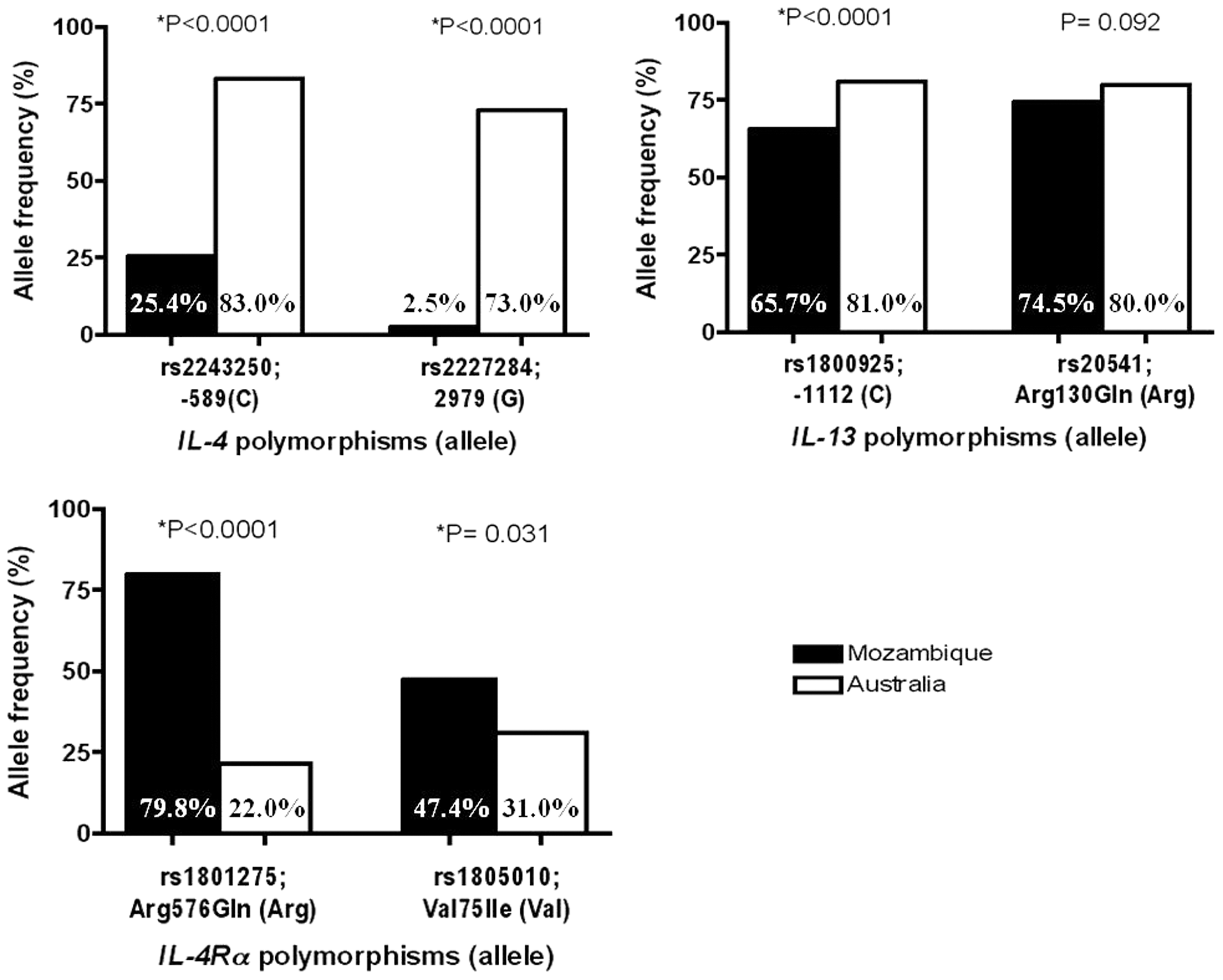
Allele frequencies of IL-4, IL-13, and IL-4Rα polymorphisms in Australian cohort versus Mozambique cohort. Mozambique represented by black bars, Australia by white bars. Data presented as a% of one allele of each SNP. Only polymorphisms that were able to be genotyped in both cohorts are shown. p-Values obtained by chi-squared tests. IL, interleukin; SNP, single-nucleotide polymorphism.
IL-4, IL-13, and IL-4Rα polymorphisms and haplotypes, and measles antibody responses
All prevaccination samples of the Australian cohort had undetectable measles-specific IgG and 14/137 (10.2%) remained seronegative postvaccination. All individuals in the Mozambique cohort were seropositive after vaccination and/or natural disease.
None of the polymorphisms alone was associated with measles IgG levels in either cohort (Table 2). Differential haplotype patterns were observed between the different populations. IL-4 and IL-13 haplotypes were not associated with measles antibody levels (data not shown). Haplotypes were not associated with measles IgG in the Australian cohort (data not shown); however, in the Mozambique children, the IL-4Rα Val.Pro.Arg and Val.Ser.Arg haplotypes (in the order IL-4Rα Val75Ile, Ser503Pro, and Arg576Gln) were significantly associated with measles antibody levels. Those with two copies of the Val.Pro.Arg haplotype had significantly higher measles IgG (geometric mean titer [GMT]: 1,940 mIU/mL, 95% CI: 918–4,100) compared with one copy (GMT: 579 mIU/mL, 95% CI: 386–867) and no copies (GMT: 975 mIU/mL. 95% CI: 739–1,288) (p = 0.016) (Fig. 2). Conversely, those with two copies of the Val.Ser.Arg haplotype had lower measles IgG (GMT: 182 mIU/mL, 95% CI: 20–1,638) compared with those with no copies (GMT: 848 mIU/mL, 95% CI: 676–1,062) (p = 0.031) (Fig. 2). The Ser503Pro polymorphism may be the determining factor of measles IgG levels within this haplotype.
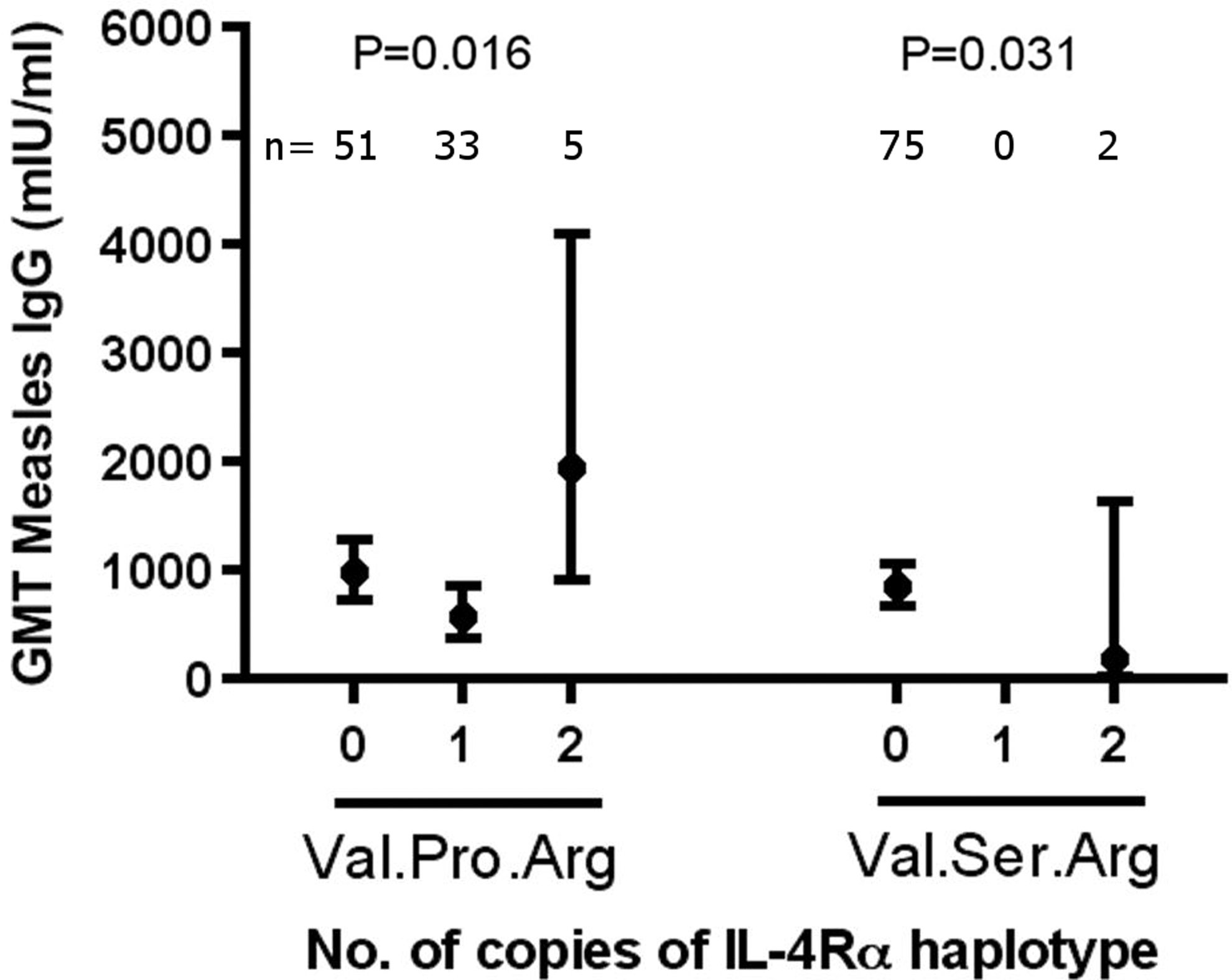
Measles IgG levels among IL-4Rα Val.Pro.Arg and Val.Ser.Arg haplotypes in Mozambique. Measles IgG levels (from n = 89 subset) in those with either two copies of the haplotype (2), one copy (1), or no copies (0). Haplotypes are presented in the order IL-4Rα Val75Ile, Ser503Pro, and Arg576Gln. p-Values obtained by one-way ANOVA. Data presented as geometric mean titers (GMT) and 95% confidence intervals.
The bold value denotes the significant result.
p-Values obtained by Kruskal–Wallis tests for Australia and one-way ANOVA for Mozambique.
Comparison of genotypic distribution in laboratory-defined measles vaccine failure cases (n = 9) versus controls (n = 165). p-Values obtained by chi-squared tests.
Able to be genotyped in one cohort only.
IL, interleukin; SNP, single-nucleotide polymorphism.
In summary, although single polymorphisms were not associated with measles IgG responses, two IL-4Rα haplotypes (with a particular influence from the IL-4Rα Ser503Pro SNP) were significantly associated with measles IgG in the Mozambican, but not Australian, children.
Mozambique measles vaccine failure cases versus controls
Only the comparison of seropositive versus seronegative children was possible in the Australian cohort; the Mozambique cohort allowed the investigation of true measles vaccine failure. In the Australian cohort, no significant difference was found in the proportion of seronegative children between the different genotypes of the IL-4, IL-13, and IL-4Rα polymorphisms (data not shown). Sixty-six of the Mozambique children (27.7%) were designated as measles vaccine failure cases as they presented with the clinical symptoms of measles and had previous history of vaccination (“clinically defined cases”). Between the clinically defined cases (n = 18) and controls (n = 71), measles IgG was not significantly different (p = 0.111) (9). The distributions of IL-4, IL-13, and IL-4Rα genotypes were not significantly different between clinically defined cases and controls (data not shown).
With the addition of measles laboratory confirmation by IgM, subjects were also defined into “laboratory-defined cases” (n = 9) and controls (n = 165). Measles IgG levels were shown to be significantly lower in laboratory-defined cases compared with controls (p = 0.004) (9). In these laboratory-defined measles vaccine failure cases, we found that the Pro variant of IL-4Rα Ser503Pro was significantly more prevalent (55.6%) than in the controls (15.4%) (p = 0.008; Table 2).
In summary, measles vaccine failure cases had significantly lower measles IgG than controls, and the IL-4Rα 503Pro variant was present in a higher percentage of measles vaccine failure cases compared with controls.
Discussion
The determining factors of measles vaccine responses and measles vaccine failure have not yet been fully elucidated. The majority of previous studies on measles vaccine responses and genetics have been in Caucasian populations. Our study is the first, to our knowledge, to investigate the genetic determinants of measles vaccine responses in a non-Caucasian resident population from a developing country where measles disease is still a major health problem. We showed that measles vaccine responses and the genetic associations with these responses differ between populations. We have also identified the importance of the Th2 pathway, involving IL-4Rα and its ligands IL-4 and IL-13, in determining measles vaccine responses and the occurrence of measles vaccine failure. This study underlines the importance of genetic studies in resident populations of developing countries where measles is still a major public health issue and where measles vaccine failure has significant consequences.
IL-4 and IL-13 signal through their common receptor IL-4Rα to initiate lymphocyte polarization toward a Th2 phenotype. This Th2 pathway is also involved in B cell differentiation, proliferation, and antibody production, modulating Ig isotype switching toward IgE and IgG4 (36) and away from the more antiviral IgM, IgG1, and IgG3. These Th2 cytokines are also known to inhibit the virus-induced production of Th1 type 1 interferon (18), thereby participating in the Th1/Th2 shift. Th2 cytokines are produced to fight extracellular pathogens such as parasites (42), and parasitized children with their primed Th2 responses (at the expense of Th1) are likely to have impaired vaccine responses (28). Genetic variants in Th2 genes that enable a Th2 skewing in the cytokine milieu may confer an impairment in the responses to early life infections and responses to vaccines.
The polymorphisms investigated in this study have been previously associated with disease risk and antibody responses. However, whether these variants have an impact on the primary responses of infants to measles vaccine, or an impact on measles vaccine failure, has not been previously reported. Atopic phenotypes have been associated with polymorphisms in IL-4, IL-13, and IL-4Rα (20), and atopy in turn has been associated with delayed maturation of cellular responses to vaccines such as tetanus (37) and antibody responses to pneumococcal polysaccharide vaccine (2). Elevated IgE levels characterize many allergic diseases (7,38). Studies have shown that IgE levels are elevated during the early stages of measles, and it has been shown that measles infection works with IL-4 to augment IgE class switching (22). It is possible that these atopy-associated genes impact measles vaccine antibody responses.
Dhiman et al. (13) investigated measles vaccine responses in Caucasian schoolchildren from the United States and found no associations with IL-4 polymorphisms; our findings agree with this. They also described associations between the IL-4Rα Val75Ile SNP and measles immune responses (13). Our findings are unique in that we found associations only when taking into account the SNPs in combination (as haplotypes). Furthermore, our most significant finding was with IL-4Rα Ser503Pro (both in the haplotype with measles IgG levels and vaccine failure cases). This SNP, as well as true measles vaccine failure, was not studied by Dhiman et al. (13). The different results observed in our African cohort, compared with our Caucasian population from Australia and with previous Caucasian studies such as Dhiman et al. (13), highlight the differences in measles vaccine responses and genetic associations in different ethnicities/populations, as well as the importance of identifying genetic determinants in an appropriate population, a population that experiences true measles vaccine failure.
The allele frequencies of many polymorphisms are expected to differ between Caucasian and African populations (21). Associations between the polymorphisms in this study and disease have also shown different patterns in Caucasians compared with those with African descent (3). In our study, we found differences in allele frequencies between our Australian and Mozambican populations for all polymorphisms (significantly large differences in all, but one). Since developing countries display higher rates of vaccine failure (1), we expected that measles vaccine responses would be impaired in the alleles that were higher in frequency in Mozambique compared with Australia. We identified a higher prevalence of the IL-4Rα 503Pro allele in Mozambique vaccine failure cases compared with controls. The frequency of the 503Pro variant was higher in Africans versus Caucasians (40.1% in Mozambique, HapMap expected European frequency of 16.7%), thus agreeing with our hypothesis.
Polymorphisms in IL-4Rα have been previously shown to associate with disease and antibody responses. IL-4Rα Arg576Gln has been shown to modulate total serum IgE levels and influence the signalling pathways through IL-4Rα (27). Those with the Gln allele also had lower pneumococcal antibody levels compared with those with Arg (43) and reduced IgG levels and cellular responses to tetanus toxoid (5). IL-4Rα Ser503Pro has been reported to affect IgE (Pro allele produced lower levels) (27) and has been associated with asthma (4). IL-4Rα Val75Ile has also been associated with both tetanus and pneumococcal antibody levels (45) and with asthma (4), demonstrating a Th2 skewing (increased sensitivity to IL-4 stimulation) in asthmatics (26). Our findings increase the knowledge regarding the considerable influence of IL-4Rα on immune responses, by demonstrating the associations between IL-4Rα SNPs and measles antibody responses and vaccine failure.
The polymorphisms we investigated in this study may have functional effects. The IL-4Rα Arg576Gln SNP has been shown to influence expression of the IgE receptor CD23 after IL-4 stimulation, which may augment the binding specificity of the receptor to increase signaling (19). The IL-4Rα Ser503Pro variation is located within the insulin-IL-4 receptor motif and affects phosphorylation in response to IL-4, triggering subsequent signaling pathways (14,24,27). We suggest that the IL-4Rα Ser503Pro polymorphism is working together with Val75Ile and Arg576Gln to modulate the receptor, perhaps affecting interaction with IL-4 and IL-13 cytokines and subsequent receptor signaling, resulting in downstream effects on measles IgG antibody responses, and leading to an increased likelihood of measles vaccine failure.
Confounding factors should be noted in all genetic association studies. Factors that may have an effect on the associations include parental smoking (5) and the higher rates of helminthic (and other) infections in underdeveloped countries, which can impact upon the Th2 environment (28,42). Other factors that may affect measles vaccine failure include malnutrition, malaria, and HIV status (25). In this study, in the Mozambique cohort, mid-upper arm circumference measurements were used to determine malnourishment; however, 97% were in the normal range. Malaria and HIV infection rates were also recorded in the Mozambique cohort; however, the rates of these were negligible. Although we are the first to investigate genetic determinants of true measles vaccine failure in a relevant cohort, larger sample sizes of vaccine failure cases in the future would be helpful to further examine the associations identified in this study. Furthermore, it is also possible that alternative SNPs in linkage disequilibrium may also have had an effect on our associations, although this is unlikely due to previous functional studies on these polymorphisms.
In conclusion, polymorphisms in IL-4Rα, particularly Ser503Pro, are associated with measles IgG antibody responses and measles vaccine failure in Mozambican children. The signalling of the IL-4 and IL-13 cytokines through their receptor would be affected by the IL-4Rα variants, perhaps leading to a Th2 skewing that has impacted vaccine responses in these children. Furthermore, the associations we identified in African children differed greatly from those in Caucasians (from our Australian cohort, as well as previous studies). Research in this area is crucial to identify children at risk of remaining vulnerable to measles postvaccination, so as to preemptively implement alternative strategies to immunize these children. Knowledge of the determinants of measles vaccine failure is particularly relevant in developing countries such as Mozambique, as the burden of measles is felt most acutely in these areas.
Footnotes
Acknowledgments
We thank the staff of the Vaccine Trials Group for the clinical conduct of the Perth study and Barbara Holt and Jenny Tizard for sample processing. We also acknowledge Marcela Pasetti from Applied Immunology Section, Center for Vaccine Development (CVD), University of Maryland, and Professor Pedro Alonso for their involvement in the Mozambique study. This study was supported by funding from the National Health and Medical Research Council (NHMRC) of Australia and the Bill and Melinda Gates Foundation.
Author Disclosure Statement
P.R. declares that he has received part funding for other studies from GlaxoSmithKline Australia and Merck. No competing financial interests exist for all other authors.