




Abstract
The aim of this study was to realize a systematic review to identify data reported in the literature involving people infected by hepatitis C virus (HCV) with cognitive dysfunctions and single nucleotide polymorphisms (SNPs). The research was realized in six databases and the selection of studies was performed in two stages. Initially, we searched indexed articles from the following electronic databases: SciELO, MEDLINE, PubMed, HighWire, LILACS, and ScienceDirect. Then the articles were completely read and those that did not meet the eligibility criteria were excluded. Therefore, 5,669 articles were obtained and, of these, 25 were selected. Finally, one article involving people with HCV and cognitive impairment was included in the review. The frequency of the APOE-ɛ4 allele in people with HCV and mild liver disease was significantly lower in those with work memory impairment (p = 0.003) and attention (p = 0.008). This situation differs from other studies that showed an association between ɛ4 allele high frequency and cognitive decline. Thus, studies with larger samples involving people with HCV, cognitive alterations, and SNPs are necessary, in view of the lack of this theme in the literature and the divergences in the findings.
Introduction
H
Chronic HCV infection may cause a variety of extrahepatic manifestations, such as central nervous system (CNS) involvement, and has been associated with neurological and/or psychiatric disorders in up to 50% of cases. Among the most commonly impaired cognitive and neurobehavioral functions are attention, mental flexibility, reasoning, and speed of information processing (3). In addition, general symptoms such as fatigue, malaise, and weakness may also be present. These changes directly affect the patient's quality of life, interfering with his or her ability to perform simple daily activities. Although not well defined, there are basically two theories to explain the pathophysiological process of cognitive and neurobehavioral disorders in patients chronically infected with HCV: (1) the virus infects the brain and releases toxins directly and (2) the virus becomes neurotoxic upon triggering a cerebral and/or systemic inflammatory process (22,29). It is known that the genetic load of the host can exert a strong influence on HCV infection.
Single nucleotide polymorphism (SNP) is a variation in a single nucleotide that occurs at a specific position in the genome. They occur once in every 300 nucleotides on average, which means there are roughly 10 million SNPs in the human genome (26). Most commonly, these variations are found in the DNA between genes and they can act as a biological biomarker of disease susceptibility and effective therapy (18). The identification of functional regulatory variants and associated modulated genes is key to interpreting genome-wide association study findings and establishing how genes are associated with disease (12). Context-specific genetic variants that directly modulate innate immune responses or gain regulatory capacity upon pathway activation may affect disease susceptibility.
In a study involving 108 patients with herpes simplex virus type 1 (HSV-1) and 132 without, 86 participants had SNP (Val158Met) detected in catechol-o-methyl transferase enzyme, responsible for the degradation of catecholamines. The 86 participants with Val/Val genotype showed a decrease in attention capacity, generating a cognitive deficit and increase in risk factors in nonelderly patients without psychiatric disorders. The effect appears to be independent of those associated with exposure to HSV-1 (9).
Another study that evaluated 201 Chinese subjects infected with human immunodeficiency virus (HIV) through contaminated blood products detected that the APOE-ɛ4 allele was associated with increased risk for cognitive deficits, and the MBL2 O/O genotype, in 12 months, was associated with increased risk for progressive cognitive decline. Their findings indicated that genetic variants in APOE and MBL2 are associated with cognitive impairment in patients with HIV (30).
The objective of this study was to identify whether there are data already described in the literature involving the relationship between cognitive dysfunctions in people infected by HCV and SNPs.
Methods
Databases, search terms, and eligibility criteria
The research was performed in the databases: SciELO, MEDLINE, PubMed, HighWire, LILACS, and ScienceDirect during the months of July–October 2016. The following descriptors were used: hepatitis C, chronic hepatitis C, cognitive disorders, neurobehavioral manifestations, and single nucleotide polymorphism. There were double and triple combinations of these terms during the searches, being chosen as inclusion criteria: articles written in Portuguese, English, and Spanish, between the years 2011 and 2016, involving people with HCV, SNPs, and cognitive impairment. Review or systematic review articles and those involving other diseases or occurred in nonhuman were excluded.
Study selection process
Three researchers independently, but comparing their findings at the end, searched the databases, using the descriptors, and evaluated titles and abstracts according to the eligibility criteria. The selected abstracts were submitted to the second stage, in which two other independent researchers reviewed the articles completely and, by consensus, excluded texts that did not meet the criteria. From the articles considered eligible, data were extracted regarding characteristics of the sample, methodology, and the main results found. This study was elaborated following the guidelines of the PRISMA platform (21).
Results
The flowchart in Figure 1 illustrates the steps taken to select studies for review. A total of 5,669 titles and abstracts were selected initially and then 5,644 were excluded because they did not meet the eligibility criteria or were duplicated.
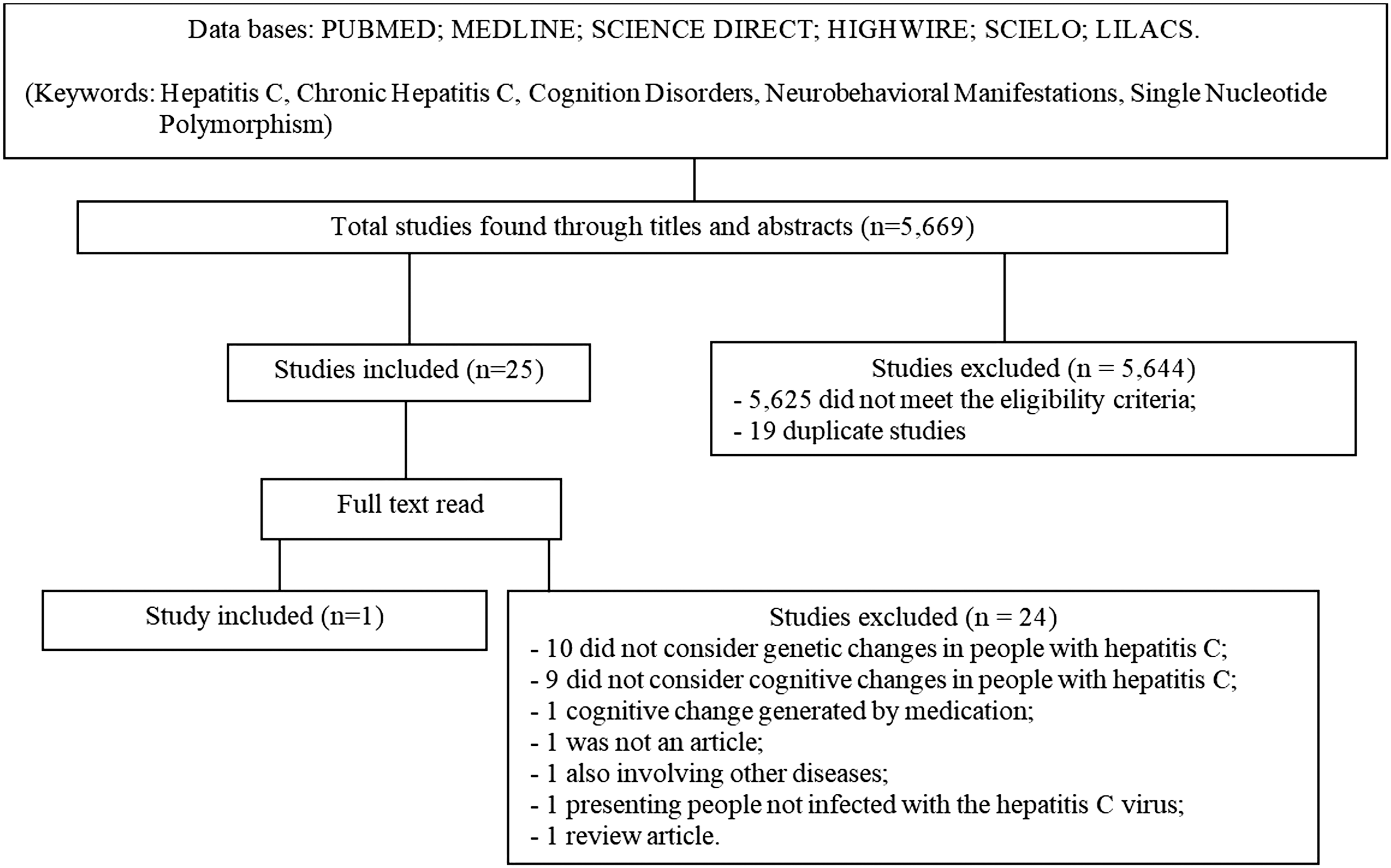
Flowchart illustrating research and selection of studies on cognitive and genetic changes in people with hepatitis C.
Table 1 lists the combinations of search terms used in the first stage. After a complete analysis of the 25 articles, only 1 was included in this systematic review. Table 2 lists the main information of the included article.
APOE, apolipoprotein E gene; BDI, Beck's depression inventory; FIS, fatigue impact scale; HADS, hospital anxiety and depression scale; HCV, hepatitis C virus; PSE, Portosystemic-Encephalopathy-Syndrome test; RFT, recurring figures test; SF-36, 36-item short form health survey; TAP, test battery for the assessment of attention; WFMT, word-figure memory test.
The authors of the evaluated article referred limitations of their study. Wozniak et al. (34) reported that because of the small number of patients included, the APOE-ɛ4 association could only be proven in two cognitive functions. In addition, there was difficulty in the interpretation of the data regarding sex due to the imbalance of this variable between the groups.
Discussion
Chronic liver disease caused by HCV often crosses the borders of the hepatic environment. It is known that about 50% of infected and untreated individuals may develop some manifestation in the CNS (1,8,3,29). The field of research for the association of different types of polymorphisms with neurological diseases may still be called recent, although in the past decade it has shown considerable growth within scientific publications.
There is still a great gap in the literature searching for the association of polymorphisms with the establishment of cognitive dysfunctions in patients affected by viral infections, such as in hepatitis C. Thus, it is necessary to conduct investigations and compile the relevant information, serving as a stimulus for health professionals who aim to supply this lack of knowledge.
Researches such as Wozniak et al. (34) confirm that there is still much to be investigated within this area. The study reported the modulation of biological components that are involved in the antiviral response against HCV. The onset/establishment of some cognitive manifestations may be associated with these components, such as memory impairment and altered attention span.
The APOE gene maps to chromosome 19 in a cluster with the related apolipoprotein C1 and C2 genes, coding for the protein called apolipoprotein E. APOE is polymorphic, with three major alleles: APOE-ɛ2 (cys112, cys158), APOE-ɛ3 (cys112, arg158), and APOE-ɛ4 (arg112, arg158). Although these allelic forms differ from each other by only one or two amino acids at positions 112 and 158, these differences alter APOE structure and function. The APOE-ɛ4 has an allele frequency of ∼14%, whereas APOE-ɛ3 has 78% and APOE-ɛ2 has 7% (27).
APOE combines with fats (lipids) in the body to form lipoproteins, which are responsible for packaging cholesterol and other fats carrying them through the bloodstream. Allele ɛ4 has been associated with atherosclerosis, Alzheimer's disease, impaired cognitive function, reduced hippocampal volume, and faster disease progression in multiple sclerosis, with greater incidence of HIV-associated dementia and accelerated progression of HIV infection. The most common allele is ɛ3, which is found in more than half of the general population (27).
In their study, Wozniak et al. (34) concluded that low frequency of APOE-ɛ4 in HCV-infected patients with neurological disorders raises the premise that possibly the polymorphic protein encoded by this gene should play a vital role in the control of cognitive mechanisms, thus preventing the occurrence of these signs and symptoms on this population. However, the small number of samples only suggests a biological association, which needs to be expanded to validate such association. In addition, other techniques with higher specificity should be used for this purpose, such as sequencing instead of the one-step polymerase chain reaction (PCR) used by the authors. It should be noted that Wozniak et al. (34) did not analyze the single base polymorphisms that indicate the presence of the polymorphic E4 allele.
In contrast, the pathophysiological link between APOE and hepatitis C resides in the mechanisms adopted by HCV to circulate and entry into the hepatocytes. The carriage of an APOE-ɛ4 allele is associated with increased serum levels of low-density lipoproteins (LDL), which lead to downregulation of the LDL receptor (LDLR). It, in turn, would be detrimental to HCV infection, since the LDLR could be used as coreceptor for HCV entry on the hepatocytes. In addition, the APOE4-induced hyperbetalipoproteinemia could directly interfere with the LDLR-mediated cellular virus uptake due to competition between free betalipoproteins and virus–lipoprotein particles for free LDLR sites (10, 24, 33). Thus APOE4-related downregulation of LDLRs can exert a protective effect on HCV infection.
The results found in the study by Wozniak et al. (34) disagreed with other findings in the literature, probably because the APOE allele variations may have different effects on the different populations and particularly in the context of different virus infection. For example, the variant ɛ4 would be advantageous because it interferes with HCV cellular entry and infection. Nevertheless, in the studies of McGuinness et al. (19) and Wendelken et al. (32), the increased frequency of APOE-ɛ4 was related to a decline in cognitive performance. McGuinness et al. (19) showed that APOE-ɛ4 has a negative impact in the speed of information processing and the immediate recall in patients with Alzheimer's disease. Already in a group of people with vascular dementia, there was less precision in tasks that demanded time of reaction of choice and in the spatial working memory. Wendelken et al. (32) showed a decline in executive function, reduction in brain white matter integrity, and more prominent cerebral atrophy in the posterior corpus callosum, thalamus, and brainstem in older people with HIV who presented APOE-ɛ4 carrier status.
The APOE-ɛ4 is a risk factor for mild cognitive impairment and Alzheimer's disease (6,15). In addition, the allele APOE-ɛ4 was associated with major risk for the development of dementia in women in comparison with that in men (5). In contrast, Becker et al. (4) did not identify any association of APOE-ɛ4 with cognitive impairment in men infected with HIV, <65 years of age. Morales et al. (23) observed that the ɛ4 allele was associated with impaired performance on the neuropsychological tests in the control, seronegative women. However, there is much to learn about the effect of APOE isoforms, especially regarding the population group studied and the interaction with other potentially protective genetic polymorphisms, so caution is advised before making determinant statements about the influence of APOE polymorphisms.
The SNPs can be used as excellent biomarkers for the onset and/or progression of a disease. However, the area of knowledge that compiles the study of polymorphisms, cognitive disorders, and viral infections still counts on a great precariousness of realized studies. Our review points to a great gap in the scientific research around this theme. It is suggested that, in the future, research with larger samples be performed to investigate the influence of genetic alterations on cognition. Longitudinal studies are also indicated to verify the real effect of the HCV on the brain.
Footnotes
Author Disclosure Statement
No competing financial interests exist.