




Abstract
Influenza infection is associated with enhanced pathology in individuals with sickle cell disease (SCD). Despite being a high priority group for annual influenza vaccination, little is known about long-term responses to influenza vaccination in this patient population. To model flu vaccination, we inoculated SCD and wild type (WT) littermate mice with the seasonal flu vaccine [containing pandemic H1N1 (pH1N1) antigen], bled the mice before and after vaccination, and intranasally challenged them with a high dose (400 PFU) of pH1N1 12 weeks later. Both WT and SCD mice were fully protected from infection, and anti-influenza immunoglobulin G titers were significantly elevated in both groups after vaccination. It appears that flu vaccination is effective in SCD mice and our data support the clinical practice of regular flu vaccination in SCD patients.
Introduction
I
Influenza Vaccination Responses in SCD Mice
Most current clinical guidelines recommend that vaccination against influenza virus should occur on an annual basis in people with SCD. In light of previous observations that vaccination responses are aberrant in SCD mice (12), we developed a mouse model of influenza vaccination and challenge using the seasonal influenza vaccine (Fluzone; Sanofi Pasteur, Inc.) and mouse-adapted strain of pH1N1 influenza virus (9). A 8- to 12-week-old female SCD and littermate wild type (WT) mice (8) were intramuscularly vaccinated with 4.5 mg of vaccine [containing 1.5 mg of CA07 2009 HA (4)] on weeks 0 and 3 (nonvaccinated WT naive mice were included as controls), i.n. challenged 12 weeks after the initial priming dose with 400 PFU of pH1N1 (four times higher than the LD100 for this strain in WT mice, data not shown), and mortality (Fig. 1A) and weight loss (Fig. 1B) were assessed. Mice were bled on weeks 0 and 4 and anti-pH1N1 titers were determined by enzyme-linked immunosorbent assay (Fig. 1C). Mice were housed under specific pathogen-free conditions and all work was conducted under an approved Institutional Animal Care and Use Committee protocol from Albany Medical College. Vaccinated WT and SCD mice survived infection and had similar endpoint anti-pH1N1 immunoglobulin G (IgG) titers 4 weeks after vaccination (as determined using a Mann–Whitney U test), whereas naive WT mice all succumbed to infection by day 18 postinfection and had no detectable anti-pH1N1 IgG titers. We again bled surviving mice 23 weeks after priming (11 weeks after infection) and determined that anti-influenza IgG titers were maintained in WT mice and increased twofold in SCD mice (data not shown), indicating that long-term protective humoral responses to influenza virus are possible in SCD mice, despite their immunological abnormalities. Both vaccinated groups did lose weight after infection, indicating that the infection was successful in these mice.
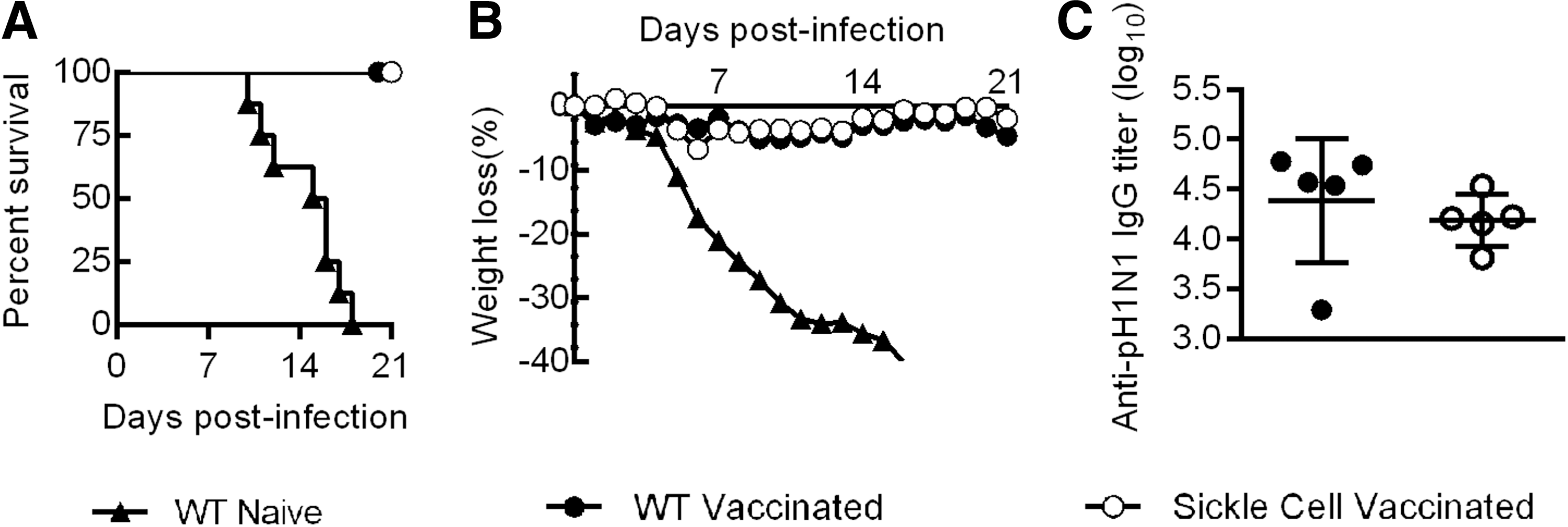
Influenza vaccination and challenge model.
Conclusion
Our results show that flu vaccination is effective at protecting SCD mice from influenza infection. This is somewhat surprising as these data are in stark contrast to reports from us (3,13) and others (2), showing that pneumococcal vaccine responses are not sustained in SCD mice. Our data, taken together with those from Karlsson et al. (7), support the clinical practice of routinely administering the flu vaccine in SCD patients to protect against severe disease associated with influenza infection.
Footnotes
Acknowledgments
The authors thank Sharon Salmon for technical assistance with the experiments and members of the Thrall laboratory at UCHC for insightful conversations regarding this line of research.
Author Disclosure Statement
The authors declare no financial or nonfinancial competing interests.