




Abstract
It has been reported that human papillomavirus (HPV) is a main cause of cervical cancer. Immune system plays key roles in the HPV infection clearance. Additionally, the roles played by immune responses in development of cancers have been documented previously. Toll-like receptors (TLRs) are the main surface or intravesicular receptors driving innate immunity, which either participate in the fight against infectious agents or participate in the progression of cancers. Thus, it has been hypothesized that the molecules may be part of the HPV/cancers puzzle. TLR4 is a unique member of TLRs family that uses both well-known TLRs related intracellular signaling pathways. Furthermore, the roles played by TLR4 against several viruses and also their related complications, such as tumors, have been demonstrated. Thus, it has been hypothesized that TLR4 may play a key role in HPV infection and its related complications. This review article collected the information regarding the mentioned plausible roles by TLR4.
Introduction
Human papillomavirus (HPV) is a wide-spread transient infectious agent, which may induce some malignancies in humans (4). HPV can be considered as the most common sexually transmitted disease (23). Accordingly, it has been reported that the risk of the virus infection is 50% among both men and women (23). It is also a known cause of common and anogenital warts, which can lead to induction of cervical and other cancers (10). Although not all HPV types are potentially oncogenic, the HPV 16 and 18 are the most dangerous types to induction of cancers among men and women (11).
It is worthy to note that HPV infection is usually cleared by the immune system, hence, both HPV 16 and HPV 18 infections can be prevented by vaccination (53). Due to the established roles played by the immune system in HPV infection clearance and based on the fact that the immune system can stimulate tumor development in some conditions, it appears that the cells and molecules in the immune system can be considered to be investigated to clarify their positive or negative roles against HPV infection.
Toll-like receptors (TLRs) are the main known innate immune receptors, which recognize endogenous, damage-associated molecular patterns (DAMPs), and exogenous, pathogen-associated molecular patterns (PAMPs), ligands to activate innate immune cells to eradicate viruses or participate in the pathogenesis of the cancers (66). TLR4 is the sole member of the TLR family that uses both known intracellular signaling pathways entitled “Myeloid differentiation primary response 88 (MYD88)” and “Toll-IL-1 receptor domain containing adapter inducing interferon β (TRIF)” (36). Furthermore, it recognizes several endogenous and exogenous ligands, including microbial PAMPs and internal DAMPs (47,64).
For example, it recognizes endogenous and exogenous lypopolysacharide (LPS), monophosphoryl lipid A (MPL), synthetic compounds, heat shock proteins, and hemagglutinin (20,21). We have discussed the roles of the molecule in the induction of appropriate immune responses against some infectious agents and also in the pathogenesis of their related complications such as hepatocellular carcinoma and breast cancer previously (28,64). Therefore, due to the roles played by the immune system in HPV infection clearance and also based on the potential roles of HPV in the induction of human related cancers, it has been hypothesized that TLR4 may be a part of the puzzle. This review article has collected the recent information regarding TLR4 roles in either anti-HPV immune responses or its cancer related pathogenesis and proposed some ideas to overcome the disease.
Common Features of HPV
Many evidences have shown that cervical cancer is caused by infections with high-risk population of papillomaviruses (52). The papillomaviruses were divided into four groups based on the host group: cottontail rabbit papillomaviruses, bovine viral papillomavirus, canine oral papillomavirus, and HPV (7,8). Papillomaviruses have circular double-stranded DNA genome, with about 8,000 nucleotides. The genome of papillomaviruses is divided into three regions, early (E), late (L), and upper regulation (UR) regions (25,40).
More than 200 different types of HPV have been identified. Types of HPV (α genus) that infect the genital tract are divided into two types: Low-risk, such as HPV-6 and HPV-11, High risk types, including HPV 18 and 16. The high risk types are associated with the development of genital cancers and are found in 99% of cervical cancers (35,55). The HPV genome is divided into three regions in terms of performance: the first region, the noncoding region, or the regulatory region is called the Long Control Region. This region includes the primary promoter, p97, and DNA sequencing regulatory sequences. The second region, the predominant region E1, E2, E4, E5, E6, and E7, is involved in the viral replication and carcinogenicity (40,43).
Viral replication started from a region that is called the initiation region (Ori), and depends on the replication factors encoded by E1 and E2. HPV also encodes two main proteins, E6 and E7, which together change the expression pattern and activities of many genes and cell proteins, which leads to progression of cancer beginning and changing cell cycle, inducing harm to DNA and genomic mutability. The third region codes the viral capsid proteins, L1 and L2 (33,56).
However, proliferation and oncogenic properties of HPV are significantly dependent on interactions with immune responses including innate immune cells. Accordingly, HPV infection may lead to induction of warts and is found in all human populations, and sometimes the infection can be associated with some neoplasms, such as anogenital and skin squamous cell carcinoma in humans, rabbit skin cancer, some cancers in cow, including upper gastrointestinal, urinary tract, and bladder cancers (6,13).
TLR4 and Its Roles in the Anti-HPV Immune Responses
TLR4, like other TLRs, contains three well-known domains, including extracellular, intra-membrane, and intra-cytoplasmic TIR (Toll/interleukin-1 receptor) domains. TLR4 recognizes the related PAMPs and DAMPs via its leucine-rich extracellular domain. Accordingly, it induces intracellular signaling pathways, MYD88 and TRIF-dependent pathways, through the intra-cytoplasmic TIR domain. Therefore, it has been hypothesized that TLR4 may recognize HPV-related PAMPs and induces some immune reactions. A study by Tobouti et al., demonstrated that HPV infection leads to downregulation of TLR4 and decreases its functions, which results in downregulation of proinflammatory cytokines, including IL-6 and IL-8 (54).
Thus, this study proved the roles played by HPV to target TLR4 gene to decrease its expression and also had potential negative roles on its functions to escape from immune responses (54). Damasdi et al. also reported protective roles of TLR4 against HPV-DNA integration to the host DNA in penile cancer (14). Accordingly, they reported that downregulation of TLR4 promotes HPV-DNA integration and increased the risk of penile cancer (14). The results were proved by Pannone et al., who reported that TLR4 downregulation is potentially associated to either increased risk of HPV-16 infection or integration of HPV-DNA into the host DNA (45). In agreement with the study, Yu et al., showed that during the progression of cervical neoplasia, TLR4 is downregulated and suggested that it may contribute to HPV-DNA integration and carcinogenesis (63).
TLR4 can induce the pathways resulting in production of the intracytoplasmic molecules, such as inflammasomes, which interfere in the viral-DNA integration to the host DNA (46,48,57,61). Thus, it may be hypothesized that TLR4 suppresses HPV-DNA integration indirectly. TLR4 plays significant roles in the induction of isotype switching against HPV antigens, which provides a good protection strategy against HPV infection (62). Therefore, TLR4 not only participates in the stimulation of appropriate cellular immunity against HPV to eradicate the virus, but also is an important molecule in induction of suitable humoral immunity to protect the healthy cells from HPV infection.
Due to the protective roles played by TLR4 against HPV, it has been hypothesized that TLR4 agonists can be used to overcome the HPV infection and also its related complications, including cervical cancers. A study by Negahdaripour et al., showed that using TLR4 agonists, as adjuvants, can promote generating humoral and cellular responses, which are the crucial mechanisms for protection against HPV (41). Using MPL, another TLR4 ligand, as adjuvant in the HPV-16 E7 DNA vaccine significantly increased the efficiency of the vaccine to prevent HPV infection (21). The protective roles played by MPL during vaccination with HPV proteins have also been documented by Srivastava et al. (50). MPL in combination with aluminum salt can also induce appropriate innate and adaptive immune responses against HPV proteins (18).
Carrageenan, a sulfated polysaccharide compound from red algae, is also recognized by TLR4 as agonist and can be used as adjuvant to enhance the immune responses against HPV proteins (67). LPS is also a famous TLR4 ligand and modulates monocyte-derived dendritic cells (DCs) and other immune cells to induce immune responses against HPV (12,49). Heat shock protein X is another ligand for TLR4 and is capable of inducing DC maturation and, then, production of proinflammatory cytokine using both the MYD88 and the TRIF signaling pathways (27). HBHA, as another TLR4 agonist, also can induce cellular in parallel with humoral immunity against HPV multi-epitope peptide vaccine (42).
Interestingly, another study demonstrated that using lambda-carrageenan, as a ligand for TLR4, induces antiviral and antitumor functions of TLR4 bearing DCs to eradicate HPV and suppress HPV-related cancers (30). An investigation by Aipire et al., proved the antitumor effects of TLR4 agonist during infection with HPV (2). Accordingly, they reported that Glycyrrhiza uralensis, an agonist of TLR4, promotes DC maturation and it leads to enhancing the antitumor efficacy of HPV DC-based vaccine (2). Heparin is a well-known ligand for TLR4, which has similar effects as G. uralensis, and induces DC maturation to produce a DC-based vaccine against HPV-related cervical cancers (62). A natural TLR4 ligand, extra domain A from fibronectin, can fuse to HPV proteins to induce appropriate immune responses against HPV-related malignancies (37). Figure 1 shows the positive roles of TLR4 against HPV infection.
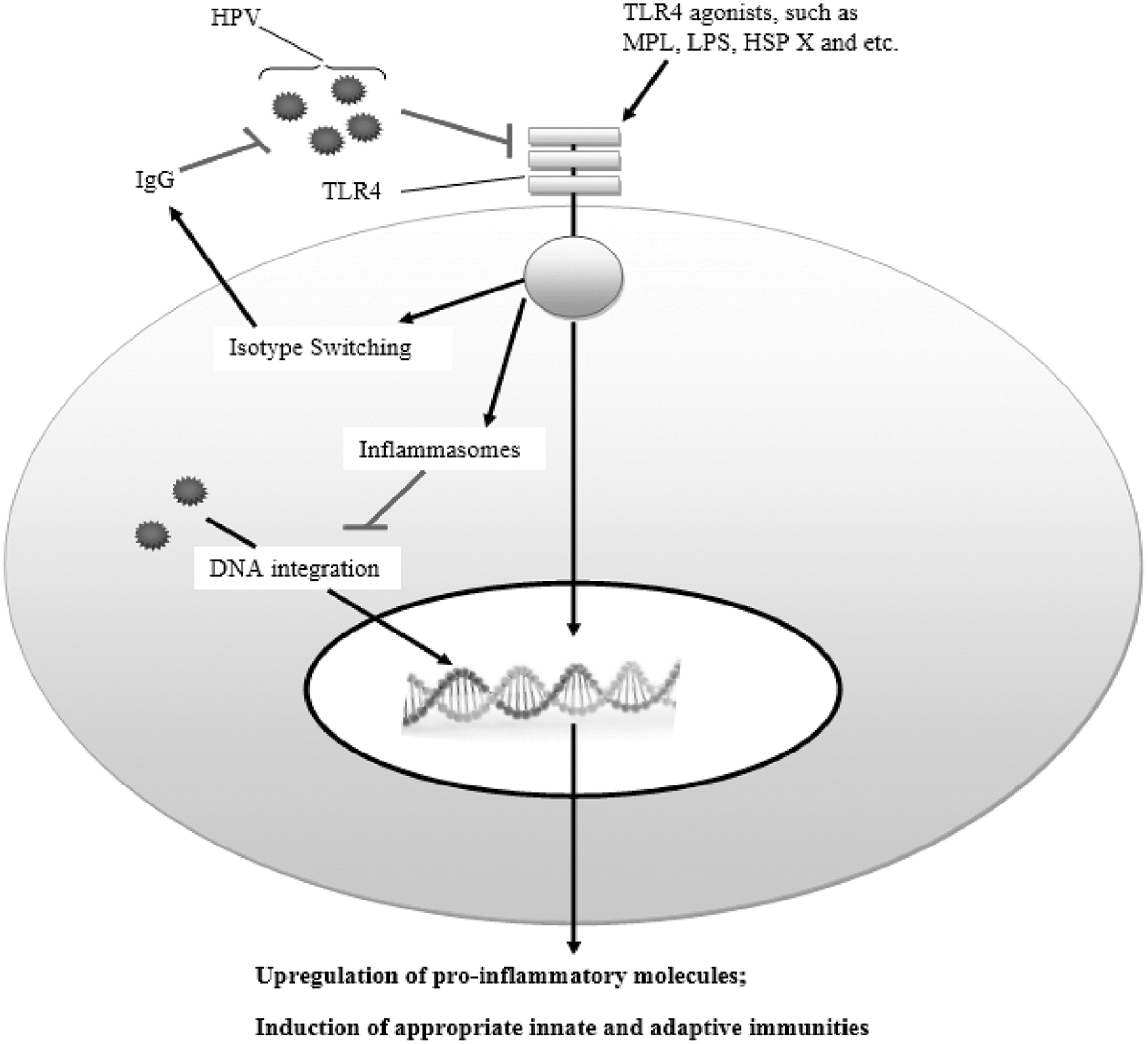
TLR4 plays key roles against HPV infection. TLR4 agonists and HPV PAMPs induce TLR4 intracellular signaling pathways and also activation of inflammasomes, which result in upregulation of proinflammatory molecules and inhibition of HPV-DNA integration to host genome, respectively. It also induces antibody isotype switching to IgG, the main antibody against viruses. HPV, human papillomavirus; IgG, immunoglobulin G; LPS, lypopolysacharide; MPL, monophosphoryl lipid A; PAMPs, pathogen-associated molecular patterns; TLR4, Toll-like receptor 4.
Collectively, it appears that TLR4 and its related pathways are the important molecular mechanisms against HPV and may be considered as an important target to be activated against HPV and its related complications. However, there is some evidence to confirm that induction of humoral immunity using HPV16 E6E7 multi-epitope vaccine, independent of cellular immunity, can be induced against HPV16 without involvement of TLR4 (17). It appears that the protection against HPV16 E6E7 multi-epitope vaccine can be classified in the immune responses to thymus-independent antigens. And another investigation proved that TLR4 expression was not changed among the patients infected with high and low risk HPV and healthy controls (9).
Due to the fact that HPV uses several mechanisms to escape from immune responses, it may be suggested that the virus may suppress upregulation of TLR4 in the patients who suffer from both high and low risk HPV. This hypothesis was proved by Aggarwal et al., who showed TLR4 expression was significantly decreased in the HPV-infected tissues when compared with the healthy control (1).
According to the results presented here, TLR4 is a critical molecule that participates in the activation of anti-HPV immune responses because HPV proliferation is associated with decreased expression of the molecule. Thus, TLR4 may be considered as a key molecule to be an innate immune cell activator against HPV. However, the hypothesis needs to be explored by further in vivo investigations on both animal and human models. Moreover, due to the positive roles played by TLR4 against HPV using TLR4 agonist in the animal models, it appears that some human clinical trials need to be performed to confirm the results.
HPV-Related Cancers and the Roles of TLR4
It has been reported that HPV infection, especially high-risk types, can induce some malignant cancers of the cervix and anus and a subset of penile, vulvar, and vaginal cancers (29). The main mechanisms used by HPV to induce the cancers are yet to be clarified completely. There is a hypothesis regarding the roles played by chronic inflammation in the induction and stimulation of cancers. Interestingly, TLRs are the main parts of this hypothesis and several investigations proved the roles played by TLRs in the induction or stimulation of cancer development (3,5,32,38,51). Due to the interaction between HPV and TLR4, it may be concluded that TLR4 could be a part of chronic inflammation in the HPV-infected patients and also may participate in the induction of HPV-related cancers.
Interestingly, it has been reported that although the normal human skin cells do not induce inflammation in response to microbial infections, the HPV-related immortalized keratinocyte cell line induces inflammation through activation of TLR4 (19). The TLR4-related inflammation also is a main cause of HPV-associated warts (59). Another recent investigation revealed that HPV alters expression of 84 genes involved in the TLR4 intracellular signaling pathways (39). Accordingly, the study showed that HPV infection was associated with various high mobility group box 1 (HMGB1) expressions and subsequently altered HMGB1-TLR4 signaling axis, which is an important signaling pathway for the proliferation and tumorigenic potential of cervical cancers (39).
Interestingly, Li et al., revealed that the cervical tissues from the patients that suffered from cervical cancers had higher expression of TLR4, NF-κB p65, and its downstream enzyme, inducible NO synthase (iNOS), when compared to the patients who had healthy cervical tissue but were infected with high-risk HPV (31). These data suggested that altered expression and functions of TLR4 and its signaling pathways are an important scenario for induction of cancers following HPV infection. Another investigation proved the roles played by TLR4 in the induction of HPV-16 E6/E7-related benign prostatic hyperplasia by induction of chronic inflammation (34). The study reported that hyaluronic acid can modulate expression of TLR4 and its related molecules to downregulate inflammation and subsequently the progression of the benign prostatic hyperplasia (34).
A study by de Matos et al., showed that TLR4 expression had a positive significant association with expression of proinflammatory cytokines, which play key roles in the induction of HPV-related chronic inflammation, in either cervical intraepithelial neoplasia or cervical squamous cell carcinoma (16). Another study by Chinese investigators showed that using a chemical compound entitled “7-4-[Bis-(2-hydroxyethyl)-amino]-butoxy-5-hydroxy-8-methoxy-2-phenylchromen-4-one (V8)” has anti-inflammatory effects on the HPV-related cervical cancer cells though inactivation of TLR4 signaling pathways (24). Evaluation of a Chinese population regarding mRNA and protein levels of TLR4 and its downstream molecules such as nitric oxide (NO) pathway showed that the molecules were significantly increased in the HPV high-risk infected squamous cell cervical cancer tissues (32).
The inducer roles played by TLR4 in the progression of HPV-related cervical intraepithelial neoplasia and invasive cervical cancers were also proved by Chinese investigators (58). They revealed that upregulation of TLR4 was associated with decreased apoptosis in the cells (58). Additionally, Werner et al., reported that bacterial agents by triggering the TLR4 and activation of the related signaling pathways can participate in the induction of HPV-related cancers (60). Due to the studies it appears that TLR4 is a main chronic inflammation mediator in the HPV-infected patients and it can be considered as a potential risk factor for development of HPV-related cancers. Figure 2 illustrates the roles played by TLR4 in the HPV-related warts and cancers.
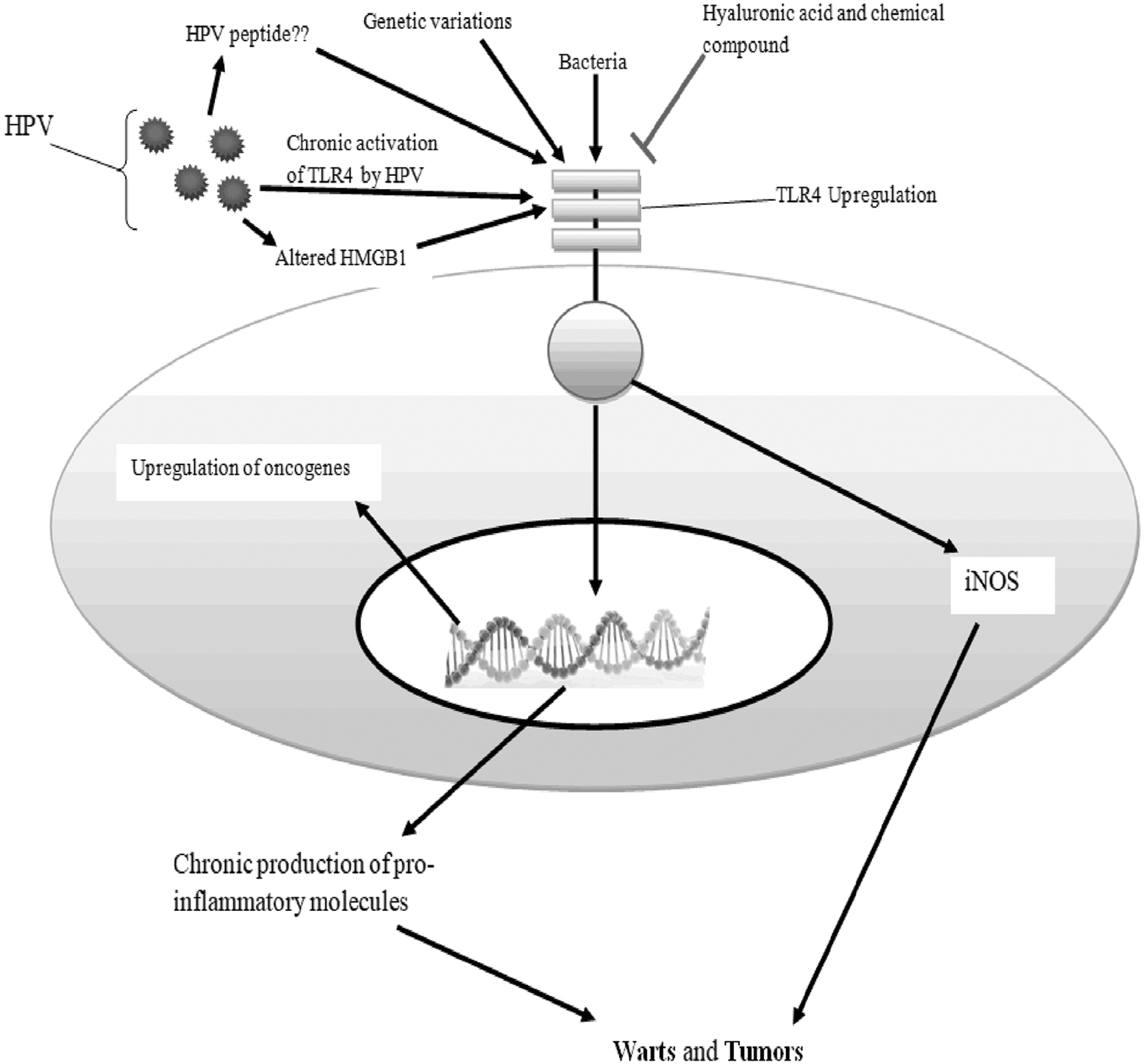
TLR4 roles in induction of HPV-related warts and cancers. HPV-related altered HMGB1, genetic variations, chronic activation of TLR4, bacteria PAMPs, and maybe HPV-peptides are the main factors for induction of chronic activation of TLR4, which can be modulated by hyaluronic acid and chemical compound. Chronic activation of TLR4 is associated with chronic upregulation of proinflammatory molecules and iNOS, the main causes of warts and cancers. Chronic activation of TLR4 also can be considered as a main factor for upregulation of oncogenes in the HPV-infected cells. HMGB1, high mobility group box 1; iNOS, inducible NO synthase.
Conclusion
TLR4 is a molecule with dual roles in the HPV-infected patients, from induction of anti-HPV immune responses to progression of cancers in the infected patients. The most important unsolved question is “When does TLR4 play a protective role against HPV and when does it induce the related cancers?” Although the investigations are not able to describe the question, authors of this review article proposed some mechanisms, which need to be explored by further studies. The plausible mechanisms may be as follows: The genetic variations in the TLR4 and its related molecules may be considered as important risk factors for alteration in the expression and functions of TLR4-related pathways. To support this hypothesis, association of the G allele of rs7873784 within TLR4 gene with increased risk of HPV-related cervical cancer have been documented by Jin et al. (26). It has been reported that viruses, such as hepatitis B virus, which are the causes of human cancers can modulate the functions of TLR4 to induce its oncogenic functions (65). It may also be hypothesized that HPV may produce a peptide to modulate the functions of TLR4. Insufficient cellular immunity, including TLR4 signaling, may lead to low chronic proinflammatory responses and subsequently results in altered microenvironment of the HPV-tissue to progress the related cancers. The roles played by TLR4 may be affected by the type of the HPV and the ethnicity of the evaluated patients. For example, Daud et al., reported that expression of TLRs in the cervical mucosa is type-specific (15).
Finally, although the roles played by TLR4 are bolded in this review article, it is worthy to note that it is not the complete story and various molecules and intracellular pathways can affect the HPV-infected cells that are recognized as tumor cells. There is one investigation that reported no differences between HPV-related oral squamous cell carcinoma, cutaneous squamous cell carcinoma, and healthy controls regarding TLR4 expression (44). The study reported that TLR5 was upregulated in the HPV-related oral squamous cell carcinoma when compared to cutaneous squamous cell carcinoma (44).
Additionally, other investigations also confirmed the roles played by other TLRs, such as TLR7, TLR8, and TLR9, in the pathogenesis of HPV (22,54). Due to the fact that the molecules recognize different ligands and develop various intracellular signaling, it appears that the roles of TLR4 in the HPV infection and its related complications need to be explored in the context of other TLR4, even other intracellular sensors, which are associated with different intracellular signaling.
Footnotes
Author Disclosure Statement
No competing financial interests exist.
Funding Information
No funding was received for this project.