




Abstract
Infectious bronchitis (IB) is a highly contagious viral disease of chickens, known to cause severe economic losses. Vaccination against IB virus (IBV) is an important control measure against the disease. The objective of the present study was to test Avishield IB GI-13, the vaccine candidate against IBV, strain V-173/11 (GI-13 genotype), according to European Pharmacopoeia (Ph. Eur.) efficacy requirements. Laboratory study on specific-pathogen-free (SPF) chickens showed 100% protection against challenge 10 days after vaccination of 1–7 day-old chickens by three recommended routes. Duration of immunity was shown to be at least 8 weeks after vaccination. Chickens with maternally derived antibodies (MDA) were 100% protected against challenge 21 and 35 days after vaccination. Testing of the vaccine candidate in field conditions on commercial broiler and layer farms showed 80–90% protection against homologous challenge after spray (broilers and layers) or oral (broilers) vaccine administration. Serum antibodies were monitored during the studies, and although good seroconversion was observed in MDA-positive chickens 34 days after vaccination or later, the data from SPF chickens indicate that non-humoral immunity is important in protection against challenge. Neutralizing antibodies in tears were detected, however, their level could not be fully linked with individual protection scores. A cross-protection study showed that administration of the combination of Avishield IB H120 vaccine and Avishield IB GI-13 vaccine candidate at day 1, confers good protection against heterologous QX-like challenge. Stability of the vaccine after reconstitution in 0.2% skimmed milk solution or distilled water at room temperature was confirmed over the period of 3 h. The vaccine candidate fully complied with Ph. Eur. requirements, with very good protection levels, indicating that it can be administered already at 1 day of age by spray at the hatchery or at 7 days of age by drinking water on the farm.
Introduction
Infectious bronchitis (IB) is a highly contagious viral disease of chickens, which is caused by
Today, over a hundred live IBV vaccines of various serotypes are marketed worldwide. The vast majority of them are based on Massachusetts (Mass) serotype, and only approximately half a dozen of them are based on 793B serotype (4). This variant 793B IB virus emerged in 1990s in the UK and France and caused welfare and economic problems in flocks, which were apparently well vaccinated with vaccines available at that time (19,21). Strain 793B spread rapidly over Eastern Europe, Russia, Turkey, the Middle East, China, Japan, Morocco, and South America (23). Since vaccines available at that time did not protect against IBV 793B, a new vaccine based on 793B strain had to be introduced. 793B type vaccines are commonly used nowadays for protection against 793B challenge. They are used alone or in combination with vaccines containing other strains of IBV (i.e., Mass) against homologous and heterologous challenges (10,12,26). According to complete S1 gene sequence, Valastro et al. classified 793B strain as GI-13 genotype (30).
Over the past decades, regulatory requirements needed for getting approval of a new veterinary vaccine intended for EU market have grown considerably. EU regulatory framework for veterinary vaccines includes documents of European Medicines Agency (3), European Pharmacopoeia (Ph. Eur.) (5,7), and European Commission (1). As a consequence of such high requirements, the cost and time needed for development and registration of a new vaccine have increased significantly. However, these requirements ensure that newly registered vaccines are of highest possible quality, with good safety profiles and proven efficacy.
In this study, we present the results of efficacy testing of Avishield IB GI-13, a new live vaccine candidate against IB, strain V-173/11, which genetically (S1 gene) and antigenically belongs to 793B IBV type and GI-13 genotype (GI-13 vaccine candidate, further in text). Efficacy testing was performed according to current EU requirements. Several animal studies were conducted under laboratory conditions on specific-pathogen-free (SPF) chickens and on commercial chickens with maternally derived antibodies (MDA) to show onset and duration of immunity after vaccination by recommended administration routes. Also, studies in field conditions on commercial broilers and layers were performed to prove efficacy of the vaccine candidate in real-life conditions. The ability of the GI-13 vaccine candidate to cross-protect against heterologous QX-like challenge, that is, to provide protectotype, when administered at 1 day of age together with Avishield IB H120 vaccine was also evaluated. Since the success of vaccination in field conditions is highly dependent on the virus stability after reconstitution of freeze-dried vaccine, in-use stability was evaluated. To determine the presence of neutralizing antibodies to IBV in tears, and their connection to the level of protection of the vaccinated chickens, virus neutralization assay was performed.
Materials and Methods
Vaccines and viruses
Avishield IB GI-13, a live freeze-dried vaccine candidate against
In a cross protection study, commercially available vaccines were used, containing strains (1) H120 and D274 clone (Poulvac IB Primer, Zoetis, United Kingdom), (2) IB Ma5 (Nobilis Ma5, MSD AH), and (3) 4/91 (Nobilis IB 4/91, MSD AH). Also, Avishield IB H120 vaccine (Genera, part of Dechra Pharmaceuticals, PLC) and GI-13 vaccine candidate were used. Challenge virus was QX-like field strain belonging to GI-19 genotype.
In-use stability testing after reconstitution of freeze-dried vaccine
In-use stability testing after reconstitution has been performed as described in the EMA Guideline (2). Two batches were tested at room temperature after reconstitution of the vaccine in two experiments. In the first experiment, the samples were reconstituted in sterilized tap water with 0.2% (m/v) skimmed milk powder, to simulate reconstitution of the vaccine when administered in the field by drinking water. In the second experiment, the samples were reconstituted with distilled water, to simulate reconstitution of the vaccine when administered in the field by spray/eye-nose drop method. Virus titer and appearance of reconstituted vaccine were tested up to 3 h after reconstitution, mimicking the field situation where the vaccine has to be applied within 3 h after reconstitution to assure that the chickens receive the desired dose. Virus titer was determined by infection of 10–11-day-old SPF chicken embryos (72 embryos per sample) with serial dilutions of the virus. After incubation of 72–96 h, allantoic fluid from each egg is tested by real-time RT-PCR for the presence of the virus, and the virus titer is calculated by Spearman–Karber equation.
Animal studies
A series of laboratory and field animal studies required for registration of live IBV vaccine in EU countries was performed to assess vaccine's efficacy. Studies were designed and performed following specific and general guidelines provided in relevant Ph. Eur. and EMA monographs and chapters, and with all needed approvals. Duration of immunity of 56 days was tested in Prophyl Ltd., Hungary, and all other laboratory studies were performed in GD Animal Health, the Netherlands. Field studies were performed on commercial farms in Slovenia by Veterinary faculty, University of Ljubljana, Institute for Poultry, Birds, Small Mammals, and Reptiles. The cross-protection study was performed in Poulpharm Bvba, Belgium.
Evaluation of efficacy on SPF chickens in laboratory conditions
Efficacy of the vaccine was evaluated on SPF chickens in laboratory conditions by administration of the GI-13 vaccine candidate by each of the recommended routes, with minimal effective dose of 102.7 EID50/chicken (5). Twenty one-day-old chickens were vaccinated by eye-nose drop and by spray, and twenty 7-day-old chickens were vaccinated orally by drinking water instillation. One group of chickens served as nonvaccinated control group for eye-nose drop and spray administration, and the other for drinking water administration, with 10 chickens in each group. All chickens, vaccinated and control, were challenged with 793B challenge strain 10, 21, and 35 days postvaccination. Immunogenicity was evaluated by scoring the ciliary activity of tracheal explants 5 days after challenge. In brief, 10 transversal tracheal sections from each trachea (3 from the upper part, 4 from the middle part, and 3 from the lower part) were examined by low magnification microscopy for ciliary activity, according to Ph. Eur. (6). Ciliary activity score was determined using a binomial score (0: ≥ 50% of the tracheal ring shows ciliary movement; 1: < 50% of the tracheal ring shows ciliary movement). A chicken was considered not affected if not fewer than 9 out of 10 rings showed normal ciliary activity. Also, 80% of control chickens have to show cessation or extreme loss of vigor ciliary activity, in order for the challenge to be valid (6).
Serum antibodies to IB virus were determined on the day of vaccination and on 9, 20, and 34 days after vaccination using ELISA (IDEXX IBV; IDEXX Laboratories, Inc.), with titers >396 considered as positive, as proposed by the manufacturer. The same cutoff value was used in all ELISA testing presented here.
Evaluation of efficacy on MDA-positive chickens in laboratory conditions
Efficacy of the vaccine was evaluated in MDA-positive chickens under laboratory conditions by administration of the GI-13 vaccine candidate by each recommended route, with minimal effective dose of 102.7 EID50/chicken (5). The design of the study was the same as described for SPF chickens, except for challenge days, which were on days 21 and 35 postvaccination.
Evaluation of duration of immunity
Duration of immunity was evaluated in SPF chickens under laboratory conditions by administration of the vaccine with minimal effective dose of 102.7 EID50/chicken (5). One-day-old chickens were vaccinated by spray, and 7-day-old chickens were vaccinated by drinking water. One group of chickens served as nonvaccinated control group for each treatment. Fifty-six days (8 weeks) postvaccination chickens were challenged with 793B challenge strain. Immunogenicity was evaluated by scoring the ciliary activity of tracheal explants 4 days after challenge, as described above. Antibodies to IB virus in chicken sera were determined on the day of vaccination and 56 days after vaccination using ELISA (IDEXX IBV; IDEXX Laboratories, Inc.).
Evaluation of efficacy on commercial broilers and layers in field conditions
Efficacy of the GI-13 vaccine candidate in the field conditions was tested on commercial broilers and layers.
In the study using commercial broilers, two flocks of hybrid Ross 308 chickens with ∼20,500 birds per house were used. Each flock was situated on a different farm with the same type of houses and conditions, and no other vaccine against IB was administered to the birds before transfer to laboratory for the challenge. One flock was vaccinated with one dose per chicken by spray at 1 day of age at the hatchery, and the other flock was vaccinated by drinking water at 7 days of age. For efficacy testing, birds were taken from each flock at two time points for laboratory challenge. Ten chickens were taken by first-hand before vaccination (nonvaccinated controls), and 20 chickens were taken by first-hand 6 days before challenge (vaccinated chickens). Challenge virus was administered 21 days postvaccination and efficacy was demonstrated by scoring the ciliary activity of tracheal explants 4 days after challenge, as described above.
In the study using commercial layers, a flock of 26,000 hybrid line Lohmann Brown chickens was used. Birds were vaccinated by spray at 1 day of age at the hatchery. For efficacy testing, birds were taken from the flock for laboratory challenge. Ten chickens were taken by first-hand before vaccination (nonvaccinated controls), and 20 chickens were taken by first-hand 4 days before challenge (vaccinated chickens). Challenge was administered 21 days postvaccination and efficacy was demonstrated by scoring the ciliary activity of tracheal explants 4 days after challenge, as described above.
In field studies, blood was taken from broilers at the day of vaccination, 21 days after vaccination, and before slaughter to determine serum antibodies against IBV by ELISA (IDEXX IBV; IDEXX Laboratories, Inc.). Layers were sampled at the day of vaccination and 18 days later.
Virus antibodies in tears
Presence of neutralizing antibodies to IB virus was measured in tears by virus neutralization assay (24) on chicken embryo kidney cells. In brief, tears were collected 20 days postvaccination (1 day before challenge) from SPF chickens vaccinated by eye-nose drop. Virus neutralization assay was performed by addition of 100 TCID50 units of vaccine IB virus to two-fold serial dilutions of tears in PBS. After 30-min incubation at room temperature, dilutions were inoculated on CEK cell monolayers in 96-well plates. Negative controls (medium) and positive controls (virus without tears) were included. Plates were centrifuged at 1000 g for 60 min and incubated at 37°C and 5% CO2. Cell cultures were examined for the presence/absence of cytopathic effect after 3 days. Antibody titer was expressed as the last dilution of tears, which still neutralized the added virus.
Cross-protection study
Fifteen commercial MDA-positive broiler chickens were vaccinated per group at 1 day of age, by eye-nose drop. The first group was vaccinated with one dose of vaccine containing strains H120 and D274 clone, together with one dose of the vaccine containing 4/91 strain. The second group was vaccinated with one dose of vaccine containing IB Ma5 strain, together with one dose of the vaccine containing 4/91 strain. The third group was vaccinated with one dose of each Avishield IB H120 vaccine and vaccine candidate GI-13. One group of chickens was left as nonvaccinated/nonchallenged control, and one group served as a nonvaccinated/challenged control. Twenty one days after vaccination, the chickens were challenged with QX-like field virus via eye drop. Four days after challenge, ciliary activity was evaluated in all groups. The protection scores were calculated as 1 – mean score for vaccinated and challenged group/mean score for challenged control group × 100, as described by Cook et al. (18) and Awad et al. (9).
Statistical analysis
Differences between levels of protection between vaccinated and nonvaccinated groups were assessed using Fisher's exact p one-tailed test in TIBCO Statistica 13.3. In the cross-protection study, the significance between the groups was assessed using R with linear regression models with the group as categorical fixed effect. The statistical significance was assessed at p ≤ 0.05.
Results
Stability after reconstitution of freeze-dried vaccine
Vaccine stability was tested on two representative batches of the vaccine at room temperature (20–25°C) in two experiments. Virus titer was measured during the period of 3 h after reconstitution, which is the recommended period, during which vaccine should be applied in the field conditions. In the first experiment, in which the vaccine was reconstituted in 0.2% skimmed milk water solution, virus titer remained on the same level during the whole tested period for both batches (Table 1). Apparent increase in virus titer over the period of 3 h was not significant and was probably caused by the inherent variability of the egg-based titration method. The appearance of the reconstituted vaccine was unchanged over the period of 3 h. No precipitation was visible. In the second experiment, in which the vaccine was reconstituted in distilled water, virus titer remained unchanged over the 3-h period for one batch. The titer of the second batch was stable over the 2-h period, while the 3-h point showed slight decrease in titer (Table 1). However, virus titer remained well above minimal effective dose of 102.7 EID50/dose throughout the whole tested period. The observed fluctuations in virus titer were again probably caused by the inherent variability of the titration method. The appearance of the reconstituted vaccine remained unchanged over the observed period with no visible precipitation.
Stability After Reconstitution of the GI-13 Vaccine Candidate
Evaluation of efficacy on SPF chickens in laboratory conditions
Efficacy on SPF chickens was evaluated by a challenge study on 1-day-old chickens vaccinated by eye-nose drop or by spray, and on 7-day-old chickens vaccinated orally by drinking water instillation. Minimum recommended vaccine dose was used. Onset of immunity was evaluated by challenge 10 and 21 days postvaccination. Duration of immunity in this particular study was evaluated by challenge 35 days postvaccination. Ten days postvaccination, achieved protection levels were already 100%, regardless of the application route (Table 2). On days 21 and 35 postvaccination, protection levels were 95% for eye-nose drop, and 100% for spray and oral administration. Nonvaccinated control chickens were all affected by the challenge, with the exception of oral route on day 21, where 90% of the control group were affected. All of the results complied with the requirements for immunogenicity of a vaccine according to current Ph. Eur. monograph (6).
Protection of Chickens Vaccinated with GI-13 Vaccine Candidate Against Homologous Challenge, Based on Ciliostasis in Tracheal Explants
Ph. Eur. requires protection levels of ≥80% after challenge, and also that ≥80% of the nonvaccinated chickens should be affected after challenge.
n = number of chickens per group; - not tested.
Detection of serum antibodies to IB was performed by ELISA on the day of vaccination and day before each challenge point, that is, on days 9, 20, and 34 postvaccination (Fig. 1 and Supplementary Table S1). SPF status of chickens was confirmed on the day of vaccination. Nonvaccinated control chickens remained seronegative at all test points. A rise in antibodies to IB was observed in 3/20 vaccinated chickens on day 20 after spray and oral vaccination. In these groups, 2/20 and 1/20 chickens were positive for IB antibodies on day 34, respectively. In the group which was vaccinated by eye-nose drop, 2/20 chickens were positive for IB antibodies on day 34.
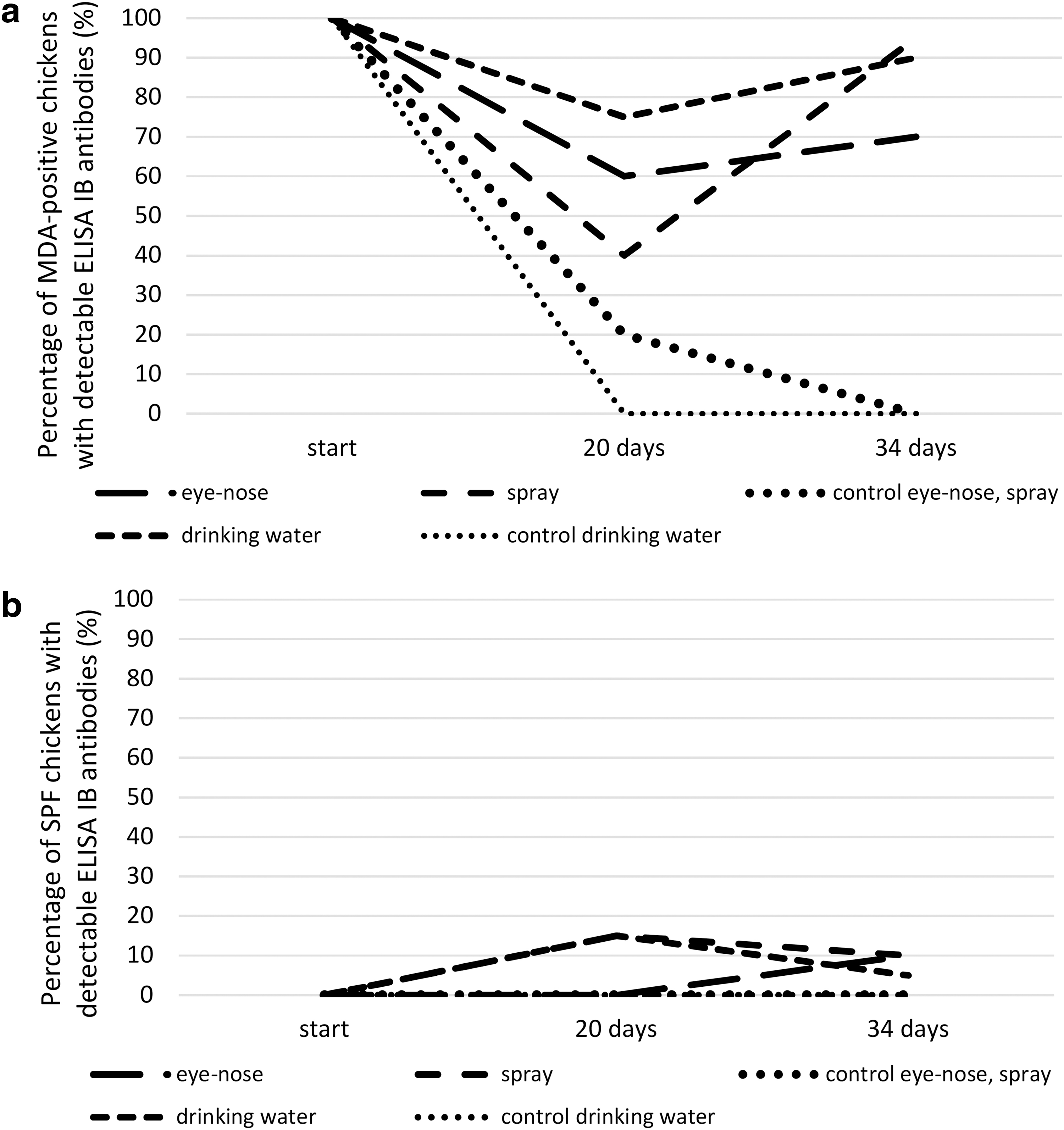
Percentage of
Evaluation of efficacy on MDA-positive chickens in laboratory conditions
Full protection of 100% was achieved for all three administration routes 21 days after vaccination, and the protection remained on the 100% level at 35 days after vaccination. Of the nonvaccinated controls, 90–100% of the chickens were affected after challenge, which is in compliance with current Ph. Eur. requirements (Table 2).
Detection of serum antibodies to IB was performed by ELISA on the day of vaccination and 20 and 34 days after vaccination (Fig. 1 and Supplementary Table S1). MDA-positive status was confirmed in all tested chickens at the start of the study. A clear decline in the level of MDA was observed in nonvaccinated control group. Twenty one days after vaccination, no MDAs could be detected in the control group for oral administration, and MDAs could be detected in 2/10 chickens in the control group for eye-nose drop/spray administration. On day 34 after vaccination, none of the nonvaccinated control chickens had detectable MDA. In vaccinated groups, a decline in the level of MDA could be observed until day 20 postvaccination, followed by an increase in titer as the result of vaccination. On day 34 after vaccination, 14/20, 19/20, and 18/20 chickens had antibodies to IB virus detected by ELISA, for eye-nose drop, spray, and oral route, respectively (Fig. 1).
Evaluation of duration of immunity
Duration of immunity longer than 35 days was evaluated in separate studies. SPF chickens, vaccinated by a minimal dose by drinking water at 7 days of age were challenged 56 days after vaccination, and another group of SPF chickens, vaccinated by spray at day-old was challenged 56 days after vaccination. Ciliary activity of tracheal explants was scored 4 days after challenge. The results are shown in Table 3.
Protection of SPF Chickens Vaccinated with GI-13 Vaccine Candidate and Challenged with Homologous Challenge 56 Days Postvaccination, Based on Ciliostasis in Tracheal Explants; Serology Results
Different letters designate that groups are statistically significantly different within an individual administration route.
n = number of chickens per group.
Administration by drinking water
After challenge at day 56 postvaccination, protection rate of 100% was achieved in the vaccinated group, while 80% of the nonvaccinated controls were affected by challenge. Respective groups were significantly different (p = 0.0004).
The presence of antibodies to IB virus was examined by ELISA on the day of vaccination and 56 days after vaccination. Before vaccination, absence of antibodies to IB virus was confirmed. On day 56 after vaccination, 9/20 chickens had antibodies to IB virus. At the same time point, nonvaccinated control chickens were all seronegative to IB virus (Table 3 and Supplementary Table S2).
Administration by spray
After challenge at day 56 postvaccination, protection rate of 85% was achieved in the vaccinated group, while 100% of the nonvaccinated controls were affected. Respective groups were significantly different (p = 0.0011).
Absence of antibodies to IB virus was confirmed by ELISA before vaccination. On day 56 after vaccination, 8/20 chickens had antibodies to IB virus, while nonvaccinated control chickens were all seronegative to IB virus (Table 3 and Supplementary S2).
Evaluation of efficacy on commercial broilers and layers
As shown in Table 4, 80% of broilers vaccinated by spray were protected, while in nonvaccinated control group only 20% protection provided by the remaining MDAs was shown. Ninety percent of broilers vaccinated by drinking water were protected, compared to 10% protection in nonvaccinated controls. Vaccinated layers demonstrated 80% level of protection, compared to 30% protection in nonvaccinated controls. Overall, chickens vaccinated in field conditions had 80–90% level of protection against challenge, which was statistically significantly different from nonvaccinated challenged controls, with p-values of 0.0027 (broilers spray), 0.0000 (broilers drinking water), and 0.0116 (layers). MDA declined in titer from day of vaccination until 21 days later, at which time point none of the sampled chickens was positive to antibodies to IBV. However, seroconversion occurred and 14/20 (70%) broilers vaccinated by spray were positive to IBV serum antibodies at slaughter. The concentration levels of serum ELISA antibodies detected in all of the field studies followed the similar pattern as in laboratory study in MDA-positive chickens, as shown in Figure 1a.
Efficacy of GI-13 Vaccine Candidate on Commercial MDA-Positive Broilers and Layers Vaccinated in Field Conditions and Challenged Under Laboratory Conditions 21 Days After Vaccination
Different letters designate that groups are statistically significantly different within an individual administration route and bird type.
Virus antibodies in tears
Virus neutralization assay performed on tears taken from SPF chickens 20 days after vaccination with minimal vaccine dose showed that neutralizing antibodies to IB virus are present in all vaccinated chickens. Antibody titers were in the range 23 to 27, with an average titer of 25.4 (Supplementary Table S3). There was no clear link between titer of anti-IB antibodies in tears and preservation of ciliary activity 4 days after challenge in an individual chicken. In this proof of concept study, 17 out of 19 tested chickens were protected from challenge, as judged by ciliary activity. However, two unprotected chickens had antibody titers of 25 and 26, which is the average or above. Contrary, one chicken with fully functional tracheal activity had low anti-IBV titer of 23.
Cross-protection study
MDA-positive broiler chickens vaccinated with combination of different commercially available vaccines at 1 day of age were challenged with a heterologous QX-like field strain (genotype GI-19). Protection scores showed that all vaccine regimes provided good protection against challenge, with no statistically significant differences between the vaccinated groups, but with the highest total score in Avishield IB H120/GI-13 vaccine candidate group (Fig. 2). Nonvaccinated challenged group was affected by the challenge, and its protection level was significantly different from the vaccinated groups.
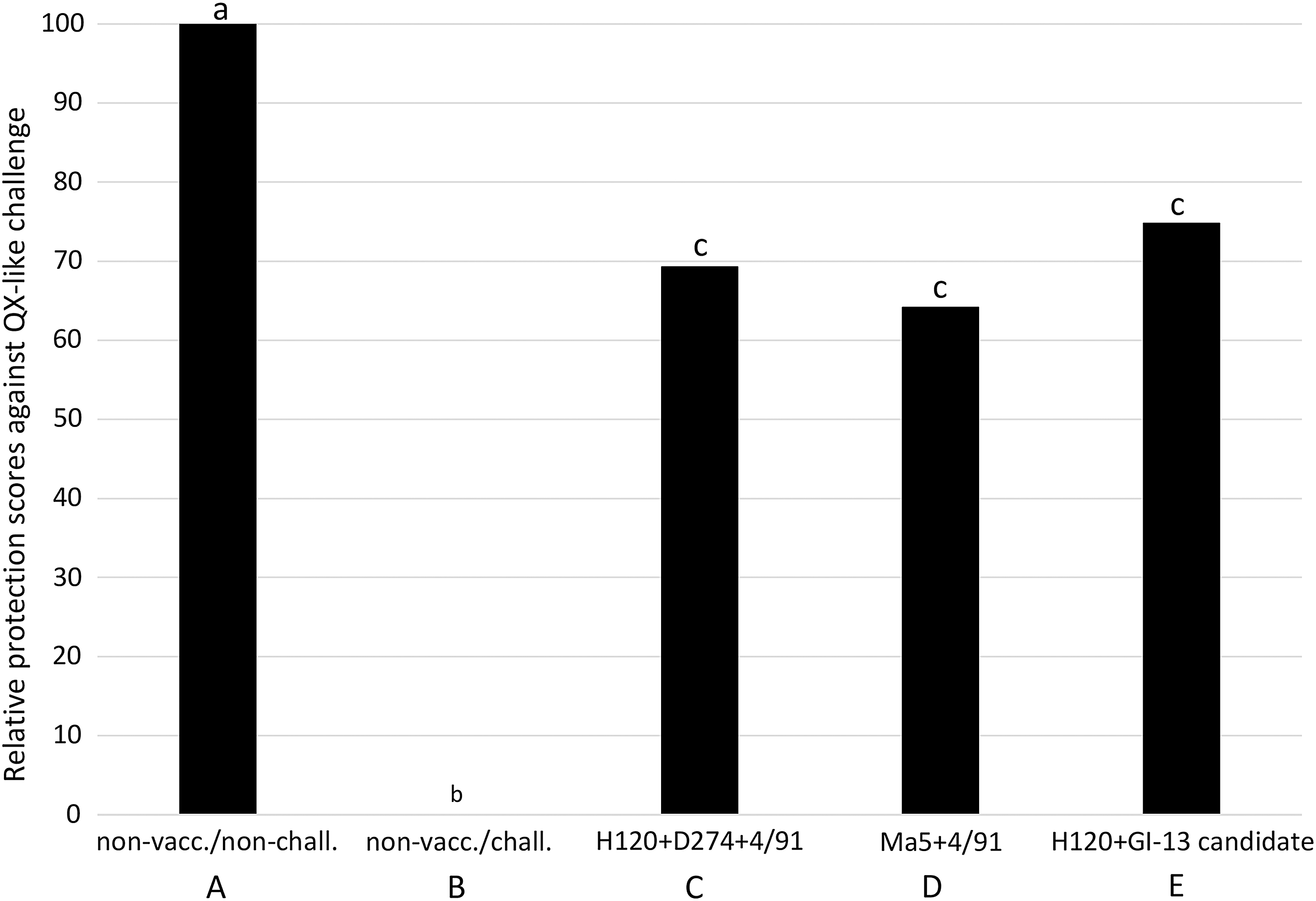
Cross-protection challenge study results. Bars indicate protection scores relative to nonvaccinated/nonchallenged controls
Discussion
Results of efficacy studies performed on live attenuated vaccine candidate against avian
Effective methods of mass vaccination of poultry are important to ensure uniform and rapid vaccination of flocks susceptible to infectious disease (31). The most common methods of mass application include vaccination by spray or by drinking water. Live vaccines are most often supplied in lyophilized form and reconstitution in water is needed before application. After reconstitution, titer of live vaccines gradually declines, and it is important to minimize the time between reconstitution and administration of a vaccine to ensure delivery of an appropriate dose of the vaccine to the flock (14). The quality and temperature of water used for vaccination is of the greatest importance (32). Chlorinated water, for example, is hazardous to vaccines and may severely influence the quantity of the vaccine delivered to birds. To overcome this issue, the common practice for drinking water administration includes the usage of skimmed milk powder in concentration of 2 g/L in water (14). For spray administration, the usual recommendation is to use distilled water for dilution of the live vaccine. According to the common practice and recommendations, we tested the stability of two batches of the GI-13 vaccine candidate, in 0.2% skimmed milk water solution and in distilled water. From the presented data, it can be concluded that GI-13 vaccine candidate is stable for 3 h after reconstitution and that slightly better results are achieved when 0.2% skimmed milk is added to water solution. It appears that skimmed milk contributes to some extent to the protection of the virus.
Ph. Eur. proposes clear criteria for assessing vaccine`s efficacy (6,7,32). Performance of the vaccine candidate should be first demonstrated on animals in laboratory conditions, and then in the field in commercial flocks. All three recommended routes of administration (eye-nose drop, spray, and drinking water) were tested in laboratory conditions. Besides Ph. Eur. requirements, testing of the onset and duration of immunity was also incorporated in this study. One-day-old SPF chickens were vaccinated by eye-nose drop and by spray, and 7-day-old SPF chickens were vaccinated by drinking water instillation. The results of ciliary activity showed excellent protection levels of 100% in SPF chickens, already 10 days after vaccination for all administration routes, indicating that onset of immunity in SPF chickens starts at latest at 10 days. High levels (95–100%) of protection were observed 21 and 35 days after vaccination for all administration routes. Ph. Eur. requires that 21 days after vaccination at least 80% of the chickens should be protected against challenge, while at least 80% of nonvaccinated controls should be affected, to pass the immunogenicity test, that is, to confirm that vaccinal virus is efficacious. With regard to these requirements, GI-13 vaccine candidate complies fully with Ph. Eur. requirements, and even exceeds the requirements.
Serological response to vaccination of SPF chickens showed a rise in antibody levels in a few vaccinated birds on days 20 and 34. This again stresses out that the basis of immunity provided by live IBV vaccines is not yet fully understood, and that serum antibodies do not always correlate with protection to IB challenge, which was very high in our case already at day 10 after vaccination. Local immunity seems to play a critical role in protecting chickens against IB challenge (15,28). Several studies showed that levels of protection after challenge correlate with levels of local respiratory antibody, and not with serum antibody (16). We performed virus neutralization test on tears of vaccinated SPF chickens, which showed that antibodies to IB virus are indeed present in tears, however, the level of neutralizing antibodies cannot be fully linked with individual protection levels based on ciliary activity scores after challenge. Similar findings have already been described (16,22), and this indicates that mechanisms other than antibody-mediated immunity play a role in protection of chickens after challenge. In addition, Chhabra et al. reported that the peak in IgA antibodies in tears is at 14 days after vaccination, so monitoring antibodies levels in tears at earlier time point after vaccination is recommended (17). Awad et al. reported that effectiveness of a vaccination program depends on the degree of cellular and local immune response at tracheal level (9). They showed that the presence of CD4+, CD8+, and IgA-bearing B cells present in trachea is associated with the level of protection after vaccination.
Duration of immunity of 56 days (8 weeks) after vaccination was demonstrated, where SPF chickens were challenged 56 days after drinking water or spray vaccination. Vaccinated groups showed 85–100% levels of protection confirming that protective immunity lasts at least 56 days (8 weeks) after administration of one minimal dose, regardless of the administration route. Serum antibodies do not seem to play a crucial role (16), since only 40–45% chickens were seropositive to IB virus before challenge. As several authors previously reported, antibody levels below the cutoff point of ELISA were detected after vaccination with H120 vaccine, and yet, the vaccine conferred protection against homologous challenge (11,25). This feature is not uncommon for vaccines against IB, especially when administered at an early age, due to immature innate and adaptive immune responses in newly hatched chicks. Administration of the vaccine later in life usually induces higher serum antibody titers (29). Zegpi et al. reported that antibodies with higher avidity are developed if the vaccine is administered at least 10 days after hatch in comparison to administration at day-old (33). Bru et al. performed an efficacy study based on Ph. Eur. where they vaccinated SPF chickens with commercially available vaccines (13). They also showed poor seroconversions at day of challenge.
Vaccination of the commercial poultry is complicated by the presence of MDA, transmitted passively from hens to offspring. MDAs provide passive immunity from infection at the early age, but can also negatively interfere with vaccination. A drop in MDA titers can be observed after vaccination, indicating that part of the antibodies are utilized by vaccinal virus (27). It is therefore required to confirm the efficacy of the vaccine candidate on MDA-positive chickens. The results showed excellent protection levels of 100% following vaccination with GI-13 vaccine candidate for all administration routes (eye-nose drop, spray, and drinking water) when challenged 21 days after vaccination. The same 100% level of protection was also observed 35 days after vaccination, demonstrating duration of immunity of 5 weeks. When challenged 21 days after vaccination, MDA-positive chickens, like SPF chickens, complied with Ph. Eur. requirements as ciliary activity was completely retained. Prevention of ciliostasis by virulent IBV is particularly important, since damage on tracheal mucosa (cilia) enables other opportunistic microorganisms to replicate and cause morbidity, mortality, and economical loss (19).
MDA-positive chickens showed higher seroconversion following vaccination when compared against SPF chickens (Fig. 1). All nonvaccinated control chickens showed gradual decrease of MDA levels. It is estimated that after ∼20 days of age MDAs provide little to no protection of chickens against IBV challenge (27). The drop of MDA levels below the cutoff point in ELISA was reported already at 10 (11) to 14 days of age (17). As MDAs are no longer present, serum antibodies produced as a consequence of vaccination contribute to protection of chickens against challenge. This is in compliance with the presented results of ciliary activity, which showed 100% levels of protection in vaccinated groups 21 days after vaccination and forward. The vaccine candidate was capable to overcome maternal antibodies and to induce protective immunity in respiratory organs as well as seroconversion in chickens vaccinated by either of the administration routes.
Testing efficacy of a vaccine candidate in laboratory conditions is mandatory according to EU regulations, and also a very good indication of efficacy of the future vaccine in field conditions. After assessment of the efficacy in laboratory conditions, EU regulations also require that vaccine candidate is tested on a commercial flock in a field trial (5). Here, we reported the results obtained on three flocks of over 20,000 commercial MDA-positive chickens, two flocks of broilers and one flock of layers, vaccinated with one dose of the vaccine candidate by spray or by drinking water. Very good protection levels of 80–90% were observed after laboratory challenge in chickens vaccinated in the field. This further supports the data from the laboratory studies, and indicates that vaccine candidate tested in these studies is equally efficacious in the field.
Cross protection study showed that concurrent vaccination with D274 and/or Mass and 4/91 (793B) strain at 1 day of age protected commercial broilers against heterologous QX-like field strain rather well. Vaccine candidate GI-13 administered together with Avishield IB H120 vaccine at 1 day of age achieved the highest level of protection between the vaccinated groups. Similar results were obtained with other tested combinations of commercially available vaccines. Similar protection scores against QX challenge strain were also observed in work presented by Awad et al. (9). They tested, among others, protection after vaccination with two different Mass +793B vaccines. One Mass +793B combination gave very similar results to the ones which we presented in this article, indicating that GI-13 vaccine candidate is as good in achieving protection against QX challenge as other commercially available vaccines. The other Mass +793B combination achieved better protection results, however, this combination also caused high and rapid onset of ciliary damage and mortality with severe lesions. It also induced higher tracheal CD4+, CD8+, and IgA-bearing B cells levels, indicating that higher cellular and local tracheal immunity probably contributed to enhanced protection scores, regardless of rather compromised safety profile of these combined vaccines. Other studies also showed that broader cross-protection is achieved when antigenically distinct live attenuated vaccines are administered. Although some studies showed that vaccination with 2 weeks apart confers better protection (18), recent studies have shown that vaccination with antigenically distinct vaccines at day 1 gives very good protection against heterologous challenge viruses (9,13). Every combined vaccination program with any two IB viruses should first be tested to confirm protection against heterologous challenge (18).
Conclusions
Evaluation of efficacy of the vaccine candidate against
Footnotes
Disclamer
Leonida Kutle, Lana Ljuma Skupnjak, Anto Vrdoljak, and Davor Janković are employed by Genera, Inc., part of Dechra Pharmaceuticals PLC, manufacturer of Avishield IB H120 vaccine and GI-13 vaccine candidate. Gert Jan Boelm is employed by GD Animal Health, the Netherlands, which performed part of laboratory trials. Ferenc Kelemen is employed by Prophyl Ltd., Hungary, which performed part of laboratory trials. Olga Zorman Rojs is employed by Veterinary faculty, University of Ljubljana, Institute for Poultry, Birds, Small Mammals, and Reptiles, Slovenia, which was a contract research organization for field studies. Joske Millecam is employed by Poulpharm Bvba, Belgium, which performed part of laboratory trials.
Author Disclosure Statement
No competing financial interests exist.
Funding Information
This work was supported by European Regional Development Fund, Cohesion Fund and The Government of the Republic of Croatia, as a part of the project product research and development in the field of live poultry vaccines KK.01.2.1.01.0092.
Supplementary Material
Supplementary Table S1
Supplementary Table S2
Supplementary Table S3
References
Supplementary Material
Please find the following supplemental material available below.
For Open Access articles published under a Creative Commons License, all supplemental material carries the same license as the article it is associated with.
For non-Open Access articles published, all supplemental material carries a non-exclusive license, and permission requests for re-use of supplemental material or any part of supplemental material shall be sent directly to the copyright owner as specified in the copyright notice associated with the article.
