




Abstract
The long noncoding RNA (lncRNA), which could bind to target DNA, RNA, or protein, plays a vital role in the pathogenesis of viral replication and disease progression. Exploring how lncRNA regulates HIV infection is crucial for studying the pathogenesis, disease progression, and effective treatment of AIDS. Recently, Kulkarni et al. convincingly provided a molecular basis for association between CCR5AS lncRNA and outcome of HIV infection. Such results open a new avenue for the treatment and prevention of viral infections. In this study, we retell this story for a broad audience about how a new lncRNA enhances HIV-1 infection in easy-to-understand and jargon-free language.
The noncoding RNAs (ncRNAs), transcribed by 98% of the human genome, can be classified into three major types: short ncRNAs (17–30 bp), middle ncRNAs (30–200 bp), and long ncRNAs (lncRNA, >200 bp) (5). As the study develops in depth, researchers have further understood the biological function of lncRNAs. Multiple mechanistic studies have identified that lncRNAs play key roles by regulating viral infection, gene expression, and cellular metabolism (8,15). lncRNA binds to target DNA, RNA, or protein and participates in biological processes including gene expression regulation, RNA maturation, and protein synthesis. Both cellular and viral lncRNAs could as RNA molecules regulate transcription or translation of viral genes and then alter protein expression and replication of target virus (2). The interaction of HIV with host cell proteins has been extensively studied, but these studies have focused on protein-coding genes and host factors involved in HIV pathogenesis and intracellular defense (3). lncRNAs (such as NRON, NEAT1, and aspro5) act as a pivotal part in the pathogenesis of viral replication and disease progression (9,10). For example, NRON, a cellular encoded lncRNA in resting CD4+ T cells, represses HIV-1 transcription by inducing Tat (transactivator protein) degradation and plays a role in HIV-1 latency (9). Therefore, exploring the role of lncRNA in HIV infection is crucial for studying the pathogenesis, disease progression, and effective treatment of AIDS.
C-C chemokine receptor 5 (CCR5), located in human chromosome 3p21–22, is composed of 3 exons and 2 introns and play a key role in HIV immunity (1). Macrophage tropic HIV strains use CCR5 as a major coreceptor for entry to CD4+ T cells during initial infection. CCR5 expression level affects the outcome of HIV infection including virus production and efficacy of clinical treatment (13). Genome-wide studies have identified associations between HIV-1 susceptibility and numerous single-nucleotide polymorphisms (SNPs) in and near CCR5 genes, including rs1015164. The rs1015164, located between CCRL2 and LINC02009, has two common SNPs (A and G) and significantly correlates with the outcome of HIV infection independently of other polymorphisms in and around CCR5 in people of European (12). However, the molecular basis for the associations between rs1015164 SNP and HIV infection remains uncharacterized. A study (6) published in Nature Immunology by Kulkarni et al. describes how rs1015164 influences an lncRNA (CCR5AS) expression, thereby affects CCR5 expression level on CD4+ T cells surface and finally alters HIV-1 susceptibility to human host.
As mentioned previously (12), it has been identified experimentally that the rs1015164A associates with HIV infection outcome in people of European ancestry. Kulkarni et al. (6) extended these findings to Hispanics, African Americans, and Japanese descent after testing different geographical patients and demonstrated that populations carrying rs1015164A allele (AA+AG) have strong associations with higher viral load and lower CD4+ T cell counts over time after HIV-1 infection. To illustrate the functional mechanism of these observation, Kulkarni et al. (6) detected transcript of an antisense lncRNA gene (RP-11-24F11.2, overlap with CCR5) near SNP rs1015164, and the lncRNA transcript CCR5AS, transcribed from the antisense strand of the CCR5 gene, was, therefore, termed. In addition, this study (6) shows that the rs1015164A SNP was related to higher cytoplasmic expression levels of CCR5AS in peripheral blood lymphocytes, CD4+ T cells, and multiple tissues including colon, visceral adipose, heart, brain, and subcutaneous adipose. Increased expression level of CCR5AS has a strong positive correlation with elevated CCR5 mRNA and CCR5 cell surface expression in CD4+ T cells (peripheral memory CD4+ T cells especially). More importantly, these findings were further supported in both knockdown and overexpression of the CCR5AS models, transfected with short interfering RNA (siRNAs) or in vitro-transcribed CCR5AS, in CD4+ T and Hut-78 T cell line, which suggest that CCR5AS lncRNA could regulate CCR5 expression (6).
To exclude the biological basis of CCR5AS influence CCR5 expression, Kulkarni et al. (6) hypothesized that CCR5AS could recruit or sequester special protein partners and, therefore, alter the stability of CCR5 mRNA. The authors (6) identified the RNA-binding protein Raly (RALY), which could interact specifically with endogenous CCR5AS by in silico analysis and RNA immunoprecipitation. Next, Kulkarni et al. (6) examined the function of RALY on CCR5 expression using RALY-targeting siRNA and found a significantly higher expression of CCR5 mRNA and CCR5 in cell surface when RALY was knocked down. These observations were further confirmed by the evidence that knockdown of RALY protein significantly enhanced the luciferase activity, in which CCR5 3′ UTR (untranslated region) was cloned downstream of the Renilla luciferase gene in the psicheck2 vector. Then the authors using Western blot and Pulldown system identified that RALY has a potential to bind with CCR5 3′ UTR and this effect can be interfered by the interaction between CCR5AS and RALY. From the RNA immunoprecipitation and in silico analysis, the authors (6) came to realize that enhanced expression of CCR5AS interferes the combination ability of RALY to CCR5 3′ UTR through increasing stability of CCR5 mRNA. Thus, these results indicate that combination of RALY with CCR5AS protects CCR5 mRNA from decay.
To better explains the phenomenon that patients with rs1015164A allele associate with bad outcome after HIV infection, which is the main purpose of that article, Kulkarni et al. (6) examined the proportion of CD4+ T cells (transfected with CCR5AS-siRNA or not) infected by R5-tropic (CCR5-dependent) or CCR5-independent HIV-1. The data revealed that down regulation of CCR5AS led to 25–50% reduction in the proportion of CD4+ T cells in the cultures infected with R5-tropic virus, whereas silencing of CCR5AS did not change the proportion of infected T cells culture with CCR5-independent virus. In addition, the R5-tropic viruses was more likely to infect CD4+ T cells of rs1015164A allele donors than those of rs1015164G donors (6).
The final chapter to the story (6) explored how rs1015164 SNP, which does not locate at transcription factor binding site, influences CCR5AS expression. Kulkarni et al. (6) examined SNPs in or near CCR5AS and identified an SNP allele, rs2027820G (in intron region of CCR5AS), was in perfect linkage disequilibrium with rs1015164A and maintains an intact activating transcription factor 1 (ATF1)-binding site and increased CCR5AS expression. However, the rs2027820A allele was in linkage with rs1015164G and disrupts ATF1 binding site, therefore, diminished CCR5AS expression. ATF1, which was expressed in multiple cell types, could activate transcription in response to cyclic adenosine monophosphate and acts a pivotal part in cell growth regulation (4,14). Taken together, rs1015164A was in perfect linkage with rs2027820G, which enhanced the expression of CCR5AS through binding of ATF1. High CCR5AS expression increased stability of CCR5 mRNA by protecting it from RALY-mediated degradation, and enhanced expression of CCR5 in CD4+ T cells and thereby resulted in bad control of R5-tropic virus infection (Fig. 1).
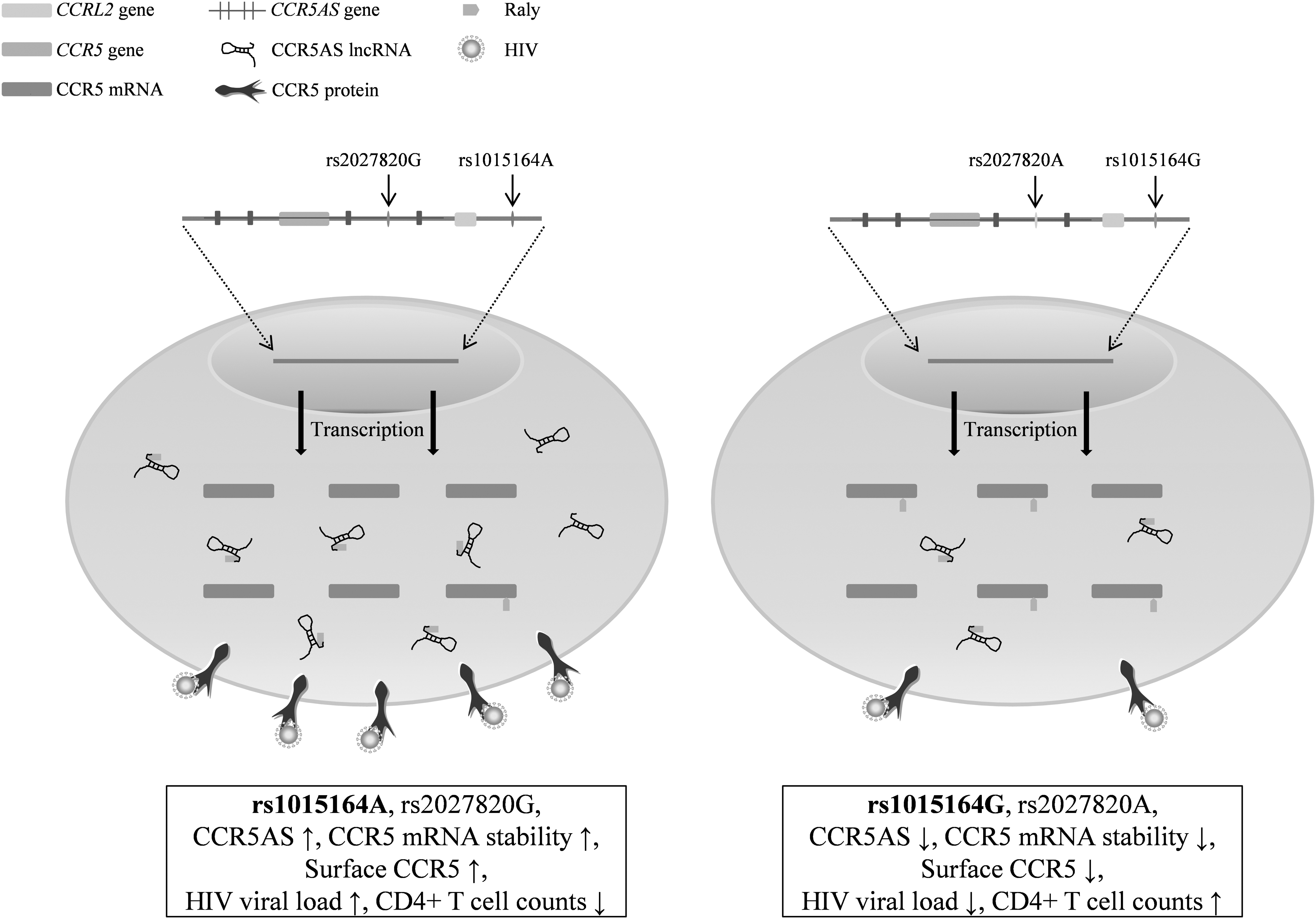
Functional mechanism for association between rs1015164 SNP and outcome of HIV infection. rs1015164A was in perfect linkage with rs2027820G, which enhanced the expression of CCR5AS through binding of ATF1. High CCR5AS expression increased stability of CCR5 mRNA by protecting it from Raly-mediated degradation, and enhanced expression of CCR5 in CD4+ T cell surface and thereby resulted in bad control of R5-tropic virus infection (high viral load and low CD4+ T cell counts). CCR5, C-C chemokine receptor 5; SNP, single-nucleotide polymorphism.
The study by Kulkarni et al. (6) convincingly provided a molecular basis for association between rs1015164 SNP and outcome of HIV infection (Fig. 1). The gene of CCR5AS lncRNA, which has been shown as an important regulator of CCR5 expression, was relatively conserved in primates. Such results provide the possibility that the regulatory function and biological mechanisms of CCR5AS may also exist in other species worldwide, which probably open a new avenue for the treatment and prevention of viral infections wherein CCR5 contributes to immune system, including HIV and HBV infection. Kulkarni et al. also provide novel and useful ideas for exploring the correlation between SNPs (in or near lncRNA) and disease outcomes given that more abnormal expression of lncRNA after HIV infection was discovered by researchers (7,11).
Footnotes
Author Disclosure Statement
No competing financial interests exist.
Funding Information
No grant funding was received for this study.