




Abstract
Dengue virus and Chikungunya virus are arboviruses that affect thousands of people worldwide annually. The mechanisms involved in viral pathogenesis still need to be better understood. Single nucleotide polymorphisms (SNPs) in immune genes may be involved in the protection, susceptibility, and/or progression of these diseases. This study was performed to investigate the SNP −174 G/C in the interleukin-6 (IL-6) gene in patients with dengue or chikungunya from Northeastern Brazil. A total of 581 blood samples were analyzed, of which 244 were part of the negative control group, genomic DNA was extracted, and the SNP was genotyped using real-time polymerase chain reaction (PCR). The data obtained were used to conduct statistical analyses of the genotype and allele frequencies. We suggest that the G/C genotype and C allele of the SNP −174 G/C in the IL-6 gene are related to protection against dengue in the studied population. No significant differences were observed in chikungunya patients. This is the first study that assessed the association of the SNP −174 G/C in patients with chikungunya. We identified the presence of the C allele as a protective factor against dengue in the studied population.
Introduction
Dengue virus (DENV) and chikungunya virus (CHIKV) are etiological agents of two arboviral diseases that are reemerging worldwide. DENV belongs to the family Flaviviridae and genus Flavivirus and has four antigenically distinct viral serotypes (DENV1–4), whereas CHIKV belongs to the genus Alphavirus of the family Togaviridae and has three distinct viral genotypes (30,32).
Infections caused by DENV and CHIKV can range from asymptomatic to severe cases, causing a varied spectrum of symptoms (19,28). Dengue has symptoms such as fever, headache, myalgia, arthralgia, and rash. The disease can be classified in dengue without warning signals (DWWS), dengue with warning signals (DWAS), and severe dengue (34). Chikungunya fever is characterized by fever associated with severe and debilitating joint pain may also include other signs and symptoms, such as headache, nausea, vomiting, myalgia, rash, and edema (7,27).
The susceptibility and progression of dengue and chikungunya to severe clinical forms can be determined through several factors inherent to the virus, environment, and host. The latter includes genetic factors such as single nucleotide polymorphisms (SNPs) and mediators of immune and inflammatory responses that can influence the immunopathology of DENV and CHIKV infections (6,10,31).
High levels of interleukin-6 (IL-6), an important proinflammatory and pleiotropic cytokine, have been detected in individuals with dengue and chikungunya and may be associated with the progression of both the diseases to severe clinical forms (15,16,22). In dengue, high levels of IL-6 have been linked to progression to hemorrhagic forms of the disease (14), and treatment aimed at decreasing IL-6 levels reduces the mortality rate (13). In CHIKV infection, IL-6 is related to severity of the disease and persistence of arthritis (23). It has been reported that IL-6 can contribute to the pathogenesis of several viral diseases (25,29). Recently, studies aimed at understanding the newly emerging coronavirus disease 2019 (COVID-19) have reported elevated levels of IL-6 in patients with severe symptoms of severe acute respiratory syndrome coronavirus 2 (SARS-CoV-2) infection, which reinforces the importance of conducting studies to determine the influence of the cytokine in various viral diseases (20,33).
The IL-6 gene, located on chromosome 7p21, is highly polymorphic. One of the mutations described for the gene is the SNP −174 G/C (rs1800795), which results from a transition of guanine (G) to cytosine (C) at the −174 position in the promoter region (1). The SNP −174 G/C in the IL-6 gene is related to changes in the production levels of IL-6, implying the development of immune responses. Additionally, the SNP has been associated with the development of rheumatoid arthritis and several diseases. According to previous studies, the G allele is associated with an increased production of IL-6, whereas the C allele is associated with a decreased production of the cytokine (3,12).
The aim of the study was to investigate the prevalence of the SNP −174 G/C in the IL-6 gene in individuals with confirmed dengue and chikungunya infections as well as in healthy individuals (control group) in Northeastern Brazil, to evaluate the influence of this SNP in the delineation of clinical manifestations caused by such diseases, and classify it as a protective, predisposition, or risk factor for severity.
Subjects and Methods
Samples
This study was conducted from June 2016 to August 2018 at a health center in Parnaíba, State of Piauí, located in Northeastern Brazil. The study was assessed and approved by the Ethics and Research Committee of the Federal University of Piauí with the numer CAAE 46111615.0.0000.5214.
A total of 581 blood samples, including from patients with clinical symptoms of DENV or CHIKV infection and negative controls were collected for composition of this study (Fig. 1). The patients were hospitalized or had been treated at the health service in the city and through laboratory tests and clinical follow-up were classified according to World Health Organization (WHO) 2009 criteria. DWWS is considered when the patient has fever and two of the following symptoms: nausea, vomiting, rash, myalgia, arthralgia, headache, retroobital pain, petechiae, and leukopenia. If the patient has previous symptoms and severe and continuous abdominal pain, persistent vomiting, fluid accumulation, mucosal bleeding, lethargy and/or irritability, hepatomegaly, and progressive increase in hematocrit accompanied by a decrease in platelet count, it is characterized as a DWAS.
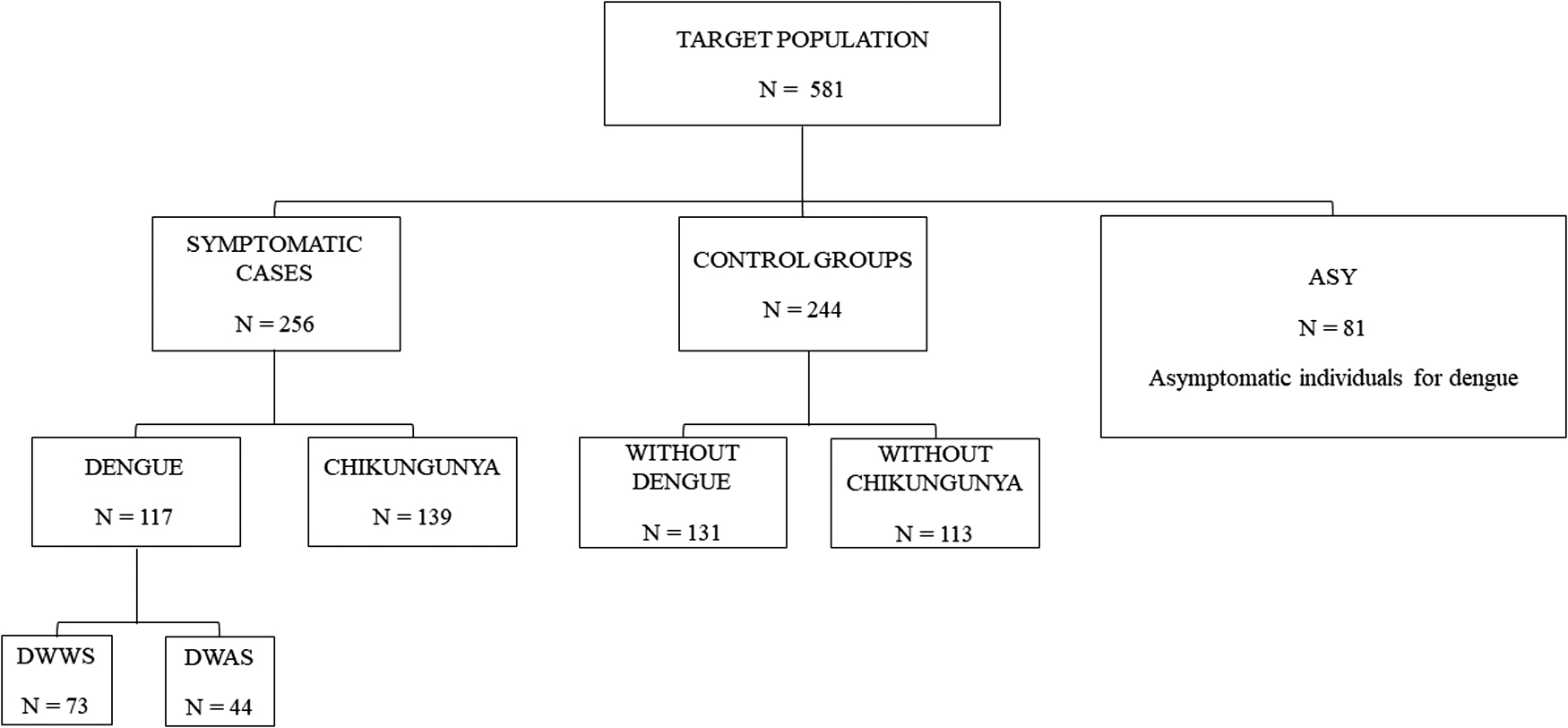
Distribution of study samples. ASY, asymptomatic patients; DWAS, dengue with warning signals; DWWS, dengue without warning signals.
To confirm dengue and chikungunya cases, as well as screen the controls, samples were tested for the presence of IgM/IgG anti-DENV or IgM/IgG anti-CHIKV antibodies, using the SD Bioline immunochromatographic test (Standard Diagnostics, Inc.) and the Enzyme-Linked Immunosorbent Assay (ELISA) (Euroimmun) serological assay according to the manufacturer's protocol. The application of molecular methodology for detection of viral RNA by reverse transcription/polymerase chain reaction (RT-PCR) (4) was also used for diagnosis. Viral RNA was extracted using the commercial QIAamp® Viral RNA Mini Kit (Qiagen, Inc., Hilden, Germany), following the instructions established in the manufacturer's protocol.
From the samples collected, 117 were positive for DENV infection and were further subdivided on the basis of symptoms/laboratory tests. Thus, 73 were classified as DWWS and 44 as DWAS. For the control group, samples from 131 volunteers with no prior presentation of clinical signs and symptoms of dengue were included. The asymptomatic (ASY) group consisted of 81 samples from individuals initially recruited into the control group. However, these samples were positive for anti-DENV IgM/IgG antibodies, indicating that they had been infected with DENV, but the patients did not develop symptoms of the disease.
Of the total samples included, 139 patients were positive for CHIKV infection, thus forming the case group. Regarding the composition of the control group for chikungunya, 113 volunteers who reported prior presentation of symptoms for chikungunya were randomly recruited.
DNA extraction
The genomic DNA of recruited individuals was extracted of total blood (300 μL) using the Wizard® Genomic DNA Purification Kit (Promega, Inc.) according to manufacturer's protocol. After extraction, a small sample of DNA (1 μL) was quantified in duplicate using a visible ultraviolet light spectrophotometer (BioSpec-nano) and was subsequently subjected to agarose gel electrophoresis to confirm the quality of genetic material.
Genotyping
Genotyping for the SNP −174 G/C (rs1800795) of IL-6 was performed using quantitative real-time PCR (qRT-PCR). Validated SNP TaqMan® Genotyping Assays (Applied Biosystems, Foster City, CA), Master Mix 2x TaqMan (Applied Biosystems), and SNP detection probe were used to determine IL-6 variant (ACTTTTCCCCCTAGTTGTGTCTTGC[C/G]ATGCTAAAGGACGTCACATTGCACA). Each valeted genotyping assay consists of two primers for amplifying the region of interest for the polymorphism and two probes that are responsible for detecting alleles. The total volume for the PCR was 5 μL and the procedure was performed using the thermocycler 7500 Fast Real-Time PCR System (Applied Biosystems) according to the manufacturer's protocol.
The thermal cycling conditions consisted of an initial hold at 95°C for 10 min followed by 50 cycles at 95°C for 15 sec denaturation and 60°C to 1 min and 30 sec for annealing and extension step. After performing qRT-PCR, the genotype of each sample was interpreted and determined using the 1.1 SDS software (Applied Biosystems, Foster City, CA) and Design and Analysis qPCR and genotyping qPCR applications available on the online tool Thermo Fisher Cloud.
Statistical analyses
The results were analyzed using the BioEstat 5.0 software. The genotype and allele frequencies of the −174 G/C mutation (rs1800795) in IL-6 were determined using simple direct counting. To test the Hardy–Weinberg equilibrium, the genotype and allele distributions were compared using the Chi-square test and its significance determined by p-value. For a value of less than five in the contingency table, Fisher's exact test was performed.
For each comparison, the association strength or odds ratio (OR) was calculated, its significance being indicated by p*-value. Values of OR >1 indicate the presence of a risk factor, OR <1 indicates a protective factor, and OR = 1 indicates a balance between risk and protection, that is, no association. For all analyses, a significance level of p < 0.05 was considered statistically significant.
Results
The average age of the group with dengue infections (DEN group) was 36.1 years, and 70% of the group comprised females (Table 1). With regard to classification, 62% of the samples were classified as DWWS and 38% as DWAS. The mean age of control individuals was 24.1 years, and 72% of them were females. The average age of ASY group was 22.6 years, and 71% of the individuals were females.
Characteristics of the Study Population
ASY, asymptomatic; DEN, dengue.
Comparative analysis of the genotype frequencies of the SNP −174 G/C in IL-6 (Table 2) between the control and DEN groups revealed that the frequency of G/C genotype was significantly higher in the control group (41.2%) than in the DEN group (26.5%, p = 0.011, OR = 0.50, p* = 0.02). Similarly, the frequency of G/C+C/C genotype was higher in the control group (46.5%) than in the DEN group (30.8%, p = 0.010; OR = 0.51; p* = 0.01). The OR values of the genotypes indicate their protective effects. The analyses of C/C (p = 0.424; OR = 0.62; p* = 0.62) and G/G+G/C genotypes (p = 0.235; OR = 0.78; p* = 0.28) in the DEN and control groups did not reveal any significant difference. All genotype frequencies were in Hardy–Weinberg equilibrium.
Genotypic and Allelic Distribution of the SNP −174 G/C of the IL-6 Gene in the Case Groups (DEN, DWWS, DWAS) and Control
p value of OR; p of χ 2 or Fisher's exact test. Statistical significance (p < 0.05).
CI, confidence interval; DWAS, dengue with warning signals; DWWS, dengue without warning signals; IL-6, interleukin-6; OR, odds ratio; SNP, single nucleotide polymorphism.
Analysis of the genotype frequencies of the SNP −174 G/C in IL-6 (Table 2) between the control and DWWS groups revealed that the frequency of G/C genotype was significantly higher in the control group (41.2%) than in the DWWS group (24.7%, p = 0.013; OR = 0.45, p* = 0.02). Additionally, the frequency of G/C+C/C genotype was higher in the control group (46.5%) than in the DWWS group (28.8%, p = 0.012; OR = 0.46; p* = 0.02). The OR values of the genotypes suggest their protective effects in the control group. The analyses of C/C (p = 0.520; OR = 0.58; p* = 0.66) and G/G+G/C genotypes (p = 0.245; OR = 0.76; p* = 0.30) did not reveal any significant difference. All genotype frequencies were in Hardy–Weinberg equilibrium.
No significant differences were observed between the genotypes in the control and DWAS groups, similar to the analyses between DWWS and DWAS groups.
Analysis of the allele frequencies of the SNP −174 G/C revealed that the frequency of C allele was higher in the control group (26%) than in the DEN group (17.5%, p = 0.023; OR = 0.606; p* = 0.03), and the OR value indicated the protective effects of the allele in the control group. A lower frequency of C allele was observed in the DWWS group (16.4%) than in the control group (26%, p = 0.027; OR = 0.56; p* = 0.04), indicating the presence of a protective factor. The analyses between the DWAS and control groups and between the DWWS and DWAS groups revealed no significant difference (Table 2).
No significant difference was observed between the genotype frequencies of the SNP −174 G/C in the ASY and DEN groups (Table 3). Similar results were observed in the analyses between the ASY and DWWS groups.
Genotypic and Allelic Distribution of the SNP −174 G/C of the IL-6 Gene in the ASY Group, Case Groups (DEN, DWWS, DWAS), and Control
p value of OR; p of χ2 or Fisher's exact test. Statistical significance (p < 0.05).
Furthermore, comparisons of genotype frequencies between the ASY and DWAS groups and between the control and ASY groups revealed no significant difference between the analyzed genotypes.
After analyzing the allele frequencies in ASY group in relation to that in others (Table 3), the frequency of C allele was found to be higher in the ASY group (25.9%) than in the DEN (17.5%, p = 0.043; OR = 0.61; p* = 0.06) and DWWS groups (16.4%, p = 0.042; OR = 0.56; p* = 0.06). The OR value indicated the presence of protective factors in asymptomatic cases. No significant difference was observed in the frequencies of C allele between the ASY and DWAS groups and between the ASY and control groups.
For chikungunya, the mean age of the positive group was 41.1 years (Table 1), and the majority of individuals were females (73.3%). The mean age of the control group was 28.5 years, and the majority of individuals were females (72%). A total of 252 samples were genotyped for the SNP −174 G/C, including positive and negative samples. The analysis of genotype frequencies (Table 4) revealed that the frequency of G/C+C/C genotype was 38.8% in the case group, while it was 40.7% in the control group (p = 0.764; OR = 0.92; p* = 0.86); however, the difference was not statistically significant. All genotype frequencies were in Hardy–Weinberg equilibrium.
Genotypic and Allelic Distribution of the SNP −174 G/C of the IL-6 Gene in the Patients Group with CHIKV and Control Group
G, wild allele; C, mutant allele; * p value of OR; p of χ2 or Fisher's exact test. Statistical significance (p < 0.05).
A frequency of 37.4% in G/C genotype was observed in the case group and 34.5% in the control group; however, the result was not statistically significant (p = 0.852; OR = 1.05; p* = 0.95). Regarding the analysis of the genotype C/C, there was also no statistical significance (p = 0.081; OR = 0.22; p* = 0.10). A frequency of G/G+G/C genotype observed in the case group was 98.6% and 93.8% in the control group, but no significant difference was observed (p = 0.082; OR = 1.01; p* = 0.98).
Regarding analyses of allele frequencies of the studied SNP, the C allele had a lower frequency (20.1%) in the symptomatic group than in the control group (23.5%, p = 0.370; OR = 0.82; p* = 0.43), with no statistical significance.
Discussion
IL-6 is a proinflammatory cytokine produced by a variety of cells, including macrophages as well as B and T cells (26). Studies have reported that the SNP −174 G/C in the IL-6 gene can alter the levels of IL-6, influencing the modulation of inflammatory responses. According to previous studies, high levels of IL-6 lead to the development of numerous inflammatory and autoimmune diseases (8,35).
In this study, we analyzed the genotype frequencies between the control and DEN groups. Statistically significant results were observed between G/G versus G/C and G/G versus G/C+C/C genotypes. Between the control and DWWS groups, a statistically significant difference was observed between G/G versus G/C and G/C+C/C versus G/G genotypes. These data suggest protective effects of G/C and C/C genotypes, which were significantly prevalent in the control group. This result is similar to previous reports (21), in which the GC genotype has been classified as a marker for resistance, that is, protection against dengue, in individuals from the state of Paraná, Brazil. However, in the literature data are diverse. For example, a Brazilian study (5) reported a relationship between the C allele on the SNP −174 G/C in IL-6 and the SNP −308 G/A allele A in the TNF-α gene, which can be a risk factor for DENV infection. Another study conducted in Brazil (9) reported an association between the allele C on SNP −174G/C in IL-6 with the persistence of dengue dermatological symptoms. Moreover, a study conducted in Venezuelans (11) reported no significant association between the SNP −174 G/C and the susceptibility to dengue. Similarly, in another study in Cuba (24), no significant difference was observed in the genotype and allele distribution between the control group and patients with dengue hemorrhagic fever.
In the analysis of allele frequency, we observed statistically significant results between the control and DEN groups and between the control and DWWS groups, indicating that the C allele can be considered as a protective factor against the disease in this study population. Between the ASY and DEN groups and between the ASY and DWWS groups, it is suggested that the C allele may also play a protective role in relation to the development of clinical manifestations.
In our study, a prevalence of mutant genotypes was observed in the control as well as in the ASY group, demonstrating the protective effects of the C allele against dengue and development of clinical symptoms. The presence of C allele has been associated with a decrease in IL-6 expression, thus causing a decrease in inflammatory responses (3,12,18). Therefore, this mechanism could provide protection for the manifestation of dengue in asymptomatic individuals. However, it is difficult to determine a specific biological mechanism because the influence of these SNP can be more complex since there are other SNPs in the IL-6 gene and thus a complex interaction between them influences the final phenotype. We believe that additional studies on different populations evaluating the cytokine levels, in different groups, may elucidate the relationship between IL-6 and arboviruses.
To date, no studies have reported the relationship between the SNP −174 G/C in IL-6 and chikungunya. Since the main targets of CHIKV infection are joints, the results for chikungunya in this study, we compared the data obtained in our study to the data of SNP 174G/C IL-6 on rheumatoid arthritis in literature. In a study conducted on Egyptian patients with rheumatoid arthritis, higher frequencies of the G/C and C/C genotypes have been observed in the case group than in the control group (p = <0.001; OR = 3.409; p = 0.001; OR = 15.341). Based on allele frequencies, the C allele was more frequently found in patients with rheumatoid arthritis than in controls (2).
In another study (17), which analyzed the SNP −174 G/C in rheumatoid arthritis patients in China, higher frequencies of the C/C genotype and C allele were observed in patients with rheumatoid arthritis than in healthy controls, indicating a significantly higher risk of arthritis (p = 0.016; OR = 4.823) in the Chinese population.
Different results were obtained in a study on the Mexican Mestizo population (36), revealing that the G/G genotype was most frequently found in patients with rheumatoid arthritis as compared with healthy patients. Nevertheless, no significant difference was observed in the allele and genotype frequencies. Therefore, the IL-6 gene polymorphism at the −174 position was not associated with arthritis in this study (p = 0.845; OR = 0.94).
The results for chikungunya obtained in this study, did not show statistical significance between the groups analyzed. Additional studies with large sample sizes of the case and control groups may elucidate the relationship between the polymorphism and disease. Our hypothesis is that the contrasting results obtained in different studies with this polymorphism may be due to several factors, which may be related to different origins or ethnic groups among populations and limited sample size.
The results obtained in this study suggest that the G/C genotype and C allele of the SNP −174 G/C in the IL-6 gene are related to protection against dengue in the studied population. Regarding the analyses of samples from patients with chikungunya, we did not observe any protective effect or risk for development of the disease, and no significant association was identified between the SNP −174 G/C and the disease.
These data contribute to a better understanding of the pathogenesis of dengue and chikungunya as well as genetic factors related to the host. New studies with diverse and significant populations that correlate the genetic factors of the host with the development of such illnesses need to be conducted.
Footnotes
Author Disclosure Statement
No competing financial interests exist.
Funding Information
This work was financially supported by Fundação de amparo à pesquisa do Estado do Piauí (FAPEPI) PPSUS/MS-DECIT/CNPq/SESAPI N° 002/2016 and Conselho Nacional de Pesquisa (CNPq) 14/2014 (grant no. 4567072014-0).