




Abstract
The avian influenza A H7N9 virus has caused severe infection and high mortality in humans. It can be extremely hazardous to the elderly since age might diminish the immune response, and poor immunogenicity of H7 hemagglutinin could diminish the vaccine efficacy in this population. To overcome this issue, adjuvants are used to induce a stronger immune response. In this study, we generated a recombinant H7N9 influenza virus using reverse genetic techniques, consisting of hemagglutinin and neuraminidase genes derived from a human H7N9 virus, with the remaining genes from H1N1 A/Puerto Rico/8/34 (PR8). To evaluate whether the adjuvant can improve immune responses in aged animals, the humoral and cellular immune responses of 18-month-old BALB/c mice to different doses of split avian influenza A H7N9 vaccine with and without the adjuvant MF59 were compared. Our data showed that aged mice immunized with MF59 elicited higher levels of hemagglutination inhibition and microneutralization antibodies and interferon-gamma-specific enzyme-linked immunospot assay (ELISPOT) responses when compared with antigens alone. It is suggested that the split avian influenza A H7N9 vaccine combined with MF59 may significantly improve immune responses to influenza vaccination in elderly humans.
Introduction
In 2013,
Elderly adults are not only particularly vulnerable to the H7N9 virus infections but also had a higher risk of death and need for mechanical ventilation and intensive care unit admission compared with younger adults (26). However, an age-related reduction in the immune response and poor immunogenicity of H7 hemagglutinin might diminish the vaccine's efficacy among the elderly (11,18). To overcome this issue, a well-established oil-in-water emulsion adjuvant, MF59, is used to improve immunogenicity and enhance the efficacy of the influenza vaccine (14). This adjuvant activates local immune cells at the injection site; increases antigen uptake, macrophage recruitment, and lymph node migration; and broadens the spectrum of antibody recognition of hemagglutinin epitopes (13). An MF59-adjuvanted trivalent inactivated influenza vaccine was first approved for human use among the elderly in 1997 by the European Union (23). To date, more than 100 million doses of MF59-adjuvanted influenza vaccines have been distributed in more than 30 countries with an excellent safety profile (9). Thus, MF59 would be an attractive adjuvant for a potential A/H7N9 vaccine.
In this study, 18-month-old mice were used to compare the immune responses to different doses of the inactivated split avian influenza A (H7N9) vaccine, mixed with or without the MF59 adjuvant, to determine if MF59 can improve immune responses in aged animals.
Materials and Methods
Animals
A group of 18-month-old, female, specific pathogen-free (SPF) BALB/c mice were obtained from Beijing Vital River Laboratory Animal Co., Ltd. (Beijing, China), and housed in the Animal Biosafety Level-2 facilities with ad libitum access to food and water. All animal procedures were performed in this work following guidelines and in accordance with a Beijing CDC's Animal Care and Welfare Committee-approved animal use protocol.
Vaccines
The HA and NA gene sequences of influenza A/Anhui/1/2013 (H7N9) were obtained from the GISAID database with accession numbers EPI439507 and EPI439509, respectively. Plasmids containing HA and NA genes of A/Anhui/1/2013 (H7N9) together with plasmids carrying the six internal genes of the PR8 virus were used to transfect Vero cells (7). Antigenic characterization of the reassortant virus, rPR8-H7N9, was performed using the hemagglutination inhibition (HI) assay with reference antiserum samples. Subsequently, the reassortant virus was amplified in SPF chicken embryos; virions were purified by centrifugation, inactivated with formalin, and filtered to remove bacteria; and the HA content was quantified by one-way immune diffusion.
Immunization
All immunogens were mixed with an equal volume of squalene-based oil-in-water emulsion AddaVax (MF59, InvivoGen, vax-adx-10) to a final volume of 100 μL. Mice were confirmed to be H7N9 virus antibody free by HI assay before immunization and then randomly divided into 10 groups of 6 mice each and prime–boost immunized at day 0 and 14, respectively, with 100 μL of different immune formulations through an intramuscular injection in the hind legs (half dose per injection site) (Table 1).
Vaccine Formulations and Study Groups
H7N9+MF59 groups, immunized with the MF59 adjuvant H7N9; H7N9 groups, immunized with the split H7N9 vaccine alone; and MF59 and PBS groups, administered MF 59 or PBS alone, respectively; w/o, without.
PBS, phosphate-buffered saline.
At 14 and 29 days postprime, blood was collected from each mouse and serum was obtained by centrifugation of whole blood. Isolated serum samples were transferred to labeled tubes and stored at −20°C until analysis. Mice from each group were euthanized at day 29 and splenocytes were isolated for enzyme-linked immunospot assay (ELISPOT) assay.
HI assay
Procedures of the HI assay have been described previously (15). Briefly, heat-inactivated serum samples were treated with a receptor-destroying enzyme and serially diluted twofold in phosphate-buffered saline (PBS). Four hemagglutinin units of the virus (rPR8-H7N9) were added and incubated at room temperature for 60 min. After incubation, 1% turkey erythrocyte solution was added and mixed, and the mixture was further incubated at room temperature for 60 min, then inhibition of hemagglutination was determined by visual inspection.
Enzyme-linked immunosorbent assay-based influenza virus microneutralization assay
A microneutralization (MN) assay for influenza virus with an enzyme-linked immunosorbent assay (ELISA)-based endpoint assessment was performed as described by a protocol available from the World Health Organization (WHO) (1). Heat-inactivated serum samples were subjected to twofold serial dilution and mixed with 100 TCID50 in 50 μL of rPR8-H7N9 virus for 2 h at 37°C. Then, Madin-Darby canine kidney cells were added to each well and incubated at 37°C for 18–22 h. Afterward, cells were fixed with cold 80% acetone in PBS, and virus growth in each well was assessed by ELISA, as described in the WHO protocol. The neutralization titer was determined as the reciprocal of the highest serum dilution (before the addition of virus or cells), resulting in at least 50% inhibition of the ELISA signal.
ELISPOT assay
A commercial, 96-well ELISPOT kit (mouse interferon-gamma [IFN-γ] precoated ELISPOT kit, Dakewe Biotech, Shenzhen, China) was used for the ELISPOT assay. Mouse splenocytes were isolated from spleens using a 70-μm nylon cell strainer (BD Pharmingen, San Diego, CA), and a single-cell suspension (5 × 10⁵ cells/well) was prepared and stimulated with the H7 HA protein (Sino Biological, Inc., Beijing, China). After incubation at 37°C for 24 h, the cells were removed and plates processed according to the instructions of the manufacturer. The number of spots was determined automatically with an automatic CTL ImmunoSpot® Reader (Cellular Technology, Shaker Heights, Ohio).
Statistical analyses
Statistical analyses were performed with GraphPad Prism. All data are expressed as mean and standard deviation. Data were statistically analyzed using the unpaired, two-tailed Student's t-test with a 1% level of significance.
Results
Antibody responses induced by immunization
To evaluate humoral responses induced by the H7N9 vaccine, mice were immunized twice with different immune formulations, at 2-week intervals. As shown in Figure 1, after the first vaccination, the HI titers could only be detected in three groups (3 μg+MF59, 0.6 μg+MF59, and 0.12 μg+MF59) and all other groups had HI titers below the limit of detection (1:10). Besides, only 4 of 6 mice in group 1 (3 μg+MF59) achieved HI seroconversion (HI titer = 40) at day 14. No animal in the PBS or MF59 control groups mounted a detectable MN response. In contrast, 44/48 (91.7%) of mice in the H7N9 vaccine-immunized groups had detectable MN responses, although the overall MN response rate remained low (MN range 10–80) at day 14 (Fig. 2).
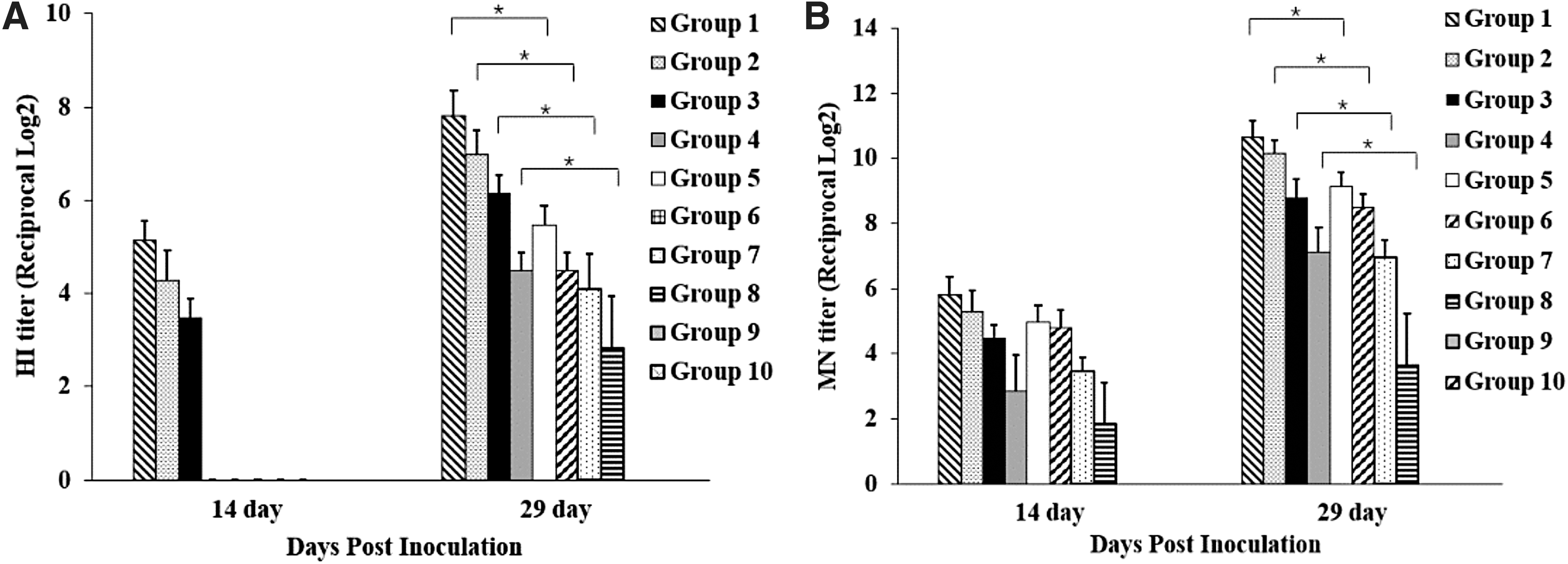
Measurements of antibody responses.
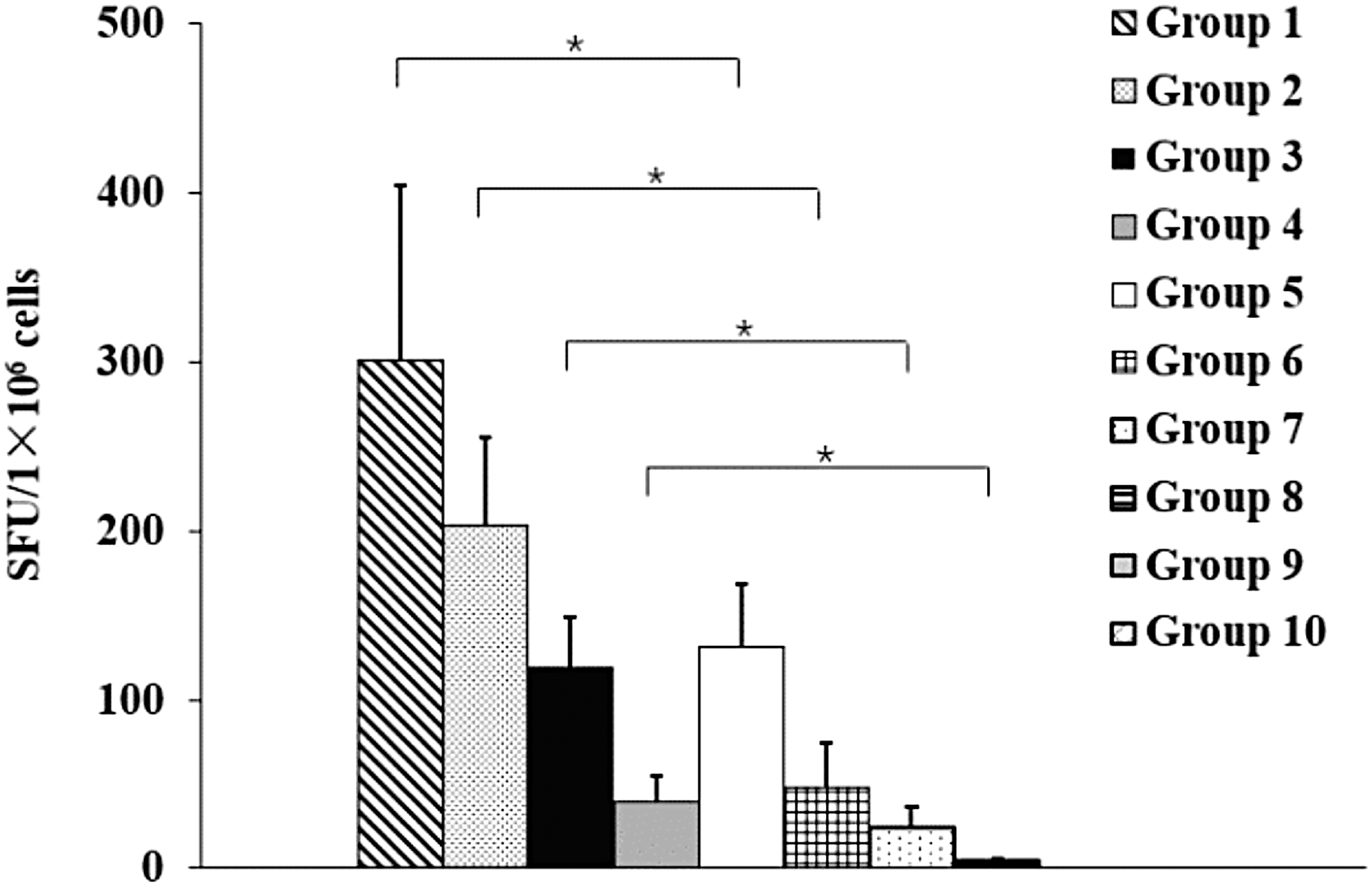
H7N9-specific T cell responses evaluated by IFN-γ ELISPOT assay. Mouse splenocytes were stimulated with the H7 HA protein for 24 h, followed by IFN-γ ELISPOT assay. IFN-γ production was determined by calculating the number of spot-forming cells per 1 × 10⁶ splenocytes. The values are expressed as means ± standard deviations. *p < 0.01. ELISPOT, enzyme-linked immunospot assay; IFN-γ, interferon-gamma; SFU, spot-forming unit.
After the second boost, titers of HI and MN of groups immunized with the H7N9 vaccine increased dramatically. In addition, a dose-dependent antibody response where antibody titers declined in correlation with reduction in the amount of HA antigen was observed. Specifically, for adjuvanted groups, the HI Geometric Mean Titer (GMT) on day 29 decreased with antigen, with values declining from 222.3 (group 1) to 22 (group 4); for nonadjuvanted groups, the HI titers declined from 44.9 (group 5) to 11.2 (group 8), and the GMTs remained low. GMT levels in the MN assay mirrored those of the HI assay and also exhibited a significant dose-dependent trend. In fact, after the first dose of immunization, MN GMT titers across the groups already showed a dose-dependent manner. At day 29, this trend increased considerably, with GMT values for adjuvanted groups 1 to 4 ranging from 1,612.7 to 142.5, while values in nonadjuvanted groups ranged from 570.2 to 28.3. It is important to note that by comparing the same amount of HA antigen with or without MF59, we observed that the MF59 adjuvant significantly increased the immune response (for the HI titer: <0.01, MN titer: <0.01).
Cellular immune responses induced by immunization
To analyze the antigen-specific T cell responses against the HA protein, splenocytes gathered from immunized mice at day 29 were assessed by IFN-γ–specific ELISPOT. As shown in Figure 2, all animals showed an ELISPOT response except for MF59 and PBS control groups. The magnitude of IFN-γ–specific ELISPOT responses correlated with the antibody responses of different immunization groups as higher humoral responses and cellular responses were observed in mice immunized with antigens mixed with MF59 compared with HA antigens alone (p < 0.01). For instance, the addition of MF59 to 3 μg HA antigens presented significantly higher IFN-γ expression compared with mice immunized with antigens alone (p < 0.01). Similarly, the same observation was also made in other groups when comparing the same amount of HA antigen with or without MF59 (group 2 vs. group 6, p < 0.01; group 3 vs. group 7, p < 0.01; and group 4 vs. group 8, p < 0.01). Combined with antibody response results, it is suggested that mice immunized with antigens mixed with MF59 not only elicit stronger humoral responses but also higher induced cellular responses than antigens alone.
Discussion
The elderly represent one of the major risk groups for influenza morbidity and mortality. Researchers have shown that infection with H7N9 can cause severe respiratory failure, and the average age of patients infected with H7N9 and who develop more severe disease is ∼63 years (3). However, an age-related reduction in immune response significantly decreased the seasonal influenza vaccine efficacy against various circulating influenza strains in the aged population, not to mention the poor immunogenicity of the H7 subtype (6). Two clinical studies suggested that conventional H7N9 vaccines produced little to no serum antibodies to the H7 hemagglutinin, even when adults received two doses of the high-dose formulations of the vaccine (21).
To overcome the issue of low vaccine effectiveness, adjuvants are used to create a stronger immune response. Previous clinical studies have shown that MF59-adjuvanted influenza vaccines elicit higher and broader protective antibody responses against influenza in patients ranging from 6 months to over 65 years of age than nonadjuvanted vaccines, especially in vulnerable populations, including the elderly and those with underlying chronic conditions (12,16,25). In this study, we present findings on the immune-enhancing effects of MF59 on the H7N9 vaccine in aged mice. Our findings presented in this study are in line with the reports mentioned above, demonstrating that the adjuvanting H7N9 antigen with MF59 elicited comparatively higher levels of HI and MN antibodies and IFN-γ–specific ELISPOT responses, suggesting that the split influenza vaccine mixed with MF59 has more advantages in improving immune responses compared with antigens alone in aged mice.
Cellular immune responses play an important role in the prevention of infection and viral clearance (22). To analyze the cellular immune responses against the influenza virus, spleen cells from spleens harvested 2 weeks after the second immunization were evaluated by IFN-γ ELISPOT analyses. Our results showed that the MF59-adjuvanted H7N9 split vaccine induced significantly higher IFN-γ levels compared with the antigen alone groups, suggesting that addition of MF59 to the vaccine increased the cellular responses of aged mice. This is consistent with findings from previous studies (5). A robust humoral response to influenza virus antigens can undoubtedly help to prevent infection. However, such immunity targets external viral coat proteins that are conserved for a given strain (22). Moreover, the elderly typically present much lower levels of HI and neutralizing antibody responses than younger adults (4). Unlike humoral immune responses, cellular immune responses typically focus on the most conserved viral proteins and tend to be more cross-reactive against other virus strains (20). Besides, many studies have shown that adjuvants, such as MF59, can induce immune cell responses by production of inflammatory cytokines, activation and maturation of dendritic cells, and increase of antigen presentation (19). This is crucial because the decline in efficacy of influenza vaccines in the elderly is associated with reduced excitability of cell-mediated and cytotoxic T lymphocyte responses, which are essential for prevention of influenza (2,10). Therefore, influenza vaccines that can stimulate cellular response in addition to antibodies may be of particular interest for the aged population since the elderly appear to derive significant benefit from cellular memory (6).
In conclusion, this study confirms that addition of the MF59 adjuvant to a split influenza H7N9 vaccine increased humoral responses and cellular responses in aged mice.
Footnotes
Author Disclosure Statement
No competing financial interests exist.
Funding Information
This research was supported by the Cultivation Fund of Beijing Center for Disease Prevention and Control, Beijing Research Center for Preventive Medicine (grant no. 2017-BJYJ-13), and Beijing Municipal Special Funds for Medical Research (grant no. JingYiYan 2018-1).