




Abstract

It is well known that the development and prognosis of severe infectious diseases are related to the function of immune cells. Some studies have reported a decrease in peripheral blood lymphocytes and T cells in COVID-19 patients (2,5). However, the role of the immune system in the course of COVID-19 is still controversial (4). This study focused on immune biomarkers in peripheral blood to find new therapeutic options.
In this single-center retrospective study, we analyzed immune cells (regulatory cells, mDCs, and pDCs), immune biomarkers (PD-1 and HLA-DR), routine blood tests and biochemistry parameters, inflammatory factors, blood gas characteristics, and the Sequential Organ Failure Assessment (SOFA) scores in 12 severe and critical COVID-19 patients in the ICU of our hospital from April 27 to May 8. The case information was reviewed and extracted from electronic medical records. All patients duly signed written informed consent. Spearman's rank correlation was used to analyze the correlation of data, and Fisher's exact test was used to compare groups.
We found that the percentage of HLA-DR expression on CD14+ monocytes was negatively correlated with C-reactive protein, length of hospital stay, D-dimer, interleukin (IL)-10, IL-6, procalcitonin (PCT), and SOFA score (p < 0.05), and positively correlated with the oxygenation index (p < 0.05). The number of CD14+HLA-DR+ cells was calculated to verify the aforementioned results (Table 1). Furthermore, the expression of HLA-DR on circulating CD14+ cells was not decreased in common COVID-19 patients (6). Given these findings, we speculated that the expression of HLA-DR on CD14+ cells could affect the severity of the disease. Patients who died or stayed in hospital for >30 days were classified as having a poor prognosis.
Correlation Between the Results of Flow Cytometry Analysis of Immune Factors and Symptoms (Laboratory) Parameters
p < 0.05 was considered statistically significant.
CRP, C-reactive protein; IL, interleukin; PCT, procalcitonin; SOFA, Sequential Organ Failure Assessment.
A receiver operating characteristic (ROC) curve for prognosis was drawn and stratified based on the number of CD14+HLA-DR+ cells measured on hospital admission to evaluate the value of CD14+HLA-DR+ cell frequency for predicting prognosis (Fig. 1). The area under the curve (AUC) of the CD14+HLA-DR+ cell frequency was 0.875, the sensitivity was 100.0%, the specificity was 87.5%, and the cutoff value was 270.56 cells/μL (p < 0.05) (Fig. 1).
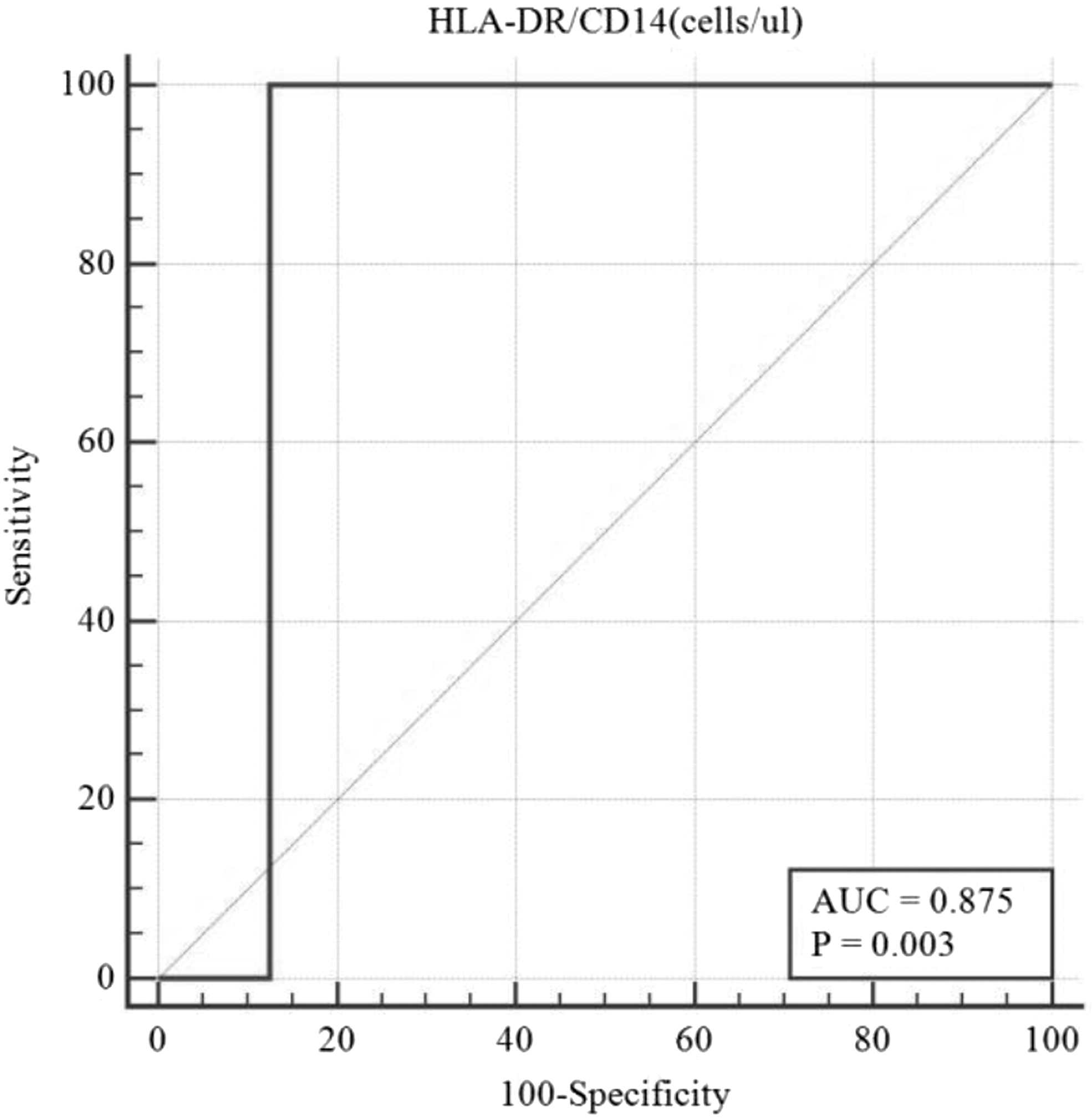
The ROC, AUC of the CD14+HLA-DR+ (cells/μL). AUC of CD14+HLA-DR+ (cells/μL) is 0.875, sensitivity is 100.00%, and specificity is 87.50%. AUC, area under the curve; ROC, receiver operating characteristic.
According to the frequency of CD14+HLA-DR+ cells, the patients were divided into two groups: the CD14+HLA-DR+ >270.56 cells/μL group and the CD14+HLA-DR+ ≤270.56 cells/μL group. The incidences (see supplementary data) of acute respiratory distress syndrome (ARDS) (60%), thrombocytopenia (60%), and necessary antibiotic upgrade (100%) in the low expression group were higher than the respective incidences in the high expression group (ARDS: 0; thrombocytopenia: 29%; antibiotic upgrade: 0; p < 0.05), and the proportion of patients requiring extracorporeal membrane oxygenation (ECMO) was significantly higher in the low expression group (60%) than in the high expression group (p < 0.05). Owing to the limited sample size and retrospective nature of this single-center study, the results need to be confirmed in subsequent larger-scale analyses.
In conclusion, the decreased expression of HLA-DR+ on CD14+ cell can be used as a marker to predict poor prognosis in severe and critical patients with COVID-19, and may become a new target of treatments for these patients.
Footnotes
Authors' Contributions
M.Y., Z.L., and K.K. contributed equally to this study, carried out the study, and drafted the article; K.-J.Y. and C.W. conceived study design; all authors read and approved the final article.
Acknowledgments
Sincere thanks to all the staff of Heilongjiang COVID-19 critical patients treatment center. Thank you for your bravery and dedication.
Author Disclosure Statement
No competing financial interests exist.
Funding Information
Supported by Novel coronavirus pneumonia emergency treatment and diagnosis technology research project of Heilongjiang provincial science and Technology Department, the National Natural Science Foundation of China (Nos. 81571871 and 81770276), Nn10 program of Harbin Medical University Cancer Hospital.
Supplementary Material
Supplementary Data
References
Supplementary Material
Please find the following supplemental material available below.
For Open Access articles published under a Creative Commons License, all supplemental material carries the same license as the article it is associated with.
For non-Open Access articles published, all supplemental material carries a non-exclusive license, and permission requests for re-use of supplemental material or any part of supplemental material shall be sent directly to the copyright owner as specified in the copyright notice associated with the article.
