




Abstract
Classic swine fever is a severe infectious and fatal disease in pigs caused by the classic swine fever virus (CSFV). Surveillance and investigation for CSFV seroprevalence contribute to knowing the immune efficiency of CSFV vaccines and reflect health status of swine herd, especially since the African swine fever virus (ASFV) outbreak in China in 2018. A total of 40,489 pig serum samples with related descriptive variables were obtained from 12 provinces and 2 cities of China from December 2017 to May 2021, covering before, during, and after three periods of ASFV outbreak. Pearson chi-square test and multivariable logistic regression analysis were used to identify impact factors related to variations in CSFV seroprevalence. Total CSFV seroprevalence was 60.40% (95% confidence interval: 59.92–60.88). Seroprevalence and antibody blocking rate mean of CSFV before outbreak of ASFV in China are higher and change gently compared with that after outbreak of ASFV. Serum collected from “summer and autumn,” “north, southwest and northwest of China,” “pig farm located in hill or mountain,” “ period before outbreak of ASFV,” “PRRSV negative farm,” and “replacement gilts, multiparous sows and boars” show high seroprevalence of CSFV. These results show trends in prevalence of CSFV antibody in recent years in China, especially when ASFV entered China. Identified impact factors provide references for improving immune efficiency of CSFV vaccine and benefit for prevention of CSFV.
Introduction
Classical swine fever (CSF), with high morbidity and mortality, is the most devastating infectious disease for swine industry worldwide and is caused by classic swine fever virus (CSFV) (6,24). Clinical manifestation of CSFV-infected pigs can be classified as acute, subacute, or chronic form according to differences of CSFV strains (low or high virulent strain) or host state (such as pig age or immunity) (18). CSFV-infected pigs are characterized by high fever (over 40°C), conjunctivitis, respiratory signs, constipation, diarrhea, skin hemorrhages, lethargy, and neurological symptoms. CSF also causes serious breeding difficulty in pregnant sows manifesting abortions, stillbirths, and mummified fetuses (4).
CSFV is a positive-strand RNA-enveloped virus belonging to genus pestivirus in the Flaviviridae family (27). Particle diameter CSFV is 40–60 nm with a genome length of ∼12.3 kb (16,19). CSFV genome consisted of a single open-reading frame and two untranslated regions (UTR) (5′-UTR and 3′-UTR) encodes a polyprotein, which is processed into four structural proteins (capsid protein C, envelope glycoproteins Erns, E1, and E2) and eight nonstructural proteins (Npro, p7, NS2–3, NS2, NS3, NS4A, NS4B, NS5A, and NS5B) by viral and cellular enzymes (10,23). The envelope glycoprotein E2 poses the most antigenic epitope and can induce strong immunoreaction and neutralizing antibodies (1).
Since the first CSF report from state of the Ohio, United States in 1833, CSF has spread worldwide and been a notified swine disease by Office International Des Epizooties (11). The live attenuated vaccine strain of CSFV based on the Chinese (C) strain has been used to control and eliminate epidemics of CSFV globally (31). CSFV is mainly prevalent in Asia, Africa, and partial South and Central America (20,25,30).
For the prevention and purification of CSFV, accurate pathogenic diagnosis and real-time CSFV antibody monitoring are essential in the modern pig breeding system. There have developed various immunology and molecular methods to detect infection of CSFV. Molecular methods mainly depend on reverse transcription–polymerase chain reaction (12,17). Virus neutralization tests, immunofluorescence technology and enzyme-linked immunosorbent assay (ELISA) are primary immunology methods (14,34). Especially, ELISA is the most widely used to detect antibody levels of CSFV because of simple operation and high throughput.
China is the largest pig producer, which possesses ∼40 million sows and produces more than half of pork production globally (5). Therefore, the primary measure for prevention and control of CSFV in China is to vaccinate live attenuated C-strain (29). Meanwhile, as obligatory immune items in intensive pig farms, the antibody level of CSFV can indirectly reflect health status of swine herd and ability against CSFV infection of pigs (8).
However, there are few reports about seroprevalence of CSFV and factors that can relate with variations in seroprevalence of CSFV in China. Especially after outbreak of African swine fever virus (ASFV) in China on August 3, 2018 (7), the seroprevalence variation trend of CSFV and pigs health situation is unclear. Therefore, we collected 40,489 samples from 14 provinces or cities of China to investigate the seroprevalence of CSFV and analyze impact factors associated with variations in seroprevalence of CSFV from December 2017 to May 2021.
Materials and Methods
Study area and population
All samples were collected from 12 provinces and 2 cities of China with the most developed pig industry, covering all 7 geographical regions. Henan, Hubei and Hunan provinces belong to central China. Five provinces of Shandong, Jiangsu, Anhui, Jiangxi, Fujian, and Shanghai are located in eastern China. Liaoning, Guangdong, Sichuan, Shaanxi provinces, and Tianjin are on behalf of China's northeast, south, southwest, and northern. The total area of 11 provinces and 2 cities is ∼2.30 million square kilometers. The geographic position of covered regions is 97°20′ E to 126°00′ E longitude and 18°10′ N to 43°30′ N latitude. Average temperature of the study area is 3–28°C.
Moreover, multiple topographic distributions consist of plain, hills, mountain basins, and plateau. The study population cover all stages of pigs, including piglets (≤21 days), weaned-piglets (22–70 days), growing-finishing pigs (≥71 days), replacement gilts, multiparous sows (≥1 parity), and boar (28).
Sampling design
Because of unreliable estimates for the number of pigs feeding in study districts, convenience sampling was used to collect samples according to simple random sampling methods. The questionnaires with detailed variable information of samples were obtained from owners of pig farms by face-to-face interview. The variable information contains sampling position, time, farm size (small: ≤100 sows, medium: 100 to 500 sows; large: ≥500 sows), season (spring, summer, autumn, and winter), topographies of pig farms (plains, hill or mountain), backgrounds of pigs (piglet, weaned-piglets, growing-finishing pigs, replacement gilts, multiparous sows and boar), and disease control information of farm-level (purification of pseudorabies virus [PRV] and porcine reproductive and respiratory syndrome [PRRSV], immunization of PRRSV).
Samples collection and ethics statements
According to care provisions and use of laboratory animals in China, all processes involved with animals operation are in accordance with the relevant criteria of the ethical committee of Huazhong Agricultural University. First, 5–10 mL of blood is collected from the precaval vein of bundled pigs using sterile needles and vacutainer tubes. Then, the collected blood is transported to laboratory in a cold chain way and centrifuged at 3,000 rpm for 5 min to obtain the serum. Finally, the serum is transferred to clean Eppendorf tubes and stored at −20°C until use.
CSFV antibody detection of serum by ELISA
According to specifications, serum antibody against CSFV was tested by a commercial ELISA kit (IDEXX Laboratories, Switzerland). The specific practical steps are as follows. First, 50 μL of sample diluent was dispensed to wells of the coated plates. Next, 50 μL of serum was dispensed to the same wells. Then, the contents of microwells were mixed by gently tapping the plates. The plates were incubated for 2 h at 18–26°C. When the incubation was complete, the solution was removed and plates were washed three times using 300 μL of wash solution. Second, 100 μL of the conjugate was added into the plates again. Finally, 100 μL of 3,3′,5,5′-tetramethylbenzidine (TMB) substrate N.12 was dispensed to each tested well. After 10 min of incubation away from direct flight, 100 μL of stop solution N.3 was added to the wells.
Finally, the absorbance of samples and control was measured at 450 nm using Multiskan FC (Thermo Scientific). Antibody blocking rate was calculated referring to the formula: (absorbance of negative control − absorbance of sample)/absorbance of negative control × 100%. If the blocking rate ≤30%, CSFV serological result of serum was considered negative. If the blocking rate ≥40%, CSFV serological result of serum was positive. If 30% < blocking rate <40%, the sample was suspicious and needs to be tested again.
Data analysis
All data were recorded, entered, and cleaned in Excel (Microsoft Excel 2007). The seroprevalence of CSFV was calculated by dividing number of positive samples by number of total samples. Confidence intervals (95% CI) of CSFV seroprevalence were estimated using the Clopper–Pearson method (22). Characteristics and serological status of pig levels were recorded as categorical variables. The putative variables associated with the serological results of CSFV were analyzed using the Pearson chi-square test.
Moreover, variables with p-value <0.05 were considered statistically significant, checked for collinearity and entered into the multivariable logistic regression analysis to identify potential impact factors related to variations in seroprevalence of CSFV. Finally, odds ratios (OR) with 95% CI and p-values were used to indicate impact which factors might influence seroprevalence of CSFV (9). All data analyses were performed using Stata 16.0 for Windows (Stata Corp, College Station, TX). The map was drawn in ArcGIS 10.7 (ESRI).
Result
Epidemic trend of CSFV seroprevalence
The distribution map of samples collected from part provinces or cities of China is given in Figure 1. A total of 40,489 pig serum samples were obtained from 12 provinces and 2 cities of China from December 2017 to May 2021. CSFV seroprevalences of provinces or cities are listed in Table 1. Total positive rate of CSFV antibody was 60.40% (95% CI: 59.92–60.88). The prevalence of 73.93% (95% CI: 68.60–78.78) in Shanghai was the highest. CSFV seroprevalences of Guangdong and Henan provinces were relatively low (Guangdong: 52.95% with 95% CI: 50.04–55.84 and Henan: 52.87% with 95% CI: 51.78–53.97) compared with other provinces or cities.

Distribution map of samples collected from different provinces or cities of China from December 2017 to May 2021. Color images are available online.
Prevalence of Classic Swine Fever Virus Antibody in Part Provinces or Cities of China
CI, confidence interval.
Figure 2 shows variation trends in the seroprevalence and antibody blocking rate mean of CSFV per month from December 2017 to May 2021. According to occurring process of ASFV in China, the time series can be divided into three periods: before outbreak, outbreak period, and stable phase of ASFV. Before ASFV entered China (December 2017 to August 2018), the seroprevalences and antibody blocking rate means of CSFV (seroprevalence: 67.277%; antibody blocking rate: 83.70%) were high and changed gently. During outbreak of ASFV in China (August 2018 to January 2020), the seroprevalence and antibody blocking rate mean of CSFV (seroprevalence: 64.928%; antibody blocking rate: 81.30%) declined and fluctuated significantly.

Epidemic variation in seroprevalence and antibody blocking rate (%) of CSFV monthly from December 2017 to May 2021. Note: samples were not collected in February and March 2020 on account of epidemic of coronavirus disease 2019 (COVID-2019). CSFV, classic swine fever virus. Color images are available online.
Finally, when the epidemic situations of ASFV were effectively controlled (April 2020 to May 2021), the seroprevalences and antibody blocking rate mean of CSFV (seroprevalence: 65.292%; antibody blocking rate: 82.10%) showed a slightly upward trend. Average seroprevalence and antibody blocking rate of the three periods given in Figure 3 demonstrated the same tendency.
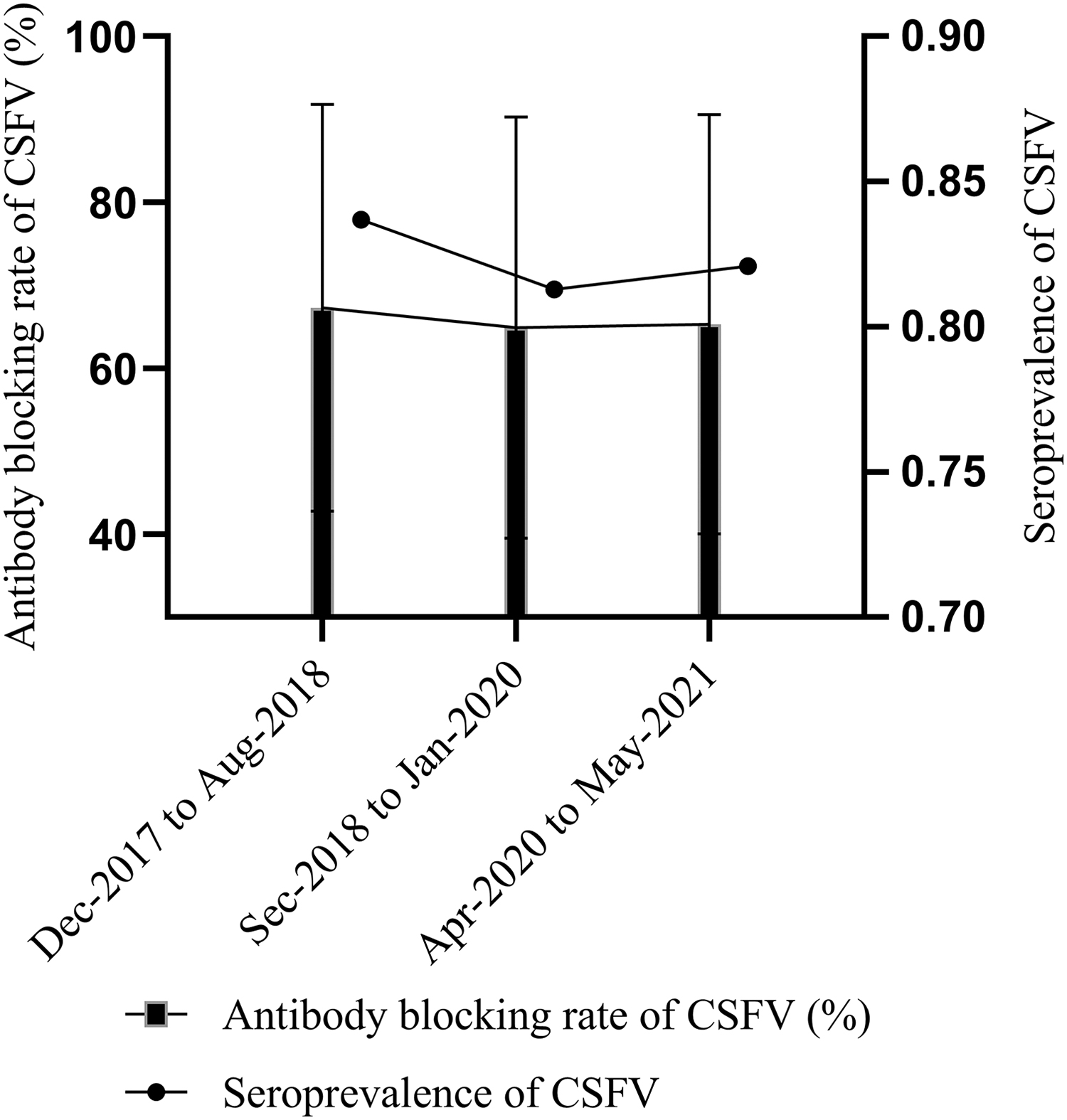
Total seroprevalence and antibody blocking rate (%) of CSFV of three periods divided by epidemic status of ASFV in China. ASFV, African swine fever virus.
Identification of impact factors associated with variations in seroprevalence of CSFV
Descriptive variables listed in Table 2 were all statistically significantly associated with seroprevalence of CSFV (p < 0.05) through Pearson chi-square test. Multiparous and boars were with the highest CSFV seroprevalences of 92.29% (95% CI: 91.84–92.72) and 92.57% (95% CI: 91.78–93.31), respectively.
Descriptive Statistic and Pearson Chi-Square Test of Pigs Level Variables Related to Seroprevalence of Classic Swine Fever Virus in Samples Collected from Part Provinces and Cities of China from December 2017 to May 2021
p < 0.05 represents the variables related to CSFV vaccine seroprevalence; ** p < 0.01; *** p < 0.001.
CSFV, classic swine fever virus; PRRSV, porcine reproductive and respiratory syndrome; PRV, pseudorabies virus.
Results of multivariable logistic analysis listed in Table 3 show that variables “pig farm size” and “PRV purification” (p > 0.05) cannot influence seroprevalence of CSFV in swine herd. CSFV seroprevalence of samples collected in summer (83.12%, 95% CI: 82.27–83.95) and autumn (82.62%, 95% CI: 81.86–83.27) were significantly higher than that in spring or winter with OR values of 1.108 (95% CI: 1.024–1.200) and 1.245 (95% CI: 1.151–1.346), respectively. CSFV antibody prevalences of samples obtained from north, southwest, and northwest China were higher than other regions of China. OR values of wean-piglets and growing-finishing pigs were, respectively, 0.382 (95% CI: 0.349–0.419) and 0.535 (95% CI: 0.486–0.589) showing significantly lower seroprevalence of CSFV compared with piglets.
Multivariable Logistic Analysis Between Related Risk Factors and Classic Swine Fever Virus Vaccine Seroprevalence of Samples Collected from 10 Provinces of China from December 2017 to May 2021
p < 0.05 denotes a significant correlation between impactor factors and seroprevalence of CSFV; ** p < 0.01; *** p < 0.001.
OR, odds ratio.
However, replacement gilts, multiparous and boar with OR values of 2.078 (95% CI: 1.825–2.365), 2.876 (95% CI: 2.600–3.180), and 2.756 (95% CI: 2.405–3.157), respectively, indicate high seroprevalence of CSFV among these swine herds. For topography of pig farms, CSFV seroprevalence of pig farms located in plains were lower than that located in hills or mountains. Samples collected before outbreak of ASFV (83.58%, 95% CI: 82.92–84.23) demonstrated high prevalence of CSFV compared with that collected after outbreak of ASFV (80.70%, 95% CI: 80.23–81.16).
There were no differences between PRRSV-negative farms and PRRSV-positive farms with no PRRSV vaccines immunity in seroprevalence of CSFV. Nonetheless, seroprevalence of CSFV in PRRSV-positive farms with PRRSV vaccine immunity (OR: 0.745, 95% CI: 0.647–0.861) was only 76.26% (95% CI: 75.50–77.01) significantly lower than that in PRRSV-negative farms (83.19%, 95% CI: 81.43–84.85).
Discussion
CSFV is an important causative agent of fatal disease in pigs with tremendous harm and economic losses to animal husbandry. The main control measures for CSFV infection in China are to widely vaccinate live attenuated C-strain (21). Therefore, investigating seroprevalence of CSFV is helpful to understand resistance of pigs to CSFV infection and also to reflect health degrees of swine, especially after the ASFV entered China (32). The live attenuated vaccine strain of CSFV (Chinese C strain) is usually the primary measure to control CSF in China, which caused it to be challenging to distinguish vaccine immunity from potential natural infection.
Although some researchers have tried to developed CSF-E2 subunit vaccines matched to specific Erns ELISA kits to differentiate CSFV antibody produced by vaccines or natural infection, lots of false-positive results of Erns antibody of CSFV make it difficult to apply clinically (2,26,15). Besides, only a few cases of CSFV natural infection have occurred in recent years (33). Meanwhile, the numbers of collected samples are enormous in our study. Hence, we assume that CSFV seropositive of pigs are mainly caused by exposure to live attenuated CSFV vaccines.
The first outbreak of ASFV in China was in August 2018 and became epidemic rapidly. Subsequently, the epidemic situation of ASFV in China was under control in 2020 (13). Our research first described and compared variations in seroprevalence of CSFV during the epidemic of ASFV in China. A total of 40,489 pig serum samples were acquired from 12 provinces and 2 cities of China between December 2017 and May 2021. Overall prevalence rate of CSFV antibody is 60.40% (95% CI: 59.92–60.88).
Moreover, the prevalence rate and antibody blocking rate mean of CSFV before outbreak of ASFV in China are higher than that during and after outbreak of ASFV (Fig. 3). Low CSFV seroprevalence during outbreak of ASFV might be mainly caused by that vaccination of CSFV was ignored in some pig farms because of ASFV epidemic. Simultaneously, as the ASFV epidemic is under control, the prevalence rate and antibody blocking rate mean of CSFV picked up again.
Descriptive variables “Season,” “Geographic location of pig farm,” “Topography of pig farm,” “Outbreak of ASFV,” “Purification and immunity status of PRRSV in pig farm,” and “Background of pigs” are statistically significantly related to seroprevalences of CSFV of pigs through multivariable logistic analysis. Seroprevalences of CSFV in spring and winter are lower at 80.19% (95% CI: 79.51–80.85), suggesting that vaccination of CSFV should be strengthened in these seasons. For variable “outbreak of ASFV,” pigs before outbreak of ASFV are more likely to be CSFV antibody positive than after the outbreak of ASFV. It is consistent with previously described trends in prevalence of CSFV (Fig. 2).
Meanwhile, pig serum samples collected from the north, southwest, and northwest of China are more likely to be CSFV seropositive, which may be owing to low prevalences of ASFV in these regions (13). These results imply that vaccination of CSFV is more ignored in endemic areas of ASFV and after outbreak of ASFV. For the topography of pig farms, there is a higher prevalence of CSFV for pig farms built on hills or mountains compared with those built on plains. There may be a geographical advantage in biosafety for pig farms built on hills or mountains, producing high immune efficiency of CSFV vaccine.
PRRSV is an immunosuppressive disease and can seriously restrain immune reaction of pigs to CSFV vaccines (3). Hence, when the farms are PRRSV positive or perform PRRSV vaccine immunization, pigs show significantly lower seroprevalence of CSFV compared with PRRSV-negative farms (3). Replacement gilts, multiparous sows and boars are usually repeatedly vaccinated CSFV vaccines and survive longer in pig farms. As a result, they show higher OR values than piglets. However, low OR values of weaned-piglets and growing-finishing pigs are owing to declines in maternal antibody levels compared with piglets. Weaned-piglets and growing-finishing pigs need to be paid more attention to prevent occurrence of CSFV because of low seroprevalence of CSFV.
Conclusions
In summary, seroprevalence investigations of CSFV performed in our study reveal trends in prevalence of CSFV in some provinces of China from 2017 to 2021. It is the first to compare variations in seroprevalences of CSFV before, during, and after ASFV entered China. The entry of ASFV generally reduced seroprevalences and antibody blocking rate means of CSFV in China. Identifying impact factors related to variations in seroprevalence of CSFV are helpful to improve immune efficiency of CSFV vaccines and beneficial for prevention of CSFV.
Footnotes
Authors' Contributions
Conceptualization, experimental design, project guide, J.Z.; Investigation, sampling, data analysis, writing draft, P.Z.; Investigation, sampling, C.W., Y.X., Y.H.; Supervision, R.F. All authors have read and consented to publish the article.
Acknowledgment
The authors thank “Wuhan Keweichuang Biotechnology Co, Ltd” for affording all expenses produced during the whole research process.
Author Disclosure Statement
No competing financial interests exist.
Funding Information
No funding was received for this study.