




Abstract
The objective of the present study was to identify factors associated with the probability of being polymerase chain reaction (PCR) positive and the level of porcine reproductive and respiratory syndrome virus (PRRSV), porcine circovirus type 2 (PCV2) occurrence in Greek farms. The study included 56 pig farms, with a total population of 22.500 sows, which represent about 40% of the entire capacity of the Greek swine production. A total of 896 blood samples (224 pools*4 samples/pool = 896 samples) from breeding stock, weaners, growers, and finishers were collected from each farm and organized in pools of 4 samples size. Further, data regarding herd health management protocols were collected. The sera were tested for PRRSV and PCV2, using real-time PCR (RT-PCR). The results indicated that both viruses remain a major challenge for the Greek swine industry. Main risk factors involved in the infection process by these viruses were identified. In particular, vaccination programs such as the mass PRRSV vaccination with modified-live virus (MLV) in breeding stock during the last stages of gestation or with killed-virus (KV) during the middle of gestation are more likely to be associated with PRRSV PCR-positivity. Farms with low biosecurity level are associated with higher PRRSV circulation. It has also been revealed that breeding stock is more likely to be associated with PCV2 circulation compared to weaners and growers. In conclusion, our results could be the basis of the development of surveillance protocols for a national monitoring system for PRRSV and PCV2, which could prevent future infection of Greek farms.
Introduction
Porcine Reproductive and Respiratory Syndrome virus (PRRSV) causes clinical disease in sows, and/or their piglets. PRRSV outbreaks remain a global problem for swine industry worldwide, causing significant economic losses (58,69).
The frequency of PRRSV outbreaks and the severity of clinical signs in a herd are driven by virulence of the particular PRRSV strain, vaccination protocols, and risk factors, such as viral or bacterial coinfections or gilt and semen introduction (61,69,81). Identification of risk factors is important to identify and implement adequate control measures and to design cost effective surveillance strategies (10,69). Previous studies have been carried out to investigate risk factors for PRRSV infection at the herd level. Increased herd size, distance to the nearest farm, pig and herd density, housing conditions, vaccination with modified live (MLV) PRRSV vaccines, and introduction of semen, boars, and gilts were found to be associated with increased risk of PRRSV infection (22,51,98).
Vaccination against PRRSV is commonly applied (73) but does not always sufficiently prevent PRRSV outbreaks (7,41,54,60,69,70,74) or controls the elimination of the virus circulation at farm level (8,45,71). Despite the implementation of various control measures, including vaccination, changes to management practices, or breed genetics, PRRSV continues to be a major health problem for pig farms worldwide (57).
Porcine circovirus type 2 (PCV2) is the primary causative agent of several syndromes known as porcine circovirus-associated disease (PCVAD). PCVAD is currently considered as one of the most relevant infectious diseases in the global swine industry not only as health problem but also from a financial point of view (30). As PCVAD is present worldwide, several studies aimed at identifying risk factors associated with PCV2 infection, as well as minimizing and monitoring the associated risk factors mainly through vaccination protocols (30,46,79). The PRRSV and PCV2 coinfection field cases are common and contribute to polymicrobial disease syndromes, such as porcine respiratory disease complex (3,39,62,89,91,99).
Under field conditions, synergistic effects occur during PRRSV and PCV2 coinfection, as the clinical signs and lesions in the coinfected pigs are more severe than that of PCV2 or PRRSV singularly infected pigs (19,23,82), while PRRSV mutation rates may be increased (67). PCV2 infection aggravates clinical signs not only induced by PRRSV but also by other porcine viruses (e.g., swine influenza, pseudorabies virus, and porcine parvovirus), and meanwhile, secondary bacterial infection and decreased health/growth performance can also enhance in vivo environment for PCV2 infection (67,86). PRRSV infection is considered to be a major trigger factor for postweaning multisystemic wasting syndrome in PCV-2-infected pigs (80).
Many studies reported the beneficial effects of commercial vaccines against PCV2, including improvement of performance parameters and decrease of PCV2 prevalence and viremia under field conditions (1,9,15,25,47,62,63,85,92,96). Moreover, PCV2 vaccination induces efficient neutralizing antibody response and reduces significantly PCV2-associated lesions and viremia in co-infected pigs with PCV2 and PRRSV (17,62).
Even if PRRSV diagnostic tools are being available worldwide, PRRSV monitoring is mainly performed at the individual farm level and following different criteria among different regions and farms (94). Therefore, the lack of regular and periodic PRRSV monitoring at farm level leads to limited epidemiological data on PRRSV surveillance at regional or national levels (94). Generally, the published data for epidemiological prevalence of PRRSV and/or PCV2 infection under field conditions, including large number of commercial farms, are limited.
The objectives of the present study were to describe for the first time the occurrence of PRRSV and PCV2 among pig farms in Greece and the association between different risk factors and vaccination protocols, respectively, and PRRS and PCV2 PCR status of these herds at different production stages (breeding stock, weaners, growers, and fatteners).
Materials and Methods
Ethics
All procedures during this clinical study were performed according to the Code of Practice for the Conduct of Clinical trials for Veterinary Medical Products and the Guide for the Care and Use of Agricultural Animals in Research and Teaching, and the animals were maintained in accordance with National and European animal Welfare requirements. All animal procedures regarding animal care and use were approved by the Ethics Committee of the Faculty of Veterinary Medicine, School of Health Sciences, University of Thessaly (Approval number: 65/26-02-2019).
Study farms and data collection
Farms
The present cross-sectional study was conducted in Greece, including a total of 56 pig farms. Inclusion and exclusion criteria for selected farms were a minimum capacity of 40 sows, as well as the operation type of exclusive farrow-to-finish farms. The selected 56 farms had a total population of around 22.500 sows, which represents about 40% of the entire capacity of Greek swine production. Moreover, only farms that the owner or pig farm manager agreed to participate in the study voluntarily were finally included.
Records/sampling
Between June 2013 and March 2020, the herds were examined and sampled at least once, evenly distributed over the whole study period. Data collection of each farm included: (a) Filling of a paper-based questionnaire on herd health management parameters in personal interviews with the farmers or pig farm managers, including the following records; location of the farm (Northern/Central/Western/Southern Greece), farm sow capacity (≤100, 100–250, 250–500, >500 sows), presence of respiratory infections (Absent/Low/Medium/High), maintenance of breeding nucleus or not, introduction of replacement gilts or not, semen introduction or not, biosecurity level (No/Low/Adequate/High), and detailed vaccination program of sow and/or weaners against PCV2 and PRRSV (mass vaccination until 3 days before farrowing, mass vaccination until 95 days of gestation, vaccination at 60th day of gestation, and 6th day of lactation). The information concerned various aspects of herd management, health parameters, husbandry, biosecurity measures, and the environment. A face-to-face interview of the farmer was followed by a pig herd examination to assess the clarity of questions and confirm the validity of information on-site. All herds were visited once by the same investigator to avoid any observer variation while filling in data capture forms. Given answers along with inspection results of actual conditions were combined by the investigator to fill in the data capture form. The biosecurity level of the farm was characterized as No/Low/Adequate/High and the presence of respiratory infections as Absent/Low/Medium/High, based on the predefined classifications as presented in Table 1. (b) Blood sampling from breeding stock, weaners, growers, and finishers by puncture of the vena jugularis externa. Blood samples were collected from 4 age groups: breeding stock (gilts, sows), weaners at 50–60 days of age, growers at 100–110 days of age, and fatteners at 150–160 days of age. Totally, 16 blood samples were taken randomly from each farm (4 samples per each age group) according to Duinhof et al. (20). The blood sampling in breeding stock was carried out at least 1 month before the application of PRRSV MLV mass vaccinations and at least 5 days before PRRSV MLV vaccination scheme at 60th day of gestation and 6th day of lactation. In farms that applied PRRSV MLV vaccination in weaners, the blood sampling of weaners was carried out at least 5–7 days before the PRRSV MLV vaccinations.
Laboratory tests
Real-time polymerase chain reaction (RT-PCR) for porcine circovirus 2 (PCV2) and PRRSV (type 1 and type 2) was performed in pools (each containing 4 samples) from collected blood samples and cycle threshold (CT) values from each pool were available. RT-PCR detects accumulation of fluorescent signal. CT is defined as the number of cycles required for the fluorescent signal to cross the threshold. Therefore, CT levels are inversely proportional to the amount of nucleic acid in the sample. Zero CT values were interpreted as negative/undetermined results.
Data Capture Form for Farm Classification According to Biosecurity Level and Presence of Respiratory Infections
Score 1: increased breathing rate, occasional coughing, and mild depression; score 2: abdominal breathing, usually lying down, standing when gently stimulated; score 3: regular coughing or holding up on forelegs in a sitting position or markedly depressed or reluctant to stand up and with an increased heart rate (>110 beats per min); and score 4: clinical score of 3 plus deteriorating toward showing signs of severe dyspnea. Besides, appetite was daily scored as normal or abnormal.
Data analysis
Statistical analysis
CT values for PCV2 and PRRSV from each pool were considered continuous data with a large proportion of values clustered at zero, skewing the nonzero values to the right (positive skew) (Fig. 1). In such cases, two-part models can be applied, where the first part includes probit or logistic regression to predict the probability of occurrence of a positive value and the second part introduces linear regression to predict the level of positive values (101). An important aspect of two-part models compared to logistic regression models is that information is not discarded, because in the second part, the question asked is not “whether or not” the event of interest occurred but “how much” it occurred (88).
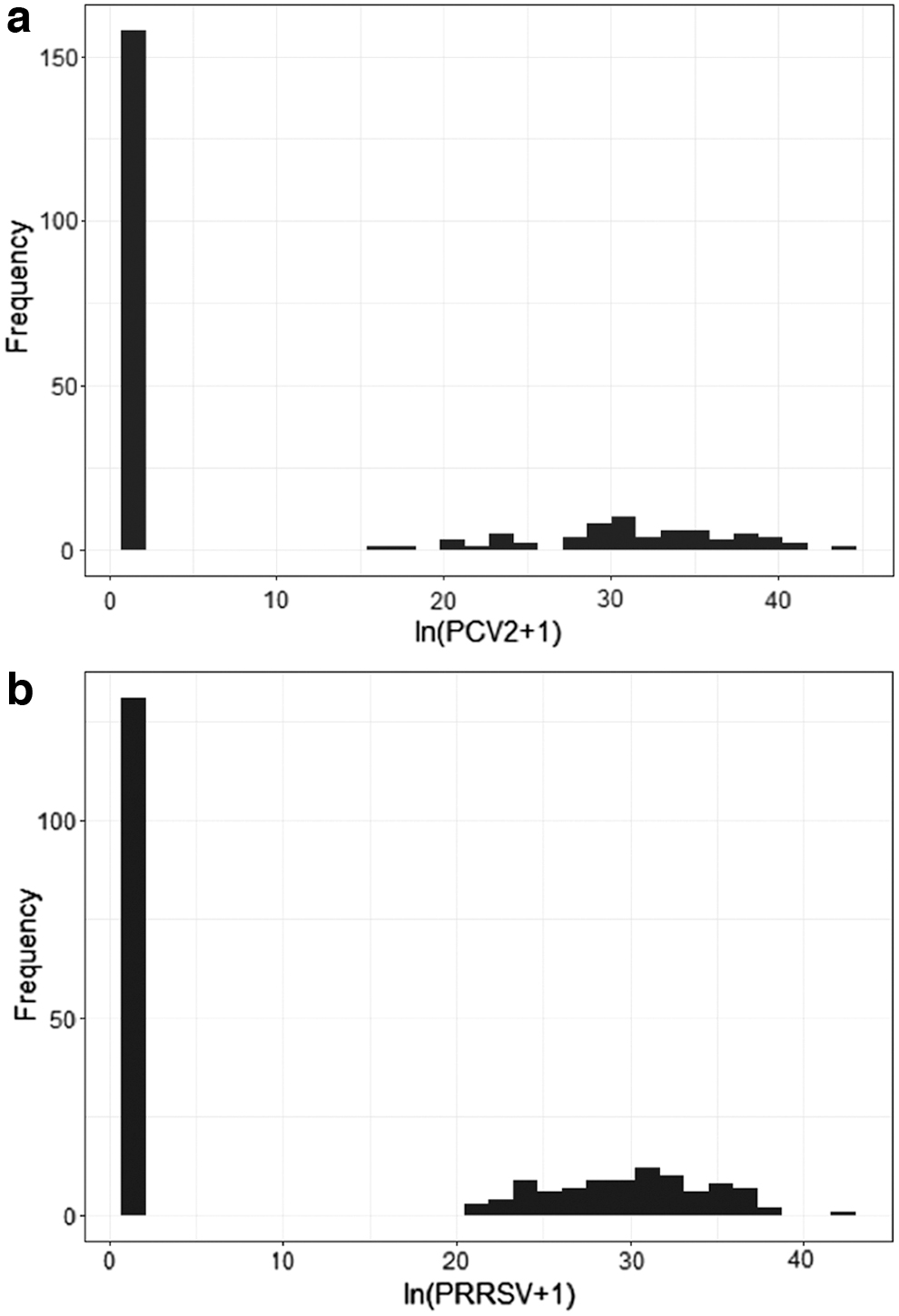
In this study, a two-part model was used for both diseases, predicting the probability of occurrence of a positive CT value, in each pool, using logistic regression in the first part of the model, while positive CT values were the response variable in the second part of the model.
Outcome variables
For each disease, two outcome variables were used, (a) zero or positive CT value and (b) the log-transformation of the positive CT values of RT-PCR.
Explanatory variables
The explanatory variables that were examined in this study were respiratory infections; farm scale; region; pool origin; vaccination program for PCV2; vaccination program for PRRSV; vaccination program (for both diseases); nucleus breeding; F1 introduction; semen introduction; and biosecurity level. All potential predictors were categorized as discrete data (Tables 2 and 3).
Explanatory Variables That Were Examined in the Study for Porcine Circovirus 2
No/Gilts and before every farrowing.
No vaccination/PCV2 and PRRSV modified live vaccine (MLV) vaccination in sows and weaners/PRRSV MLV vaccination in sows and PCV2 and PRRSV MLV vaccination in weaners/PRRSV MLV vaccination in sows/PCV2 vaccination in weaners/PCV2 vaccination in sows and PRRSV killed vaccine (KV) vaccination in sows/PRRSV KV vaccination in sows and PCV2 vaccination in weaners.
Explanatory Variables That Were Examined in the Study for Porcine Reproductive and Respiratory Virus
Only the differences from PCV2 are mentioned.
No vaccination/PRRSV MLV vaccination on the 60th day of gestation and 6th of lactation/PRRSV KV vaccination in sows.
No vaccination/PCV2 and PRRSV modified live vaccine (MLV) vaccination in sows and weaners/PRRSV MLV vaccination in sows and PCV2 and PRRSV MLV vaccination in weaners/PRRSV MLV vaccination in sows/PCV2 vaccination in weaners/PCV2 vaccination in sows and PRRSV killed vaccine (KV) vaccination in sows/PRRSV KV vaccination in sows and PCV2 vaccination in weaners.
Model implementation
Two-part models refer to a mixture of distributions that take the general form:
OR
where y are the observed CT values for PCV2 and PRRS from each pool, Pr(Y > 0) the probability of occurrence of a positive CT value and h(y) a probability density defined when y > 0.
For a random variable Yi, which represents the amount of a quantity with observed yi, for each pool, let Ri, represents the occurrence variable where:
OR
The conditional probability of Ri is defined as:
OR
where θ1 is a vector of fixed occurrence effects.
Therefore, the logistic regression part (first equation of the two-part model) for occurrence is defined as:

where X1i is a vector of covariates for occurrence.
The second (nonzero) part of the model is defined as:
Si = [Yi/Ri = 1] is set to be the “intensity” variable with probability density function (p.d.f.) f(si|θ2) for s
i > 0, where θ2 is a vector of fixed intensity effects. Therefore, the lognormal model (second equation of the two-part model) for intensity is defined as:
where X2i is a vector of covariates for intensity.
All candidate variables were initially screened, one-by-one, to both equations, with a significance level of 0.25. Variables with p < 0.25 were then offered to the two-part model, which was subsequently reduced by backwards elimination, until only significant (p < 0.05) variables remained.
For the logistic regression part, the reported estimate and 95% confidence intervals (CIs) for each predictor was the odds ratio (OR), while for the linear regression part was the coefficient a2 in the equation (2), given that all the other predictors included in the model are held constant.
Goodness of fit
The logistic regression part was assessed by the Hosmer and Lemesbow goodness of fit test (34). The linear regression part was assessed by the Pearson's chi-squared test.
Statistical software
The two-part model was implemented in the RStudio programming environment (75).
Results
From the selected 56 farms, 896 samples were collected from all age groups and organized in 224 pools (each containing 4 samples).
One hundred fifty-eight pools had a zero RT-PCR value for PCV2, while the log-transformed median and variance of the 66 positive RT-PCR PCV2 pool values were 3.395 and 0.047, respectively.
On the contrary, 131 pools had a zero RT-PCR value for PRRSV and the 93 positive values had a log-transformed median and variance equal to 3.376 and 0.027, respectively.
The back-transformed results for the effect of predictors associated for both the occurrence (part I) and intensity (part II) model for PCV2 and PRRSV are summarized in Tables 4 and 5.
Estimate and 95% Confidence Intervals for the Effect of Predictors for the Odds Part (Logistic Regression) and Intensity Part (Linear Regression) for Porcine Circovirus 2
No vaccination/PCV2 and PRRSV modified live vaccine (MLV) vaccination in sows and weaners/PRRSV MLV vaccination in sows and PCV2 and PRRSV MLV vaccination in weaners/PRRSV MLV vaccination in sows/PCV2 vaccination in weaners/PCV2 vaccination in sows and PRRSV killed vaccine (KV) vaccination in sows/PRRSV KV vaccination in sows and PCV2 vaccination in weaners.
Estimate and 95% Confidence Intervals for the Effect of Predictors for the Odds Part (Logistic Regression) and Intensity Part (Linear Regression) for Porcine Reproductive and Respiratory Syndrome Virus
No vaccination/PRRSV MLV vaccination on the 60th day of gestation and 6th of lactation/PRRSV KV vaccination in sows.
No vaccination/PCV2 and PRRSV modified live vaccine (MLV) vaccination in sows & weaners/PRRSV MLV vaccination in sows & PCV2 and PRRSV MLV vaccination in weaners/PRRSV MLV vaccination in sows/PCV2 vaccination in weaners/PCV2 vaccination in sows and PRRSV killed vaccine (KV) vaccination in sows/PRRSV KV vaccination in sows and PCV2 vaccination in weaners.
Porcine circovirus type 2
Logistic regression part
Farms located in Western Greece are less likely to be PCV2 PCR-positive [OR 0.25 (95% CI: 0.07–0.71)] compared to farms located in other regions of Greece (Southern/Northern/Eastern Greece). Also, pools from breeding stock are more likely to be associated with positive CT values compared to pools from weaners [OR 0.21 (0.09–0.46)] and growers [OR 0.36 (0.17–0.75)]. Vaccination of sows for PRRSV and weaners for PCV2 is associated with small probability of PCV2 PCR positivity compared to other applied vaccination programs [OR 0.39 (0.21–0.74)].
Linear regression part
Pools from weaners and growers are expected to have lower CT values, in comparison with pools from breeding stock [slope coefficient 0.82 (0.71–0.94), 0.88 (0.78–0.99), respectively].
Porcine reproductive and respiratory syndrome virus
Logistic regression part
Presence of medium or high percentage of respiratory infections in the farm is associated with higher probability of PRRSV PCR positivity [OR 2.3 (1.16–4.64)]. Mass vaccination until 3 days before farrowing and until 95 days of gestation is more likely to give positive CT values [OR 6.27 (3.17–12.89)]. Further, vaccination of sows for PRRSV, weaners for PCV2 and PRRSV, and sows for PCV2 and PRRSV (killed vaccine) is expected to increase PRRSV PCR positivity [OR 7.28 (2.59–23.36)]. Pool from weaners, growers, and finishers are associated with PRRSV PCR positivity [OR 12.03 (4.54–35.53), OR 7.87 (2.96–23.08), OR 3.91 (1.2–13.39), respectively] compared to pools that come from breeding stock.
Linear regression part-
Nucleus breeding is associated with higher CT values [slope coefficient 1.17 (1.07–1.27)], if the other predictors in the model are held constant. Also, farms with “medium”/“adequate”/“high” biosecurity level are associated with lower CT values [slope coefficient 0.92 (0.86–0.99)], if the other variables included in the model are held constant.
Discussion
Control of both PRRSV and PCV2 relies in four different aspects: early diagnosis and monitoring, biosecurity level, herd management, and immunization. Despite the different strategies that have been applied to minimize the PRRSV and PCV2 prevalence, both remain a huge problem in the worldwide swine industry. So, we designed a study to describe the occurrence of these two viruses among pig farms in Greece and associate the possible risk factors and PRRSV/PCV2 PCR-status in these herds. The survey provides useful information about the surveillance of PRRSV and PCV2 at national level, revealing data for the occurrence of the viruses and main risk factors for their monitoring.
Concerning the PRRSV circulation in pig farms, vaccination could be a key component to reduce the severity and frequency of the virus-related problems and significantly contribute to the control of the infection (52,55,71). However, the efficacy of current PRRSV vaccines in the field is not known with precision and very few data are available regarding their efficiency in reducing PRRSV transmission.
Based on the results of our study, vaccination schemes which could lead to an increased PRRSV circulation in the farms are the mass MLV PRRSV vaccination programs in breeding stock, especially during the last stages of gestation (until 3 days before farrowing) and the KV vaccination of sows during the middle of gestation. With regard to our observations about the mass MLV PRRSV vaccination, they can be explained by the safety concerns of MLV virus vaccines that have been reported in many studies.
Many cases of vertical and horizontal transmission of the virus, due to MLV vaccines, have been demonstrated (16,50,56,57,78). More specifically, there have been reports describing clinical cases, in which despite the MLVs had achieved replication of the vaccine virus in vaccinated animals, subsequently, the virus had been transmitted to naive animals (98). In addition, the vaccine virus can cross the placental barrier, particularly if sows are vaccinated after the 90th day of their gestation and provoke transplacental infection in the fetuses followed by a possible subsequent death (84).
Our results about PCR-positivity in PRRSV MLV vaccinated farms may be also explained by the fact that PRRSV, as an RNA virus, is prone to mutation and its diversity continues to increase (18,29,90). The increasing genetic diversity may result in strains, which break through the efficacy of current PRRS vaccines and undermine PRRS control based on the use of vaccination only (26).
Previous studies reported that PRRSV infection with different strains leads to different virological and immunological outcomes and results in different degrees of homologous and heterologous protection (19), as well as that different PRRSV strains differ in their susceptibility to antibody neutralization (48). Therefore, PRRSV MLVs may provide partial cross-protection against a PRRSV infection. Nevertheless, PRRSV MLVs could achieve a significant reduction in the frequency and severity of the virus outbreaks in commercial pig populations or even assist to eliminate the disease (7,60,70,74,76,83,84).
Regarding the KV PRRSV vaccination, our results are consistent with previous studies, which described their protective efficacy against the virus (97). Specifically, they reported that the KV vaccines may fail to reduce viremia, duration, titers of virus shedding, and prevent reproductive losses (38,103). However, in contrast to what our survey has described, a recent study suggested that the KVs could, effectively, cease the virus transmission or eliminate PRRSV from herds, resulting in drastic reduction infection occurrence, if it is adequately applied (7).
This contradiction to our results could be justified by the beneficial effects of PRRSV KV vaccines on speeding up recovery and potentially reducing infectivity of the pigs (4,38). For this reason, they have been recommended as therapeutic vaccines for PRRSV treatment rather than for disease prevention, as they can decrease pathogen shedding in PCR-positive animals and improve the reproductive performance, for example, increased farrowing rate, number of weaned pigs, and health status of piglets born to vaccinated sows (38,68,103).
In addition, we observed that the vaccination of weaners against PCV2 and PRRSV (MLV vaccine) is expected to increase PRRSV circulation in the farm. These results are in contrast to previous studies, which report that MLV PRRSV vaccination of weaners followed by a PCV2 vaccination had a beneficial effect in decreasing PRRS viremia and the pigs were protected against PRRS, but they showed increased PCV2 replication (26,55,58). This disagreement could be explained either from partial protection of applied commercial MLV PRRSV vaccines against field strains or wrong time of vaccination; near to time of infection or not providing enough time for efficient immunity to be raised against PRRSV infection (40,43,93).
As mentioned above, the PRRS MLVs provide partial virological and clinical protection against heterologous PRRSV strains, and given that the virus is highly prone to mutation, most challenges in the field can be considered as heterologous (49,53).
Consequently, the MLVs may be less effective against PRRS. However, at a herd level, the efficacy of the MLV vaccines should be evaluated in both virological and epidemiological terms. Specifically, the goals of a proper vaccination scheme against PRRSV are not only the animal's clinical protection, but also the ceasing of virus transmission in the pig farm. Therefore, the potential efficacy of MLV vaccines can be estimated through the evaluation of the biological parameters related to transmission and the determination of the virus reproduction rate (73).
Our results further indicate that a combined approach of surveillance for infection and PRRSV laboratory diagnosis is necessary to control or even eliminate the PRRSV from the farms. Generally, to design a vaccination program against PRRSV, it is very important to (a) investigate the serological profile, to determine the time of natural infection, and (b) determine the field strain and compare the results of the sequencing analysis with the commercial MLV vaccines (72,98).
PRRSV infects and compromises the function of pulmonary alveolar and intravascular macrophages resulting in a number of immunological outcomes that increase the animal's susceptibility to secondary infections caused by other pathogens (31,37,66). Our results confirmed that the presence of medium or high percentage of respiratory infections in the farm caused by other pathogens is associated with higher probability of PRRSV PCR positivity. In addition, we found that weaners, growers, and finishers were more likely to show PRRSV PCR positivity compared to breeding stock. Several studies, whose findings are consistent with ours, described clinical cases of persistence of PRRSV infection in a breeding herd, which were caused by mixing susceptible with infected pigs in later finishing stages.
Indeed, after a PRRSV outbreak, a subpopulation of pigs remains susceptible and can be subsequently infected in different stages of production (5,59). Therefore, where susceptible and infectious pigs are mixed, such as at weaning/growing/finishing house, various subpopulations of the herd may be infected (10).
Increased purchase of sows/gilts and semen without any previous serological examination alongside with poor biosecurity level were shown to be significant risk factors for PRRSV infection at herd level. These results are in agreement with previous’ studies, which described several cases of virus introduction through these routes (51,81). The use of contaminated semen has, also, been reported as an important transmission route of PRRSV into a farm. More specifically, Botner et al. (6) demonstrated that the clinical outbreaks occurring in Danish PRRS-free breeding herds were caused by the import of contaminated semen.
In addition, several works reported clinical cases of PRRS infection, in which trucks, trailers, and other vehicles used for transporting pigs, feed, or animal products were responsible for the virus spread. It was shown that the virus could be isolated from the ventral surface of transport vehicles, the truck wash floor, drivers’ boots, or from the surface of various types of containers (11 –14).
Concerning the PCV2 circulation in pig farms, since commercial vaccines against PCV2 became commonly available in 2006, their use lead to control clinical signs and economical losses, characterized by improvement of performance parameters and a declining level of PCV2 prevalence and viremia in the field (1,9,25,41,47,62,63,85,92,96). Nevertheless, we found several risk factors associated with PCV2 circulation in herds. More specifically, breeding stock was more likely to be associated with PCV2 circulation (PCR positive CT values) rather than to weaners and growers. Recent studies, whose findings are similar to ours, revealed that the spread and maintenance of PCV2 infection in farms was mainly due to gilts from the quarantine and rearing area and sows up to the second parity, which were viremic (21).
In addition, it has been reported that a 1-year mass PCV2 vaccination was able to improve the pig's performance parameters, but not to eradicate the virus infection, and PCV2 became detectable again when vaccination was stopped (24). Another explanation of our results may be the absence of vaccination programs against PCV2 in breeding stock, which is applied in the majority of Greek farms, resulting in the maintenance of PCV2 circulation in sows. However, Lin et al. (44) reported that natural exposure of PCV2 occurs in the growing to fattening period, and viremia can last until slaughter.
Moreover, we observed that farms located in Western Greece are less likely to be PCV2 PCR positive compared to farms located in other regions of Greece (Southern/Northern/Eastern Greece). Recent surveys reported the role of the wide PCV2 inoculation in the determination of a differential fitness among genotypes, which may affect the virus epidemiology and evolution (27,28,64,65,87,100). Therefore, our observation raises questions about the efficacy of vaccination programs against PCV2 or the contact network between farms, which could play an important role due to introduction of animals from vaccinated farms, in which different PCV2 strains may circulate (32,33,35,36,42,77). Based on our results, further studies are required to investigate the strains that are circulating in pig populations in Greece.
Furthermore, our results showed that the vaccination of weaners for PCV2 is associated with small probability of PCV2 PCR positivity, while breeding stock is more likely to be associated with positive CT values compared to weaners, indicating that PCV2 infection in a herd can be maintained, thanks to the presence and the circulation of the virus within the breeding herd and thus virus’ shedding by gilts and young sows in farrowing units.
Recent epidemiological studies focused on the development platforms as a tool, which allows the rapid visualization of PRRSV, including stakeholder information, for monitoring PRRSV infection at the national level (94,95,102). Our results could be the start for the development of a national surveillance-monitoring program in Greece, to develop efficient monitoring strategies that might diminish PRRSV and PCV2 impact on swine industry.
Conclusion
According to our results, it can be concluded that PRRSV and PCV2 infections remain a major problem for swine industry in Greece. The study provides useful information about the surveillance of PRRSV and PCV2 at national level, revealing data for PRRSV and PCV2 prevalence and main risk factors for their monitoring, such as vaccination programs. In particular, PRRSV mass vaccination of sows at the late stage of gestation (until 3 days before farrowing) is more likely to be associated with PRRSV circulation in breeding stock. Furthermore, weaners, growers, finishers, and nucleus breeding herds are associated with PRRSV PCR positivity in Greek farms. Moreover, presence of medium or high percentage of respiratory infections in the farm is associated with higher probability of PRRSV PCR positivity.
However, vaccination of sows for PRRSV, weaners for PCV2 and PRRSV, and sows for PCV2 and PRRSV (killed vaccine) is expected to increase PRRSV PCR positivity. Finally, farms with “medium”/“adequate”/“high” biosecurity level are associated with lower PRRSV circulation. As for PCV2 occurrence, breeding stock is more likely to be associated with PCV2 active circulation compared to weaners and growers. However, vaccination of sows for PRRSV and weaners for PCV2 is associated with small probability of PCV2 PCR positivity compared to other applied vaccination programs.
Based on our results, a development of surveillance platforms for a national monitoring system for PRRSV and PCV2 in Greece could be established. Future molecular epidemiological studies could be very useful not only to investigate the evolution of these viruses but also to further understand the main risk factors, such as the level of cross-immunity between field and vaccine strains.
Footnotes
Author Disclosure Statement
No competing financial interests exist.
Funding Information
This work was funded by Zoetis Hellas S.A. through the Research Committee of the University of Thessaly, Greece (grant number: 6252, Scientific Responsible: Associate Professor V. Papatsiros).