




Abstract
Maternal immunity may affect vaccination success in young lambs. This study was aimed to determine the duration of the maternal immunity in lambs born from vaccinated ewe against Sheep pox. The level of neutralizing antibody against Sheeppox virus (SPPV) was measured in 14 lambs that were fed colostrum of their immunized mother (MCF lambs; n = 14) or reared with colostrum of ewes that were not immunized against Sheep pox, as the control (C lambs; n = 7), using virus neutralization index. The lambs were randomly divided into four experimental groups and after blood sampling, they were challenged by a virulent SPPV at different postbirth days, including 15 (2 CF and 1 C lambs), 30 (4 CF and 2 C lambs), 60 (4 CF and 2 C lambs), and 90 (4 CF and 2 C lambs) days of age. All the C lambs had no antibody titers against SPPV. Results of the challenge test showed that, up to 60 days of age, the MCF lambs had only localized scabs at the inoculation site and did not show any secondary pock lesions associated with Sheep pox; while all the C lambs were infected (p < 0.05). However, the percentage of lambs with Sheep pox signs was not different between C and MCF lambs after the challenge test at 90 days old lambs (p > 0.05), indicating decrease of maternal immunity. These findings revealed that the duration of maternal immunity against SPPV is ∼60 days, and vaccination is better to be performed at later ages.
Introduction
Sheep pox is a malignant and contagious viral disease of sheep with clinical signs of fever, rhinitis, skin lesions and internal lesions, conjunctivitis, respiratory distress and death (1,12,17). The causative Sheeppox virus (SPPV) is classified into the Capripoxvirus genus along with goatpox virus and lumpy skin disease virus of the Poxviridea family (8,15). At field conditions, the virus is transmitted by the aerosol route, close contact with infected animals, and mechanically transmitted by biting flies (7,14). Sheep pox is a high-prevalence disease bringing considerable mortality rate; hence, it imposes a drastic economic loss on the sheep farming sector. These characteristics nominated Sheep pox as a cause of animal bioterrorism and notifiable disease, which is categorized in group A of the World Organization for Animal Health diseases (5,16).
Sheep pox is endemic in Africa, Northern Ecuador, the Middle East, Turkey, Iran, Afghanistan, Pakistan, India, Nepal, and parts of China (2,16,23). In these areas, the main controlling strategy of the disease is annual vaccination using a live-attenuated vaccine (5,7,23). To establish active immunity against SPPV, the determination of proper time of vaccination in young lambs is of importance (12,17). Maternal immunity, provided by the transportation of maternal antibodies through the colostrum to the young ruminants, plays a crucial role in the prevention of disease before vaccination (25); while lambs with no maternal immunity show ∼90% mortality when they are exposed to the virulent SPPV (21).
Meanwhile, the maternal antibody may decrease the vaccine effectiveness, once vaccination is carried out at an inappropriate age. In this regard, Precausta et al. (17) reported that vaccination of lambs having high levels of maternal antibody did not elicit appropriate immune response, and the animal remained susceptible to the disease until the next vaccination. Thus, the determination of an appropriate age for the administration of Sheep pox vaccine is a critical step in vaccination success of young animals.
Previous investigations have demonstrated that maternal immunity protected lambs against virulent SPPV up to 1 month after birth (11). Another study estimated that the appropriate age for vaccination against SPPV was 2 months (17); while the others suggested that 3 months is the age when vaccination should be performed (13). To control Sheep pox disease in Iranian sheep herds, the annual vaccination program with a live-attenuated vaccine of RM65 strain is scheduled (19); however, there are no conclusive data showing the appropriated age of vaccination against Sheep pox disease in lambs. Therefore, this study was conducted to determine the appropriate age of vaccination against SPPV in lambs by measuring the duration of passive immunity acquired by feeding colostrum of immunized ewes.
Materials and Methods
Animals and experimental groups
Twenty-five healthy pregnant ewes without any history of SPPV or vaccination against Sheep pox disease were randomly selected from the RVSRI sheep flock, located in Kordan Research Station. Animals were vaccinated through a live-attenuated Sheep pox vaccine (105.5 tissue culture infectious dose [TCID] 50/mL; RVSRI, Iran), 2 months before expected parturition. After blood sampling at 21 days postvaccination, sera were collected to measure antibody titers against SPPV by virus neutralization index (VNI). At parturition, 21 healthy lambs were born and immediately fed adequate colostrum of their individual corresponding mother (MCF lambs; n = 14) or reared with colostrum of ewes that were not immunized against SPPV, as the control (C lambs; n = 7).
The lambs were then randomly divided into four experimental groups and after blood sampling, they were challenged by 104 skin infectious dose (SID)50/mL of virulent SPPV (Azerbaijan SPV Isolate) at different postbirth days, including 15 (2 MCF and 1 C lamb), 30 (4 MCF and 2 C lambs), 60 (4 MCF and 2 C lambs), and 90 (4 MCF and 2 C lambs) days of age. An outline of experimental design including treatment, time of blood collection, and challenge test is ascribed in Figure 1.
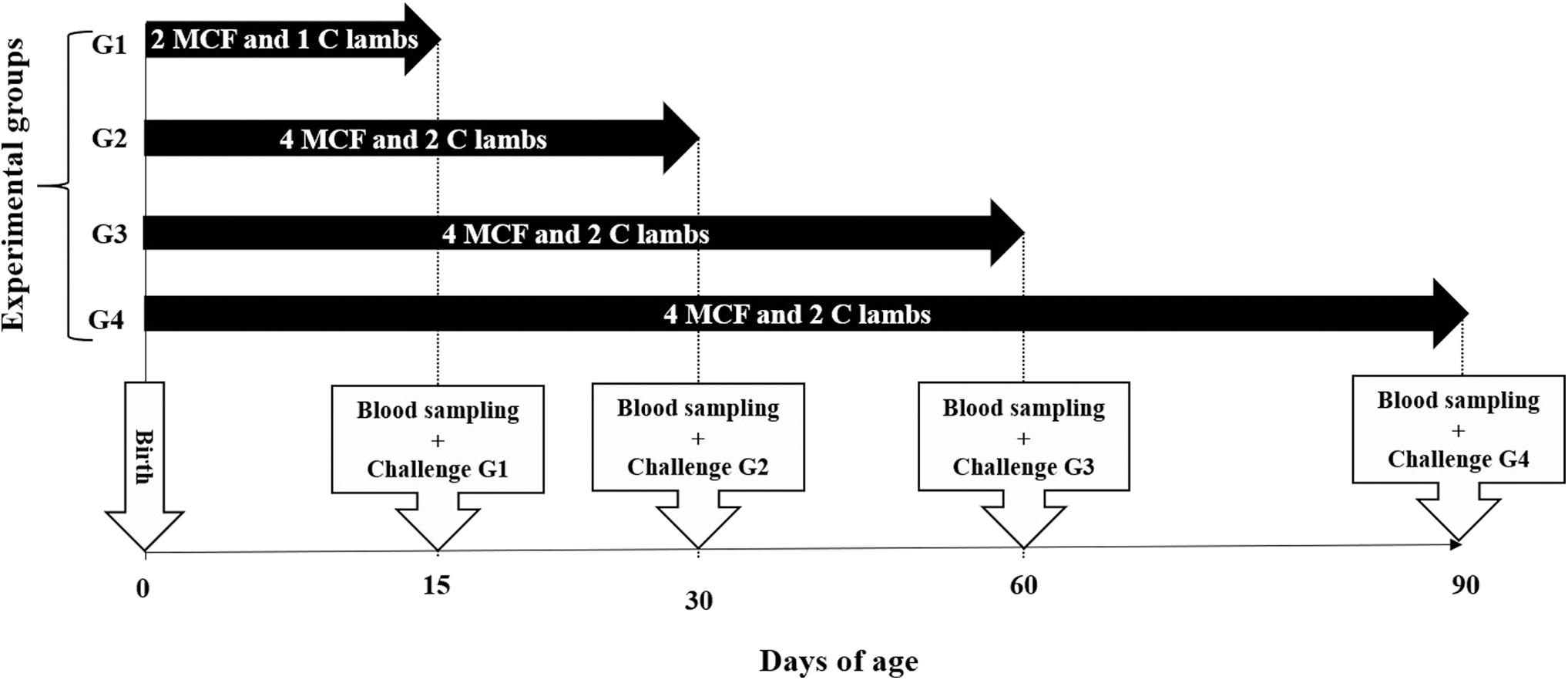
An outline of experimental design, including experimental groups, time of blood collection, and challenge with virulent SPPV in MCF or C lambs. C, lambs fed colostrum of unvaccinated dams as the control; MCF, lambs fed colostrum of their immunized mother; SPPV, Sheeppox virus.
Measurement of antibody titers against SPPV
To measure the antibody titers against SPPV, the VNI method was used. The VNI was performed by the microtitration method and a 96-well plate using secondary lamb kidney (LK) cells, as described previously (16). In brief, serum samples were diluted with DMEM at 1:5 ratio and were inactivated by heating at 56°C for 30 min. A 50 μL of each serum sample was added to the wells of two columns of the microplate. Then, the SPPV (106.1 TCID50/mL) was diluted in a log dilution series of log10 5.0; 4.0; 3.5; 3.0; 2.5; 2.0; 1.5 TCID50 per milliliter. Starting with row G and the most diluted virus preparation, 50 μL of the virus was added to each well in that row. This step was repeated with each virus dilution, so that the highest titer virus dilution was placed in row A.
The microplate was incubated at 37°C for 1 h. Then, a 100 μL of LK cell suspension (10,000 cells per well) was added to each well, and the microplate was reincubated at 37°C and 5% CO2 atmosphere, for nine successive days. During incubation, the microplates were examined daily for cytopathic effect, and the serum titer was calculated by the Karber method. The difference between test serum titer and the negative serum titer was calculated as the VNI (16).
Challenge test
A 0.1 mL of virulent SPPV Azerbaijan isolate, 105 SID50/mL (24), was inoculated subcutaneously into all lambs at different postbirth days, including 15, 30, 60, and 90 days of age. The lambs were then examined daily for general and clinical signs of Sheep pox, including body temperature, lymph node status, mucosal membrane status, and most importantly, skin lesions, during the next 21 days (13,20).
Statistical analysis
Data collected from the VNI test were analyzed by S-PLUS8 and SPSS 24.1 software and one-way analysis of variance through independent t-test. Results of the challenge test were compared in C and MCF lambs by Fisher's exact and chi-square tests. The protective level of neutralizing antibody against virulent SPVV was analyzed using MedCalc 19.1.3 software and interactive dot diagram analysis. Statistical difference was p < 0.05.
Results
Sera neutralizing antibodies titer
Sera neutralizing antibody titers measured in vaccinated ewes and their offspring are reported in Table 1. As shown, the ewes had an appropriate serum titer 3 weeks after vaccination (1.63 ± 0.06). The C lambs did not have neutralizing antibody titers in all experimental groups during different ages. However, at day 15 of age, 100% of MCF lambs had neutralizing antibodies ≥1.5 and considered as positive sera. There was a low correlation coefficient (4.9%) between the mean titer of neutralizing antibodies in pregnant ewes and their corresponding MCF lambs at 15 days of age.
Descriptive Results of Neutralizing Antibody Titer Against Sheeppox Virus in Vaccinated Ewes and Their Corresponding Lambs That Were Fed Colostrum of Their Immunized or Nonimmunized Dams
C, control (lambs that feed colostrum from unvaccinated dams); N.I., neutralization index; MCF, mother colostrum-fed lambs.
At 30 days of age, only 10 of 12 tested MCF sera (83%) had neutralizing antibodies titer ≥1.5; meanwhile, it was decreased to one of the eight MCF lambs at days 60 and 90 of age. The mean antibody titers in MCF lambs were higher compared with their corresponding C lambs, at 15, 30, 60, and 90 days of age (p < 0.04; Fig. 2). However, a decreasing trend in neutralizing antibodies titer of MCF lambs was noted by increasing the age (p < 0.03; Fig. 2).

Serum neutralization index in MCF against SPPV or C during different days of age. Note: details of treatment and experimental design are shown in Figure 1.
Challenge with virulent SPPV and clinical examinations
Results of challenged lambs with virulent SPPV and observation of postchallenge clinical signs are represented in Table 2 and Figure 3. The percentage of lambs with clinical signs of Sheep pox was higher in C lambs compared with their corresponding MCF lambs, at 15, 30, and 60 days of age (p < 0.05; Fig. 3). However, the Sheep pox incidence rate and the percentage of lambs with clinical signs of the disease were not different between C and MCF lambs during 90 days of age (p > 0.05; Fig. 3).

Sheep pox incidence rate (%) in MCF against SPPV or C, during different days of age. Note: details of treatment and experimental design are shown in Figure 1.
Neutralization Index Value and Clinical Signs of Challenged Lambs Through Virulent Sheeppox Virus That Were Fed Colostrum of Immunized Ewes (MCF) or Colostrum of Nonimmunized Dams
Note: details of treatment and experimental design are shown in Figure 1.
C, lambs fed colostrum from unvaccinated dams (control); MCF, lambs fed colostrum from their immunized mother.
In addition, up to 60 days of age, all the C lambs showed clear pock lesions as well as secondary symptoms associated with the Sheep pox, while MCF lambs had no primary or secondary clinical signs of the disease (Table 1). However, during day 90 of age, with the exception of one lamb in the MCF group, all the challenged lambs showed clear signs of Sheep pox. Results of interactive dot plot analysis revealed that >90% of lambs with SNI value ≥1 was protected in challenge with virulent SPPV (Fig. 4).
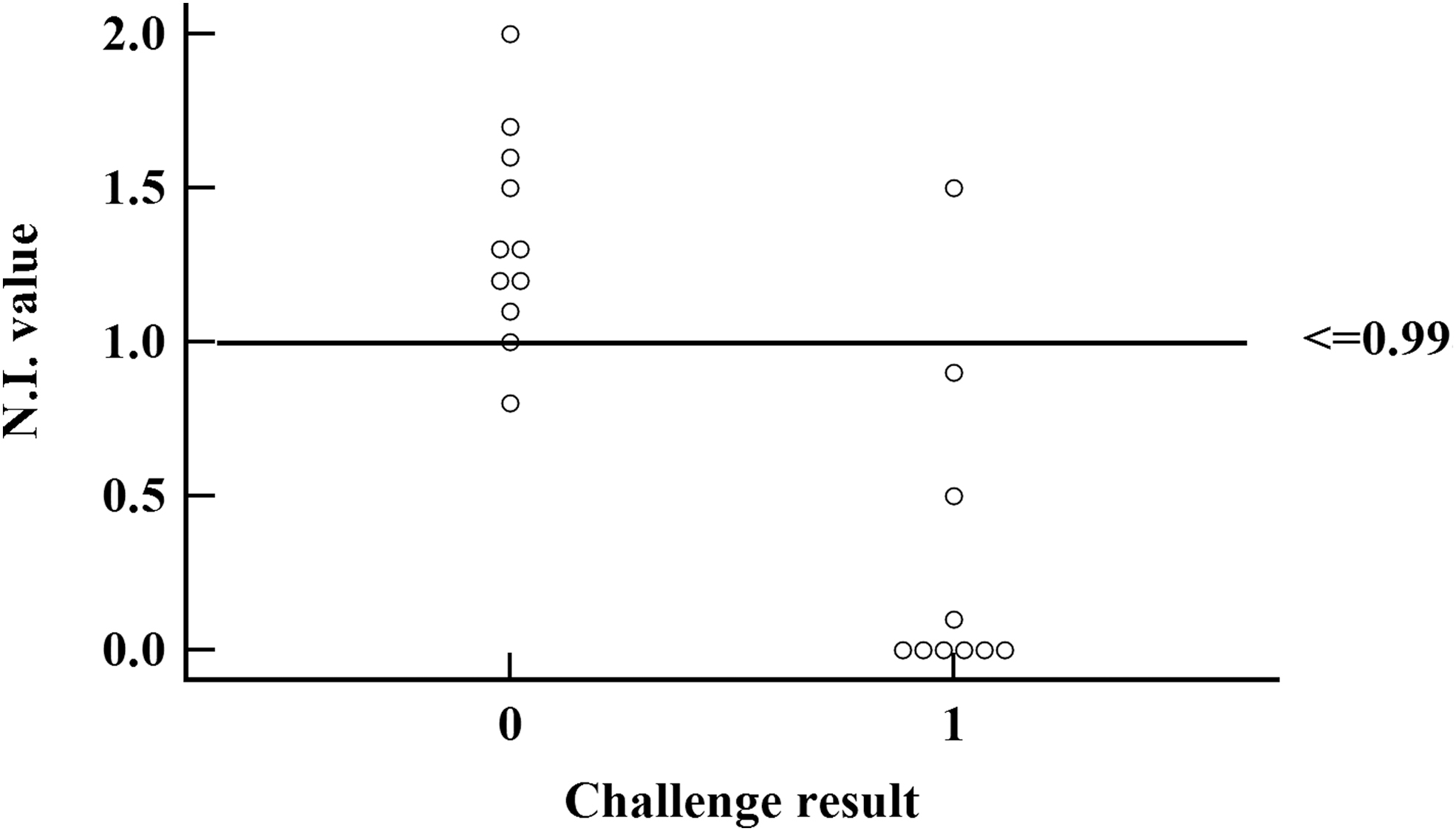
Relationship between serum N.I. and incidence of Sheep pox disease in lambs challenged by virulent SPPV. Note: 0 = healthy lambs; 1 = infected lambs. N.I., neutralization index.
Discussion
Sheep pox is a malignant and contagious disease of sheep that, in the endemic areas, is controlled mainly by vaccination of susceptible animals with a live-attenuated vaccine in a regular vaccination program (1,5,23). Traditionally, lambs that are born from the immunized ewes are vaccinated against Sheep pox at third month of age, and then the vaccination is repeated annually. However, there is no conclusive information about the duration of maternal immunity in lambs. The presence of a high antibody level at the time of vaccination has shown to reduce vaccine efficacy, and thereby resulting in vaccination failure (17). In an attempt to estimate the appropriate age of vaccination in lambs, this study investigated the duration of immunity acquired through feeding colostrum of immunized dams against Sheep pox.
The results of this study demonstrated that the administration of the live-attenuated Sheep pox vaccine to the pregnant ewe effectively increased immune response 3 weeks later, such that the neutralization index (N.I.) in 81% of the vaccinated ewes was ≥1.5. Although according to the OIE guideline (16) animals with the N.I. value ≥1.5 are considered positive, it has been well established that the immune response to Poxviridae virus infections is mainly cell mediated, and humoral immunity plays a lesser role in protection against Sheep pox (6,9). Therefore, the N.I. value of 1.5 may not be a reliable threshold in forecasting protection against Sheep pox. In this line, the N.I. value observed in some vaccinated ewes (such as ID numbers 917 and 944 to 946) was <1.5, while it would be expected to be protected against the disease.
The findings of this study showed that feeding colostrum from vaccinated dams successfully transmitted specific antibodies against Sheep pox to their lambs. The mean N.I. value of lambs at 15 days of age was 1.9; however, control lambs had no N.I. titers. Due to the fact that during pregnancy, circulating immunoglobulin cannot cross the ruminant placental membranes, the lack of neutralizing antibody in control lambs was expected (25). It is noteworthy to mention that the serum N.I. value of MCF lambs, in some cases, was higher than that observed in their mothers.
The measured correlation coefficient between the N.I. values in dams and their corresponding lambs at the 15 days of age was ∼5%, showing negligible correlation between them. This finding is probably due to the active transfer of immunoglobulins to the mammary gland during Peripartum period (22). It is well documented that in a selective and active manner, the blood IgG is transferred to the mammary gland during 3–4 weeks before lambing. This probably lowers the plasma IgG levels during preparturition in dams, while it is concentrated in the colostrum (3,22).
Results of clinical examinations after the challenge test showed that virulent SPPV replicated at the inoculation site and caused scabies lesions. The lesions at the inoculation site did not differ between control and MCF lambs in terms of severity and extension, indicating that immunity acquired from colostrum (passive immunity) could not inhibit virus replication at the inoculation site. This finding was in agreement with results reported by Kitching et al. (13), which showed that the replication of SPPV at inoculation site was not inhibited in the animals receiving anti-Sheep pox hyperimmune serum. However, it has been shown that injection or inoculation of SPPV into the skin of vaccinated (active immunity) animals triggered a delayed hypersensitivity reaction, which in turn inhibited local SPPV replication (13).
Besides, as maternal immunity cannot inhibit virus replication at the inoculation site, inoculation of virulent SPPV caused fever and enlargement in prescapular lymph nodes (close to the inoculation site) in both the MFC and C lambs. Meanwhile, the acquired passive immunity in MCF lambs inhibited the virus release from the inoculation site to the body and protected them against Sheep pox at least up to 60 days of age. These findings emphasize the adequacy of the antibody titer acquired by passive immunity in the prevention of Sheep pox disease. However, challenge test in C lambs was associated with several clinical symptoms of Sheep pox such as fever, nasal and ocular discharge, keratoconjunctivitis, dyspnea, and emaciation, resulting in infection throughout by making generalized pock lesions in other parts of the body.
Serological investigation showed that at 15 days of age, 100% of MCF lambs had an N.I. value ≥1.5, associated with 100% protection in challenge test. Despite 83% and 12.5% of the MCF lambs having N.I. values ≥1.5 at the 30 and 60 days of age, respectively, again 100% of the lambs were protected in the challenge with virulent SPPV. However, all C lambs were infected.
There was no significant difference between the C and MCF lambs in terms of the percentage of the disease incidence after challenge test at 90 days of age, indicating the loss of immune defense against Sheep pox. It is worth noting that in the vaccinated animals with active immunity, the protection is obtained mainly due to cell-mediated immunity. However, in animals with passive immunity, the protection is mediated only by the transmission of maternal antibodies obtained by colostrum ingestion. Therefore, the immunity of MCF lambs during the first 60 days of age was only humoral, and their infection at 90 days of age is most likely due to the reduction of antibody levels as reported in this study.
Even though the neutralization index ≥1.5 is considered as a positive and effective titer against Sheep pox, according to the results of this study, N.I. values ≥1 could be suggested as protective titer in animals only possessing passive immunity. Consistently, Gomes et al. (10) demonstrated that 90% of the lambs, which had only passive immunity and neutralizing antibody levels ≥1, were protected against SPPV. Some studies indicate the lack of significant correlation between the level of neutralizing antibodies and immunity against Sheep pox (6,12); however, in agreement with the present findings, some other studies reported a significant relationship between the level of neutralizing antibodies and the protection against the disease (4,18).
Therefore, it can be concluded that when the humoral immunity is the only protective measure against SPPV, neutralizing antibodies ≥1 may protect the animal against Sheep pox. However, the relationship between the level of humoral immunity and protection against Sheep pox is still questionable, and requires more comprehensive studies.
Based on the previous findings (14), vaccination against Sheep pox is carried out in lambs at third month of age. However, the results of this study demonstrated that the lambs with only passive immunity are most likely protected against the virulent SPPV up to 60 days of age. In agreement, Gulyaz (11) also suggested that the optimum age for vaccination against Sheep pox is 6–8 weeks of age. However, Kitching (13) reported that lambs receiving anti-SPV hyperimmune serum will be protected against virulent SPPV at most up to 87 days of age, which is relatively long than that reported in this study.
In conclusion, the results of this study showed that maternal immunity in lambs born from immunized dams could protect them against Sheep pox up to days 60 of age. Therefore, earlier vaccination may cause interference between maternal antibodies that were acquired through colostrum and the vaccinal virus, resulting in vaccination failure or reduction of its efficacy. Accordingly, a timeline between 60 and 90 days is probably the optimal time to vaccinate nonimmunized lambs against Sheep pox; however, it is important to find that under low but still detectable NA after days 60 of age, the vaccine response will not be suppressed, and thus vaccination efficacy at this time will increase protection. Therefore, further studies are required to determine the age of vaccination exactly.
Footnotes
Authors' Contributions
M.H.E.-J., A.R.Y., H.R.V., Z.H., and M.A. are all from Agricultural Research Education and Extension Organization (Karaj, Iran), where education and research are the primary functions.
Acknowledgments
The authors thank Razi Vaccine and Serum Research Institute and the staff of Animal Viral Vaccine Department for supporting this study.
Author Disclosure Statement
No competing financial interests exist.
Funding Information
This study was financially supported by the Razi Vaccine and Serum Research Institute, Agricultural Research, Education and Extension Organization in Karaj, Iran (No. 2-18-18-88030).