




Abstract
Maintaining herd immunity against the rubella virus is important for controlling the spread and recurrence of rubella. Rubella vaccination for children has been affordable in Saudi Arabia since 1982. To assess the immune response derived from vaccination, we assessed the seroprevalence against the rubella virus among the population of the Madinah region. An indirect enzyme-linked immunosorbent assay (ELISA) was used to measure anti-rubella IgG antibodies in 791 serum samples obtained from 336 (42.5%) men and 455 (57.5%) women, ranging from 14 to 49 years in age. Among all participants, 94.2% were seropositive for rubella IgG antibodies, indicating a high degree of immunization. However, 5.8% of participants were seronegative, suggesting a population of either poor vaccine responders or the potential risk of waning vaccine-induced immunity. No significant difference or association with rubella seropositivity was identified according to age, sex, or pregnancy status. The median anti-rubella IgG antibody concentrations differed significantly between age groups (p < 0.001). Although a high percentage of the tested population in Madinah demonstrated anti-rubella IgG antibody seropositivity, a notable percentage of the population were seronegative, making them susceptible to infection.
Introduction
Rubella is a contagious viral infection caused by the rubella virus, a single-stranded RNA virus that belongs to the Togaviridae family and is the sole member of the Rubivirus genus (9). Although most cases of rubella infection result in a mild illness, fetal infections can result in miscarriage or congenital rubella syndrome (CRS) (
The development and introduction of rubella virus vaccination have resulted in significant decreases in the incidence of both primary rubella virus infection and CRS, one of its most serious consequences, in many countries. However, despite significant advances, rubella continues to pose a worldwide public health risk and remains a critical viral infection that requires surveillance (17).
Two distinct approaches to rubella vaccination have been employed worldwide. The first approach specifically targets CRS through the selective vaccination of women of reproductive age and adolescent girls (24,25). The second approach is intended to interrupt viral transmission by vaccinating the entire population to eliminate the infection reservoir in both male and female children, lowering the overall risk of infection among adults and offering indirect protection for unvaccinated women of reproductive age, preventing all viral transmission by eradicating rubella and CRS (24,25).
A Saudi Royal decree in 1982 required that all children must receive vaccinations to obtain birth certificates (30). Therefore, in Saudi Arabia, each newborn receives a birth certificate at the age of 1 year after receiving all necessary vaccinations. Consequently, all participants 39 years of age and younger have received the measles, mumps, and rubella (MMR) two-dose vaccine. Previous national studies on MMR-induced immune responses against measles and mumps showed positive influences of the vaccine, which demonstrated good vaccine efficiency and induced prolonged protective immunity. They reported that the seropositivity rates were 92% against measles and 79% against mumps (20,21). However, little researches exist on vaccine-induced immunity against rubella in Saudi Arabia.
The few published data focused exclusively on immunity among women of reproductive age, with limited studies on the immune status of men who have been regularly vaccinated since the introduction of the MMR vaccine in 1982.
To evaluate the effectiveness of rubella vaccination approaches and identify hidden immunity gaps, the susceptibility to rubella within a population must be determined. Therefore, in this study, we aimed to investigate the seroprevalence of antibodies against rubella in women of reproductive age and examined the rubella serostatus among age-matched men in the Madinah region of Saudi Arabia.
Materials and Methods
Study population
This study was performed as a cross-sectional seroepidemiological study conducted between September 2021 and October 2021. The study population consisted of outpatients who received medical care at King Fahad General Hospital (a central hospital located in the Madinah region), who were either willing and able to provide consent or for whom consent was provided by a legal representative. The hospital treats patients who live in the central and rural areas surrounding the Madinah region. Total number of population in the region is estimated to be 1,150,000. Using Epi Info software (Epi Info7.2.4.0; CDC, Atlanta), the minimum number of patients required in this study was 545 patients. This number was calculated based on confidence level of 99.99% and expected frequency of patients immune against rubella of 90%.
Participant selection
Samples were collected using a convenience sampling method. Posters containing information on the study objectives and targeted groups were placed in waiting rooms inside the hospital. Contact information was provided on the posters to allow patients to make inquiries or obtain additional details regarding the procedure for the collection of data and blood samples. After the agreement to participate, patients were requested to go to phlebotomy room for blood drawing and then blood samples were transferred to virology laboratory for separation and processing.
A total of 791 individuals 14 to 49 years of age were investigated. Participants were divided into four age groups based on Saudi Arabia's rubella vaccination recommendations (4,13) as follows: (i) 40–49 years: individuals born before 1982 (only girls 11–14 years) received one dose of RA27/3 vaccine, (ii) 30–39 years: individuals born between 1982 and 1990 (boys and girls 1 and 11–14 years) received two doses of noncompulsory MMR vaccine, (iii) 20–29 years: those born between 1991 and 2001 (boys and girls 1-year old) received a mandatory one dose of MMR vaccination, and (iv) 14–19 years: individuals born after 2001 (boys and girls 1 and 2 years) received two doses of MMR vaccination.
Laboratory testing
Blood samples were collected in 5 mL vacutainer serum tubes. Centrifugation was performed within 1 h of sample collection for 15 min at 2,500 rpm, and sera were stored at −20°C until analysis.
Enzyme-linked immunosorbent assay
The HUMAN Rubella IgG enzyme-linked immunosorbent assay (ELIZA) (Ref. No. 51208; Human Gesellschaft fur Biochemica und Diagnostica mbH, Wiesbaden, Germany) was used for the detection of anti-rubella IgG antibody according to the manufacturer's instructions using a semiautomated ELISA washer and reader (Biotek, Winooski). Antibody levels ≥10 IU/mL were considered positive and protective (12,29). The assay specificity and sensitivity are 97.0% and 93.4%, respectively. Test performance characteristics are accessible at
Ethical approval
This study was conducted in compliance with relevant national regulations, institutional policies, and the tenets of the Helsinki Declaration. The Research Ethics Committee of the College of Applied Medical Sciences at Taibah University approved the study (IRB No. MLT/2020/78/221).
Statistical analysis
Statistical analysis was performed using the Statistical Package for Social Sciences (IBM SPSS Statistics version 25, Armonk, NY). Qualitative variables are presented as the frequency and percentage, whereas quantitative variables are presented as medians (interquartile ranges [IQR]). Prevalence data are provided with 95% confidence intervals (95% CIs). Chi-square or Fisher's exact test was used where appropriate to test the associations between two categorical variables. Mann–Whitney U test was used to detect significant differences between two independent groups, whereas the significant differences among more than two groups of non-normally distributed quantitative data were detected using the Kruskal-Wallis test. A two-tailed p-value ≤0.05 was considered significant.
Results
General characteristics of the study subjects
In this study, 791 participants were recruited, including 336 (42.5%) men and 455 (57.5%) women, of which 121 (26.6%) were pregnant. The participants ranged from 14 to 49 years of age, with a median age of 28 years (IQR: 22–37 years). The median age of female participants was 26 years (IQR: 22–37 years), and the median age of male participants was 30 years (IQR: 23–37 years). Participants were further divided into four age groups: 14–19 years (12.1%, n = 96), 20–29 years (41.6%, n = 329), 30–39 years (29.6%, n = 234), and 40–49 years (16.7%, n = 132).
Anti-rubella IgG antibodies associated with age, sex, and pregnancy status
The analysis indicated that rubella seropositivity was detected at a significantly higher percentage (94.2%, n = 745; p < 0.001) than seronegativity (5.8%, n = 46).
In Table 1, we describe differences in the humoral immune response (IgG seropositivity) according to age, sex, and pregnancy status. A relatively higher proportion of men were seropositive for the anti-rubella IgG antibody (95.2%, 95% CI: 92.9–97.5) than women (93.4%, 95% CI: 91.1–95.7), although this difference was not significant (p = 0.357).
Distribution of Rubella Serological Status by Sex, Age Group, and Pregnancy Status
40–49 years: born before 1982 (only girls 11–14 years) received one dose of RA27/3 vaccine; 30–39 years: born between 1982 and 1990 (boys and girls 1 and 11–14 years) received two doses of noncompulsory MMR vaccine; 20–29 years: born between 1991 and 2001 (boys and girls 1-year-old) received a mandatory one dose of MMR vaccination; and 14–19 years: born after 2001 (boys and girls 1 and 2 years) received two doses of MMR vaccination.
CI, confidence interval; MMR, measles, mumps, and rubella.
A high rubella IgG seropositivity frequency of >90% was observed across all age groups. The highest and lowest IgG antibody seropositivity proportions were observed among the age groups 14–19 years and 40–49 years, which were 95.8% (95% CI: 94.4–97.2) and 90.9% (95% CI: 88.9–92.9), respectively. High seropositivity percentages were also observed among the participants in the 20–29-year and 30–39-year age groups, although no significant difference in rubella seropositivity rates was observed across different age groups (p = 0.343). When men and women 40–49 years of age were examined separately, a higher proportion of women were seropositive for the anti-rubella IgG antibody (92.4%, 95% CI: 90–94.8) than men (88.7%, 95% CI: 85.3–92.1).
We observed similar proportions of seropositivity for rubella IgG antibodies among pregnant women (93.4%, 95% CI: 89–97.8) and nonpregnant women (93.4%, 95% CI: 90.7–96.1, p > 0.99).
In addition, the anti-rubella IgG antibody concentrations were compared across age groups (Fig. 1), which revealed a significant difference (p < 0.001). The median anti-rubella IgG antibody concentration for the 30–39-year group (48.60 IU/mL) was higher than the median anti-rubella IgG antibody concentrations for the 40–49-year (33.41 IU/mL), 20–29-year (28.44 IU/mL), and 14–19-year (23.37 IU/mL) age groups.
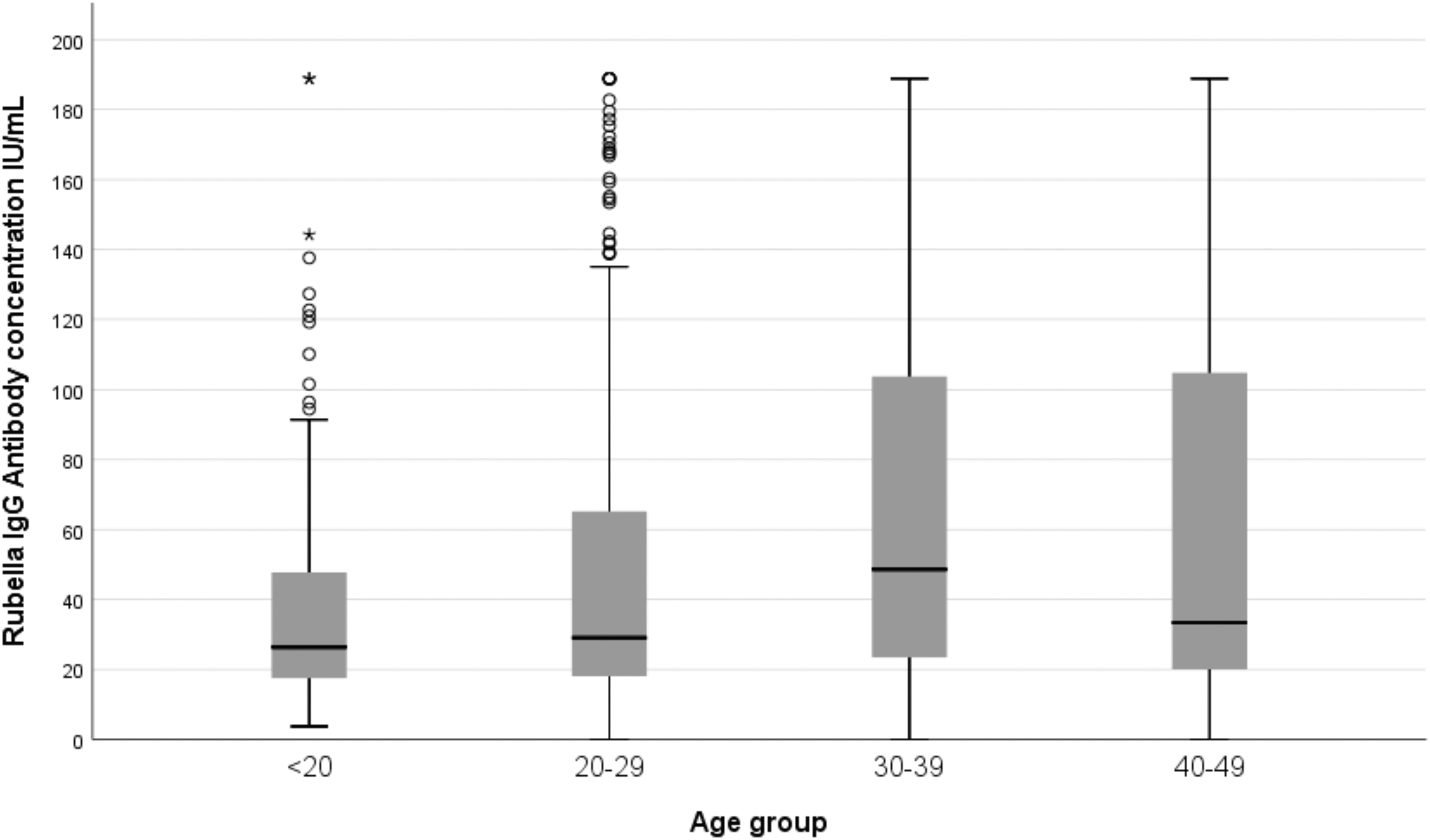
Box plots displaying the relationship between anti-rubella IgG antibody concentrations and age groups. The horizontal line in box plot represents median age. Upper and lower ends of box plot represent 75th and 25th percentile, respectively. The distance between the two percentiles is the IQR. The ends of the whiskers represent one and a half times the IQR. The median anti-rubella IgG antibody concentrations differed significantly between age groups (p < 0.001). IQR, interquartile range.
Discussion
Saudi Arabia introduced the rubella vaccination in 1978, and by 1982, the MMR vaccine was available to all children of both sexes at the age of 12 months and was offered to all prepubescent girls. Later, in 1991, the government launched an expanded program on immunization (EPI). The EPI made the rubella vaccine available as part of the national MMR vaccination program. However, the EPI schedule has been adjusted multiple times to ensure high coverage. As of 2013, the MMR vaccination is provided to all children at the ages of 12 and 18 months and at the age of school entry (4).
Postpartum vaccination for rubella seronegative women is also performed in Saudi Arabia. Antenatal rubella IgG antibody tests are routinely performed during the first antenatal appointment, allowing unprotected women to be identified and vaccinated postpartum. Despite these efforts, the number of seronegative pregnant women has not decreased since the introduction of the rubella vaccine to schoolgirls in 1978 (26). Because effective prevention against CRS depends on avoiding rubella infection during pregnancy, studies examining the seroprevalence of anti-rubella antibodies can inform the development of health policies. Therefore, findings from such investigation will contribute to add a lot to the policy makers.
In this study, we investigated the anti-rubella IgG prevalence among women of reproductive age and age-matched men in the Madinah region, aiming to estimate population immunity and evaluate the effectiveness of prior vaccination efforts. In Saudi Arabia, the coverage rate for MMR vaccine was 96% (3).
Overall, our results showed a higher seroprevalence proportion among the studied population, with a seropositivity rate against rubella of 94.2%, which is higher than the WHO-demanded threshold for effective herd immunity (17,22). Our finding is consistent with three studies conducted in the United States, Australia, and Lao People's Democratic Republic, which are countries known to achieve high vaccination coverage rates (8,28,33). In addition, the seronegative outcomes may also represent evidence of waning vaccine-induced immunity, which is a potential factor that has been associated with an increase in the number of rubella infection outbreaks in recent years (7,15,16).
A prolonged immune response against rubella virus may not be activated due to a single vaccine dose, particularly in the absence of recurring rubella virus exposure, and immunity might be strengthened by re-immunization with a booster dose. The gradual waning of rubella-specific antibodies in the absence of viral exposure or booster immunizations may eventually lead to seronegativity (18,19,27).
The periodic evaluations of continued rubella vaccine-induced immunity years after vaccination and examining the effects of population characteristics, such as race, sex, and age, on antibody levels, serve as the primary objectives of most rubella vaccination studies performed to assess population immunity and national vaccination policies. In our study, we found no significant differences in seropositivity according to sex or age, in good agreement with other reports evaluating seropositivity differences for anti-rubella IgG antibodies between sex and age groups (7,31,33). By contrast, a recent study showed that seronegativity was associated with the male sex (10). However, inconsistencies between studies bust account for regional differences in childhood vaccination programs and the demography of each study cohort, in addition to potential differences in the sensitivity of the test used to detect antibodies (23).
Comparing seropositivity rates among men and women of different ages reveals that men 40–49 years of age have low seropositivity rates than those born after the introduction of MMR vaccination. The seronegative individuals in this age group were most likely not vaccinated. This finding emphasizes the need for a vaccination strategy that covers older adults (32).
We found that the median anti-rubella IgG antibody concentrations differed significantly between age groups. The median anti-rubella IgG antibody concentration for the 30–39-year group, who received two doses of noncompulsory MMR vaccine, was the highest, followed by the partially vaccinated 40–49-year group, and finally the younger age groups that were vaccinated with mandatory one and two MMR doses, respectively. Low anti-rubella IgG antibody concentrations in the younger age groups are most likely due to waning antibodies following vaccination (6,14).
According to data from England, France, Germany, and Australia, anti-rubella IgG antibody concentrations are lower in younger age groups than in older groups because rubella immunity is mostly vaccine induced in the younger age groups and natural boosters are less likely to occur due to increased vaccination coverage and, as a result, lower antibody titers and antibody waning in the vaccinated groups in the absence of wild-type virus circulation (5,14). On the contrary, the rubella immunity in the vaccinated 30–39-year group is vaccine induced and they were assumed to have been exposed to rubella due to low vaccination coverage before 1991 (13) (
The findings of our study indicated that both pregnant and nonpregnant women in our study had a similar anti-rubella IgG antibody seronegativity rate of 6.6%, which was consistent with the proportion of seronegative pregnant women reported by the recently conducted study by Rasool et al. in Riyadh City, Saudi Arabia (26). Another previously conducted study in Saudi Arabia showed a seropositivity rate of 93.7% among female university students 19 years of age. The same study reported that the antenatal group (15–40 years of age) displayed a seropositivity rate of 94.4% (1). Another study performed among school-aged children in Jeddah, Saudi Arabia, showed a 90% overall seropositivity rate against rubella (11).
The strength of this study was the assessment of rubella serostatus of the male population of Saudi Arabia for the first time. Seroprevalence studies are crucial for determining the overall performance of vaccination programs and determining the need for adjustments in health care policies to prevent recurring infection outbreaks.
Our study had several limitations. First, we lacked any clinical information, such as previous infection. However, to receive a birth certificate, evidence of a complete vaccination schedule is required. Second, limited resources and a lack of access to government-level data regarding overall vaccination coverage rates limit the generalizability of these study findings, which represent a cross-sectional view of only one region of the country. Additional nationwide seroepidemiological investigations are necessary to determine the seroprevalence of anti-rubella antibodies in other regions of Saudi Arabia.
Our study shows that the percentage of susceptible men older than 40 years is high, which may increase the risk of a potential outbreak. A lack of supplementary immunization activities (SIAs) targeted to specific age groups regardless of prior vaccination status leads to a substantial proportion of susceptible older cohorts who have not been vaccinated and have not been exposed to virus. SIAs are implemented to limit the accumulation of susceptible people to a level that may sustain transmission and, as a result, to prevent outbreaks. The lowest levels of anti-rubella IgG antibody among seropositive participants were detected in the younger age groups, indicating that natural acquired immunity results in a higher level of antibodies compared to vaccine-induced immunity.
To prevent future rubella infections and CRS, it is critical to identify susceptible populations and, in addition to high coverage of two doses of the MMR vaccine in children, perform supplementary vaccination of seronegative individuals as well, especially men older than 40 years.
Footnotes
Author Disclosure Statement
No competing financial interests exist.
Funding Information
The authors extend their appreciation to Taibah University, represented by the Deanship of Scientific Research, for funding this project (no. RC-442/4).