




Abstract
Dengue virus (DENV) is the causal agent of dengue fever. The symptoms and signs of dengue vary from febrile illness to hemorrhagic syndrome. IFITM3 and TNFA are genes of the innate immune system. Variants IFITM3 (rs12252 T>C) and TNFA (rs1800629 G > A and rs361525 G>A) might alter gene expression and change the course of the disease. Our first objective was to determine whether these variants were associated with the susceptibility and severity of dengue. The second was to assess the association of these variants with each symptom. We studied 272 cases with suspected dengue infection, of which 102 were confirmed dengue cases (DENV+) and 170 were dengue-like cases without DENV infection (DENV−). Samples of 201 individuals from the general population of Mexico were included as a reference. Genotyping was performed by the polymerase chain reaction-restriction fragment length polymorphism technique. Odds ratios and confidence intervals were calculated using Pearson's chi-square test and later adjusted for age and sex with a binary logistic regression model. Haldane correction is applied when necessary. We found a significantly higher frequency of the A allele of TNFA rs361525 in both the DENV+ and DENV− groups compared with the general population. Focusing on DENV+ and DENV−, the frequency of the A allele of TNFA rs361525 was higher in the DENV+ group. A broad spectrum of symptoms was related to the A allele of both TNFA variants. We conclude that TNFA rs361525 increases the susceptibility to symptomatic dengue but can also be associated with susceptibility to other dengue-like symptoms from unknown causes.
Introduction
Dengue fever, considered a vector-borne disease (VBD) transmitted by Aedes mosquitoes, is caused by the dengue virus (DENV), which belongs to the flavivirus genus. Dengue is found in all tropical and subtropical regions of the world (Paixão et al, 2018). Four serotypes are known (DENV 1–4), which can cause dengue fever (Liu, 2014). This disease can manifest in a broad spectrum of symptoms ranging from febrile to hemorrhagic syndrome (OMS, 2020).
In Mexico, dengue cases are classified into three categories based on the guidelines set by the Institute for Diagnosis and Epidemiological Reference (Instituto de Diagnóstico y Referencia Epidemiológicos “Dr. Manuel Martínez Báez” InDRE) for laboratory surveillance (InDRE, 2021). These are dengue without warning signs characterized by a sudden 40°C fever with migraine, nausea, vomiting, retro-orbital pain, arthralgia, myalgia, petechiae, or leukopenia. If the patient presents with the hemorrhagic syndrome and plasma leakage alongside the previous symptoms, it is categorized as dengue with warning signs. The persistence of these symptoms can lead to severe dengue (SD), in which cardiovascular complications and compromise of multiple organs can lead to the patient's death (InDRE, 2021; PAHO, 2019).
Both viral and host genetic factors can influence the course of the disease (van Sluijs et al, 2017). The interferon-induced transmembrane protein 3 (IFITM3) and the tumor necrosis factor-alpha (TNF-α) are part of the innate immune response. IFITM3 is expressed by the IFITM3 gene located at 11p15.5. It prevents the entry of the viral genome into the cell by inhibiting viral fusion with the cell's endosomes (Shi et al, 2017). This protein can inhibit the entry of the West Nile virus, Zika virus, Ebola, hepatitis C, HIV, SARS-CoV-1, and DENV (Brass et al, 2009; Perreira et al, 2013; Savidis et al, 2016).
TNF-α is a cytokine expressed by the TNFA gene located at 6p21.33. It is involved in various immune processes, including activation, proliferation, and maturation of macrophages, apoptosis of infected cells, inflammation, and efferocytosis (Sedger and McDermott, 2014). Previous studies have shown a significant increase in TNF-α levels in SD cases (Pabalan et al, 2017).
In our study, we focused on three single-nucleotide variants (SNVs) that could alter the antiviral function of these genes. IFITM3 rs12252 (T>C) is an SNV on exon 1 that is involved in the expression of the Δ2IFITM3 isoform, which lacks 21 amino acids from the N-terminal region. This variant is associated with severe influenza (Everitt et al, 2012). IFITM3 can inhibit DENV entry to the cell (Chan et al, 2012; Zhu et al, 2015); the effect of IFITM3 rs12252 on DENV infection has not been reported.
TNFAs rs1800629 (G>A) and rs361525 (G>A) are, respectively, located at the −308 and −238 positions on the TNFA promoter sequence. Both are associated with altered TNFA expression (Kiss-Toth et al, 2013; Pabalan et al, 2017; Simpson et al, 2012; Xavier-Carvalho et al, 2013). TNFA rs1800629 increases gene expression, and the A allele has been associated with an increased risk of dengue fever (DF) and dengue hemorrhagic fever (Fernandez-Mestre et al, 2004; Perez et al, 2010; Vargas-Castillo et al, 2018). Other studies observed a protective effect of this A allele (Sam et al, 2015) and the GA genotype (Sánchez-Leyva et al, 2017) against dengue.
The effect of TNFA rs361525 on gene expression is less specific, with some studies associating the A allele with a lower gene expression (Simpson et al, 2012), while others observed a higher gene expression (Kiss-Toth et al, 2013). TNFA rs361525 A allele has been associated with protection against dengue (García-Trejo et al, 2011) and a higher risk of SD (Sam et al, 2015; Vejbaesya et al, 2009).
Our first objective was to determine whether the gene variants IFITM3 rs12252, TNFA rs1800629, and rs361525 are associated with susceptibility and severity of dengue. Few studies indicate if the effect of these variants is specific to DENV infection or if it is an unspecific response from the innate immune system. The second objective is to determine whether any of our variants of interest is associated with the presence or absence of individual dengue symptoms.
Materials and Methods
Study population
This study included 272 patients with suspected dengue infection (SDI). A triplex real time-quantitative polymerase chain reaction assay was performed to detect DENV. The SDI group was divided into 102 confirmed dengue cases (DENV+) and 170 dengue-like cases without DENV infection (DENV−). A sample of 201 individuals from the general population of northwestern Mexico was included as a reference. The inclusion of the DENV− group was to assess the association of IFITM3 and TNFA variants with DENV infection. We followed the InDRE criteria for classifying the SDI cases (InDRE, 2021). All samples analyzed in this study met the guidelines of the Mexican Institute of Social Security (Instituto Mexicano del Seguro Social IMSS) regarding the use of samples from diagnostic of VBDs for epidemiological surveillance and research. The Local Research and Ethics Committees (Comité Local de Investigación en Salud. Comité de Ética en investigación) approved this study under the institutional registration code R-2022-1305-001.
DNA isolation
Coagulated blood samples of the SDI group were collected from the Surveillance and Epidemiological Research Support Laboratory (Laboratorio de Apoyo a la Vigilancia e Investigacion Epidemiologica LAVIE) sample collection. Blood clots were dissolved with 0.25% trypsin in Hanks' balanced salt solution and incubated at 37°C for 30 min. DNA was isolated with the Gustincich et al (1991) method, which uses dodecyl trimethyl ammonium bromide and cetyl trimethyl ammonium bromide (Gustincich et al, 1991). The quality and quantity of the isolated DNA were determined using a NanoDrop 2000 (model ND-2000; Thermo Fisher Scientific, Wilmington, DE).
PCR amplification and genotyping
For the amplification of the gene regions that contain our variants of interest, we used the following primers: for IFITM3 rs12252 5′-ACTGTTGAGAAACCGAAACTACTGG-3′ and 5′-CTATAGGGAGAACTGCTCTGGGCT-3′ producing a 624 bp fragment (López-Jiménez et al, 2018); for TNFA rs1800629 5′-GGCAATAGGTTTTGAGGGCCAT-3′ and 5′-TCCTCCCTGCTCCGATTCCG-3′ that amplifies a 107 bp fragment (Wilson et al, 1992); and for TNFA rs3615255 5′-AAACAGACCACAGACCTGGTC-3′ and 5′-CTCACACTCCCCATCCTCCCGGATC-3′, which product is a 155 bp fragment (Skoog et al, 1999). All PCR reactions included positive and negative controls.
All DNA samples were genotyped using all restriction enzymes that all cleave in the position of the wild-type allele of each variant. For the T allele of IFITM3 rs12252, we used the MscI enzyme and produced two fragments (490 and 134 bp). For the G allele of the TNFA variants, we used the NcoI enzyme for rs1800629 (87 and 20 bp fragments) and BamHI for rs361525 (130 and 25 bp fragments). In all digestion reactions, a positive control for each genotype was included. PCR and digestion products were visualized in 6% polyacrylamide (29:1) gel electrophoresis at 120 V for 70 min. The gel was stained with silver nitrate following Sanguinetti's method (1994) (Sanguinetti et al, 1994).
Data collection and statistical analysis
Demographic and clinical information was recovered from the databases of the National System of Epidemiological Surveillance (Sistema Nacional de Vigilancia Epidemiológica SINAVE) and the Epidemiological Control System version 3.0.3.10 (Sistema de Control Epidemiológico SISCEP). We used Microsoft Excel 365 to estimate allelic and genotypic frequencies, Hardy–Weinberg equilibrium, and other descriptive statistics. Pearson's chi-square test, odds ratio (OR), and confidence intervals (CIs) were calculated using IBM SPSS Statistics version 21. Haldane correction was applied to avoid a division by zero error (Haldane, 1940). ORs and CIs were adjusted for sex and age using binomial logistic regression. We used the SHEsis online software (Shi and He, 2005) to perform haplotype analysis and estimate the linkage disequilibrium (LD) and risk association for both the TNFA variants.
Results
Demographic characteristics
The characteristics of each group are shown in Table 1. The average mean age was 33.11 ± 18.02 for the SDI group and 34.91 ± 10.73 for the general population. In the DENV+ group, the most frequent serotype was DENV2 (70 cases), followed by DENV1 (19 cases) and 13 nontypeable serotypes. No association was found between the serotype and the severity of dengue (p = 0.926). We observed an increased frequency of females in the DENV+ group (p = 0.004, Exp (B) = 2.011, CI 95% = 1.271–3.511). The Mann–Whitney U test found differences in the mean age between the DENV+ and DENV− groups (p = 0.025).
Demographic Characteristics of the Studied Population
Significant differences between female distribution were observed in the DENV+ and DENV− groups.
Significant differences in the mean age were found between the DENV+ and DENV− groups.
DENV, dengue virus; DNWS, dengue without warning signs; DWWS, dengue with alarm signs; SD, severe dengue; SDI, suspected dengue infection.
Variant association with the susceptibility and severity of dengue
The distribution of the genotypic and allelic frequencies is shown in Tables 2 and 3. The frequency of the TNFA rs361525 A allele and GA genotype was significantly higher in the SDI group compared with the general population. When comparing the DENV+ with DENV−, the frequency of the A allele was higher in the DENV+ group. The A allele and dominant model (GA+AA vs. GG) of TNFA rs361525 were associated with higher susceptibility to developing dengue symptoms, either originated by DENV infection or an unknown cause unable to be identified by the Triplex assay (Table 4). No association was observed for IFITM3 rs12252 and TNFA rs1800629 with the susceptibility to dengue, and none of the three variants was associated with dengue severity.
Allelic and Genotypic Frequencies of IFITM3 rs12252, TNFA rs1800629, and TNFA rs361525 Across the Suspected Dengue Infection Cases and General Population
Significant differences in the frequency distribution between groups were observed.
DENV+ is different from the general population.
DENV− + is different from the general population.
Allelic and Genotypic Frequencies of IFITM3 rs12252, TNFA rs1800629, and TNFA rs361525 Across All Dengue Classifications
The p-Value, Odds Ratio, and Confidence Intervals for Variant TNFA rs361525
A significant association was found based on Pearson's chi-square test.
CI, confidence interval; OR, odds ratio.
Haplotype analysis
We observed low LD when comparing the SDI group, the general population (D′ = 0.205), and between the DENV+ and DENV− groups (D′ = 0.388). In the association analysis between the SDI group and the general population, the GA haplotype (rs1800629G and rs361525A) was associated with an increased risk of developing dengue symptoms (p < 0.001, OR = 2.860, CI 95% = 1.584–5.162), while the GG haplotype was associated with protection (p < 0.001, OR = 0.474, CI 95% = 0.313–0.718) (Table 5). Because of the low frequency of the AA haplotype, it was excluded from the analysis.
Results of the Haplotype Analysis Preformed with the SHEsis Online Software
Significant differences are marked in bold.
Due to the low frequency of the AA haplotype, it was excluded from the analysis.
Variant association with individual symptoms
The association of each variant with every dengue symptom was performed for the SDI, DENV+, and DENV− groups individually (Fig. 1). For the C allele of IFITM3 rs12252, two nonwarning signs (petechiae and positive tourniquet test) were associated. For the TNFA rs1800629 A allele, there were three nonwarning signs (myalgia, petechiae, and severe polyarthralgia), one SD symptom (cold extremities), and one atypical (dysgeusia). For the TNFA rs361525 A allele, there is one nonwarning sign (exanthem), two warning signs (persistent vomiting and high hematocrit count), and three atypical (epistaxis, otitis, and pruritus).
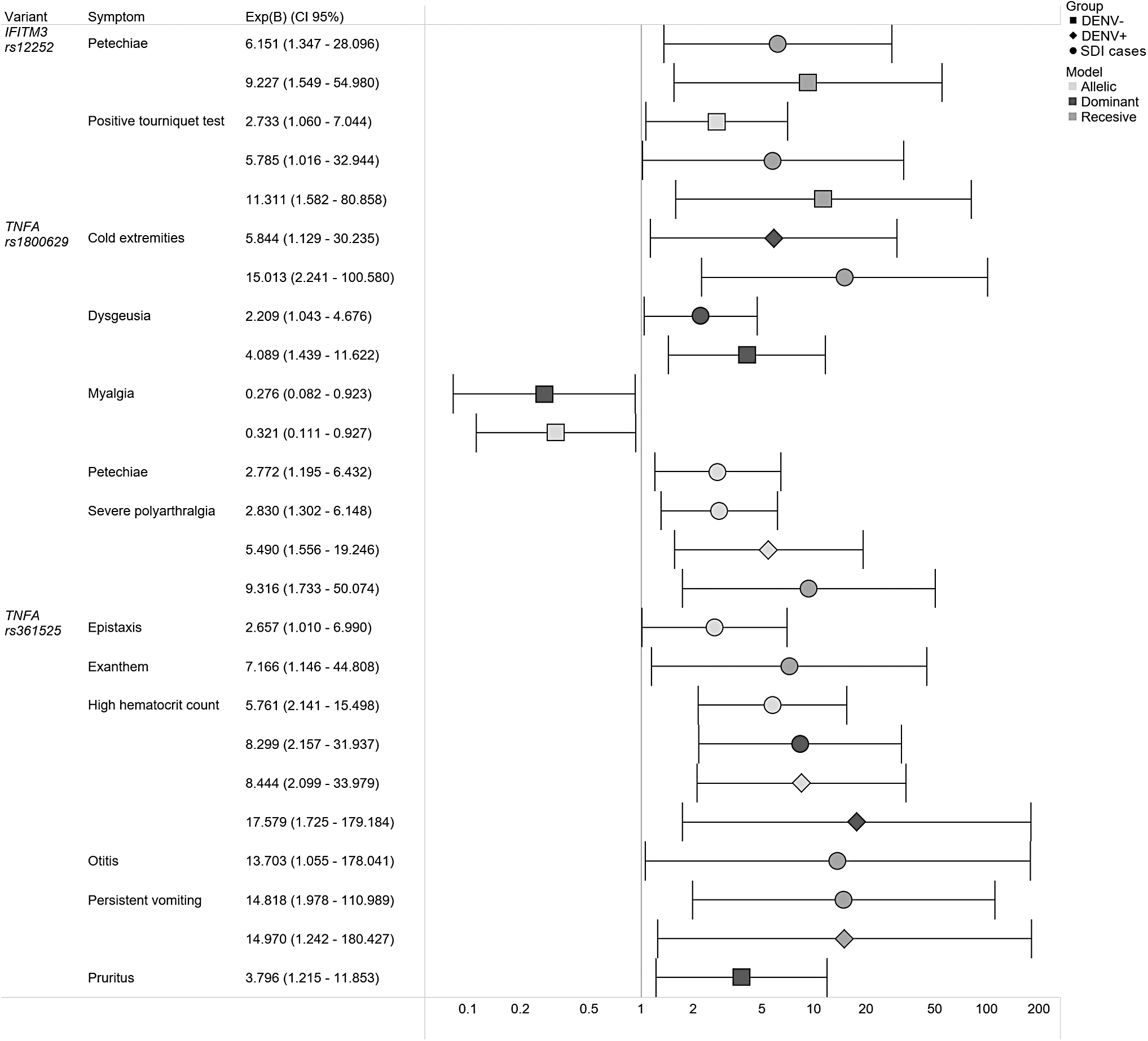
Symptoms significantly associated with each variant and model based on Pearson's chi-square test. CI, confidence interval; DENV, dengue virus; SDI, suspected dengue infection.
When comparing the distribution of frequencies of the symptoms between the DENV+ and DENV− groups, seven symptoms were associated with DENV infection. Three of them were nonwarning signs (retro-ocular pain, exanthems, and vomit), one warning sign (persistent vomiting), and two atypical (diaphoresis and epistaxis) (Fig. 2).

Symptoms significantly associated with DENV presence based on Pearson's chi-square test.
Discussion
Dengue fever is one of the most important VBDs in the modern day. Unfortunately, there is no treatment, and the current vaccine is not as efficient and widespread as hoped (Wilder-Smith, 2020), and so, it is crucial to continue studies of SD-indicative biomarkers.
This study is the first to assess the association of IFITM3 rs12252 with dengue in the Mexican population. Our first objective was to determine whether our gene variant of interest is associated with susceptibility and severity of dengue. However, we did not find any association between this variant and dengue, even though this variant was associated with other infectious diseases (Gómez et al, 2021; Prabhu et al, 2018; Zhao et al, 2019). An explanation for this would be that the CC genotype can express the complete IFITM3 protein and that the truncated protein is yet to be isolated (Zhao et al, 2019).
No association was found for TNFA rs1800629 with dengue, which is the same result observed in a previous study of the Mexican population (García-Trejo et al, 2011). In contrast, some studies associated the A allele (Pabalan et al, 2017; Sam et al, 2015), GA genotype (Sam et al, 2015; Sánchez-Leyva et al, 2017), and dominant model GA+AA (dos Santos et al, 2017; dos Santos et al, 2020) with protection from dengue, while others associated the A allele with a higher risk of dengue (Fernandez-Mestre et al, 2004; Vargas-Castillo et al, 2018). In the work of Cansanção et al 2016, they also compared a dengue-positive group with a dengue-like group. They found that the TNFA rs1800629 A allele, along with the IL6-174 C allele, increased the risk of dengue infection.
In other viral infections, the GG genotype of TNFA rs1800629 is associated with protection from prenatal transmission of HIV (Ahir et al, 2015), while the A allele and dominant model AA+GA versus GG are, respectively, related to the severity of hepatitis C and B (Grandi et al, 2014; Sghaier et al, 2015), and influenza (Li et al, 2020).
We observed an association of the TNFA rs361525 A allele, GA genotype, and dominant model GA+AA with increased susceptibility to developing dengue symptoms. When comparing the DENV+ and DENV− groups, the association of the A allele is significantly higher in the DENV+ group—focusing only on dengue-positive groups, a study on a Malaysian population (Sam et al, 2015) and the meta-analysis of dos Santos et al (2020) associated the A allele with an increased risk of dengue. This differs from other studies where a protective effect (García-Trejo et al, 2011) or no association was found for TNFA rs361525 (Naing et al, 2018; Sánchez-Leyva et al, 2017; dos Santos et al, 2020).
In other diseases, TNFA rs361525 A allele has been associated with the persistence and relapse of hepatitis B and C (Grandi et al, 2014; Sghaier et al, 2015). The GA genotype and A allele were associated with influenza (García-Ramírez et al, 2015; Li et al, 2020), and no association was found with the human papillomavirus or HIV (Ahir et al, 2015). The importance of the DENV− group in this study is to assess if the association of TNFA rs361525 is specific to DENV infection. We observed that this variant increases the susceptibility to developing symptomatic dengue caused by DENV infection. Nevertheless, it can also be associated with susceptibility to other dengue-like symptoms from unknown causes.
We observed an increased frequency of females in the DENV+ group compared with the DENV− group. On the contrary, Cansanção et al (2016) reported a higher frequency of females in symptomatic cases without dengue (Cansanção et al, 2016). Dettogni et al (2015) observed that females had a longer persistence of dengue fever, perhaps due to hormonal and genetic differences (Dettogni et al, 2015).
Our haplotype analysis showed low LD values between the two TNFA variants. The GA haplotype was associated with an increased risk of developing dengue symptoms, whereas the GG haplotype was associated with protection. Similar results were found by Sánchez-Leyva et al (2017) for the GG haplotype and Sam et al (2015) for the GGA haplotype (rs1800629G, rs361525G, and rs1800610A).
Regarding our second objective, which is to determine whether any of our variants of interest is associated with the presence or absence of individual dengue symptoms, we observed that the C allele of IFITM3 rs12252 was associated with a higher risk for petechiae and a positive tourniquet test. Previous studies have observed that IFITM3 can regulate the release of proinflammatory cytokines (Shi et al, 2017). This variant may affect the regulatory level, but confirming that is far from the scope of our study.
The TNFA rs1800629 A allele was associated with a higher risk of polyarthralgia, petechiae, dysgeusia, cold extremities, and protection from myalgia. Previous studies in dengue patients associated the GA+AA model with protection from thrombocytopenia and increased AST and ALT (Sam et al, 2015). The GG genotype was associated with the persistence of neurological, psychological, and behavioral symptoms (Dettogni et al, 2015). In chikungunya patients, the AG genotype was associated with shorter persistence of joint pain (Bucardo et al, 2021). TNFA rs361525 A allele was associated with a higher risk of high hematocrit count, epistaxis, exanthem, pruritus, persistent vomiting, and otitis.
It is known that TNF-α is a crucial immunological and inflammatory regulator capable of inducing apoptosis of the infected cells to stop the virus from spreading (Valaydon et al, 2016; Yu and He, 2016), and it is associated with musculoskeletal diseases (Kiss-Toth et al, 2013), vascular leak (Malavige and Ogg, 2017), and inflammatory diseases such as rheumatoid arthritis and inflammatory bowel disease (Patel and Wadhwa, 2021). This could explain the diversity in the associated symptoms.
When comparing the DENV+ and DENV− groups, we observed six symptoms associated with DENV: vomiting, persistent vomiting, diaphoresis, retro-ocular pain, exanthem, and epistaxis. These are common symptoms of dengue fever (Hasan et al, 2021). Interestingly, studies have observed that vomiting, persistent vomiting, and epistaxis are early indicators of SD (Senavong et al, 2021; Yuan et al, 2022), even if two of them are not considered warning signs.
Conclusion
We conclude that TNFA rs361525 G > A increases the susceptibility to symptomatic dengue caused by DENV infection. Still, it can also be associated with susceptibility to develop dengue-like symptoms from unknown causes. Haplotype GA (rs1800629G and rs361525A) was associated with an increased risk of developing dengue symptoms, whereas the GG haplotype was associated with protection. Lastly, a broad spectrum of symptoms was associated with the minor alleles of each variant, especially the TNFA variants. Most of these symptoms were nonwarning signs.
Footnotes
Acknowledgments
We want to thank Alejandrina Muñoz Palomeque for her assistance in the first experiments of this work. We thank the Mexican Institute of Social Security (IMSS) for providing the necessary resources to develop this study.
Authors' Contributions
M.E.V-.A.: Formal analysis, investigation, visualization, and writing—original draft. L.d.C.R.d.l.T.: Writing—review and editing, validation, and supervision. M.d.P.G-.M. and A.M-.F.: Resources. H.M-.F.: Project administration, supervision, validation, and writing—review and editing.
Author Disclosure Statement
The authors declare no conflict of interest.
Funding Information
This work was possible thanks to the Mexican Institute of Social Security (Instituto Mexicano del Seguro Social) and partially funded by the Postgraduate Incorporation and Permanence Program in the National Quality Postgraduate Program (Programa de Incorporación y Permanencia de Posgrado en el Programa Nacional de Posgrado de Calidad PROINPEP). The National Council of Science and Technology (Becas Nacionales, Consejo Nacional de Ciencia y Tecnología CONACYT) through the National Scholarships program, granted to Villanueva-Aguilar a postgraduate scholarship.