




Abstract
Recombinant adenovirus vector has been widely used in vaccine development. Due to the pre-existing immunity of human adenovirus type 5 (HAd5) in humans, a range of rare human and chimpanzee adenovirus vectors have been developed. In the previous study, we constructed novel adenovirus vector Sad23L and Ad49L based on simian adenovirus type 23 (SAd23) and human adenovirus type 49 (HAd49), which were used in the development of ZIKV and COVID-19 vaccines. However, the levels of pre-existing neutralizing antibody (NAb) of HAd49 and SAd23 remain unclear in China. In this study, we measured NAbs titers of HAd5, HAd49, and SAd23 in 600 healthy blood donors from 6 regions across China. NAb titer of HAd49 or SAd23 was significantly lower than that of HAd5 (p < 0.001). There was no significant difference in seroprevalence and NAb titers of three adenoviruses between male and female donors. The seropositive rates of HAd5 and SAd23 increased with age growth in a positive correlation (p < 0.01), while in contrast to HAd5, HAd49, and SAd23 had a low level of pre-existing immunity in Chinese population, which suggested that Ad49L and Sad23L vectors could be used in vaccine development for humans.
Introduction
Adenoviruses (Advs) are nonenveloped and double-stranded DNA viruses. To date, ∼100 types of human and primate adenoviruses are classified into 7 subgroups (A–G) (Thounaojam et al., 2016). Adenoviruses are highly contagious pathogens that cause many diseases, such as acute febrile respiratory disease, conjunctivitis, cystitis, gastroenteritis, myocarditis, and even life-threatening pneumonia (Kunz and Ottolini, 2010). However, recombinant adenoviruses are safer and can be as the vectors inducing the strong humoral and cellular immunity, which is widely used in the development of vaccines for various infectious diseases (Von Delft et al., 2018; Xiang et al., 2014), including HIV (Duerr et al., 2012), ZIKV (Xu et al., 2018), rabies virus (Hu et al., 2007), Ebola (Li et al., 2017), and Influenza A (Antrobus et al., 2014). Currently, recombinant human adenovirus type 5 (HAd5) vector is widely used. However, due to its widespread pre-existing immunity in humans, the immunogenicity of HAd5-mediated transgene is heavily restricted (Buchbinder et al., 2008; McElrath et al., 2008). To overcome the pre-existing immunity, a range of rare human and chimpanzee adenovirus vectors have been developed (Cheng et al., 2016; Dicks et al., 2012; Liu et al., 2018; Yan et al., 2021).
In our previous studies, two adenoviral vectors Sad23L and Ad49L derived from simian adenovirus type 23 (SAd23) and human adenovirus type 49 (HAd49) were used to develop ZIKV and COVID-19 vaccines, which induced strong humoral and cellular immunity in mice, marmosets, and macaques (Luo et al., 2020; Luo et al., 2021a; Luo et al., 2021b). However, neutralizing antibody (NAb) levels of HAd49 and SAd23 in Chinese population have not been measured.
In this study, we aimed to investigate the seroprevalence of NAbs against HAd5, HAd49, and SAd23 in Chinese blood donors in relation to age and gender.
Materials and Methods
Ethics approval
The present study was reviewed and approved by the Ethics Committee of the southern medical university. All serum donors provided their written informed consent to participate in this study, and to the use of the data for publication.
Human serum samples
A total of 600 (6 × 100) serum samples of healthy blood donors were randomly collected from January 2019 to August 2019 at Guangzhou, Chengdu, Harbin, Shenzhen, Xi'an, and Yichang blood Centres, China. The percentages of male and female were 62% or 38%, respectively. The ages ranged between 18 and 57 years.
Cells and viruses
Human embryonic kidney (HEK293) cells were maintained in complete Dulbecco's modified Eagle's medium supplemented with 10% fetal bovine serum (Hyclone), 1% penicillin, and streptomycin (HyClone). Recombinant replication-defective adenoviruses HAd5-eGFP, SAd23L-eGFP, and Ad49L-eGFP expressing green fluorescent protein (eGFP) were provided from the laboratory (Luo et al., 2020). The recombinant adenoviruses were amplified in HEK293 cells to generate high-titer viruses and then purified by cesium chloride density gradient centrifugation (Holkers et al., 2014). Viruses were stored at −80°C.
Enzyme-linked immunosorbent assay
The microtiter plates (Corning) were coated overnight with 0.1 mL of 1 × 10⁶ viral particles HAd5-eGFP, SAdL23-eGFP, or HAdL49-eGFP viruses, respectively. Serum samples were twofold serially diluted and added to the plates. The binding antibody (BAb) was detected by the goat anti-human IgG-HRP (Beijing Bersee Science and Technology, Co. Ltd, China). Endpoint titer was defined as the highest reciprocal serum dilution that yielded an absorbance >0.2 and a ratio of signal than cutoff (S/CO) >1.
Adenovirus neutralization assay
The HEK293A cells were seeded into 96-well plates at 2 × 10⁴ cells per well. Tenfold serial dilutions of the recombinant adenoviruses were prepared, and 100 μL of each recombinant adenovirus were added to each well of the plate. Twenty-four hours later, the fluorescence intensity of eGFP cells was examined by fluorescence microscope with Cell Imaging Multi-Mode Reader to determine an optimal virus concentration in the adenovirus neutralization test. A serial dilution of each sample (1:10 to 1:1280) was added to equal amount of HAd5-eGFP, SAd23L-eGFP, and HAd49L-eGFP at 4.35 × 10⁵ plaque formation unit (PFU), 5 × 10³ PFU, 2.18 × 10³ PFU per well for 1 h at 37°C, respectively. One hundred microliters of mixture were transferred to 293A cells in 96-well plate. Twenty-four hours later, the 96-well plate was examined by Cell Imaging Multi-Mode Reader (Cytation 1; BioTek).
The control wells were infected with the same amount of viruses without adding serum sample. The NAb IC50 titer was defined as the sample dilution at which a 50% inhibition rate of adenovirus infected cells. Inhibition rate (%) = (1 − sample relative light unit [RLU]/virus control RLU) × 100. Values <10, 10–40, 40–640, and >640 were defined as negative, low, moderate, and high NAb titers, respectively.
Statistical analyses
The seroprevalence rate between different groups was conducted using Pearson chi-square test. The NAb titers among groups were performed by the Mann–Whitney test. The trend of adenovirus seroprevalence with age was analyzed by Cochran–Armitage trend tests. Comparisons of adenovirus NAb titers in different groups were performed by Jonkheere–Terpstra trend tests. All the statistical analyses were computed with SPSS version 21.0 (SPSS, Inc., Chicago, IL), and p-values of <0.05 were considered significant. The graphs were conducted by GraphPad Prism version 8 (GraphPad Software, La Jolla, CA).
Results
Titration of neutralizing antibodies to HAd5, HAd49, and SAd23 among blood donors in China
Previously, the reactivity of NAb to three types of adenoviruses was measured as 75.2% to HAd5, 2.2% to HAd49, and 10.3% to SAd23 among 600 blood donors across China (Luo et al., 2021a). Seropositive rate of HAd5 was significantly higher than that of SAd23 or HAd49 (p < 0.001), of which the highest prevalence of HAd5 (90%) was found in Guangzhou among six cities (p < 0.001) (Fig. 1A). The seropositive rate of SAd23 (20%) in Yichang was observably higher than that (3%) in Shenzhen (p < 0.001). Correspondingly, the seropositive rates of HAd49 showed no significant difference in low level from six regions of China (Fig. 1A).
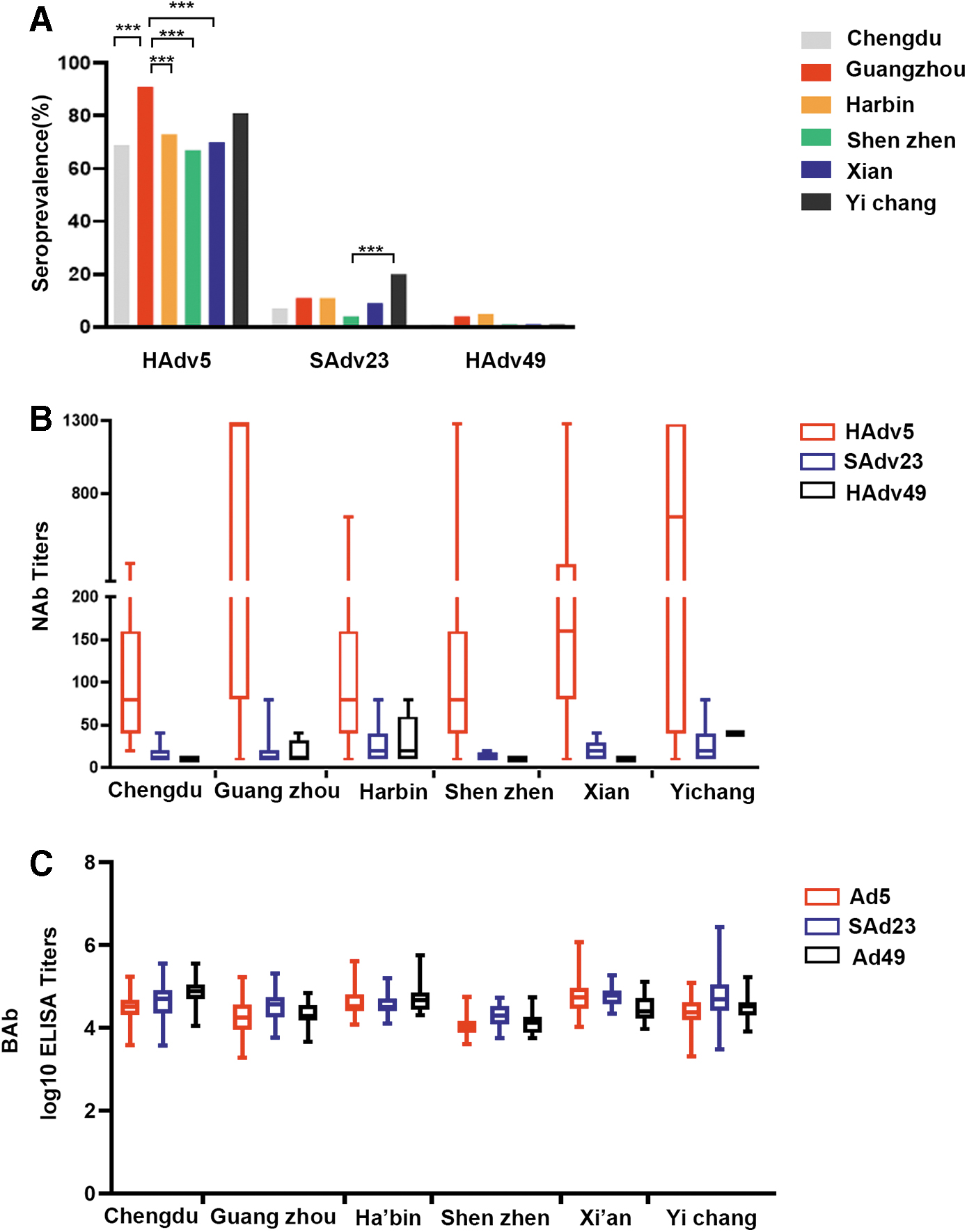
Profiling of seropositive rates and NAb and BAb levels for HAd5, SAd23, and HAd49 (n = 600).
Among seropositive samples, the NAb titers to HAd5 in Chengdu, Guangzhou, Harbin, Shenzhen, Xi'an, and Yichang were 100, 800, 130, 150, 249, and 665, respectively, of which NAb titers were significantly higher in Guangzhou and Shenzhen of South China. NAb titer against HAd49 or SAd23 was significantly lower than that against HAd5. The low titers of NAb to SAd23 and HAd49 were detected mainly between 10 and 80, while 41% of subjects exhibited NAb titer to HAd5 > 160. There was no statistically significant difference between SAd23 and HAd49 NAb titers from six regions of China (Fig. 1B), and also, there were no statistical difference among BAb titers to Ad5, SAd23, and HAd49 from six regions of China (Fig. 1C) (p > 0.05).
Distribution of HAd5, SAd23, and HAd49 NAbs in different gender and age groups
The NAb seropositive rate of HAd5 in females was observably higher than that in males (p = 0.041), but no significant difference was observed between six cities. Among the seropositive samples, HAd5 NAb titers were not statistically different between male and female in Guangzhou, Harbin, Shenzhen, and Yichang (p = 0.589, 0.554, 0.430, and 0.947, respectively), but slightly higher in females in Chengdu and Xi'an (p = 0.042 and 0.031, respectively) (Fig. 2). The pre-existing NAb levels to SAd23 and HAd49 were lower and no significant difference between males and females (p = 0.651 and 0.138, respectively).
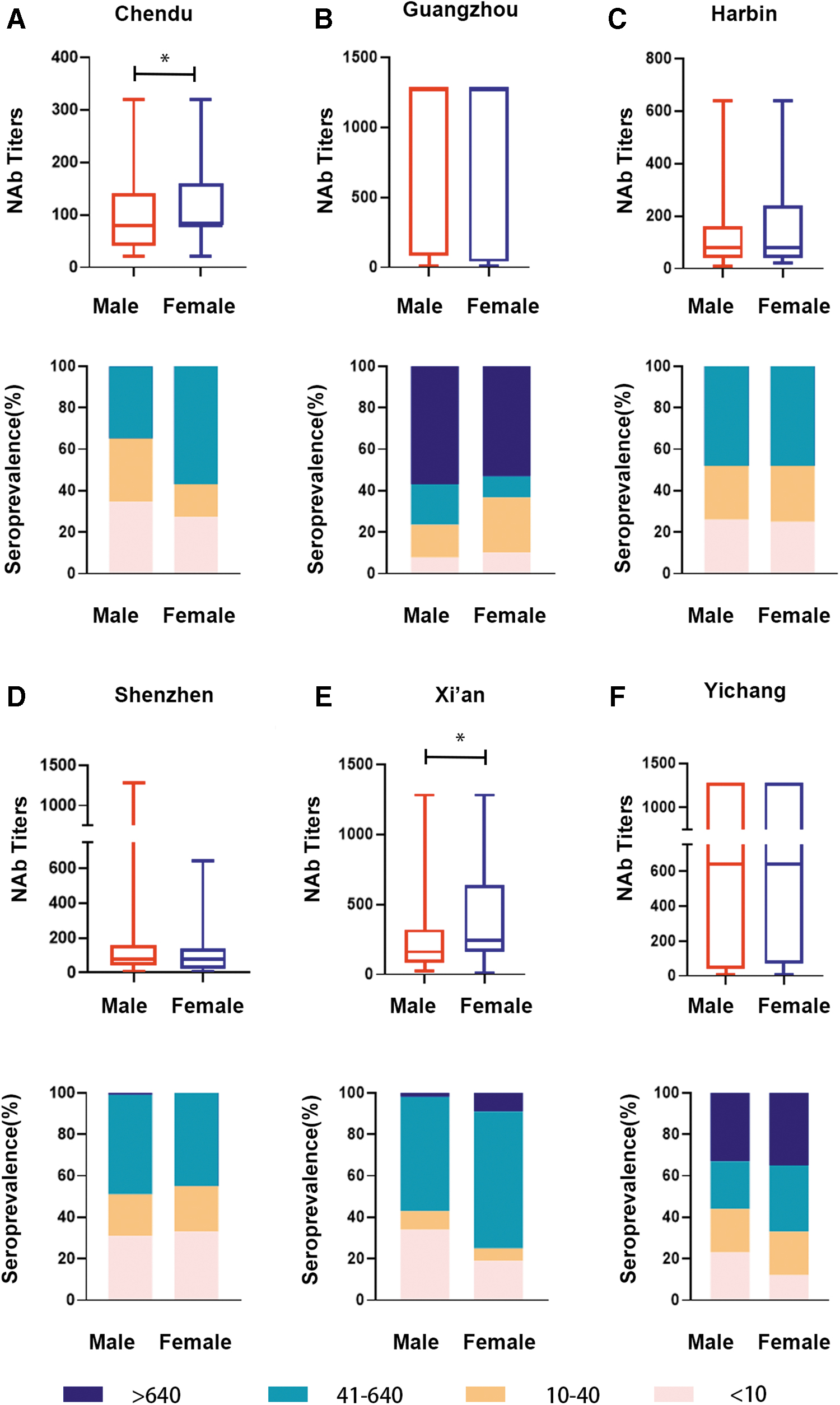
Distribution of HAd5 NAb titers according to the gender of blood donors in six regions of China.
The NAb seroprevalence in different age groups was analyzed, of which the seropositive rate of HAd5 increased with age growth of populations in Chengdu, Guangzhou, Harbin, and Xi'an (p = 0.008, 0.022, 0.004, and 0.005, respectively), but not in Shenzhen, and Yichang (p = 0.875 and 0.160, respectively) (Fig. 3). Generally, the seropositive rates of HAd5 and Sad23 increased with age growth of populations in China (p < 0.001; p = 0.01), but was not observed for HAd49, possibly due to its low prevalence (p = 0.438).

Seroprevalence and distribution of HAd5 NAb titers in the different age groups of blood donors.
Among the seropositive samples, HAd5 NAb titers were not significant difference between the different age groups in Chengdu, Guangzhou, Shenzhen, Xi'an, and Yichang (p = 0.712, 0.316, 0.248, 0.663, and 0.915, respectively), but statistically lower in Harbin (p = 0.013) (Fig. 3). SAd23 and HAd49 NAb titers varied insignificantly between the different age groups (p = 0.579 and 0.557), while the high level of HAd5 NAb titers at age ≥50 group accounted for 72.72% in Guangzhou, 100% in Chengdu, 57.9% in Harbin, 83.3% in Xian, and 66.6% in Yichang, respectively.
Cross-reaction between HAd5, HAd49, and SAd23 neutralizing antibodies
HAd5 seroprevalence was not different between HAd49 seronegative and seropositive samples, and HAd49 NAb seroprevalence was also not different between HAd5 seronegative and seropositive blood donors (p = 0.616). The same status was found between HAd49 and SAd23 NAb seroprevalences (p = 0.547). Evidently, HAd5 NAb seroprevalence (87.1%) was significantly higher in SAd23 seropositive than that (75.1%) in SAd23 seronegative samples, and also, SAd23 seroprevalence (13.6%) was also significantly higher in HAd5 seropositive than that (6.1%) in HAd5 seronegative samples (p = 0.037) (Fig. 4A, B). The imbalance of HAd5 or SAd23 NAb seroprevalence in SAd23 or HAd5 seropositive and seronegative samples suggested a positive correlation between HAd5 and SAd23 neutralizing antibodies.

Analysis of NAb seroprevalence and NAb titers for cross-reaction among HAd5, SAd23, and HAd49 infected or noninfected blood donors.
The HAd5 NAb titers in HAd49 seropositive samples were significantly higher than those in the HAd49 seronegative samples (p = 0.021) (Fig. 4E). HAd5 NAb titers in SAd23 seropositive and seronegative samples were varied insignificantly (p = 0.333) (Fig. 4D), and SAd23 NAb titers in HAd5 or HAd49 seropositive and seronegative samples were not statistically different (p = 0.103 and 0.222, respectively) (Fig. 4F, G), and also, HAd49 NAb titers were comparable between HAd5 or SAd23 seropositive and seronegative samples (p = 0.710, 0.513 respectively) (Fig. 4H, I).
Discussion
Pre-existing immunity largely limits the use of HAd5 vector in vaccines. Approximately 30–100% of adults carry specific NAb against HAd5 in Europeans, North Americans, Asians, or Africans (Zhang et al., 2013). A series of rare adenoviruses with low seroprevalence have had been developed for novel adenoviral vectors, which are mostly derived from species B or D of adenoviruses (Abbink et al., 2007; Teigler et al., 2012; Weaver and Barry, 2013), such as HAd26 (Dyer et al., 2016). In our previous study, we had constructed two adenovirus vectors, Ad49L and Sad23L, based on HAd49 and SAd23 (Luo et al., 2019).
According to previous report, the seroprevalence rate of SAd23 was ∼20% in Brazil, or 1.5–4.0% in the United States and Thailand (Ersching et al., 2010), while HAd49 was ∼2% in Belgium, no preexisting immunity in 103 Scottish patients, but ∼22% in sub-Saharan, highlighting significant geographical variation in seroprevalence (Abbink et al., 2007; Tebruegge and Curtis, 2010; Vogels et al., 2003). The examination of pre-existing HAd49 and SAd23 NAb levels may provide an important information for potential use of Ad49L and Sad23L vectors in vaccine development and clinical practice.
Several studies had investigated the pre-existing NAbs of adenoviruses in humans and chimpanzees (Mast et al., 2009; Sun et al., 2011; Thorner et al., 2006; Yu et al., 2013; Zhang et al., 2013). The seroprevalence of HAd5, SAd23, and HAd49 was reported previously for 75.2%, 10.3%, and 2.2%, respectively (Luo et al., 2021a), while HAd49 and SAd23 epidemiological features have not entirely been characterized in Chinese population. In this study, we analyzed the NAb levels of HAd5, HAd49, and SAd23 in blood donors from Chengdu, Guangzhou, Harbin, Shenzhen, Xi'an, and Yichang cities across China.
The results showed that NAb titers (ranged between 1:10 and 1:80) against SAd23 and HAd49 were substantially lower than those against HAd5 in 600 Chinese blood donors, while 41% of Chinese subjects exhibited HAd5 NAb titers >1:160. These results indicated the low prevalence and pre-existing NAb titers of SAd23 and HAd49, suggesting they could be potentially used as new vectors for vaccine development. In the six regions presenting whole China, the highest seroprevalence of HAd49 and SAd23 was 5% or 20%, respectively, but NAb titers were mostly between 1:10 and 1:40, indicating that the pre-existing immunity was low. In contrast, the highest seropositive rate and NAb titer of HAd5 were over 90% and 1:1,000 among the six regions of China (Fig. 1) (Luo et al., 2021a; Wang et al., 2014).
Interestingly, NAb titer against HAd5 is notably higher than those against HAd49 and SAd23, but BAb titers are not significant difference among HAd5, HAd49, and SAd23 infected blood donors. HAd5 belongs to adenovirus species C, which is reported as the most common type in humans (Garnett et al., 2002). Duo to widely prevalent in the human population, the high NAb titer against Ad5 was detected. Though different types of adenoviruses have been classified, they still have common antigens bound by antibodies of HAd5, HAd49, and SAd23 (Ebner et al., 2005).
HAd5 NAb titer detected in females was slightly higher than that in males in Chengdu and Xi'an, while no statistical significance was seen in other regions (Fig. 2). Low titers of SAd23 and HAd49 NAbs were observed, and no significant difference between males and females was detected. In addition, we found that the seropositive rate of HAd5 increased with age in Chengdu, Harbin, and Xi'an (Fig. 3), which was consistent with the previous report (Ye et al., 2018). Similarly, among SAd23 seropositive samples, seropositive rate increased with age, but due to the small numbers of HAd49 seropositive samples, the change of HAd49 prevalence with age was not observed.
Interestingly, the results showed that HAd5-seropositive donors tended to have higher SAd23-seropositive rate than HAd5-seronegative donors, and vice versa, indicating that there was a positive correlation between HAd5 and SAd23 seroprevalence. However, our previous study confirmed that SAd23 had no cross-reaction with HAd5 (Luo et al., 2020), which suggested that this small number of individuals might be more susceptible to these two adenoviruses. However, the mechanism behind this phenomenon needs to be clarified in future research.
In summary, we investigated the seroprevalence and the pre-existing NAb levels of HAd5, SAd23, and HAd49 in Chinese population. The results emphasized the pre-existing immunity of Sad23 and Ad49 was low, and Sad23L and Ad49L vectors might be the ideal tool for development of human vaccines.
Footnotes
Acknowledgments
The authors thank Guangzhou, Harbin, Yichang, Chengdu, Xi'an, Shenzhen Blood Centers for obtaining the blood samples.
Authors' Contributions
P.Z.: Conceptualization (lead); writing—original draft (lead); data analysis (lead). Q.W.: review and editing (lead); Conceptualization (equal). P.Z.: Software (lead); writing—review and editing (equal). C.W.: Methodology (lead); writing—review and editing (equal). E.Z.: Conceptualization (supporting); Writing—original draft (supporting). L.Z.: Conceptualization (supporting); review and editing (supporting). C.L.: Conceptualization (lead); review and editing (lead). T.L.: Conceptualization (lead); review and editing (lead).
Author Disclosure Statement
No competing financial interests exist.
Funding Information
This work was supported by the grants from the National Natural Science Foundation of China (No. 32070929, 31970886 and 82271868), Guangdong Natural Science Foundation Outstanding Youth Project (No. 2022B1515020050), the Postdoctoral Science Foundation of China (2021M691474), and Guangdong Basic and Applied Basic Research Foundation (2021A1515110991).