




Abstract
In May 2022, mpox began to spread worldwide, posing a serious threat to human public health. Modified Vaccinia Ankara–Bavaria Nordic (MVA–BN) is a live attenuated orthopoxvirus vaccine that has been authorized by the U.S. Food and Drug Administration as the vaccine of choice for the prevention of mpox. In this study, we conducted a meta-analysis of all currently published literature on the efficacy and safety of the MVA–BN vaccine in the real world, showing that the MVA–BN vaccine is effective and safe, with efficacy of up to 75% with a single dose and up to 80% with a two-dose vaccine. Meanwhile, we found that subcutaneous injection has lower local and systemic adverse events than intradermal injection, regardless of single- or two-dose vaccination, and subcutaneous injection is better tolerated in children, the elderly, or people with underlying medical conditions. These results have important reference value for clinical practice.
The disease of mpox (formerly known as monkeypox) is a zoonotic disease endemic in Central and West Africa. Cases in nonendemic countries are usually associated with recent travel to endemic countries or contact with infected people or animals from endemic countries. However, it should be noted that most of the mpox cases recorded in the 2022 outbreak occurred in Western and European countries, with no apparent epidemiological link between the cases in these regions (Vaughan et al., 2022).
As of September 6, 2023, the total number of laboratory-confirmed cases is 86,724 with 157 deaths (World Health Organization, 2023). Modified Vaccinia Ankara–Bavaria Nordic (MVA–BN) is a third-generation live attenuated nonreplicating modified vaccinia Ankara vaccine developed by Bavarian Nordic. The vaccine is approved for smallpox prevention in the United States and Europe and was licensed by the FDA in 2019 for monkeypox prevention (US Food & Drug Administration, 2023). The effectiveness and safety of the vaccine needs to be further evaluated in large populations.
At present, there is an increasing number of studies on the effectiveness and safety of the MVA–BN vaccine in the real world (Bertran et al., 2023; Dalton et al., 2023; Deng et al., 2023; Deputy et al., 2023; Frey et al., 2023; Ladhani et al., 2023; Montalti et al., 2023; Montero Morales et al., 2023; Rosenberg et al., 2023; Wolff Sagy et al., 2023), but no systematic review and meta-analysis of the effectiveness and safety of the MVA–BN vaccine has been published.
In September 2023 and according to the study protocol, we searched several databases: PubMed, Embase, and Cochrane Central Register of Controlled Trials (CENTRAL). The following MeSH (Medical Subject Heading) terms and search terms were used: (“monkeypox or mpox or monkeypox virus”) AND (“MVA-BN or Modified Vaccinia Ankara-Bavarian Nordic or JYNNEOS or Imvanex or efficacy or adverse event”). The inclusion criteria included (1) individual study populations being at least 15 cases; (2) the key available data tabulated data or effect (95% confidence interval [CI]) must be clearly stated.
No restrictions on language of publication were applied. To improve validity of data, we excluded non-peer-reviewed articles in preprint databases. Review Manager, version 5.2, was used to conduct the statistical analysis. With a 95% CI, the odds ratio (OR) was used to assess dichotomous variables. Using the I 2 statistic and the Cochran's Q test, we evaluated the heterogeneity. Statistical significance is defined as a p-value <0.05.
A total of 10 articles involving 28,687 patients were identified, including 5 observational studies, 3 case–control studies, 1 prospective cohort study, and 1 randomized non-placebo-controlled partially blinded study. Of the 10 studies included in the analysis, 4 were from the United States, 2 from the United Kingdom, and 1 each from Italy, Spain, Australia, and Israel. Table 1 describes the detailed characteristics of the study population and vaccine effectiveness. All six studies evaluated the effectiveness of the first dose, and three studies evaluated the effectiveness of the second dose.
Characteristics of Studies Included in Meta-Analysis
CI, confidence interval.
The meta-analysis revealed after one dose of MVA–BN vaccine, the prevalence of the vaccine immunized group was significantly lower than that of the control group (OR = 0.25, 95% CI: 0.13–0.48, p < 0.0001; I 2 = 87%) (Fig. 1A) (Bertran et al., 2023; Dalton et al., 2023; Deng et al., 2023; Montero Morales et al., 2023; Rosenberg et al., 2023; Wolff Sagy et al., 2023). The overall effectiveness of a single dose of the MVA–BN vaccine was 75% (95% CI: 52–87%).
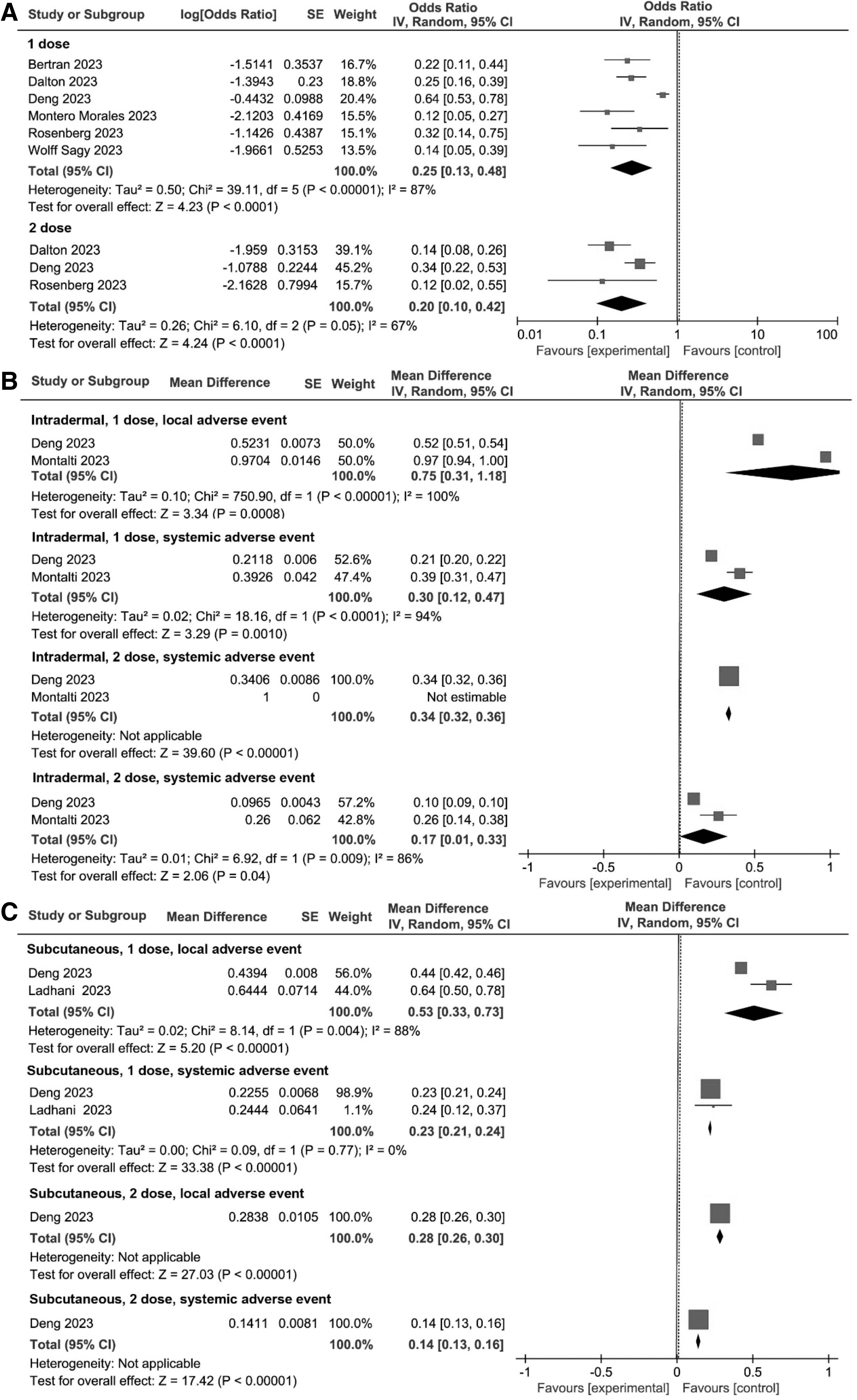
In three case–control studies, two doses of the MVA–BN vaccine increased overall effectiveness to 80% (58–90%) (Dalton et al., 2023; Deng et al., 2023; Rosenberg et al., 2023). The safety analysis of the vaccine showed that the incidence of local and systemic adverse events after intradermal injection was 75% (95% CI: 31–118%) and 30% (95% CI: 12–47%), respectively (Fig. 1B, C) (Deputy et al., 2023; Frey et al., 2023; Ladhani et al., 2023; Montalti et al., 2023).
The incidence of local and systemic adverse events after subcutaneous injection was relatively low (53% [95% CI: 33–73%] and 23% [95% CI: 21–24%], respectively) (Fig. 1B, C). We also observed the same phenomenon in the two-dose groups, with subcutaneous injection having a lower incidence of local and systemic adverse events than intradermal vaccination (local adverse events: 34% intradermal vs. 28% subcutaneous, systemic adverse events: 17% intradermal vs. 14% subcutaneous) (Fig. 1B, C).
In conclusion, our study shows that the MVA–BN vaccine is effective and safe, with a single dose of the vaccine up to 75% effectiveness and two doses of the vaccine even more effective. Meanwhile, we found that subcutaneous injection has lower local and systemic adverse events than intradermal injection, regardless of single- or two-dose vaccination, and subcutaneous injection is friendlier to children, the elderly, or people with underlying medical conditions. These results have important reference for clinical practice. Given the rapidly changing epidemiological situation and the advancing process of vaccine research, further exploration into the duration of vaccine-induced protection is warranted.
Availability of Data and Materials
The data sets used and/or analyzed during this study are available from the corresponding author on reasonable request.
Ethics Approval and Consent to Participate
Not applicable.
Consent for Publication
Not applicable.
Footnotes
Authors' Contributions
Y.P. analyzed the data, and drafted and revised the article. X.Z., D.C., Q.L., and F.T. retrieved and collected the data. X.L. and Y.L. supervised the study and approved the final article. All authors have agreed to the published version of the article. All authors read and approved the final article.
Author Disclosure Statement
The authors declare that they have no competing interests.
Funding Information
This study was supported by the Baise Science and Technology Plan Project (baike20233653), Bose Talent Highland (Nos. 2020-3-2), Building Projects from the Key Laboratory of Molecular Pathology (Hepatobiliary Diseases) of Guangxi (No. Guiweikejiaofa [2020]-17) and the Key Laboratory of Tumor Molecular Pathology of Guangxi Higher Education Institutes (Guijiaokeyan [2022]-10), and Clinical Key Specialty Building Project (Pathology) of Guangxi (Guiweiyifa [2022]-21).