




Abstract
Human T-cell lymphotropic virus type-I (HTLV-I)-associated myelopathy/tropical spastic paraparesis (HAM/TSP), the main neurological manifestation of HTLV-I, is a chronic inflammatory disease. Viral-host interaction and host genetics are two important contributors to the development of the HAM/TSP. This study was conducted to measure the serum level of tumor necrosis factor-alpha-like weak inducer of apoptosis (TWEAK) by ELISA method in three groups of participants including 34 HAM/TSP patients (HAM/TSP), 35 asymptomatic HTLV-1 carriers (ACs), and 20 healthy controls (HCs). Also, the titer of the proviral load in two groups of HAM/TSP and ACs was assessed by the real-time polymerase chain reaction (PCR). The statistical results showed that, there is no significant difference between the three groups in TWEAK cytokine level (p = 0.667). Also, there was no significant difference in proviral load titer between groups of HAM/TSP and ACs (p = 0.08). Furthermore, no significant difference was observed between proviral load and TWEAK cytokine concentration between groups of HAM/TSP and ACs. Our findings showed that despite the inflammatory nature of HAM/TSP disease, the expression level of TWEAK in HAM/TSP patients is not significantly different from the groups of ACs and HCs. Therefore, the involvement of other factors in causing HAM/TSP is not unexpected.
Introduction
The human T-cell lymphotropic virus (HTLV-1) is recognized as the first retrovirus which has infected a significant global population of approximately 15–20 million individuals (Kamali et al., 2022). The transmission of HTLV-1 infection from person to person occurs through various means, such as mother-to-child breastfeeding, sexual activity, the use of shared needles, and contaminated blood products (Fani et al., 2019). The virus is transmitted through cellular synapses to T and B lymphocytes, fibroblasts, and macrophages (Rizkallah et al., 2015). Although HTLV-1 infections have been reported worldwide, the main endemic areas of the virus include southwestern Japan, the Caribbean Islands, South America, West Africa, Australia, the Melanesian Islands, Europe, the Pacific Islands, and the Middle East, especially northeast of Iran (Sabzevar, Neyshabour, Mashhad)(Gessain and Cassar 2012). Most people infected with HTLV-1 are asymptomatic, but it causes a persistent neurological disorder called HTLV-1-associated myelopathy/tropical spastic paraparesis (HAM/TSP) and other inflammatory disorders in 5% of infected people (Enose-Akahata and Jacobson 2019; Rizkallah et al., 2015). Sphincter dysfunction and sensory disturbances in the lower limbs are common symptoms of HAM/TSP. HAM/TSP predominantly manifests in the adult population at the age of 40 to 50 years, with a prevalence ratio of approximately 3:1 in women to men (Enose-Akahata and Jacobson 2019; Nozuma and Jacobson 2019). The blood–brain barrier (BBB) is safeguarded by astrocytes, pericytes, microglia, and mast cells, and governs the ingress and egress of vital biological substances to sustain the central nervous system (CNS) in its defense against infectious microorganisms. The immune response to infectious microorganisms in CNS is unique from the peripheral tissues (Keaney and Campbell 2015; Varatharaj and Galea 2017). HAM/TSP is characterized by the infiltration of inflammatory immune cells into the perivascular of the CNS and spinal cord. CD4 lymphocytes infected with HTLV-I migrate to the CNS, causing the local proliferation of anti-HTLV-I specific CD8 cells and increasing the expression of inflammatory cytokines and chemokines, and finally progressing disease (Enose-Akahata and Jacobson 2019; Yamauchi et al., 2021). Tumor necrosis factor-alpha (TNF)-like weak inducer of apoptosis (TWEAK) is a 249-amino acid protein that belongs to the TNF family and modulates inflammatory pathways in several tissues. TWEAK is characterized as a type II transmembrane protein associated with the cell surface; however, a diminutive, biologically active variant can be released into the extracellular environment. Presently, there exists a singular receptor identified to interact with TWEAK exhibiting physiological affinity, which is classified as a type I transmembrane protein and is referred to in the scholarly literature as either TWEAK receptor (TweakR) or fibroblast growth factor-inducible 14 (Fn14). TweakR/Fn14 represents the most diminutive member of the TNF receptor (TNFR) superfamily documented to this point, and it seemingly transmits signals through the recruitment of various distinct TNFR-associated factors. Despite its initial characterization as an inducer of apoptosis, subsequent research has revealed that it plays a role in numerous inflammatory and immunological processes. The function of this novel biomarker has been shown in autoimmune and inflammatory disorders, such as multiple sclerosis, lupus, rheumatoid arthritis, and nervous system diseases. Monocytes and macrophages secrete TWEAK, which after binding to Fn14, stimulates the release of cytokines that lead to inflammation (Salem et al., 2018; Zimmermann et al., 2011). Animal studies showed that during CNS inflammation, TWEAK has a pro-inflammatory effect and causes the diapedesis of monocytes during inflammation and increases inflammation and demyelination (Stephan et al., 2013). Also, human investigations have demonstrated that TWEAK and Fn14 are present within the CNS and that, in reaction to a multitude of stimuli, including cerebral ischemia, there is a notable elevation in the expression of TWEAK and Fn14 in perivascular astrocytes, microglia, endothelial cells, and neurons, which is subsequently associated with an enhancement in the permeability of the BBB and increased cellular apoptosis (Yepes, 2007).
Hence, the results that are linked with the inflammatory environment in the CNS may indicate immunological disorder in HAM/TSP, which may contribute to an improved comprehension of the progression, pathogenesis, and clinical intervention of the disease. To better understand the mechanism of HAM/TSP development, this study investigated TWEAK serum level, proviral load expression, and the relationship between them in HAM/TSP subjects and HTLV-1 healthy carriers.
Material and Methods
Study design
In this analytical cross-sectional study, sample collection was performed according to the rules and regulations set by the Ethical Committee of Kerman University of Medical Sciences (ethical number: IR.KMU.REC.1400.595). Before participating in the study, all individuals were apprised of the study protocol and subsequently furnished written assent.
Population study
In this study, 89 patients are divided into three groups: 34 HAM/TSP positive (HAM/TSP), 35 HTLV-1 asymptomatic carriers (ACs), and 20 healthy controls (HCs) who had been referred to the HTLV-1 clinic of Ghaem Hospital affiliated with Mashhad University of Medical Sciences (MUMS), Mashhad, Iran. The serum level of TWEAK was measured by the enzyme-linked immunosorbent assay (ELISA) method in three groups of participants; in addition, the real-time PCR assessed the proviral load in two groups of HAM/TSP and ACs. The inclusion criteria for HAM/TSP patients were as follows: (1) HTLV-1 positive serology confirmed by qualitative PCR method, (2) Confirmation of the diagnosis of HAM/TSP symptoms by a neurologist, and (3) Patients without a history of previous treatment with interferon. The inclusion criteria for HTLV-1 asymptomatic carriers were considered as follows: (1) HTLV-1 positive serology confirmed by qualitative PCR method and (2) Absence of neurological clinical symptoms in clinical examination. The inclusion criteria for HC were: (1) Absence of the HTLV-I infection and (2) Absence the other inflammatory diseases.
Sample collection
Plasma and peripheral blood mononuclear cells (PBMC) samples of patients were collected from the neurology department of Ghaem Hospital in Mashhad. Also, Plasma and PBMC samples of HTLV-1 asymptomatic carriers and healthy subjects were obtained from healthy blood donors who were referred to the Mashhad Blood Transfusion Organization.
TWEAK plasma levels
All plasma samples were measured in duplicate for TWEAK serum levels using the Human TWEAK ELISA kit (ZellBio, Germany), which had a sensitivity of 18 ng/L with a standard curve range of 150–4800 ng/L.
HTLV-1 proviral load
To measure the HTLV-1 Proviral load (PVL), PBMCs were isolated from Ethylenediaminetetraacetic acid (EDTA)-treated blood samples and DNA extraction from PBMC was done by Blood mini kit, Qiagen, Germany. Real-time PCR was performed by the commercial quantification kit (Novin Gene, Iran) in the temperature program of 40 cycles of PCR at 95°C for 10 min, 95°C for 15 s, and 60°C for 60 s, using specific primers and a fluorogenic probe by a Rotorgen Q 6000 machine (Qiagen, Germany) that was described in details elsewhere (Manzarinejad et al., 2023).
Statistical analysis
The SPSS statistical software (version 22) was employed to determine the frequency, percent, mean, and standard deviation. Also, Chi-square tests, t-tests, ANOVA, and Spearman correlation analysis were used to identify association between TWEAK serum level and proviral load in HAM/TSP patients. A backward multiple logistic regression test at a significance level of 0.05 was implemented for confirming the estimated relation. Also, GraphPad Prism 9 software was used for creating the graphs and tables.
Results
Demographic data of patients
Among the 89 participants, 82 cases (92.13%) and 7 cases (7.86%) were female and male, respectively. The mean age of participants was 46.49 ± 11.976, which was 48.50 ± 12.011, 44.34 ± 11.573, and 46.85 ± 12.579 in the groups of HAM/TSP patients, the asymptomatic carrier, and the healthy subjects, respectively.
TWEAK serum level and proviral load
The mean serum TWEAK concentration in the three groups of HAM/TSP positive patients, HTLV-1 asymptomatic carrier, and healthy control groups was (64.465 ± 244.41 ng/mL), (43.81 ± 166.14 ng/mL), and (17.91 ± 5.799 ng/mL), respectively (Fig. 1). Despite the high level of serum TWEAK in the HAM patients, no significant difference was observed between the groups (p = 0.667). The mean HTLV-I proviral load in two groups of HAM/TSP patients and HTLV-1 asymptomatic carriers were (2245.39 ± 2569.75 copies/104 PBMCs) and (1205.44 ± 2280.96 copies/104 PBMCs), respectively, which was not statistically different (p = 0.08).
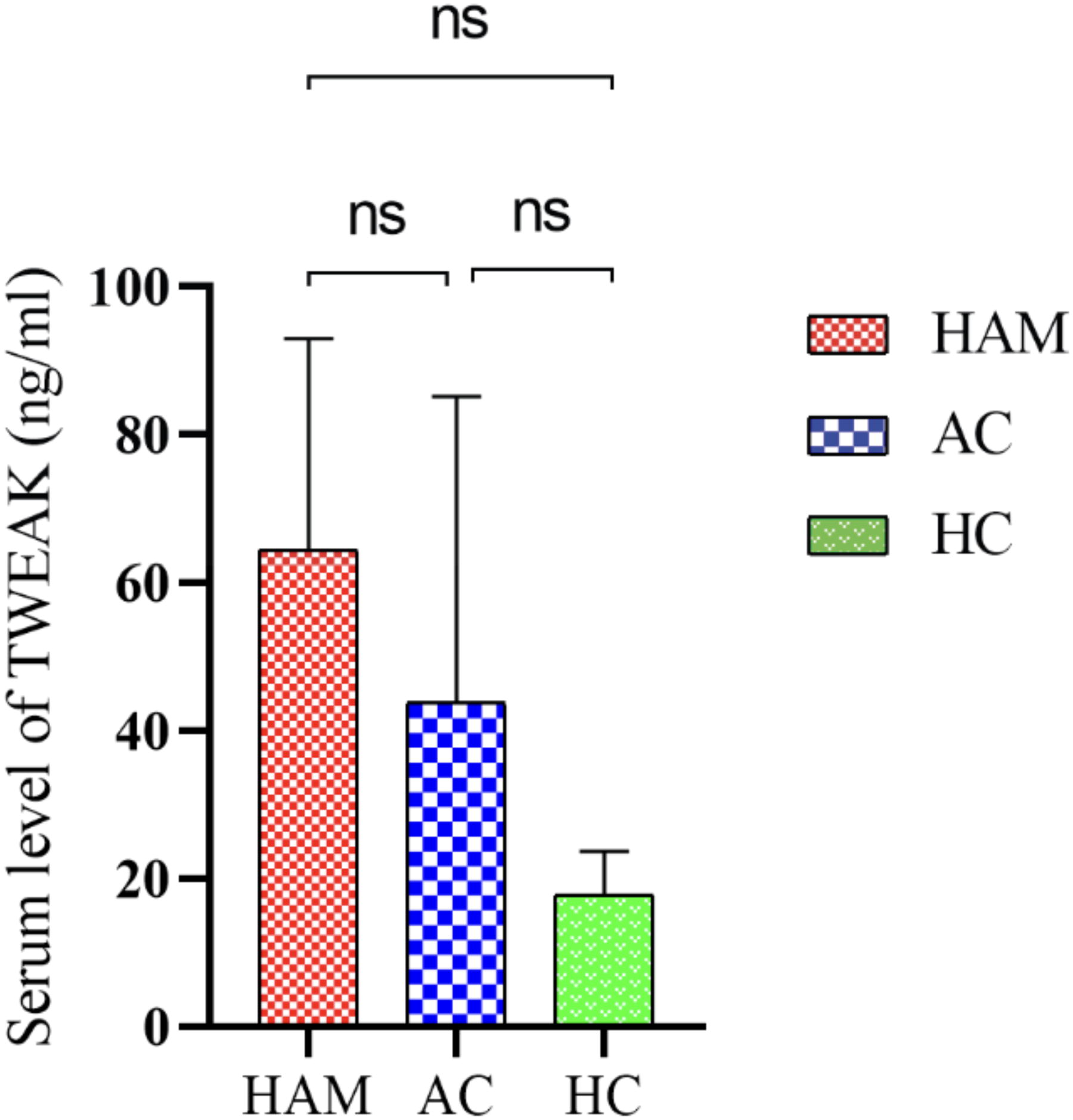
Serum levels of TWEAK in HAM patients, asymptomatic carriers (ACs), and healthy controls (HCs). No significant difference was observed between HAM, AC and HC groups (p = 0.66). Error bars show standard deviation. n.s indicates non-significant. HAM, human T-cell lymphotropic virus type-I (HTLV-I)-associated myelopathy.
Correlation between proviral load with TWEAK level
As shown in Figure 2, there is no significant difference between proviral load and TWEAK cytokine concentration in both HAM/TSP (p = 0.33) and ACs groups (p = 0.94).
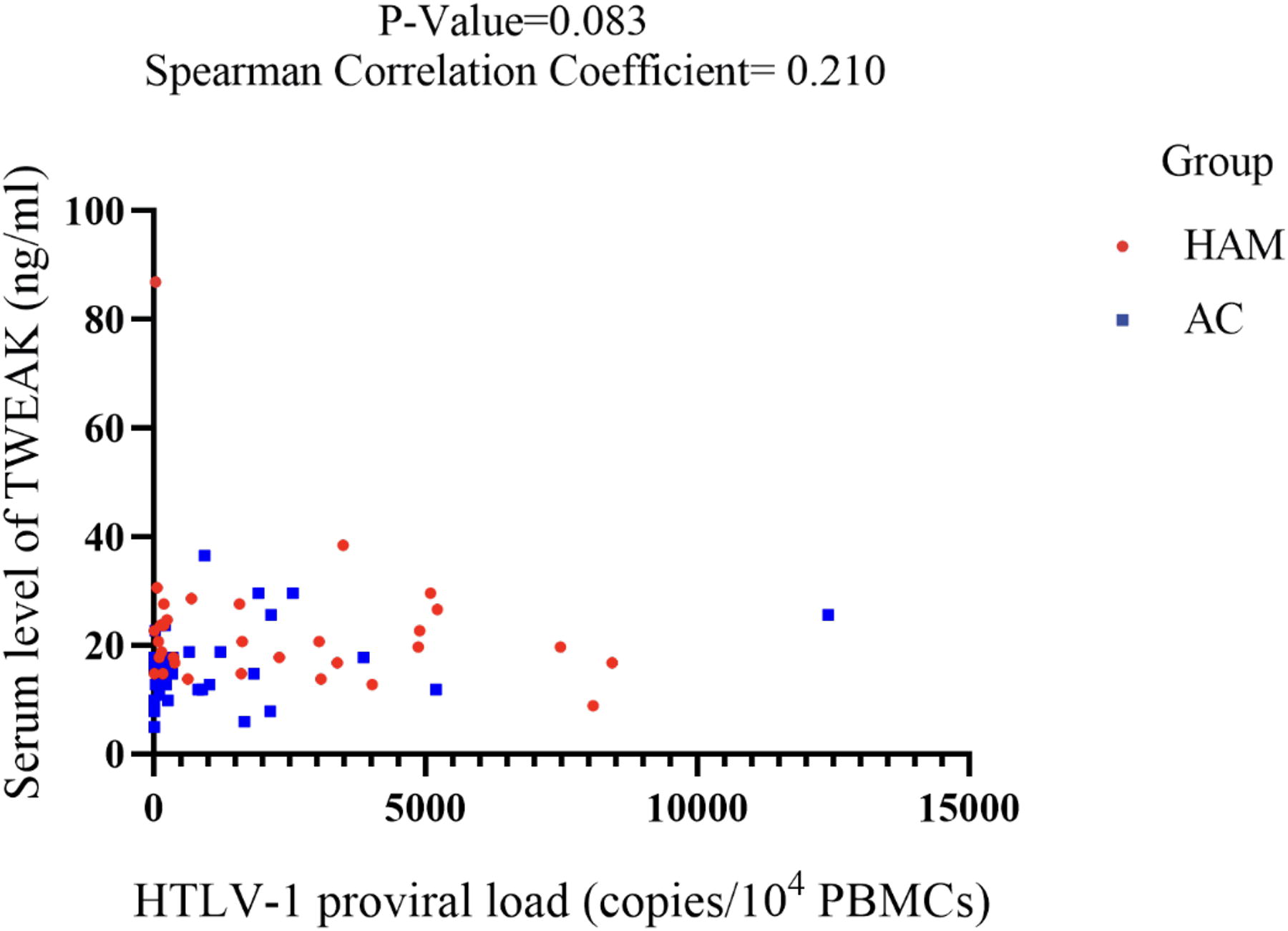
TWEAK serum level and HTLV-1 proviral load in HAM patients, asymptomatic carriers (ACs). There was no significant correlation between TWEAK serum level and proviral load in HAM patients (p = 0.33) and ACs (p = 0.94). HAM, human T-cell lymphotropic virus type-I (HTLV-I)-associated myelopathy
Correlation between proviral load and TWEAK with clinical symptoms
The most common neurological signs of HAM/TSP among our patients were bladder disorder, spastic gait, decreased libido, and a movement disorder of the lower left and right muscles, Table 1, shows that there is no significant correlation between proviral load and TWEAK cytokine concentration with clinical symptoms.
Common Clinical Symptoms in HAM/TSP Patients
HAM/TSP, human T-cell lymphotropic virus type-I (HTLV-I)-associated myelopathy/tropical spastic paraparesis; TWEAK, tumor necrosis factor-alpha-like weak inducer of apoptosis.
Discussion
As mentioned, HAM/TSP is an inflammatory disease related to HTLV-1. Despite the passage of four decades since the identification of HTLV-1 and its associated diseases, many questions about HTLV-1 pathogenesis and HAM/TSP remain unresolved; nevertheless, studies suggest that HAM/TSP is most likely the result of the mutual and unique effect of the host’s immune system and the HTLV-1 virus on each other. Recent research on the role of immunological factors, such as cytokines in increasing or decreasing infections, shows the importance of the immune system in inflammatory diseases. One of these factors is TWEAK, which expresses at a high level in inflammatory diseases and leads to the activation of related inflammatory cascades(Campbell et al., 2004; Itoigawa et al., 2015). Recently various Studies have increased speculations about the role of pro-inflammatory cytokines in the progression of HAM/TSP disease. In our study, the expression level of this cytokine did not show a significant difference between the patient groups and the control group. One of the most important hypotheses is that inflammation-related cytokines may be expressed at a high or low level during inflammatory diseases. Different viral families stimulate different immunological pathways during replication. Some viral species can block the transcription of particular cytokines such as TWEAK during infection to escape from the immune response. For example, Kaposi’s sarcoma-associated herpesvirus (KSHV) can downregulate the expression of the TWEAKR receptor to prevent the expression of the inflammatory cytokines and apoptosis. Therefore, KSHV-infected cells are long-life cells due to inhibiting the inflammatory response(Abend et al., 2010). But in another study, the expression level of Fn14 and TWEAK was increased in COVID-19 patients compared to the control group, which may be involved in the pathogenesis of COVID-19(Yalçın Kehribar et al., 2020). On the other hand, TWEAK-expressing immune cells can migrate to other immune organs (Abós et al., 2021), not investigated in this study. Each virus can increase cytokines in serum or infected target tissues according to its replication characteristics. For example, SARS-CoV-2 patients and human papillomavirus 16 can increase the TWEAK level in serum and keratinocytes of infected tissues, respectively(Cheng et al., 2015; Yalçın Kehribar et al., 2020). Also, proviral load is one of the other important factors involved in the pathogenesis of chronic virus infections that has received attention in recent years. Recently, several studies reported that HTLV-I proviral load in HAM/TSP patients is higher than in asymptomatic carriers, indicating that probably proviral load plays a critical role in the progression of HAM/TSP disease (Matsuzaki et al., 2001). But in our study, the mean HTLV-I proviral load in HAM/TSP patients and HTLV-1 asymptomatic carriers has no significant difference statistically (p = 0.08). It can be explained that viral factors combined with host genetics are associated with increased clinical progression and risk of HAM/TSP. The most significant viral factors are the HTLV-1 proviral load, HTLV-1 subtype, Human leukocyte antigens (HLA) type, and the frequency of HTLV-infected TCD4+ lymphocytes. Additionally, age, sex, route of transmission, and high antibody titer have also been found to be related factors (Enose-Akahata, Vellucci, and Jacobson 2017; Goncalves et al., 2008; Haziot et al., 2019). Furthermore, no significant difference was observed between proviral load and TWEAK cytokine concentration in both patients (p = 0.33) and carrier groups (p = 0.94). Another finding of the present study was the lack of correlation between proviral titer and TWEAK cytokine concentration with clinical symptoms such as bladder disorder, spastic gait, decreased libido, and Movement disorder of the lower right and left. Clinical manifestations and their occurrence percentages are diverse among different populations. Some studies have shown a significant relationship between clinical symptoms and proviral titer, while in some investigations, there is not. Overall, it is more likely that host and environmental factors are more influential in the occurrence of HAM/TSP than expected (Goncalves et al., 2008). However, more in-depth and practical study is needed. Budgetary restrictions were one of this study’s drawbacks, which regrettably hindered further assessments. Furthermore, the main limitation of our study is the small sample size, so we strongly suggest conducting a study with a larger sample size to examine factors such as the expression level of Fn-14, TWEAK, and their mRNAs.
Conclusion
Excessive activation of the immune response and pro-inflammatory cytokines play a more prominent role in the morbidity and mortality of viral infections than the cytopathic effects of viruses. The results of this study showed that despite the inflammatory nature of HAM/TSP disease, the expression level of TWEAK does not increase in these patients.
Footnotes
Acknowledgment
The authors of this study are grateful to the staff of Kerman University of Medical Sciences.
Ethical Approval
Sample collection was performed according to the rules and regulations set by the Ethical Committee of Kerman University of Medical Sciences (ethical number: IR.KMU.REC.1400.595)
Availability of Data and Materials
The data cannot be shared openly, for example, to protect study participant privacy.
Author Disclosure Statement
The authors have no competing interests to declare that are relevant to the content of this article.
Funding Information
No funds, grants, or other support was received.