




Abstract
Abstract
This article seeks to explore the relationship among three individual-level trait measures of masculinity and two aspects of intimate partner violence (IPV), physical violence and coercive control, in a sample of 137 heterosexual men court mandated to a batterers' treatment program. Results indicate that aspects of masculinity, specifically restrictiveness and hostile sexism, may contribute to the use of coercively controlling tactics in intimate relationships. Furthermore, implications from these findings suggest that failure to achieve desired control may lead to the use of physical violence. With inconsistent past findings and the limited study of clinical populations, further examination of these concepts provides increased understanding of the mechanisms behind IPV perpetration. Results provide a greater understanding of the complexity of this violence to better assist individuals experiencing IPV.
Introduction
W
While many of the tactics used in coercive control are in and of themselves psychologically harmful in nature, and others lead to psychological harm, Buzawa and colleagues (2015) advocate taking a right perspective where coercive control is seen as deleterious and criminal because it is an assault on personal autonomy and dignity, rather than as deleterious because of its harmful psychological consequences. Regardless of perspective, a growing body of data suggests that measuring coercive control has more ecological validity than measuring physical violence alone; coercive control appears to increase the sensitivity of understanding abuse dynamics (Beck and Raghavan 2010; Downs et al. 2007). Coercive control has been theorized to operate most effectively within patriarchal structures that enable adherence to traditional gender roles, serving as proof and endorsement of stereotypical masculinity (Stark 2007). Masculinity is often linked to dominance, toughness, honor, sense of male entitlement or ownership over women, approval of physical chastisement of women, and cultural condoning of violence as a means to resolve interpersonal disputes (Heise 1998). However, although research on coercive control is growing, little is known about the relationship between coercive control and different indices of masculinity. In addition, while a relationship between coercive control and physical violence has been proposed (Stark 2007), not much is known on how coercive control, masculinity, and physical violence may inter-relate. Yet, these relationships are crucial to better understanding how abuse dynamics operate. Accordingly, the overarching goal of this study was to examine how dominance, hostility toward women, and hostile sexism, three indices of stereotypical masculinity, may contribute to use of coercive control and physical violence.
Dominance has been defined as beliefs, including the promotion of men's superiority and authority over women (Levant and Richmond 2007), and behaviors such as restrictiveness, and disparagement (Straus 2008). Hamby (1996) advocates a conceptualization of dominance as a deviation from an egalitarian relationship and the insistence of dominance by one partner in the relationship. Hamby (1996) found that one component of dominance, restrictiveness (beliefs of entitlement leading to controlling or intruding on decisions or behaviors), was most associated with physical violence. Several studies have explored the relationship between dominance and physical and psychological violence using primarily undergraduate samples. A study of undergraduates found that male dominance was a predictor of physical violence, but not psychological violence (Whitaker 2013). Straus (2008) found that among undergraduates, both men and women who dominate their partners were more likely to engage in physical violence.
Hostility toward women is a personality trait or attitudinal set that is marked by prejudice and misogynist views of women across various dimensions, including relationships, work, gender roles, and women's abilities (Glick and Fiske 1996). Central to hostility toward women is cynicism, mistrust, and denigration, which include sexism and negative stereotypes of women (Check 1985; Glick and Fiske 1996; Miller et al. 1996). The majority of the research on hostility toward women has focused on one component of IPV, sexual violence, with higher hostility toward women correlated with sexual aggression and assault in male undergraduate samples (Forbes et al. 2004), as well as in rapists (Marshall and Hambley 1996; Marshall and Moulden 2001). Ross and Babcock (2009) found that men with more hostility toward their partners were more controlling and more violent. Hostility toward women was correlated with dominance in male undergraduates, supporting the notion that a need to control may be expressed through hostility (Lisak and Roth 1990). Although the majority of research has focused on the relationships between hostility toward women and sexual misconduct, this construct may be relevant to IPV, as hostility is thought to contribute to violence (Check 1988; Malamuth et al. 1991).
Hostile sexism involves anger and resentment for women who fail to adhere to traditional gender roles, along with attempts to justify traditional gender roles. Studies have found that hostile sexism predicted positive attitudes toward the use of IPV among undergraduates (Forbes et al. 2005; Sakalli 2001) and a higher tolerance for IPV within undergraduates and community members (Glick et al. 2002). Research using undergraduate males reported that men with hostile sexist attitudes were more likely to commit verbal and sexual coercion (Forbes et al. 2004) and physical and psychological partner violence (Whitaker 2013). One of the few studies to explore the role of hostile sexism in a sample of male domestic violence offenders found that men who endorsed hostile sexism had a higher risk of domestic violence reoffending (Eades 2003). Thus, hostile sexism appears to be associated with increased overall propensity for and actual commission of IPV acts.
Finally, one study supports the relationships among masculinity indices, physical violence, and coercive control. Specifically, Whitaker (2013) found that controlling behaviors mediated the relationship between dominance and partner violence such that a male partner's control seeking had the strongest influence on the occurrence of partner violence, more so than male dominance (measured in this study as restrictiveness) and hostile sexism. Even when controlling for hostile sexism, controlling behavior was still the most influential, increasing the likelihood of IPV, suggesting a mediating role of coercive control.
In sum, few studies have used the same measures of masculinity or IPV, and generally only in undergraduate populations, limiting conclusions. Furthermore, the crucial relationship between coercive control and physical violence remains underexplored. Thus, further examination of these concepts may provide increased understanding of the mechanisms behind IPV perpetration. Accordingly, the following research hypotheses were proposed:

Hypothesized model. Diagram showing the correlations between variables and the mediating pathway.
Materials and Methods
Participants
Participants were recruited from a batterers' treatment program in the northeastern United States following institutional review board (IRB) approval from the host institution. Inclusion criteria included being male, older than the age of 18, and mandated to treatment due to a violent incident with an intimate partner. Participation could be counted toward a court-mandated counseling session.
Data were collected from 137 men. Participants were diverse, identifying as Caucasian (n = 60, 43.8%), Latino/Hispanic (n = 33, 24.1%), Black/African American (n = 15, 10.9%), and other (n = 28, 20.4%) (self-identified as a race or ethnicity other than the three provided categories). Ages ranged from 19 to 62 years old, M = 38.6 years, standard deviation (SD) = 9.8. A majority of participants had completed college (n = 94, 68.6%), a third completed high school (n = 33, 24.1%), and the remainder completed primary school or obtained their General Education Development (GED). Most participants were employed in some capacity (n = 112, 81.8%). Due to the diversity of the sample, differences were explored across race, employment status, and education level (Tables 1–3). There were no significant differences on the predictor or outcome variables.
GED, General Education Development.
Measures
Interpersonal Relationship Rating Scale
The Interpersonal Relationship Rating Scale was used to examine self-reported acts of coercive control and physical violence toward a partner (Beck et al. 2009). Items on the subscales inquire about the frequency of behaviors with a partner in the last 12 months, with responses ranging from zero (never) to five (daily). Physical violence was measured by two subscales: “Physical Abuse” and “Threatened and Escalated Physical Violence,” and coercive control was measured using the subscale “Coercive Control.” The authors' published alphas for men across several studies are 0.799 for the Coercive Control subscale, 0.903 for the Physical Abuse subscale, and 0.788 for the Threatened and Escalated Physical Violence. In the present sample, a Cronbach's alpha coefficient of 0.697 and 0.700 was obtained, respectively, for the Coercive Control subscale and the Physical Violence subscale. Published mean scores among victims were 2.35 (Coercive Control), 3.01 (Physical Violence), and 0.42 (Threatened and Escalated Physical Violence) (Tehee et al. 2013). In this sample, mean score and SD for the combined Physical Violence subscale and Coercive Control subscale, respectively, were M = 2.42, SD = 3.20 and M = 6.59, SD = 6.26.
The Hamby Scale a
The Hamby Scale was used to assess for dominance, and for the purpose of this study, only the Restrictiveness subscale was used (Hamby 1996). Participants were asked to respond to questions about communication with and behavior toward their partners. The Restrictiveness subscale consists of nine items and all items are measured on a 4-point Likert scale (1 = Strongly Disagree, 2 = Disagree, 3 = Agree, 4 = Strongly Agree). The published alpha for the Restrictiveness subscale is 0.73 with a Cronbach's alpha coefficient of 0.737 in the present sample. The published mean among undergraduates is 20.92, and the mean score and SD for Restrictiveness subscale in this sample were M = 19.69; SD = 4.60.
Hostility toward Women Scale
The Hostility toward Women Scale assesses for aggressive attitudes and behaviors toward women, using responses of either true or false (Check 1985). Check (1985) reported an internal consistency coefficient of 0.80 and a test–retest reliability of 0.83. A Cronbach's alpha coefficient of 0.78 was obtained in the present sample. The mean score and SD for Hostility toward Women Scale in this sample were M = 26.15; SD = 2.32, compared to an average score of 8.79 among undergraduate men.
Ambivalent Sexism Inventory
The Ambivalent Sexism Inventory was used to assess for participants' reported sexism. Participants are asked to respond to questions on their attitudes toward women in general and responses were recorded on a zero (Strongly Disagree) to five (Strongly Agree) Likert scale (Glick and Fiske 1996). The reported scale reliabilities range from 0.80 to 0.92 across several studies (Glick and Fiske 1996). The reliability of the Hostile Sexism subscale for this population was 0.79 as measured by coefficient alpha. The mean score and SD for the total subscale were M = 25.47, SD = 9.50, and the mean for the individual subscale items ranged from 2.84 to 1.68. Published scale means for the Hostile Sexism subscale range from 3.05 to 2.38 for male respondents across several studies (Glick and Fiske 1996).
Analyses
All data were analyzed using the Statistical Package for the Social Sciences (SPSS), Version 22. Correlations were used to analyze the relationship between dominance (restrictiveness), hostility toward women, and hostile sexism. Regressions were used to analyze the possible mediating role of coercive control using a single mediator model. Due to the lack of significant differences on the predictor and outcome variables, no factors were adjusted for in the regression models. Because hostility toward women was not significantly correlated with coercive control and hostile sexism was not significantly correlated with physical violence, both variables were dropped from the mediation analyses. Subsequent analyses were conducted using only dominance (restrictiveness). Multiple regression analysis was used to assess the role of coercive control in mediating the relationship between dominance (restrictiveness) and physical violence.
Results
Hypothesis 1: Intercorrelations among masculine traits. Pearson correlation coefficients were computed and two significant results emerged. Hostility toward women was significantly negatively correlated with dominance (restrictiveness), r = −0.263, n = 137, p = 0.004. Conversely, hostile sexism was significantly positively correlated with dominance (restrictiveness), r = 0.317, n = 137, p = 0.000. In addition, while not a stated hypothesis, results indicated that hostility toward women and hostile sexism were significantly negatively correlated, r = −0.504, n = 137, p = 0.000 (Table 4).
p ≤ 0.001, **p ≤ 0.01, *p ≤ 0.05.
Hypothesis 2: Physical violence. Pearson correlation coefficients revealed that only dominance (restrictiveness) was significantly positively correlated with physical violence, r = 0.240, n = 137, p = 0.006. Conversely, hostility toward women was significantly negatively correlated with physical violence, r = −242, n = 137, p = 0.010. Finally, hostile sexism was not significantly correlated with physical violence, r = 0.160, n = 137, p = 0.074.
Hypothesis 3: Coercive control. Both dominance (restrictiveness), r = 0.236, n = 137, p = 0.007, and hostile sexism, r = 0.224, n = 137, p = 0.012, were significantly positively correlated with coercive control. Hostility toward women was not significantly correlated with coercive control, r = −0.137, n = 137, p = 0.155.
Hypothesis 4: Medication model. Before entering coercive control into the model, analyses indicated that dominance (restrictiveness) was significantly correlated with both physical violence (r = 0.240, n = 137, p = 0.006) and coercive control (r = 0.236, n = 137, p = 0.007), respectively. Coercive control and physical violence were also significantly correlated, r = 0.565, n = 137, p = 0.000 (Fig. 2). Once coercive control was entered into the model, dominance (restrictiveness) was no longer significantly correlated with physical violence, r = 0.106, n = 137, p = 0.163. Coercive control remained significantly correlated with physical violence, r = 0.539, n = 137, p = 0.000 (Table 5; Fig. 3). These results suggest that coercive control mediates the path from dominance (restrictiveness) to physical violence.
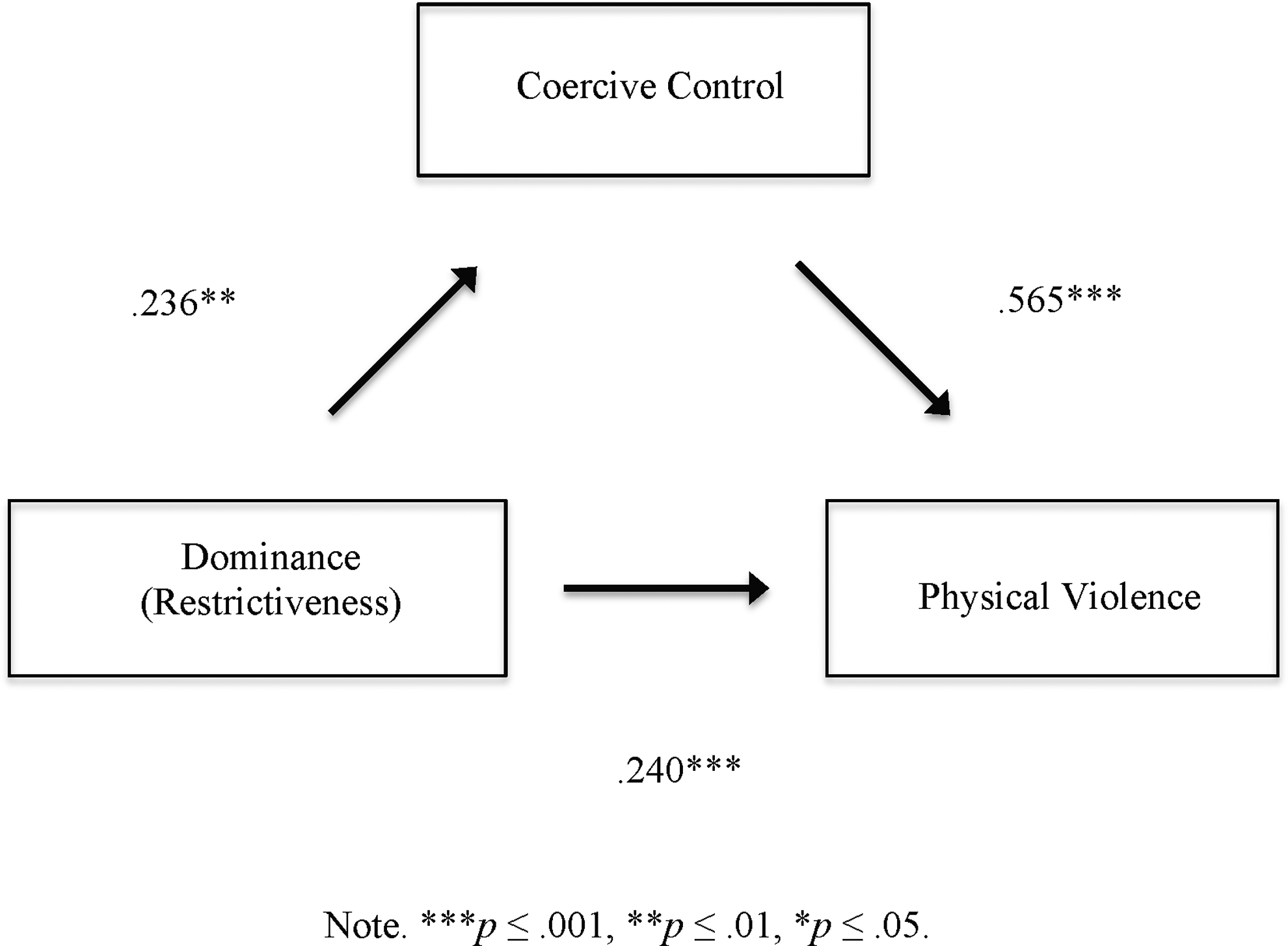
Model before mediation. Diagram showing the correlations between variables before entering the hypothesized mediating variable.
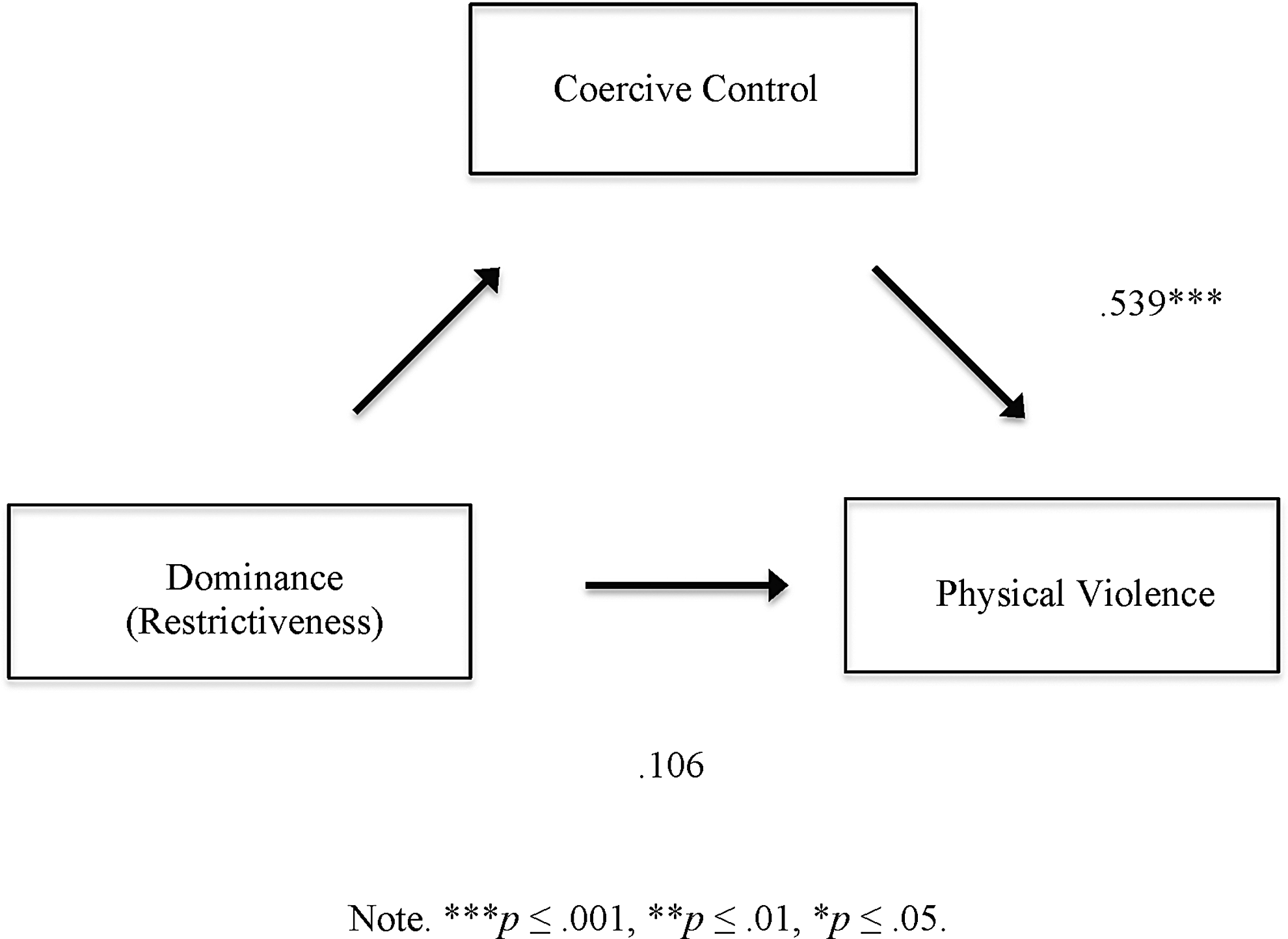
Model after mediation. Diagram showing the correlations between variables after entering the mediating variable.
Discussion
In this sample of violent men, two of the three masculinity indices measured suggest an interesting series of pathways through which abusive dynamics may develop. First, hostile sexism was only associated with coercive control. This finding is consistent with other research with undergraduate samples that also found a positive relationship between hostile sexism and verbal and sexual coercion (Forbes et al. 2004). Fears and beliefs that women are jockeying for power and are willing to use unfair means to obtain such power increase men's use of behaviors such as controlling access to resources and monitoring partner's activities. Second, somewhat differently, men who reported higher levels of restrictive beliefs also reported higher levels of coercive control and physical violence. This is consistent with previous research among undergraduates that found a link between dominance and IPV (Straus 2008; Whitaker 2013). However, once coercive control was considered, restrictiveness no longer influenced physical violence. Thus, restrictiveness contributed to using physical violence only indirectly though controlling behaviors. Because a key aspect of restrictiveness is beliefs about control, high levels of this trait are likely to translate into a myriad of coercively controlling behaviors, including isolating the victim, manipulation, and microregulation to maintain control. One possibility is that men with higher beliefs about restriction may feel entitled to control their intimate partners but when this fails, they resort to physical violence (Stark 2007). Why do the authors not see the same pattern in hostile sexism? Perhaps anger and resentment that women are robbing men of power do not lead to physical violence because coercive tactics rather than physical violence is more effective in soothing such internal threats.
Interestingly, the third trait of masculinity assessed in this study, hostility toward women, did not appear to influence whether men used tactics such as intimidation, isolation, and microregulation to control their intimate partners. A closer look at the items suggests that the measure is not only tapping anger and resentment as the authors intended but also personal experiences of humiliation and powerlessness and may be indexing emasculation. If so, feeling personally emasculated may have the opposite effect—withdrawing from contact and shunning relationships rather than pursuing women to gain more control. Indeed, the unexpected negative correlation between hostility toward women and hostile sexism supports the above interpretation and suggests that these two facets of masculinity are related, but in opposition. In turn, a closer look at hostile sexism indicates that items tap beliefs around the loss of autonomy and that the items are global rather than specific and personal. Thus, men who endorse feeling emasculated at a highly personal level are less likely to equally endorse more global beliefs that women can successfully rob them of power and these differences relate back to what abuse tactics are used, if any.
Overall, these findings suggest that men who endorse a certain kind of masculinity, particularly restrictiveness and hostile sexism, may attempt to gain control over their partners through the use of coercive tactics. While both restrictiveness and hostile sexism are directly related to coercive control, only restrictiveness mediates the relationship between coercive control and physical violence. If coercively controlling tactics fail to result in the desired control, these individuals may resort to physical violence toward their partners to reassert their desired level of control. This finding is consistent with the idea that physical violence occurs when coercion alone cannot enforce the desired level of control (Stark 2007).
Past research has been inconclusive on the role of masculinity in IPV, with some studies finding support for a relationship between traditional gender roles and IPV (Allen et al. 2009; Anderson and Umberson 2001; Berkel et al. 2004), and other research suggesting that gender roles are unrelated to IPV (Archer 2000; Felson 2002; Straus 2008, 2011). The lack of consistent findings has been used to suggest that IPV is not gendered, and indeed, such findings have contributed to the gender symmetry debates where women are argued to be as abusive to men, with little regard for outcome or context (Straus 2011). Gender-neutral theories have also led to temporary theoretical paralysis in how to think about gender and IPV in Lesbian, Gay, Bisexual, Transgender, Queer/Question (LGBTQ) contexts. The differentiated results from this study are important because they support the view that IPV is gendered but that researchers must pay careful attention to how gender roles are measured and what they represent. A more comprehensive understanding of hostile sexism, hostility toward women, and restrictiveness will help to construct a better clinical and research picture of positive and pathological masculinity. How these constructs may or may not translate to other contexts of violence (e.g., LGBTQ and female to male IPV) will also help researchers and clinicians untangle how gender operates across different groups.
Conclusions
There are several limitations to these findings. First, this study used a relatively small sample size of individuals within the criminal justice system. Although 137 participants is a significant size for a sample of batterers, the small sample size limits the generalizability of the findings to a broader population and may not generalize to individuals without involvement in the criminal justice system. Second, the authors used self-report cross-sectional data from a sample in mandated treatment. Thus, these results may have measurement error from impression management biases inherent in this population and are also limited to snapshots of psychological realities rather than dynamic pathways. In addition, this study focused exclusively on men in heterosexual relationships, limiting generalizability to same-sex partnerships. Nevertheless, this study opens interesting windows for future research.
While masculinity has been criticized as unimportant to the understanding of IPV, this study offers a different perspective—perhaps because the authors used multiple indices of masculinity and measured physical violence and coercive control using a clinical sample. Findings indicate that the type of masculinity one measures matters and how these measures are associated with IPV differs. In other words, the authors cannot take a “one size fits all” approach but must theorize more precisely on why a certain masculinity trait may be associated with physical violence, sexual violence, or coercive control. More research examining these unexpected but intriguing findings in clinical populations of batterers will increase the understanding of masculinity and abuse.
Footnotes
Acknowledgments
The authors thank John Jay College and the Graduate Center, CUNY, and Alternatives to Domestic Violence for their support of this research.
Author Disclosure Statement
No competing financial interests exist.