




Abstract
Abstract
Social networking (e.g., blogging and social networking website use) frequency among adolescents has increased exponentially in the last decade. An unfortunate by-product of increased communication via the Internet is cyberbullying; however, there is a paucity of longitudinal research exploring the relationships between social network use and cyberbullying in an adolescent sample. The current study used a three-wave longitudinal study of over 3000 (at Wave 1) Singaporean youth to examine whether the relationship between Wave 1 social network use and Wave 3 cyberbullying perpetration was mediated by an increase in Wave 2 development of positive cyberbullying attitudes. Results using structural equation modeling showed support for this hypotheses: Wave 1 social networking use predicted Wave 2 positive cyberbullying attitudes 2 years later. Finally, Wave 2 cyberbullying attitudes predicted Wave 3 cyberbullying perpetration 1 year later. Overall, these results suggest that social networking can be used to harm others through the development of positive cyberbullying attitudes—a link that has received very little empirical attention.
Introduction
I
Recent statistics show that 4.4 million Singaporeans are active social media users, and 4 million of those surveyed are using mobile devices to access social media, which makes Singapore ranked third in the world (at 77%) of citizens that use social media (Loh, 2017).
One potential negative consequence arising from the high frequency of social networking is cyberbullying, defined as, “the use of information and communication technologies such as electronic mail, mobile phone, pager, short message service, and websites that support deliberate, repeated, and hostile behaviors by an individual or group that intend to harm others” (Tanrikulu et al., 2015, pp. 709). Myriad online mediums exist for cyberbullying others, which may include social media platforms (e.g., social networking websites, blogging) or other means of digital communication (e.g., texting).
Whitaker and Kowalski (2015; Study 2) showed that Twitter and Facebook—social media platforms—were the two highest listed venues by which cyberbullying victimization occurs (see also Gorzig and Frumkin, 2013). Moreover, Mesch (2009) showed that youth were more likely to report being cyber-victimized via social media platforms (e.g., chat rooms and social networking websites) than nonsocial media Internet platforms (e.g., online game play). Overall, these findings suggest that being cyber-victimized is more likely to happen on social media platforms; however, there is a paucity of research examining the relationship between social media participation and cyberbullying perpetration. Barlett (2016, 2017) argued that studying the variables that predict cyberbullying perpetration is important because if replicable theory-driven results, regarding the psychological predictors and processes that predict cyberbullying perpetration, are uncovered then interventions can be created or tailored to focus on these variables. The link between social media exposure and cyberbullying, as well as the variables that may mediate this relationship, is yet to be longitudinally tested.
Using descriptive statistics, Hinduja and Patchin (2010) showed that cyberbullying offending was more likely to happen in an online chat room (a social media platform) than via e-mail (a nonsocial media Internet platform). Drawing on this literature, the objective of the current study was to use a longitudinal design with over 3000 (at Wave 1) Singaporean youth to examine the longitudinal relationship between early social networking frequency (i.e., social networking websites and blogs) and later cyberbullying behavior. The cyberbullying behavior that the authors assessed was not specific to harming others exclusively on social media, but rather a broadly assessed construct. Their aim is to make the results of this study generalizable to all types of cyberbullying tactics—not just those perpetrated on social media websites. However, the authors do posit that social media use will be longitudinally correlated with cyberbullying behavior, such that those who are on social media more frequently are also more likely to cyberbully others using the broadest sense of the term.
Their theoretical position is that social media exposure at Wave 1 will predict positive cyberbullying attitudes 2 years later (Wave 2), which predicts cyberbullying perpetration in the subsequent year (Wave 3). In other words, the authors predict that the relationship between Wave 1 social media participation and Wave 3 cyberbullying perpetration will be mediated by Wave 2 positive cyberbullying attitudes. Myriad theories applied to explain cyberbullying, including the Theory of Reasoned Action (Doane et al., 2014), Theory of Planned Behavior (Heirman and Walrave, 2012), and the Barlett Gentile Cyberbullying Model (BGCM; Barlett and Gentile, 2012), and longitudinal data (Barlett, 2015; Barlett et al., 2014, 2016; Barlett et al., 2017), all posit the importance of positive cyberbullying attitudes predicting subsequent cyberbullying perpetration. However, it is unknown what role social media participation has on the development of positive cyberbullying attitudes.
Theoretically, the BGCM (Barlett and Gentile, 2012) posits that cyberbullying perpetration is a learned behavior via previous cyberbullying perpetration that facilitates the development of positive cyberbullying attitudes. Once an individual attacks another person using technology, the BGCM posits that the perpetrator may perceive themselves as anonymous (among other learned constructs) due to the online nature of the harmful communication. Many social media platforms either claim to be anonymous (e.g., Yik Yak, Twitter) with the use of handles (pseudonym names) or afford anonymity by necessitating account creation information (e.g., e-mail and name) that can easily be fictitious (e.g., Facebook). Perceived anonymity is one key learned construct that has been reliably shown to predict positive cyberbullying attitudes (Barlett et al., 2016) and serves as one possible avenue by which social media use can predict cyberbullying perpetration. Although the authors did not measure anonymity perceptions in the current study, social media participation may be an additional predictor of cyberbullying attitudes and behavior. Indeed, before examining anonymity as a mediator, it is important to establish that social media use is longitudinally correlated with cyberbullying perpetration and positive cyberbullying attitudes. Specifically, their aim is to examine the relationship between Wave 1 social media participation and Wave 3 cyberbullying perpetration (3 years later) through Wave 2 positive cyberbullying attitudes.
In addition to examining the longitudinal relationship between early social media use and later cyberbullying perpetration via positive cyberbullying attitudes, the authors wanted to make sure that their effects were robust to sex and age differences. Meta-analytic results have shown that males are more likely to cyberbully others than females, but these effects were moderated by age—males cyberbully more during emerging adulthood than females, females cyberbully more during middle childhood than males, and there are no sex differences between males and females during adolescence (Barlett and Coyne, 2014). Therefore, the authors statistically controlled for age and participant sex in their path modeling.
Methods
Participants
A total of 3079 (1553 male) Singaporean students participated in the study at Wave 1of their longitudinal study in the year 2010. For the purposes of this study 1 , Wave 2 scale administration occurred in 2012 and 1086 (554 male) participated. Finally, Wave 3 was conducted in 2013 and included 886 (469 male) students. The starting sample included 1210 2 Primary school children who were between Primary 3 and 6 and 1869 Secondary school students who were between Secondary 1 and 5. The age range of participants at Wave 1 was 8–17 years (M = 13.01, SD = 2.40), and the majority were Chinese (71%), 18% Malays, 7% Indians, and 4% of other ethnicities. This racial distribution is reflective of the general population in Singapore.
Materials
Cyberbullying perpetration
The Ybarra et al. (2007) cyberbullying questionnaire was used to assess engagement in cyberbullying behaviors broadly (i.e., not specific to cyberbullying on social media). Participants were asked to indicate how often they engaged in cyberbullying behaviors in the past year on a 1 (never) to 6 (everyday/almost everyday) rating scale. This scale had three items. A sample item includes, “…made aggressive or threatening comments to anyone online.” Items were summed such that higher scores indicate more engagement in cyberbullying behavior (current study α = 0.76). This measure has been shown to be valid and correlates with other cyberbullying-related variables, such as cyberbullying victimization (Barlett and Gentile, 2012), positive cyberbullying attitudes (Barlett et al., 2014), and perceived anonymity (Barlett, 2015).
Positive cyberbullying attitudes
The Positive Attitudes toward Cyberbullying Questionnaire (Barlett and Gentile, 2012) was adapted for the current study to assess the degree to which participants endorsed positive cyberbullying attitudes. The authors changed the language of the items slightly to make it understandable to youth, since the scale was originally validated on college-aged participants. This is a nine-item questionnaire that asks participants to rate their agreement with the items on a 1 (strongly disagree) to 5 (strongly agree) rating scale. A sample item includes, “It is ok to send nasty or mean things to others if they deserve it.” Certain items were reverse scored such that higher scores indicate more positive cyberbullying attitudes (current study α = 0.79). This measure assesses positive cyberbullying attitudes broadly and not specific to social media exposure. Research has shown that scores on this measure correlate with cyberbullying behavior (Barlett and Gentile, 2012; Barlett et al., 2016), showing its validity.
Social media exposure
A researcher-created questionnaire was used to assess social media exposure. This measure consisted of several items that assessed the frequency to which youth engaged in several different media activities (e.g., video game play, watching television); however, the authors only analyzed the three items pertaining to social media. Participants were asked how often they (a) blogged on websites, (b) used sending instant messages on the Internet, and (c) used social networking websites on their computer for every hour of the day on a 0 = 0 h, 1 = 0.5 h, and 2 = 1 h rating scale. A sample item includes, “How much time do you spend on the following activity?—using social networking sites (online).” Social media was not explicitly defined for participants. The authors chose these variables to coincide with Carr and Hayes (2015) definition of social media. These questions were asked twice, once for weekdays and once for weekend days. For each of the three social networking variables, the authors summed up the weekday hours and multiplied it by five and added that to the summation of the weekend day hours multiplied by two. This created a weekly estimate of the number of hours for each of the three social media mediums listed above.
Procedure
Their study was a part of a larger four-wave longitudinal study entitled “Singapore Youths in the Cyber-world” (also referred to as the 2010–2014 Cyber Wellness project). To explore what Internet activities Singaporean youths are engaged in, a stratified two-stage cluster sampling method was used to obtain a nationally representative sample. The overall sample was designed to represent all students from Primary 3 to Secondary 5 in Singapore. A total of 30 randomly selected Singaporean schools with 107 classes were invited to participate in the study. Two schools later dropped out from the first year of study. The final sample thus includes 28 schools (15 Primary schools and 13 Secondary schools). Informed consent was sought from the parents through the schools. A liaison teacher from each school collated the information and excluded the students whose parents refused consent from the study. Assent was obtained from the students through informing them that participation in the survey was voluntary and that they could withdraw at any time. The online questionnaires were administered by teachers during school sessions in computer laboratories with a set of standardized instructions. Each student was issued a random serial number to be used as the identifier to ensure the data confidentiality. All of the ethical procedures and policies of the Ministry of Education and the participating schools were followed.
Data analysis plan
Before testing their primary hypotheses, the authors conducted several preliminary analyses, which included: (a) checking the skew for all relevant variables, (b) examining the zero-order correlations between their continuous variables, and (c) testing sex differences on the variables of interest. The results from their preliminary analyses guided their statistical techniques for their longitudinal path model used to examine their primary mediation hypothesis. Based on past research (Barlett et al., in press) examining the longitudinal relationship between early positive cyberbullying attitudes and later cyberbullying perpetration in a sample of Singaporean Youth (r = 0.25), a sample size of 123 is needed to achieve a power of 0.80 with a two-tailed alpha level of 0.05, which the authors had at all three waves, and past research using Monte Carlo simulations showed that their sample sizes at all three waves were sufficient (Wolf et al., 2013).
Results
Table 1 displays the descriptive information for the variables of interest. As expected, all of the variables (sans age and sex) were significantly positively skewed (all Zs > 8.00, all ps < 0.01). Therefore, the authors will present both parametric and nonparametric inferential statistics for their correlations and t-tests and use bootstrapping procedures for their structural model to account for the significant skew.
Numbers below the diagonal are Spearman Rank Ordered correlations, and numbers above the diagonal are Pearson correlations. Participant sex was coded as 1 = male, 2 = female.
p < 0.01.
p < 0.05.
Table 1 displays the zero-order and Spearman rank ordered correlations between relevant variables. Of theoretical interest, Pearson correlation coefficients revealed that Wave 2 cyberbullying attitudes significantly correlated with Wave 3 cyberbullying perpetration. Spearman rank ordered correlations showed similar results.
Several independent samples t-tests were conducted to examine whether male and female participants differed on any of the key variables. Results are displayed in Table 2 and show that males endorsed more positive cyberbullying attitudes at Wave 2 and engaged in more cyberbullying perpetration at Wave 3 than females; however, females reported spending more time on social networking websites on the computer, social networking websites on their phone, and blogging than males. Results from several Mann–Whitney U tests to address the skewed nature of the data did not differ from the results obtained from the independent samples t-tests.
Z value represents the results from Mann–Whitney U tests.
p < 0.05.
MPLUS with maximum likelihood estimation techniques was used to test their theoretical longitudinal structural model. First, the three social media variables comprised the Wave 1 social media latent variable. This latent variable was used to predict Wave 2 positive cyberbullying attitudes, which predicted Wave 3 cyberbullying perpetration. To account for the skewed nature of the variables, the authors used 5000 bootstrapped estimates with 95% confidence intervals. Initial model testing showed that the blogging frequency observed variable did not load onto the media latent variable well (B = 0.31, p < 0.05). According to Shevlin and Miles (1998), when factor loadings are low (0.30), mis-specified models will fail to be rejected, and thus, the authors removed blogging frequency from the model. Results of their new model (omitting blogging frequency) showed that the model fit the data well, χ2 (df = 2) = 2.75, p = 0.25, CFI = 1.00, TLI = 0.99, RMSEA = 0.01 (90% CI: 0.00–0.04), SRMR = 0.02. The unstandardized path estimates along with 95% confidence intervals are depicted in Figure 1 and show that all the path coefficients were positive and significant, suggesting that Wave 1 social media participation predicts Wave 2 cyberbullying attitudes, which predict Wave 3 cyberbullying behavior. Indirect model statements were included to test for the mediating effect of Wave 2 cyberbullying attitudes in the relationship between Wave 1 social media use and Wave 3 cyberbullying perpetration. Results showed significant mediation, Indirect β = 0.04, 95% CI: 0.01–0.07. Finally, because the authors found significant sex differences on the variables used in their structural model, the authors reran the same model, but had sex predict the Wave 3 cyberbullying perpetration, and results showed that the path coefficients displayed in Figure 1 were largely unchanged. Finally, results were also largely unchanged when the authors had participant age predict the Wave 1 social networking latent variable.
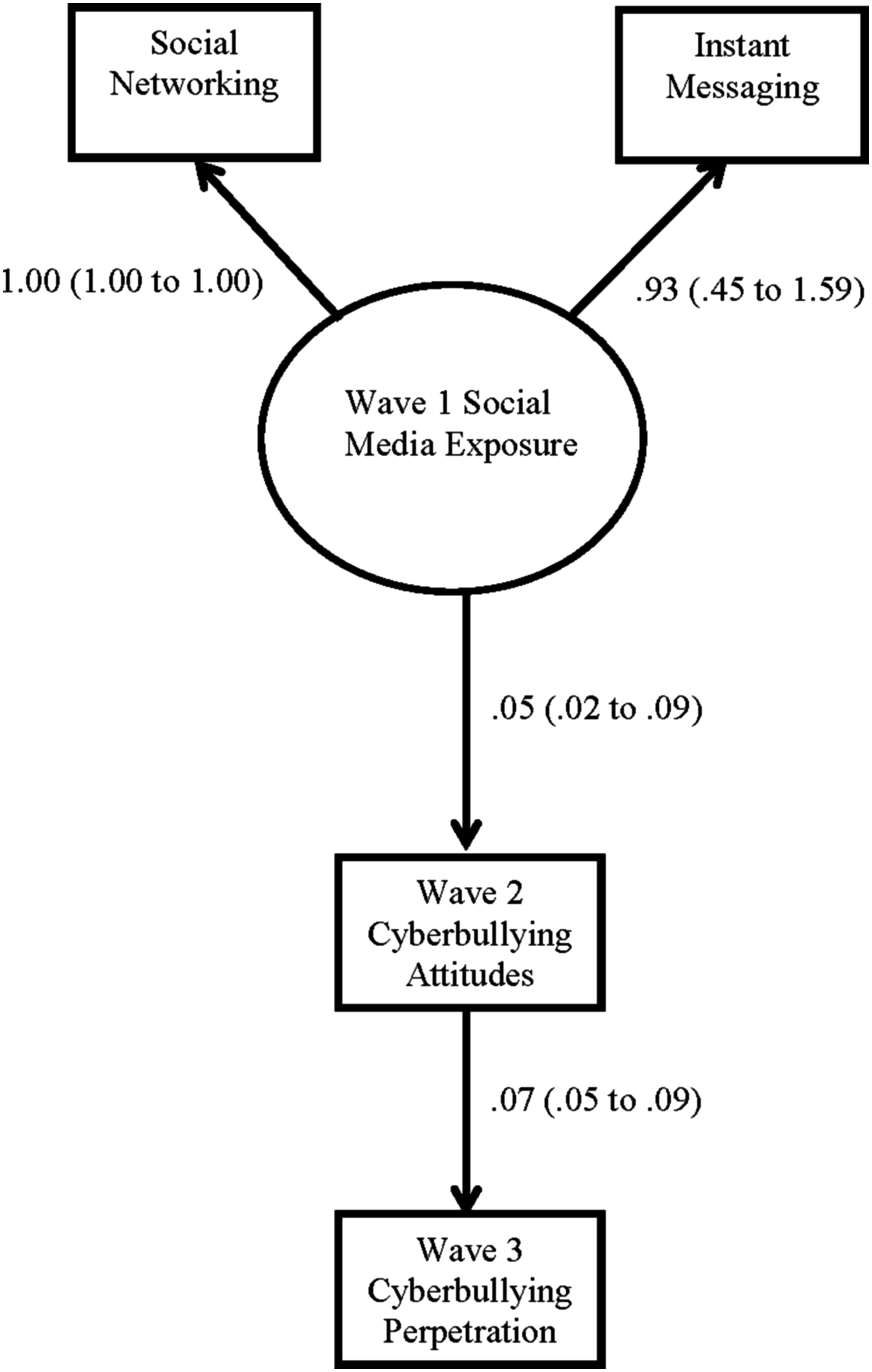
Results from the Structural Model.
Discussion
The current study used a three-wave longitudinal study that spanned 4 years on a sample of over 3000 Singaporean youth (at Wave 1) to investigate the role of social media participation on the development of cyberbullying attitudes and behavior. While cyberbullying attitudes have long been linked to cyberbullying behavior (e.g., the BGCM; Barlett and Gentile, 2012), there is a paucity of research highlighting the role of social media in this relationship. While other studies have investigated the role of other Internet-based and technological mediums—such as e-mail or online video game play—these forms of communication have made poor predictors of cyberbullying behavior (Barlett, 2015; Whitaker and Kowalski, 2015, Study 2). Moreover, neither online game play nor e-mail use are considered social media platforms (Carr and Hayes, 2015). Due to the interconnectivity of social media on the Internet, youth may be more willing to harm others online due to previous social media use; however, there is a lack of quality longitudinal studies testing this assertion. Indeed, while some research has suggested that social media is related to cyber-victimization (e.g., Mesch, 2009), longitudinal evidence linking early social media use to later cyberbullying perpetration through the development of positive cyberbullying attitudes has, to their knowledge, never been tested.
The authors predicted that social media participation—as defined by Carr and Hayes (2015)—at Wave 1 would predict cyberbullying perpetration 3 years later, mediated by the development of positive cyberbullying attitudes assessed 2 years later. The data in this longitudinal study support this hypothesis. Wave 1 social media participation predicted Wave 2 cyberbullying attitudes, which predicted subsequent Wave 3 cyberbullying behavior. Moreover, their results showed that Wave 2 cyberbullying attitudes mediated the relationship between Wave 1 social media participation and Wave 3 cyberbullying behavior. These findings suggest that participation in certain social media platforms is one factor that relates to the development of positive attitudes toward cyberbullying, subsequently increasing the likelihood of future cyberbullying offenses. This study provides new longitudinal data to reaffirm the directionality of the effects, further supporting the hypothesis that participation in social media platforms may encourage the development of cyberbullying attitudes and perpetration over time.
The literature that examines the theoretical variables and psychological processes that predict cyberbullying perpetration has grown recently, which has allowed researchers, scholars, school administrators, parents, and youth to uncover the reasons why, and for whom, cyberbullying perpetration occurs. Indeed, myriad personality, parental, media, and demographic variables (Kowalski et al., 2014 for a meta-analysis) have reliably been shown to predict cyberbullying. Barlett (2016, 2017) noted that cyberbullying interventions could be tailored or created in accordance with this research. For instance, due to the negative correlation between empathy and cyberbullying perpetration (e.g., Doane et al., 2014; Steffgen et al., 2011), Schultze-Krumbholz et al. (2016) developed a successful cyberbullying perpetration intervention that trained empathy to youth. This example illustrates how primary research that shows a reliable effect can be taught to reduce cyberbullying. If subsequent research shows a correlation between social media use and cyberbullying perpetration—akin to their study—then perhaps future interventions can train youth to be more careful online or have youth decrease the amount of time spent on social networking websites to, hopefully, reduce positive attitudes toward cyberbullying and subsequent behavior.
Akin to all psychological research, future research should address possible alternative explanations for the findings. First, because the authors did not analyze Wave 1 cyberbullying attitudes, one alternative is that positive cyberbullying attitudes already existed before Wave 1, which calls into question their theoretical position. As the authors noted in Footnote 1, data were collected as part of a larger study (Barlett et al., in press), in which the authors assessed cyberbullying attitudes at Wave 1. Ethics prohibit us from publishing the correlation between Waves 1 and 2 cyberbullying attitudes; however, when the authors reran their path model that added the path between Wave 1 and Wave 2 cyberbullying attitudes, the relationship between Wave 1 social media and Wave 2 cyberbullying attitudes remained significant (B = 0.03, 95% CI: 0.01–0.07), suggesting that this specific concern is void. However, other variables not in the data may be acting on both positive cyberbullying attitudes and social media use, such as parental monitoring (Khurana et al., 2015), Big 5 personality traits (Hughes et al., 2012), traditional bullying frequency (Erdur-Baker, 2010), and others.
An additional related topic for future research is to examine whether there are certain characteristics of specific social media platforms that afford youth a higher chance of cyberbullying others. For instance, the BGCM (Barlett and Gentile, 2012) posits that positive cyberbullying attitudes are more likely to be developed and automatized when individuals perceive themselves to be anonymous online. Certain social networking websites afford anonymity more than others. For instance, Facebook users have their name (and often picture) associated with their posts and comments, whereas Yik Yak does not. This does not preclude that Facebook users could use a fake name and picture; however, their point is that the BGCM posits that more anonymous-friendly social networking websites are more likely to be used to harm others online. To their knowledge no study has explicitly examined this hypothesis.
There are some limitations to the current research that future research should address. First, common in longitudinal studies, there was participant attrition over time. As the authors indicated in Footnote 2, the attrition is likely due to youth changing or finishing school among other unforeseen reasons why youth may not have finished the study. Although the authors still had adequate sample sizes at all three waves of data collection to examine their hypotheses, participant attrition is a limitation and future research should exhaust all methods to retain participants. Indeed, several independent samples t-tests showed that youth who completed all three waves had significantly lower levels of Wave 1 IM frequency, lower levels of Wave 1 social networking frequency, and lower levels of Wave 2 cyberbullying attitudes, but had significantly higher Wave 1 blogging frequency compared to those who did not complete all three data collection waves (all ts > 2.09, all ps < 0.04). There was no difference between these two groups on Wave 3 cyberbullying perpetration, t(884) = −0.82, p = 0.41.
Second, their study was exploratory, and the authors are unaware of any existing cyberbullying-specific theory that includes social media participation as a predictor of the processes that govern cyberbullying perpetration. Indeed, the BGCM (Barlett and Gentile, 2012) suggests that anonymity and the irrelevance of physical stature online also contribute to positive cyberbullying attitudes and, subsequently, perpetration. However, the current study fails to fully test the BGCM, as anonymity and physicality measures were not included. The BGCM does not yet posit social media exposure into its theorizing, but if future work can replicate these findings while including other more established theory-driven cyberbullying predictors, then theory can be modified to include social media exposure.
Third, the authors adapted some of the measures used in the current research from their original derivation. For instance, the positive cyberbullying attitude measure changed the wording of some items to make them more understandable for youth. Barlett and Gentile (2012) validated this measure on a college-aged population, and the authors wanted the items to validly measure cyberbullying attitudes in youth. The authors are unaware of any positive cyberbullying attitude measures validated on youth samples, although corollary evidence for construct validity has shown that similar attitude measures predict cyberbullying perpetration in youth in past work (Barlett, 2015) and the current study. Future research should validate a cyberbullying attitude measure to assess this important construct in youth.
Finally, the fast-paced ever-changing nature of online communication may change the conclusion of these results if future work tried to replicate these findings. Currently, social media websites (e.g., Facebook) are used in high frequency; however, in the future it is unclear whether or not the same social networking websites, blogs, etc. will be used or relevant. The authors are not arguing that results from the current study are invalid or will be invalid in the future; however, the authors are arguing that care is needed in selecting social media frequency questions, because of the fast rise and fall in popularity of many social networking platforms. Future research should make sure to ask participants about the frequency of current social networking websites and cellular phone applications to get the most valid and generalizable results that reflect social media habits currently.
Overall, the current study adds theoretically exciting data to the existing literature. It establishes the importance of social media usage in the development of positive attitudes toward cyberbullying, resulting in increased cyberbullying behavior over time—findings that have not yet been tested in the literature. Their study sets the stage for continued research on this phenomenon and may lead to theoretical advancements to better address cyberbullying issues online and reduce its impact on today's youth.
Footnotes
Author Disclosure Statement
No competing financial interests exist.