




Abstract
Abstract
The Centers for Disease Control and Prevention (CDC) cited intimate partner violence (IPV) as a serious, yet preventable public health problem that affects millions of Americans in our country daily. Given the enormous prevalence of IPV combined with the operating assumption that media can impact public opinion and policy, it is important to uncover how topics such as IPV are portrayed in the media, as these portrayals provide potentially significant influence on the public's opinion of IPV and related policies that directly impact victims, survivors, and perpetrators. The purpose of this study seeks to uncover the portrayal of IPV at the community level as reported by the media—notably, a local newspaper in a county located in the southeastern United States. The media analysis revealed several pertinent thematic categories that describe the frequency and content of IPV reporting in the Greensboro News & Record. Beginning in 2015, it appears that the county's plans for opening the Guilford County Family Justice Center sparked increased media attention in the county, which perhaps contributed to subsequent years of frequent coverage of community resources, support services, funding sources, and public awareness events related to domestic violence in the local community. While a direct explanation cannot be provided for the total cause of the significant decrease in IPV-related homicides as revealed in this study, the media analysis suggests that Guilford County is making significant strides against IPV.
Introduction
Intimate partner violence (IPV) is a serious, yet preventable public health problem in our society today—a problem that affects millions of people around the world irrespective of age, race, gender, ethnicity, religion, socioeconomic status, or sexual orientation (Murray and Graves 2012; Centers for Disease Control and Prevention 2017). The prevalence and incidence rates of IPV in the United States and across the globe are astonishingly and overwhelmingly high, particularly for women compared with men. The Centers for Disease Control and Prevention's (CDC) 2015 National Intimate Partner Violence and Sexual Violence Survey (NISVS) offers a wealth of statistical information regarding the prevalence and incidence of IPV, including, but not limited to the following, (1) nearly one in three women and one in seven men in the United States report experiencing severe physical violence from an intimate partner in their lifetime; (2) 10% of women and 2% of men report being stalked by an intimate partner; and (3) nearly 47% of women and 47% of men have experienced psychological aggression, such as humiliating or controlling behaviors (Smith et al. 2017).
It should also be noted that IPV begins early in the lifespan among both women and men. According to the 2015 NISVS, ∼71.1% (or nearly 31 million) of women who reported being victims of contact sexual violence, physical violence, and/or stalking by an intimate partner first experienced these forms of violence by that partner before age 25 years (Smith et al. 2017). The other 25.8% first experienced IPV before age 18 years. Men also experienced IPV early in the lifespan with ∼55.8% who reported IPV-related victimization first experiencing these forms of violence before age 25 years and 14.3% of male victims first experiencing IPV before 18 years (Smith et al. 2017). These statistics point to the need for intentional, purposeful, and strategic IPV prevention initiatives to interrupt the development of later forms for IPV given its tendency to first appear early in the developmental lifespan (Niolon et al. 2017).
On a more local level, North Carolina has received notoriety for domestic violence-related incidents, particularly homicides, in recent years. Specifically, Guilford County, the state's third largest county, ranked third in the state for domestic violence-related homicides in 2012, according to the North Carolina Attorney General's Office, where six homicides were reported (Gamm and Williamson 2013). In 2013, a North Carolina Health News report revealed that Guilford County domestic violence-related homicides had increased to a reported 11 homicides in the county, making Guilford County the number one county in the state for reported domestic violence-related homicides; subsequently, the same was also true in 2014 with eight reported homicides (Battaglia 2016).
As described by Murray and colleagues (2014), Family Justice Centers (FJCs) are becoming increasingly widespread across the country, namely as a result of President George W. Bush's FJC Initiative in 2003. FJCs are designed as “one-stop shops” for victims of IPV and family violence where a multidisciplinary team of professionals work together under one roof to provide coordinated services to victims of family violence (Family Justice Center Alliance 2018). Specifically, FJCs offer comprehensive services for domestic violence victims, including law enforcement, victim advocacy, counseling, safety planning, legal assistance, case management, healthcare services, housing assistance, transportation resources, child support services, elder abuse services, job training, and community education and prevention (Boyd 2006; Family Justice Center Alliance 2018; Olson and Parekh 2010; Townsend et al. 2005). In many ways, FJCs alleviate the burden of victims attempting to navigate a vastly complex array of services in different locations during a time of crisis where the issue of safety is an immediate concern (Townsend et al. 2015). Ultimately, FJCs offer increased supportive services for victims and their families that represent the best practice approach in responding to domestic violence where promoting victim safety and holding offenders accountable are primary goals (Family Justice Center Alliance 2018; Townsend et al. 2015).
According to Murray and colleagues (2014), the consideration of a FJC, a “one-stop shop” for victims of domestic violence to access a wide-range of services at one location, was ongoing since 2009 when a committee was formed by county commissioners to recommend the formation of a FJC in 2010. The Guilford County FJC was opened in June 2015, and since its inception, the center has served nearly 11,000 clients and families, where domestic violence-related homicides have significantly decreased over recent years with three reported homicides in 2015 and four reported homicides in 2016 according to the North Carolina Department of Public Safety (Guilford County Family Justice Center 2016; North Carolina Department of Public Safety 2017).
Given the operating assumption that media can impact public opinion and policy, it is important to uncover how topics such as IPV are portrayed by the media, as these portrayals provide significant influence on the public's opinion of IPV and related policies that directly impact victims, survivors, and perpetrators. For example, Carroll and McCombs (2003) described agenda setting theory that points to the agenda-setting effects of news media on the public's attention to, understanding of, and opinions about topics in the news is salient to the public agenda, noting implications of significant world events that have shaped the public's opinion on various issues (e.g., war, politics, business, social movements).
In other words, the agenda-setting influence of mass media, based on respective events happening in today's world, significantly influences “…the salience of elements on the news agenda on the public agenda” (Carroll and McCombs 2003, p.37). These same salience cues presented in respective media outlets contribute to issues, persons, or other objects that are most important to the public agenda—thus impacting the prioritization of various issues at the forefront of public attention and thought (Carroll and McCombs 2003). In recent years, incidences of IPV, particularly those occurring among celebrities and other well-known figures and personalities have pervaded mass media outlets, thus impacting the salience of the public's opinion of IPV combined with potential prioritization efforts to address the issue on local, national, and international levels. Thus, the purpose of this media content analysis seeks to uncover the portrayal of IPV as reported by the local media, notably, the Greensboro News & Record. Specifically, this content analysis seeks to address the following research questions: (1) In the last 5 years, has the frequency of IPV reporting increased in Guilford County? (2) How frequent are IPV programs and supportive services reported for victims and survivors in Guilford County? (3) How has the Guilford County FJC impacted, and how IPV is discussed in the county by the media? and (4) From what perspective (e.g., negative, positive, and neutral) is IPV reported?
Methods
The researchers utilized a conventional approach to content analysis where coding categories are derived directly from the data, allowing new insights to emerge from the data itself as opposed to eliciting themes using preconceived categories (Kondracki et al. 2002; Lacy et al. 2015). The following search terms were used to identify relevant articles and editorials to include in the content analysis via the Newspaper Source Plus database provided by The University of North Carolina at Greensboro library: “INTIMATE PARNER VIOLENCE” or “DOMESTIC VIOLENCE” or “PARTNER ABUSE” or “SPOUSE ABUSE.” Articles were retrieved via the Newspaper Source Plus database where the “Publication” field input was “Greensboro News and Record.” Note, only relevant articles and/or columns, editorials, and briefs based on set inclusion criteria (noted above) were included in the content analysis. From a qualitative standpoint, publications were reviewed for topic relevance and major themes and/or changes were identified. Next, publications were sorted into categories based on themes. To increase inter-rater reliability, the first author conducted the first set of reviews followed by the second author who conducted the second set of reviews. Both authors reviewed the major themes presented in the publications, designated an initial thematic code, and finally reached consensus for the final publication codes that are presented in the results section.
Inclusion criteria for the content analysis included relevant IPV articles and/or columns, briefs, and editorials published in the News & Record within the last 5 years (October 2012–October 2017) as of October 18, 2017. The authors' purpose for examining this section of publications is to delineate trends and changes in IPV reporting occurring in Guilford County over time. In addition, the authors included articles relating national coverage on IPV to uncover how national IPV reporting instances are covered locally in the News & Record. Selected articles and/or columns, briefs, and editorials in the analysis had to include information related to IPV occurring in Guilford County and/or the surrounding Piedmont/Triad area. Nonrelevant publications and duplicate publications were excluded from the analysis.
Results
Search criteria yielded 41 results in total. After applying exclusion criteria, seven articles were removed from the analysis, leaving a remaining total of 34 relevant publications included for the content analysis. The authors identified a total of seven thematic categories that described the publications included in the content analysis: (1) public awareness at the local level; (2) public awareness at the national level; (3) recognition of the Guilford County FJC, criminal reports; (4) IPV-related programs; (5) IPV-related services; (6) funding support; and (7) personal survival stories. In some instances, publications fell into more than one category, such as personal survival story combined with FJC recognition, which yielded a double-count of reported publications. A summary table of publication results is included (Table 1).
Summary Thematic Categories and Author Perspectives by Article Title
FJC, Family Justice Center; IPV, intimate partner violence.
Nearly 35% (N = 12) of the results rendered referenced the opening, function, and overall effects of the Guilford County FJC, which opened in June 2015. The sheer frequency of mention of the Guilford County FJC in recent years ultimately points to the media's interest in domestic violence in the Greensboro community, especially as it relates to how the issue is being addressed by county government officials and policymakers. News & Record columnist, reported that the center provides dozens of services for victims of family violence where the center represents a collaborative effort between Guilford County and the city of Greensboro. Since its opening, reported that the agency has served ∼10,000 people with the primary goal of improving the navigational process of the justice system. From an author perspective, these publications were reported with a positive tone. Two of these publications are double-referenced, one which related a personal IPV survivor story and the other which related a criminal report.
Approximately 35% of (N = 12) publications referenced articles covering IPV-related criminal charges and investigations, including arrests made, outstanding warrants, and reports of IPV-related injury and/or death. One of these publications also made reference to the Guilford County FJC. These publications simply stated the factual information of the respective case, thus pointing to a neutral perspective tone. Next, references to community-support services, including discussions of victim advocacy services, social services (e.g., Department of Social Services), and housing services, were discussed (N = 4). Two of these articles were reported with a more positive stance, while the third publication's report maintained a more neutral stance and also referenced the Guilford County FJC. One publication (N = 1) stood alone and referenced a specific community-support program for children living with domestic violence in their home. Camp Hope, a week-long camp designed especially for children who have witnessed or directly experienced domestic violence in the home was described by Camp Hope counselor Jack Huckabee as follows:
Their background makes it tougher on them, but we find a way to let them let it out so they can just be kids. They might not be able to stop what's happening at home, but coming here can help them deal with it (Queram 2016).
Approximately, 15% (N = 5) articles referenced IPV-related public awareness events and/or information relevant at the local community level, which included events such as the Rockingham County Domestic Violence Candlelight Vigil and the Greensboro Fire Department Annual Stair Climb, all of which were reported in neutral or positive tones. Similarly, two publications (N = 2) referenced IPV-related public awareness occurring at the national level from a positive perspective, including a review of national domestic violence awareness campaigns (e.g., “No More”) and IPV-related reports among celebrities involving professional athletes and music entertainers (e.g., Ray Rice, Kurt Busch, Chris Brown). The News & Record also highlighted the importance of funding support sources instrumental in the combat against domestic violence in Guilford County, including reference to state and federal funding sources, needed to help fund domestic violence-related support programs (N = 2). For example, one author discussed the impact of a $750,000 grant offered by the U.S. Department of Justice on Violence Against Women to provide services for victims of domestic violence in Guilford County.
Personal survival stories (N = 2) also served as a distinct category included in the media analysis, as several articles detailed the personal accounts of individuals who had directly experienced IPV in a previous relationship. Two publications related the personal survival stories of IPV victims from a positive perspective, both of which also referenced other thematic categories. One survivor, Eileen Martin, reported that the abuse she experienced—both psychological and emotional—continued in her previous marriage for >20 years before she decided to leave the relationship (Queram 2016). Another survivor [White] detailed her personal story of abuse during the grand opening of the FJC in June 2015, where she revealed how she was nearly stabbed to death by her ex-husband; furthermore, White reported that she uses her personal story of survival as a way to inspire others, especially as it relates to how victims use the court system to call for protection against their abusers. One article in this category also stressed the importance of funding support, recognition of the FJC, and community-support services for victims and their families. In addition, the second publication also made specific reference to the FJC.
With regard to Research Question 1, “In the last five years, has the frequency of IPV reporting increased in Guilford County as indicated by the Greensboro News & Record?” the results of the media analysis suggest that the answer is yes. Based on designated search criteria described above, the News & Record did not report any publications related to IPV from 2012 to 2014. However, from 2015 to 2017, IPV reporting in the News & Record increased dramatically, including 18 publications in 2015, 14 publications in 2016, and 8 publications in 2017, as of October 18, 2017. The histogram depicted in Figure 1 graphically illustrates the frequency of IPV reporting in the Guilford County as indicated by the Greensboro News & Record from 2012 to 2017.
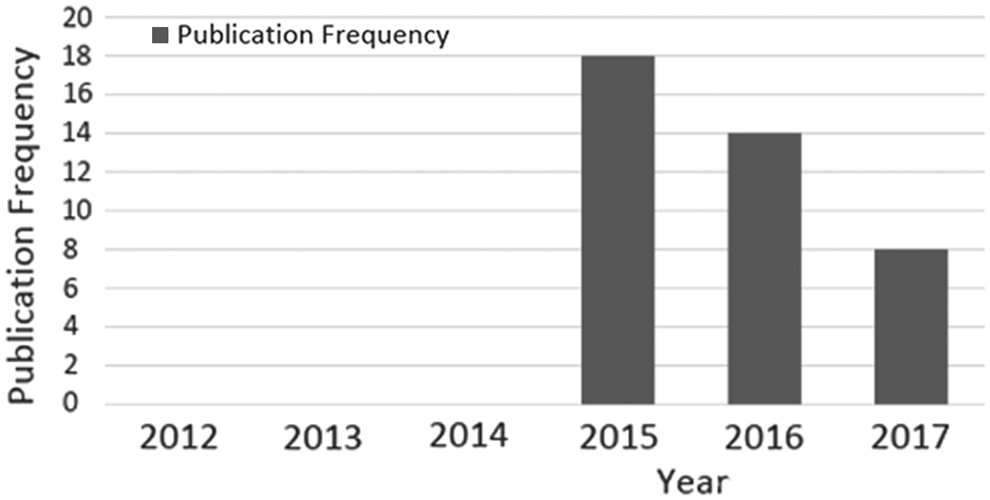
Frequency of IPV reporting in the News & Record. IPV, intimate partner violence.
With regard to Research Question 2, “How frequent are IPV programs and supportive services reported for victims and survivors in Guilford County as indicated by the Greensboro News & Record?” results of the media analysis suggest that two thematic categories fall within the description of community support services and programs. First, references to the Guilford County FJC occurred 12 times in the media analysis (∼35%). The FJC was frequently cited as the premier, one-stop resource location for victims and survivors of domestic violence, sexual assault, child abuse, and elder abuse in Guilford County and the surrounding Piedmont/Triad area. Second, references to community support services and programs occurred five times total, which ranged from coverage of victim advocacy services to a community-support camp program designed for children living with domestic violence in the home. The pie chart depicted in Figure 2 graphically illustrates the percentage of reporting instances that referenced IPV-related programs and support services in the News & Record, including a primary focus on the reporting of the Guilford County FJC.
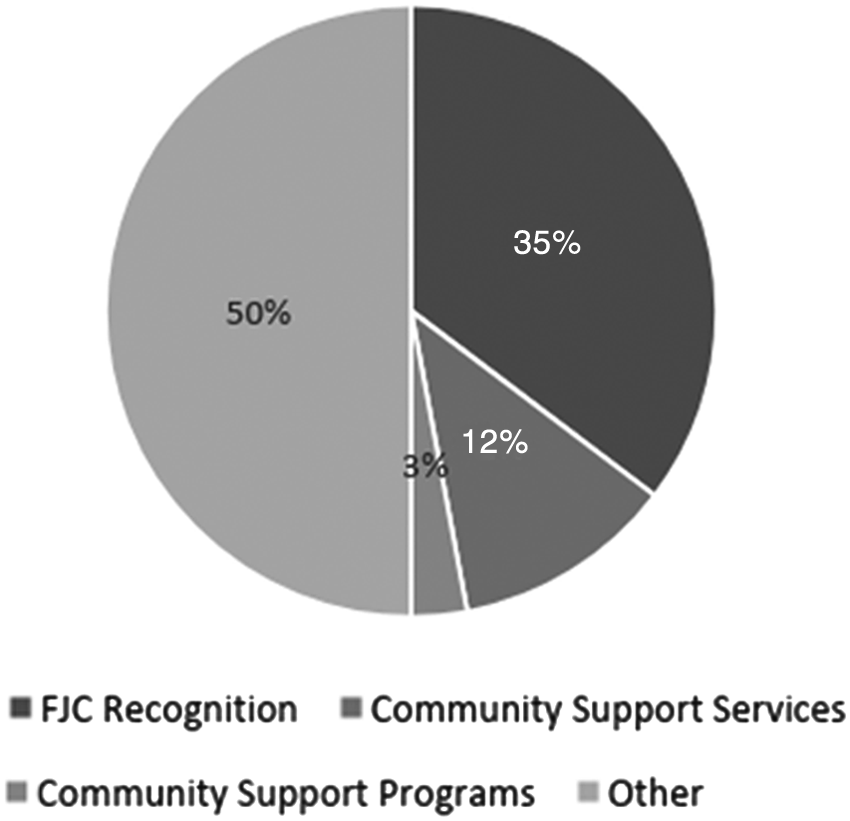
Reporting of the Guilford County FJC and community support services and programs in the News & Record. FJC, Family Justice Center.
Related to Research Question No. 3, “How has the Guilford County Family Justice Center impacted, and how IPV is discussed in the county by the media?” it appears that the opening of the FJC sparked increased media attention and coverage of IPV-related issues from multiple perspectives, ranging from recognition of the center itself to various public awareness activities and criminal reports of domestic violence in the community. Further discussion of the FJC and its impact is included in the Discussion section. With regard to the final Research Question, “From what perspective (e.g., negative, positive, neutral) is IPV reported?” all publications were interpreted to maintain a neutral or positive stance on IPV-related issues in the local community—see Table 1 and Figure 3 for details.
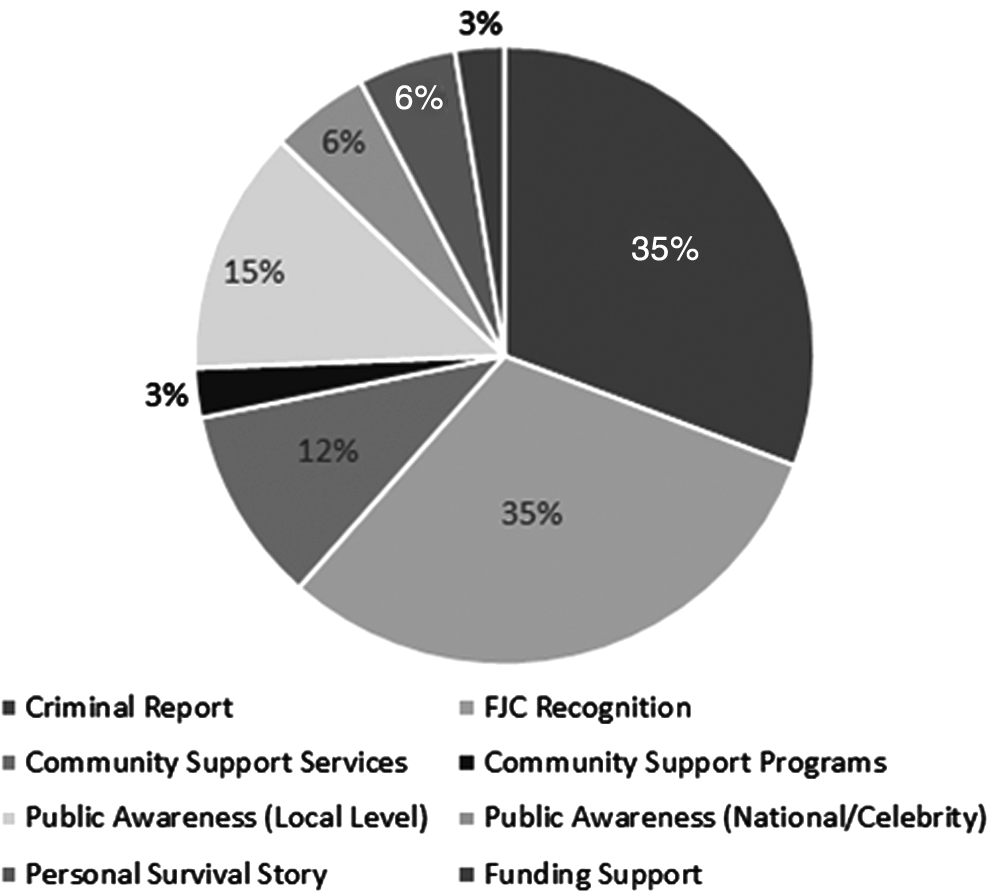
Summary publication results included in content analysis by thematic category.
Discussion
Over the last several years, the Greensboro News & Record has placed an increased priority on the reporting of IPV in Guilford County. The content analysis revealed several pertinent thematic categories that describe the frequency and content of IPV reporting in the Greensboro News & Record. Reported statistical homicide rates in Guilford County indicated that between 2010 and 2013, 25 people died from domestic violence and 11 of those deaths occurred in 2013, thus making Guilford County the number one county in the state for domestic violence homicides (Battaglia 2016). In 2015, the Federal Bureau of Investigation ranked North Carolina as 24th in the nation for incidents of domestic violence homicides where 99 domestic violence-related homicides were reported. However, in Guilford County, domestic violence accounted for only 1 of 34 violence-related deaths—a significant drop from the previous 2 years where domestic violence claimed the lives of 10 and 6 individuals in 2013 and 2014, respectively.
Beginning in 2015, it appears that the county's plans for opening the Guilford County FJC sparked increased media attention in the county, which perhaps contributed to subsequent years of frequent coverage of community resources, support services, funding sources, and public awareness events related to domestic violence in the local community. Furthermore, reported prevalence and incidence of IPV-related homicide rates have significantly dropped in Guilford County since 2015 compared to previous years where the county was ranked number one in the state for IPV-related homicide. One might presume that the opening of the Guilford County FJC initiated a dramatic decrease related to IPV-related homicides; however, a limitation of the content analysis points to a lack of empirical evidence that supports any type of causal relationship between the opening of the FJC and decreased IPV-related homicide rates in Guilford County. In other words, a direct explanation cannot be provided for the total cause of IPV-related homicide decreases.
Moreover, the authors' subjective interpretations of the content analysis results represent another limitation of the study, as other subjective interpretations may have led to different conclusions. Finally, while the national FJC model represents a best practice approach for responding to family violence, the model does not address evidence-based primary prevention efforts that are needed to combat the violence from occurring in the first place, such as teaching safe and healthy relationship skills, engaging influential adults and peers, disrupting the developmental pathways toward partner violence, creating protective environments, and strengthening economic support for families (Niolon et al. 2017).
Conclusion
As evidenced by this content analysis, the recognition and support received by the Guilford County FJC appears to point to the usefulness of the national FJC model as an effective, collective response for responding to family violence in the local community. In summary, a causal relationship between decreased IPV-related homicide rates and the opening of the Guilford County FJC cannot be determined based on the evidence presented in this content analysis. However, the local community's response to the opening of the center points to positive reactions related to how IPV is addressed at the community level.
Future research efforts in this area should address how primary prevention efforts related to IPV are addressed in the local media, especially as it relates to evidence-based approaches discussed by public health experts (e.g., teaching safe and healthy relationship skills, engaging influential adults, creating positive protective environments; Niolon et al. 2017). Furthermore, the local community should continue to prioritize funding sources for victims of domestic violence, as a lack of adequate financial backing for community support programs and services may prove to be detrimental for this pervasive public health concern.
Footnotes
Acknowledgment
The first author, Joy Kelly, would like to acknowledge Dr. Erica Payton (second author) for her dedicated assistance, encouragement, guidance, and authorship contribution related to the publication of this article during the pursuit of her doctoral degree.
Author Disclosure Statement
No competing financial interests exist.