




Abstract
In the past 30 years, police have become increasingly militarized in their uniforms, equipment, and approach. Arming police, and ensuring that their weapons are more powerful, numerous, and visible, is typically justified in rhetorical terms: it is common sense that police need to be armed; otherwise they would be unable to do their job. The implication is that a police officer without a gun is automatically helpless and ineffective. Our study is examining the belief, often expressed as an unchallengeable truth, that arming police is essential for both community and officer safety. This trump card is typically used to assuage philosophical or practical concerns about the weaponization of police: it effectively shuts down further discussion. There is literature that argues that armed, aggressive, and/or military style policing can negatively affect safety, but this contention is rarely tested in a real-world context. In this article, we offer a comparison of four jurisdictions. All are similar in terms of governance structures, socioeconomic indicators, and cultural links, but they differ in the degree to which their police are routinely armed. In light of recent events, and a renewed debate regarding the routine arming of currently unarmed police, this article sets out preliminary findings from a wider research project, which is seeking an evidence-based answer to the question “Does arming police increase safety?”
Introduction
In the past 30 years, across Western jurisdictions, police have steadily become more militarized. Mummolo (2018, p. 9181) describes the structural, tactical, cultural, and equipment changes that are embodied within and by police militarization. A fundamental aspect is the routine carrying of firearms, along with the transition to more powerful firearms, and making such weapons more numerous and more visible. Such changes are typically justified in rhetorical terms: to ensure community safety in the face of an increasing threat. It is often presented as common sense that police need to be armed to be able to do their job. The implication is that a police officer without a gun is helpless and ineffective, a perspective summed up succinctly by an ex-London Metropolitan Police firearms officer:
Your job is to protect the public. How can you do that if you cannot first protect yourself? (Long 2016)
But what is the actual effect, in the real world, of routinely arming police? Are police safer? Is the community safer? These basic questions should, we argue, be explored with an open mind and with reference to evidence. Rhetorical or presumption-driven justifications are not sufficient for such an important aspect of policing and society. Police legitimacy, the broad acceptance of police authority by the community, is vital to successful policing. An essential component of that legitimacy is the belief that police will use force within limits set by law and, more broadly, by community standards and expectations. Even at less critical levels of policing—routine interactions such as traffic stops—research has highlighted the importance of perceptions of procedural and operational fairness (Mazerolle et al. 2013; Tankebe and Liebling 2013; Terrill et al. 2016; Tyler 2006; Tyler and Wakslak 2004).
Where police routinely carry firearms, they are, in effect, empowered to exercise potentially lethal levels of force at any time and in any place. In such circumstances, the need for and expectations of legitimacy are even greater (Reiner and O'Connor 2015; Yesberg and Bradford 2018). There is, therefore, a need to quantify and monitor the effect upon police and community safety of how police carry and use firearms.
That police should be armed with powerful and visible weaponry is a belief particularly entrenched in American policing. This philosophy was exemplified by George Fletcher Chandler, a 1920s police reformer, whose work with the police of New York State was regarded as a model for other jurisdictions. Chandler wrote,
… any arm that has been used under the rules of warfare may be used by the police. This includes revolvers, pistols, rifles of every description, tanks, machine guns, Gatling guns, gas, and even artillery … … the revolver… should be carried on the outside of the uniform in the place where it can most easily be drawn. … First, for the psychological effect, and secondly, because in the dangerous work of enforcing the law (and there is no more dangerous every-day work) a peace officer should have as good a chance as the criminal. What good, in an emergency, is a revolver in the hip-pocket …? (Chandler 1930, pp. 44–5).
The enduring reality of Chandler's philosophy can be seen almost daily in news reports from the United States. A powerful example is provided by Rohde (2014), who drew attention to the policing of civil disturbances in Ferguson, Missouri:
In August 2014, the police who faced protesters in Ferguson, Missouri looked more like soldiers than officers of the peace. Citizens squared off with a camouflage-clad police force armed with tear gas and grenade launchers, armored tactical vehicles and rifles with long-range scopes.
The predominant policing philosophy of Great Britain sits in stark contrast to that of the United States, and was summed up neatly by historian Charles Reith. Writing in 1952, Reith observed that in America,
both police and criminals carry arms … their contacts with each other very frequently take the form of shooting matches, each side believing that, because the other side is armed, firing is necessary, in self-defence (Reith 1952, p. 107).
This construct is, paradoxically, reflected in many contemporary arguments presented in support of routinely armed police; that armed offenders necessitate an armed police response (Plowman 2009; Rossi 2008). However, Reith argued that ready use of weapons was an expression of weakness rather than strength, and British police maintain order without inflicting civilian casualties:
The success of the British police lies in the fact that they represent the discovery of a process for transmuting crude, physical force … (p. 162).
British policing is, of course, far from perfect. British police have faced serious challenges and scandals over the use of force. These include fatal shootings by police, such as the deaths of Jean Charles de Menezes in 2005 (McCulloch and Sentas 2006) and of Mark Duggan in 2011 (Peachey 2014). Despite police officers not being routinely armed, the weaponry and processes available to British police can still constitute lethal force—exemplified by the 1979 killing of Blair Peach with a police baton (Renton 2014).
High-profile incidents and perceived changes in criminal behavior, such as a rise in random knife crime, have caused the routine arming of British police to be questioned more openly (Eustachewich 2018; Robinson 2019), and led to notable operational developments. Following the 1986 shooting massacre of 16 people in Hungerford, armed response vehicles were introduced nationwide (Waddington and Wright 2010). In 2009, specialist police armed with submachine guns were deployed on routine patrol in London for the first time (Moore 2009). Late in 2018, London's Metropolitan Police confirmed plans for armed police to patrol certain high-crime areas, with their firearms visible, primed, and ready (Dodd 2018).
Despite these developments, the vast majority of British police do not carry firearms, and the underlying philosophy of minimum force continues to prevail in British policing (Waddington and Wright 2010).
Has this limited capacity to use lethal force made British police and the British community less safe? Personal and community safety are contested and complex concepts, and direct causal relationships between any given factor and community safety are difficult to establish. However, we argue that meaningful comparative real-world studies can be made, providing an evidence-based answer to the question: where police are not routinely armed, and their capacity to use lethal force is thus limited, are police and/or members of the community less safe?
Materials and Methods
This study is examining four locations (Table 1):
Manchester, England
Toronto, Canada
Auckland, New Zealand
Brisbane, Australia
Overview of Cities Examined, Key Firearms Legislation, and Whether Police Are Routinely Armed
Frontline police have access to a firearm, which is kept secured in their vehicle—use is discretionary.
The four cities are broadly comparable. Each is a regional center, English is the official language and the dominant (but not the only) community language, and British political and legal traditions are commonplace. Government is generally stable, and the underpinning capitalist economies are relatively prosperous. There are, of course, differences. These include climate, geography, population size, and cultural traditions. For the purpose of our study, the key point of difference is the extent to which police are routinely armed. In Manchester and Auckland, operational police do not routinely carry firearms. 1 In Brisbane and Toronto, operational police do routinely carry firearms. This makes the four cities ideal locations to test the key questions our project raises. 2
Data are analyzed at both national and city levels, which helps allow for geographical and population differences, and increase contextual equivalence. Each city is of similar status, and their jurisdictions have a range of firearms control, licensing mechanisms, and operational policing traditions.
Patterns of behavior and risk in relation to serious crime, police shootings, and other measures of community and police safety inform the analysis. The key objective is to explore whether the routine arming of police officers makes them and/or the community safer. To date, all data analyzed have been retrieved from publicly available repositories. 3 It has not been possible to ensure absolute comparability for all measures or to test the accuracy of the data.
The focus of this article is the interaction between specific variables—notably the routine arming of police and measures of community and officer safety. We recognize that safety can be affected by more than just the presence or absence of a firearm (Petersson et al. 2017). There are a number of possible factors that may explain a pattern of firearm use, and the relationship between these factors is complex. For example, Zimring (2017) argues that the experience in the United States has shown that effective and consistent police leadership can reduce the number of civilian deaths at police hands, even though wider cultural factors may remain largely unchanged. Equally, lax management, confused protocols, and a lack of accountability can contribute to poor outcomes.
As the project moves forward, assessment of internal institutional factors will form part of a range of multivariate analyses to draw out the effect of other variables, to test the interaction between variables, and to understand the overall interplay with the routine presence or absence of a police firearm.
While we acknowledge their limitations, the findings set out in this article are an important addition to discussion of the routine arming of police. The real world cannot always wait, and events such as the massacre in Christchurch, New Zealand, and rising public alarm over knife crime in England and Wales have caused the issue of arming police to again become matters of public debate. There is a risk that a perceived need to respond to high-profile events will lead to reactive changes to policy and operational policing. There is, therefore, a genuine urgency to contribute an evidence-based perspective to these debates. Our preliminary findings, though necessarily cautious, are essential to inform discussion.
Where necessary, we identify key limitations within the findings. We emphasize that this article not a definitive statement of results. Rather, it is reporting preliminary findings, to inform discussion and to refine plans for the remainder of the study.
Preliminary Results
National data provide a useful starting point and basis for comparison, followed by analysis at city level.
National data: populations
Figure 1 sets out the relative size of the countries within which the cities examined are located.

National data: fatal police shootings
The number of civilians fatally shot by police officers in England/Wales, Canada, and New Zealand, between 2007 and 2017, is shown in Figure 2.
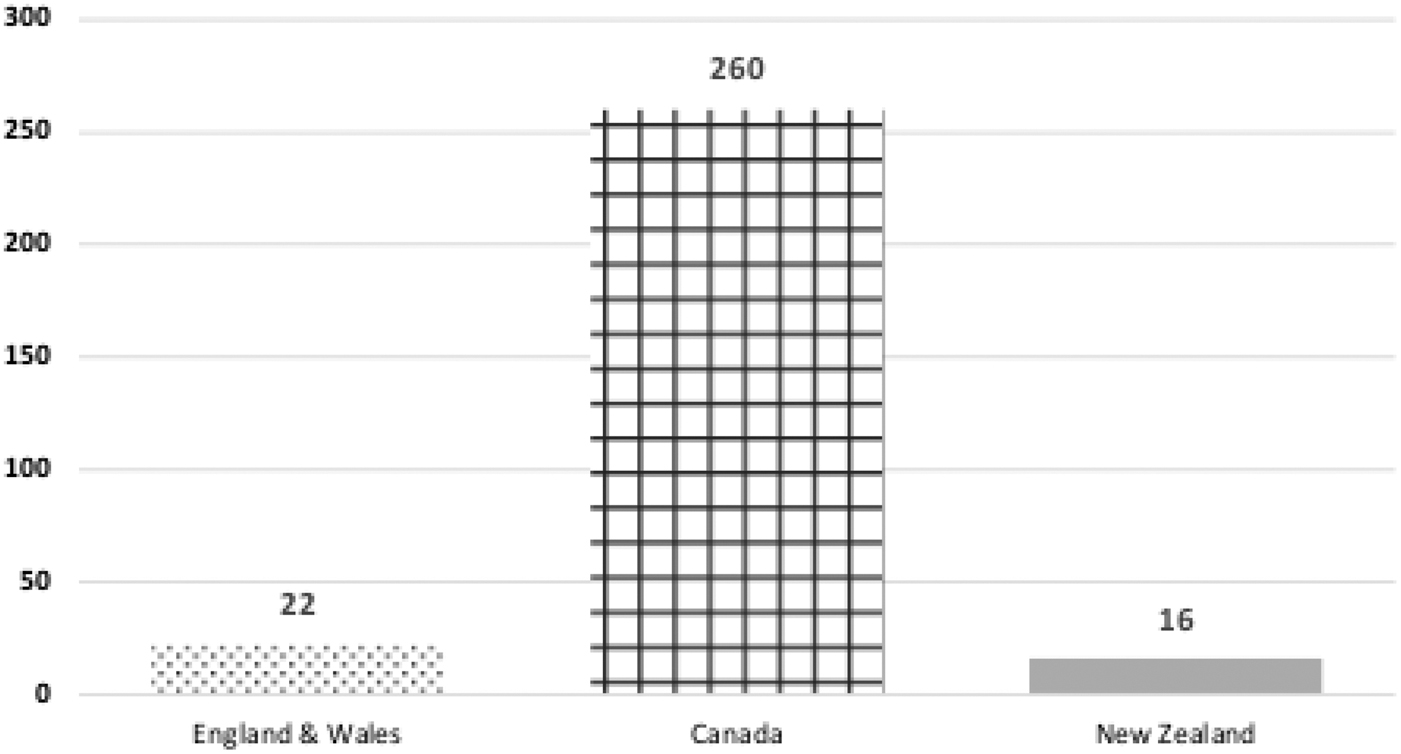
Civilians fatally shot by police: 2007–2017. Data were not publicly available for Australia covering a comparative time frame. Data sources: Huffington Post (2017), New Zealand Herald (2008), Queensland Police (2015), Radio New Zealand (2015), USA Today (2018), Wall et al. (2017), Wikipedia (2018a, 2018b).
The number of fatal police shootings in Canada was ∼12 times higher than that in England/Wales, and 16 times higher than that in New Zealand. Population differentials do not explain these figures. Most notably, despite having a larger population than Canada, police shootings in England/Wales were significantly lower (22 compared with 260).
National data: general risk/community safety
It is reasonable to presume that police within any jurisdiction (whether routinely armed) are more likely to discharge a firearm in response to potentially lethal force, or where there is a heightened risk of serious crime or harm. Such situations will, of course, be varied, and not easy to predict. Several indicators of general risk, and associated community safety, are set out here: homicides, homicides by firearm, and the number of violent offenses causing injury. Of course, high-risk situations may not necessarily involve firearms, and only a small proportion of police interactions will be in response to a homicide.
Figure 3 depicts the total number of homicides for the period 2007–2016. Homicide numbers in England/Wales map closely to those in Canada, despite the population of Canada being about a third lower. Homicide numbers in Australia and New Zealand are proportionate to their relative populations, and that of England/Wales. Canada has the highest number of homicides in relation to its population.

Total number of homicides, by country: 2007–08 to 2015–16. The annual reporting periods for each jurisdiction are not identical. Data sources: ABS (2016), AIC (2017), New Zealand Police (2018a, 2018b), ONS (2017), Queensland Police (2018a), Statistics Canada (2018a), Toronto Police Service (2018a), UK Government (2018).
Figure 4 maps the recorded numbers of firearm homicides between 2010 and 2016. Despite having a much smaller population and a lower total number of homicides, Australia recorded broadly similar numbers of homicide by firearm to England/Wales. New Zealand recorded minimal homicides by firearm, while Canada experienced the highest levels of gun-related homicides by a notable margin.
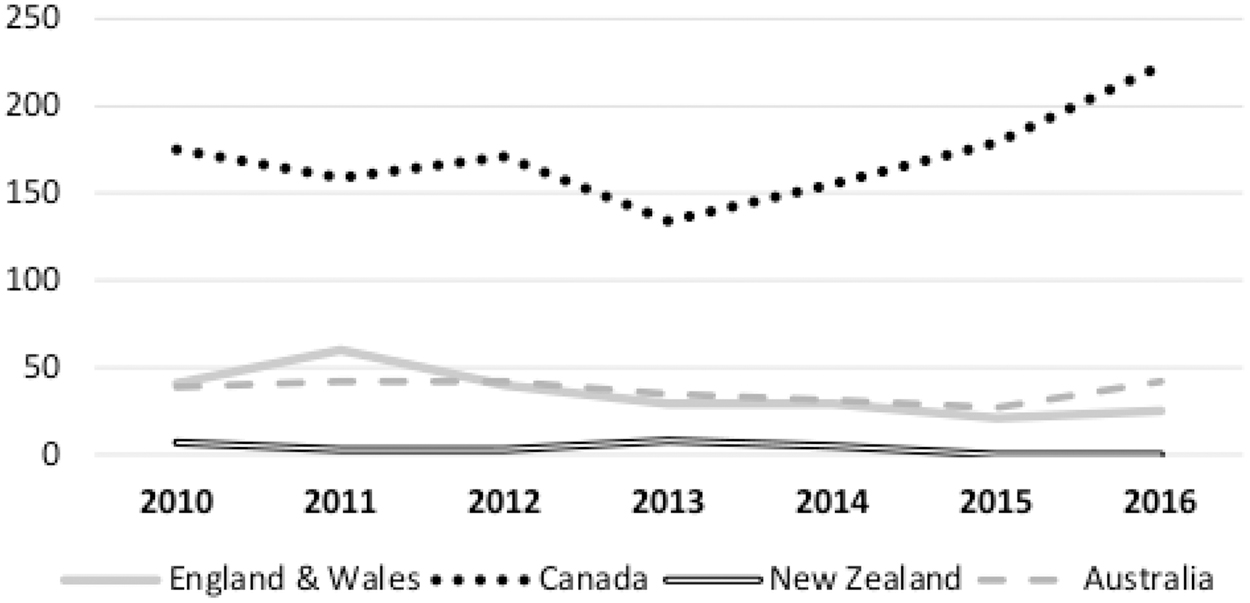
Figure 5 maps recorded numbers of violent offenses causing injury in England/Wales and Canada. It reveals largely consistent numbers, despite the population differential.

At a national level, these preliminary data suggest that the routine arming of police officers does not automatically make the community safer. Indeed, in Canada, civilians appear to be at much greater risk of violent crime and homicide generally, of harm from armed offenders, and of harm from the armed police themselves.
City data: populations
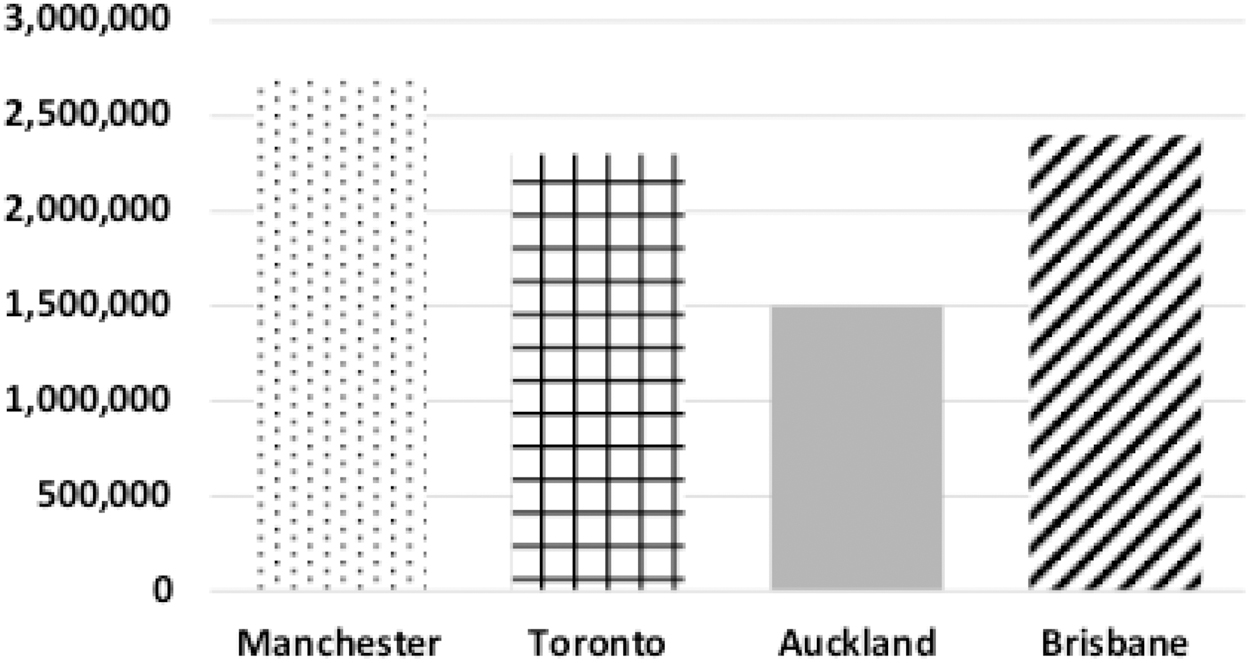
Turning our attention to the four cities, once again, the relative populations form a key basis for analysis, and are set out in Figure 6. Manchester is the most populous, followed closely by Brisbane and Toronto, and then Auckland.
City data: fatal police shootings
Figure 7 compares the number of civilians fatally shot by police in each city, this time for the period 1980–2017.

Civilians fatally shot by police: 1980–2017. Data for Brisbane relate to the whole of Queensland, and for a much shorter period (2000–2014). Data sources: Huffington Post (2017), New Zealand Herald (2008), Queensland Police (2015), Radio New Zealand (2015), USA Today (2018), Wall et al. (2017), Wikipedia (2018a, 2018b).
Despite being the most populous city, Manchester recorded only one fatal police shooting across the whole 37-year period. By contrast, Toronto recorded 24 fatal police shootings and Auckland 6. The data for Brisbane are not directly comparable, as the 18 fatal shootings relate to the whole State of Queensland over a much shorter period (14 years rather than 37). Brisbane accounts for ∼45% of Queensland's population (Queensland Government 2015; Queensland Police 2017), so direct comparison with the other three cities is limited. However, the findings still point to a higher number of fatal police shootings when compared with Auckland and Manchester. Data for nonfatal shootings will be examined as the study progresses.
City data: general risk/community safety
It is possible that the higher number of fatal police shootings in Toronto reflects police responses to higher levels of serious crime. Figure 8 maps the recorded numbers of homicides in each city between 2003 and 2017.
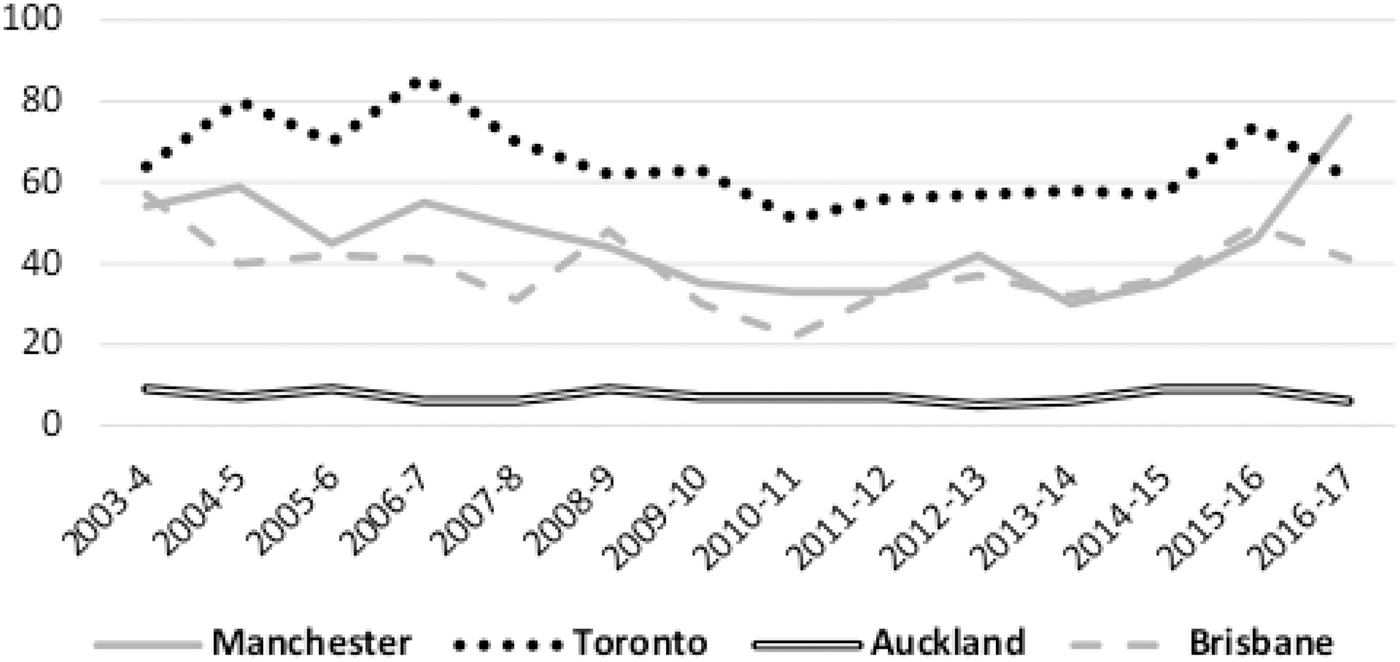
Toronto does record the highest number of homicides of the four locations, but the relative difference when compared with the other cities is notably lower than that for fatal police shootings. Homicide numbers in Manchester sit between about one half and two thirds of numbers in Toronto. Yet, the number of fatal police shootings was 24 times higher in Toronto than in Manchester. The reasons for police shootings are complex and not necessarily directly linked to homicide rates, but the results continue to suggest that the routine arming of police officers correlates with a greater risk of harm from a police firearm.
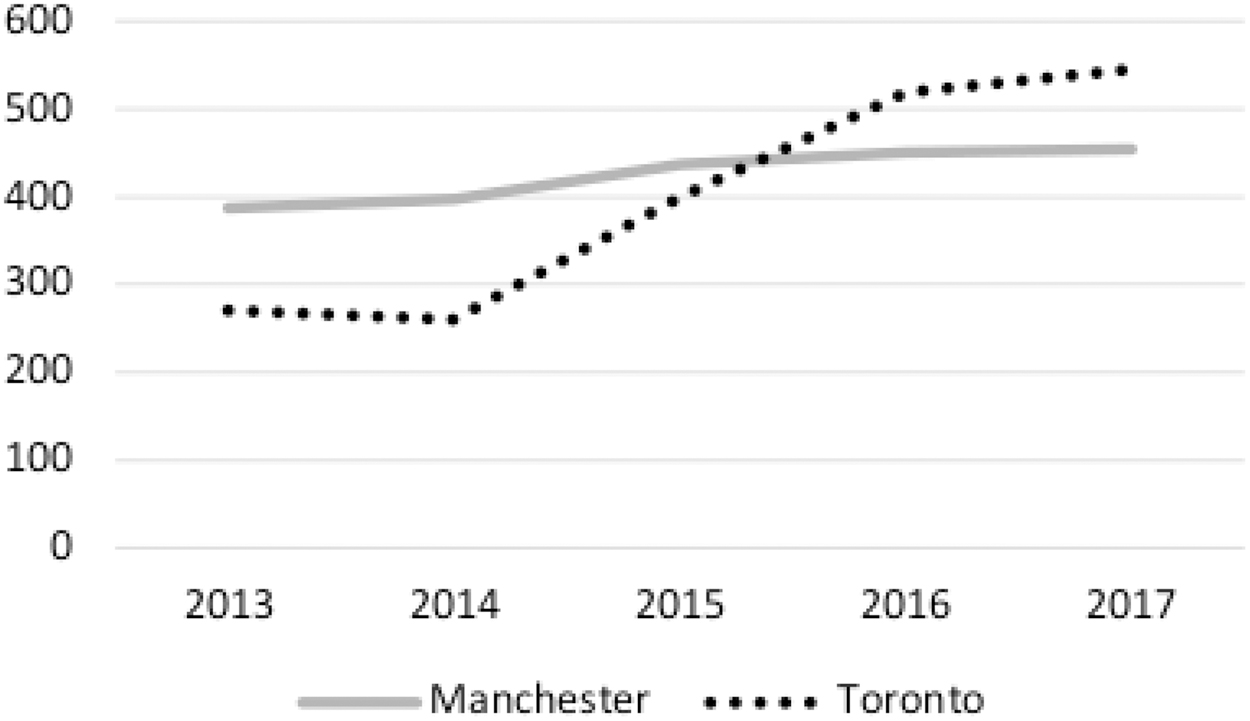
To interrogate the differences a little further, Figures 9 and 10 offer a comparison of firearms offenses recorded in Manchester and Toronto. These two cities are polar opposites with respect to the routine arming of police. In absolute terms, the difference in the number of firearms offenses (point and/or discharge) between 2013 and 2017 is small. In relative terms, in both 2015 and 2016, firearms were present during violent crime in Toronto at about twice the rate in Manchester. However, this difference is again notably lower than the comparative risk of being fatally shot by an offender or by police in Toronto or Manchester (Fig. 2).

Police officer safety
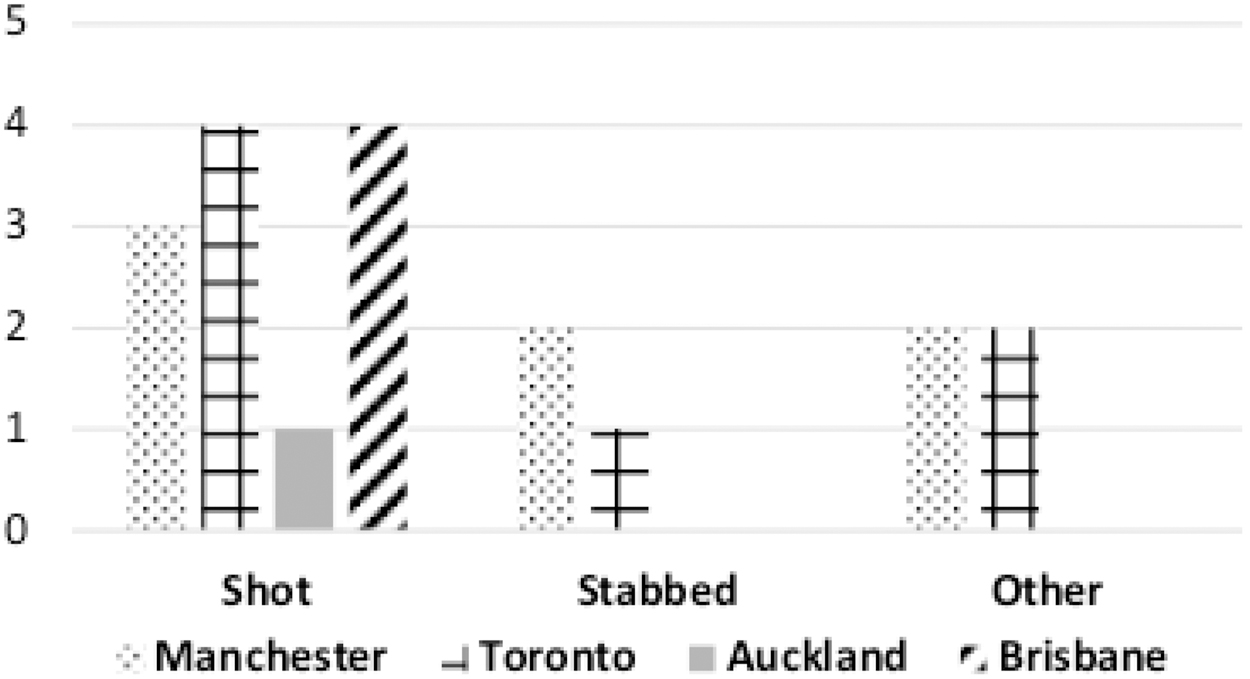
Finally, we turn to police officers themselves—and whether being routinely armed makes them safer. It is difficult to obtain public data relating to police injury for each of the four locations, but police deaths are recorded. Figures 11 and 12 illustrate the number of police officers killed in the line of duty (excluding accidents such as vehicle collisions) in each location.
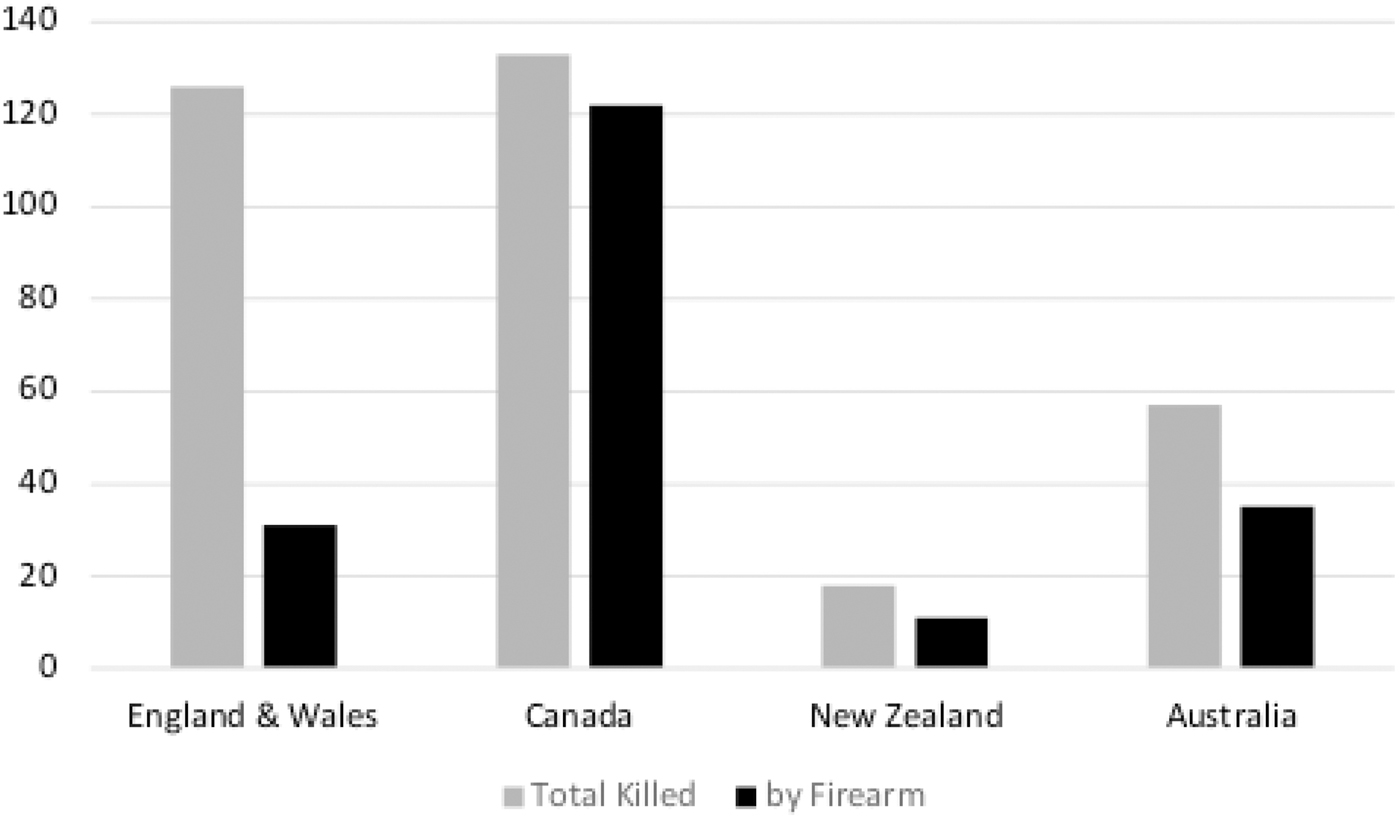
Given its population, Canada recorded a disproportionate number of police deaths, when compared with the other locations. In England/Wales, 25% of police deaths were caused by firearms, compared with 92% in Canada, and 61% in New Zealand and Australia.
The number of nonaccidental police deaths shows remarkable similarity across all four cities. Manchester and Toronto both recorded seven, Brisbane four, and Auckland just one. These are simple datasets, and particularly at city level, any assumptions discerned are speculative. However, the data suggest that being armed does not reduce the likelihood of a police officer being killed in the line of duty. For those officers who are killed, being routinely armed correlates with a greater likelihood of being shot. The study will continue to examine police officer risk and harms (including injury, trauma, self-harm (including by accident) and the use of firearms as a method of suicide).
Discussion
This article sets out some high-level findings that have emerged from preliminary analysis. It is too early for a full discussion, but some interesting indicative correlations are evident.
When we set the number of fatal police shootings against levels of serious crime and population size, England/Wales and Manchester record comparatively low numbers of serious crime and fatal police shootings, despite being the most populous locations. In New Zealand, the number of homicides by firearm is low, but fatal police shootings are relatively high, particularly when compared with England/Wales. Despite a population about half that of England/Wales, Australia records similar numbers of homicides by firearms and higher levels of civilians shot by police. Canada and Toronto experience higher levels of serious crime and notably higher numbers of fatal police shootings of civilians when compared with all other locations.
The findings indicate that the number of fatal civilian shootings by police is higher where police are routinely armed. Homicide and violent crime are also generally more prevalent where police are routinely armed, but the differences are not sufficient to account for the discrepancy in fatal police shootings. The numbers of nonaccidental police deaths are comparable across all city locations, but clear differences are evident at a national level—with a disproportionately high number in Canada, the vast majority of which are caused by a firearm.
It is simplistic to ascribe differences in civilian shootings and police deaths only to the routine arming of police: other factors undoubtedly contribute. However, that does not negate the validity of these findings—that there is an absence of clear evidence that arming police automatically or necessarily makes them or the community safer. Armed police may feel safer, but our findings mirror Hendy's assertion that “routine armament may not necessarily be the silver bullet to improve police safety, as some believe it might be” (Hendy 2014, p. 191).
In the context of recent high-profile events, and renewed debate about the need to routinely arm currently unarmed police, these findings provide an essential additional dimension. Rather than being driven by assertions of need, perceived risk, or the interests of political expediency, any proposed change to police firearm policy or operational practice must consider the data that are available.
Conclusion and Next Steps
This article has drawn attention to key questions about the effect of the routine arming of police. It is generally accepted that a police officer with a firearm is likely to make different choices about how to handle a volatile situation than a police officer who does not have a firearm. The latter will, of necessity, focus on deescalation and containment. By contrast, an officer carrying a firearm has the option of fatal force from the outset. The findings presented in this article demonstrate that the extent to which routinely arming police changes the nature of policing and the associated risks, to the community and to the officer, merits much deeper analysis. As Hendy (2014, p. 191) observed,
… routinely armed officers may be more readily equipped to deal with dangerous firearm incidents, in terms of their ability to have immediate access to firearms, but their armed status does not necessarily equate to an increase in safety…
Furthermore, when it comes to the use of potentially lethal force, in Great Britain there is an operational threshold and procedural expectation of absolute necessity. This contrasts with the reasonable belief model, which predominates in the United States (Squires and Kennison 2010) and which, according to Gross (2017, p. 67), encourages a “‘shoot first, think later’ approach to policing.” The wider effect of institutional factors and policing tradition, highlighted by Zimring (2017), adds a further layer of philosophical and operational complexity.
We acknowledge the limitations of generalized comparisons, and of using public data that may be incomplete, unverified, or not directly comparable. We are also mindful that our findings reveal differences both within the jurisdictions where police are routinely armed and within those where they are not. This affirms the influence of other factors, such as broader gun culture, core demographics and associated challenges, police training and procedural expectations, the nature and effect of police militarization. Moving forward, we are expanding our analysis to examine additional offense categories, comparing relevant use of force guidelines and operational practices across jurisdictions, examining mental health awareness provisions and practices, and ensuring a deeper exploration of the effect on officer and community safety of the routine arming of police.
While we recognize the need for ongoing research, these preliminary findings suggest that routinely arming police does not correlate with lower levels of serious crime, but it does appear to correlate with an increased likelihood of being fatally shot by police. A direct causal link is not claimed. However, the findings cast doubt upon the underlying but rarely challenged rationale for routinely arming police that it makes the community safer.
Footnotes
Author Disclosure Statement
No competing financial interests exist.
Funding Information
No funding was received for this article.
1
In New Zealand, firearms are carried securely in frontline vehicles.
2
The obvious omission from the sample is a city of similar size in the United States. It was decided to exclude the United States from this study, at least in the initial stage. Statistically, the United States is an outlier, due to prevailing public attitudes to firearms, their ready availability and prevalence in the wider community (Evans et al., 2016). For a comparative perspective, which does include policing in the United States, see Sarre ( ).
).
3
Accessed in November 2018.