




Abstract
Abstract
The objective of this study was to investigate whether state-level gender inequity is associated with state-level intimate partner homicide rates (IPHR), male homicide rates, female homicide rates, firearm-related homicide rates, and overall homicide rates over the period of 2000–2017 in the United States. Using a cross-sectional design, we evaluated the association of state-level gender inequity with seven types of homicide victimization between 2000 and 2017 in the United States. We obtained annual state-specific overall, male and female IPHR, annual state-specific, male, female, and total homicide rates, and firearm homicide rates. We also created a gender inequity index at the state level that comprised health, labor, and empowerment dimensions. We used a negative binomial model to calculate incidence rate ratios (IRR) to represent the percentage difference in homicide rate for each one standard deviation increase in gender inequality. After controlling for variables known to be correlated with homicide, we found that the average state-level gender inequity index was associated with all measures of homicide, including total homicide rates (IRR 1.05, confidence interval [95% CI] 1.03–1.08), total intimate partner homicide victimization rate (IRR 1.09, 95% CI 1.03–1.16), female intimate partner homicide victimization rate (IRR 1.08, 95% CI 1.02–1.15), male intimate partner homicide victimization rate (IRR 1.14, 95% CI 1.04–1.25), female homicide victimization rate (IRR 1.07, 95% CI 1.03–1.12), male homicide victimization rate (IRR 1.06, 95% CI 1.02–1.10), and firearm homicide victimization rate (IRR 1.06, 95% CI 1.02–1.11). Gender inequity is associated with rates of overall homicide, intimate partner homicide, female homicide, male homicide, and homicide with a firearm at the state level in the United States. Promoting gender equity at the state level may contribute to social changes that could help reduce homicide rates, including IPHR.
Introduction
In 2016, there were 17,205 homicides in the United States. Of these, 66% were perpetrated by someone known to the victim such as a family member or acquaintance (Puzzanchera et al. 2018). Rates of intimate partner homicide specifically, have declined steadily over the past 40 years in the United States (Fox and Fridel 2017; Puzone et al. 2000). Nonetheless, it remains a gender-based violence problem: 42% of all homicides of women are perpetrated by intimate partners, while only 5% of homicides of men are (Cooper and Smith 2011). Furthermore, while the rate of intimate partner homicide involving male victims decreased by 71% from 1976 to 2015, it decreased substantially (55%) for intimate partner homicides involving female victims (Fox and Fridel 2017). “Femicide” is a term used to describe homicide of women, irrespective of the relationship between the victim and perpetrator; although the vast majority of femicide worldwide is perpetrated by a current or former intimate partner, intimate partner homicide and femicide are sometimes used synonymously in the research literature (Garcia-Moreno et al. 2012).
It has become common for health leadership organizations like the World Health Organization to suggest that intimate partner homicide and/or femicide may be controlled using the public health method of arraying risk factors according to the levels of the social-ecological model (Krug et al., 2002; Garcia-Moreno et al. 2012; Gressard et al. 2015). The social-ecological model suggests that for any health issue, one should consider predisposing factors at the individual, peer, family, community, institutional, and societal level (Bronfenbrenner 1977). Gender inequity, gender inequitable attitudes, and traditional gender norms are now often named as societal-level factors suspected of contributing to intimate partner homicide and/or femicide (Garcia-Moreno et al. 2012; Heise et al. 1999). Gender inequity is typically defined based on aspects of health, education, economic participation, and political empowerment, and has previously been assessed at the national level (Caman et al. 2017).
Why and how gender inequity might influence homicide and/or femicide rates have been explained by a theory called the ameliorative hypothesis (Whaley and Messner 2002). This theory posits that when men have better access to and control of resources and opportunities, the result is a cultural belief system that devalues women relative to men (Whaley and Messner 2002). This might influence homicide rates in two ways. First, if men perceive that society considers them superior to women, they may feel more entitled to aggress against women who threaten their sense of superiority (DeWees and Parker 2003; Vieraitis et al. 2007; Whaley and Messner 2002). Second, men in situations of gender inequity may perceive that they may have impunity for violent crimes against women (CMDPDH 2012; Whaley and Messner 2002). A reason why a more gender equitable society may result in fewer male-on-male homicides is that gender inequity may encourage certain forms of masculinity, including propensity to violence more generally (Whaley and Messner 2002).
Two prior studies have provided evidence that gender inequity at the state level may be related to partner violence victimization in the United States (Gressard et al. 2015; Willie and Kershaw 2019). First, a study of youth dating violence victimization in the United States created a gender inequality index (GII) score of United States for the year 2013. This study found that a state's GII score was associated with the percentage of high school-attending females, but not males, who reported being physically assaulted by a dating partner in the past year (Gressard et al. 2015). A second study examined state-level prevalence estimates of partner violence from 2010 to 2012, and used the same indicators as Gressard and colleagues to calculate state-level GII for the years 2005–2009 (Willie and Kershaw 2019). This study found that the state-level GII score was associated with nonfatal partner violence victimization for women, but not for men.
The prior two studies were groundbreaking for characterizing gender inequality at the state level in the United States and attempting to correlate GII with a state-level indicator of partner violence. However, both studies are limited in that they only examined intimate partner violence for 1 or 2 years, and assessed GII in a single year. They also did not study homicide. Building upon these preliminary studies, we examined the relationship between GII at the state level using data from 2000 to 2017, including annual state-specific homicide rate data. This study was designed to investigate whether state-level gender inequity would be strongly, positively associated with state-level intimate partner homicide rates (IPHR) over this 17-year period. We also investigated whether state-level gender inequity was associated with the state-level femicide rate, homicide of men, firearm-related homicide, and homicide overall.
Materials and Methods
Design overview
Using a cross-sectional design, we evaluated the association of state-level gender inequity with seven types of homicide victimization between 2000 and 2017 in the United States.
Outcome variables
Annual state-specific male, female, and total IPHR
First, we examined total annual IPHR and gender-specific IPHR in each state, derived from absolute homicide counts from the Supplementary Homicide Reports (SHR) of the Federal Bureau of Investigation's (FBI's) Uniform Crime Reports (Barber et al. 2002; Loftin et al. 2008; Shields and Ward 2008). This source was needed because the Centers for Disease Control and Prevention's Web-Based Injury Statistics Query and Reporting Systems (CDC WISQARS) does not report the victim-offender relationships for homicides. The SHR, which is compiled from monthly reports submitted by state and local law enforcement agencies to the FBI, includes data on the victim-offender relationship when it is known. Categories of the victim-offender relationship include spouses, common-law spouses, ex-spouses, and dating partners, but not former dating partners (Langford et al. 1998). In approximately one-third of cases, the SHR is missing data on the victim-offender relationship. However, a multiple imputation procedure has been developed and used for these missing data (Fox and Swatt 2005). In this approach, the victim-offender relationship is assessed using demographic and other variables based on modeling of the relationship of these variables to the victim-offender relationship in known cases. Fox provided us with multiply imputed files that cover the entire period 2000–2017 (Fox 2018). We have previously demonstrated that regression results obtained using the imputed data are similar to those obtained using only the cases in which the offender-victim relationship is known (Diez et al. 2017; Siegel et al. 2014).
Annual state-specific, male, female, and total homicide counts
The second set of outcome variables was the annual count of male, female, firearm-related, and total homicides in each state, obtained from the CDC WISQARS database (U.S. CDC 2019). This is the best source for homicide data, as it relies upon standardized death certificates maintained by the National Center for Health Statistics (NCHS). In addition, ∼99% of all deaths are reported to NCHS (Regoeczi and Banks 2014). Reported homicides include murder and nonnegligent homicide, but exclude deaths due to unintentional injury or law enforcement (i.e., police killings).
The CDC does not report homicide counts that are less than 10. Consequently, outcome data for several of the smaller states were missing for several years. Thus, we excluded six states for which there were data for fewer than 8 years: New Hampshire, North Dakota, Rhode Island, South Dakota, Vermont, and Wyoming.
Exposure variable
Gender inequity at the state level
We created an index based on the United Nations' Gender Inequality Index (Griffith and Rose 2016). Consistent with the United Nations index, our index reflects gender-based disadvantages across three domains: health, labor, and empowerment, and comprises six indicators: (1) chlamydia rate per 100,000 people, for which data were obtained from the U.S. CDC STD Surveillance Reports 2000–2017; (2) annual number of live births per 1000 girls 15–19 years of age (i.e., adolescent birth rate), for which data were obtained from the CDC, NCHS database; (3) the ratio of women's labor market participation rate compared to men's, for which data were obtained from the Bureau of Labor Statistics (United States Department of Labor, 2019); (4) the ratio of female-owned businesses to male-owned businesses, for which data were obtained from the Survey of Business Owners from the U.S Census Bureau; (5) the ratio of women's median earnings compared to men's, for which data were obtained from the American Community Survey from the U.S. Census Bureau; and (6) the percentage of state legislators that are female, for which data were obtained from the National Conference of State Legislator's website (Supplementary Table S1). Index score values range from 0 to 1: 0 reflects greater equity between males and females, and 1 reflects greater inequity.
Control variables
We controlled for several state-level factors known to be associated with homicide victimization rates in our analysis, including total population size, population density, percent black, percent Hispanic, the Gini coefficient (a widely used measure of income inequality), poverty rate, unemployment rate, nonhomicide violent crime rate (assault, robbery, and rape), property crime rate (burglary, larceny, and motor vehicle theft), percentage of the population that is young adults (18–34 years of age), incarceration rate, percentage of state population that is married (15 years os age and older), percentage of state population that is divorced or separated (15 years of age and older), and the percentage of households with a gun (derived using a widely used proxy: the proportion of suicides committed with a firearm) (Azrael et al. 2004).
Analytic methods
We used a negative binomial model because our outcome was a count variable that is not normally distributed, but skewed and overdispersed. The outcome was the number of homicides of a given type in a particular state in a given year, and the offset was the log of the relevant population. For example, when modeling the female homicide counts, we used the log of the female population as the offset. The use of the offset accounts for the different population sizes across states and is essentially modeling differences in homicide rates. We chose a negative binomial over a Poisson model because there was overdispersion (i.e., the standard deviation of the outcome variable was greater than the mean).
Our panel data were clustered by year (18 levels) and by state (44 levels). We entered year as a fixed effect in the regression models to control for clustering by year. We used a GEE approach to account for clustering among states (Liang and Zeger 1986). We used a first-order autoregressive working correlation matrix and robust variance estimators to produce consistent standard errors (Horton and Lipsitz 1999; Liang and Zeger 1986; Pendergast et al. 1996). These standard errors are robust to the presence of serial autocorrelation and heteroscedasticity (Marvell, 2001). We assessed model fit using the quasi-information criterion, which Pan identified as the ideal criterion to assess the choice of correlation assumptions for GEE models (Pan, 2001). Based on this criterion, a first-order autoregressive working correlation matrix produced the best fit for the data. All analyses were conducted using STATA version 15 (College Station, TX: StataCorp, 2019). To make it easier to interpret the coefficients from the negative binomial regression, we calculated and report incidence rate ratios (IRR) with standardized covariates. The IRR can therefore be interpreted as the percentage difference in homicide rate for each one standard deviation increase in that variable.
Results
Average state-level GII scores ranged from 0.23 (Vermont and New Hampshire) to 0.40 (South Carolina and Alabama) between 2000 and 2017 (Table 1). We also observed variation in annual state-level homicide victimization rates (Fig. 1). For example, across the years 2000–2017, New Hampshire had the lowest average: overall homicide rate (1.39/100,000), overall IPHR (0.29/100,000), female victimization IPHR (0.46/100,000), male homicide rate (2.00/100,000), and firearm homicide rate (0.72/100,000). Massachusetts had the lowest average female homicide rate (1.00/100,000), and Minnesota had the lowest average male victimization IPHR (0.14/100,000). In contrast, across the years 2000–2017, Louisiana had the highest average: overall homicide rate (12.75/100,000), overall IPHR (1.41/100,000), female victimization IPHR (1.8/100,000), male victimization IPHR (0.89/100,000), male homicide rate (20.95/100,000), and firearm homicide rate (9.98/100,000). Alaska had the highest average female homicide rate (4.73/100,000).
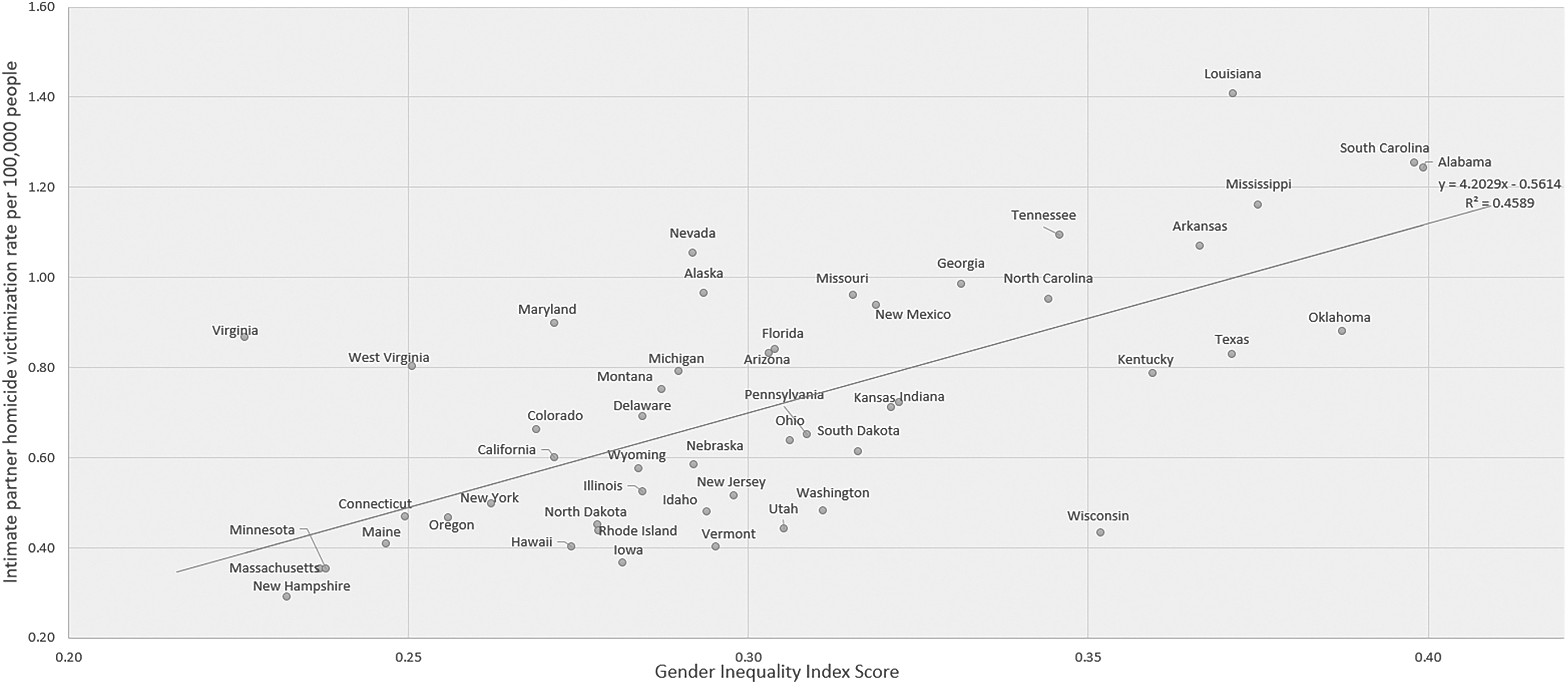
Intimate partner homicide victimization rate versus gender inequality score, 2000–2017.
Average Gender Inequality Index Score and Homicide Victimization Rates (per 100,000), 2000–2017
The average state-level GII was associated with total homicide victimization rates, controlling for the percent of the state identifying as black race, percent Hispanic, property crime rate, nonhomicide violence crime rate, state total population, population density, poverty rate, unemployment rate, the percent of state population 18–34 years of age, the Gini income inequality index score, incarceration rate, percentage of state population that is married, percentage of state population that is divorced or separated, and percentage of households with a firearm (IRR 1.05, confidence interval [95% CI] 1.03–1.08). In other words, for each standard deviation higher on the gender inequity scale (meaning, more gender inequity), there was a 5% increase in overall homicide victimization rates. The GII was associated with the total IPHR (IRR 1.09, 95% CI 1.03–1.16), the male IPHR (IRR 1.14, 95% CI 1.04–1.25), and the female IPHR (IRR 1.08, 95% CI 1.02–1.15). Each standard deviation higher on the GII scale was associated with a 9% increase in total intimate partner homicide victimization, a 14% increase in male IPHR, and an 8% increase in female IPHR. The GII was also associated with the overall female victimization homicide rate (IRR 1.07, 95% CI 1.03–1.12), the overall male victimization homicide rate (IRR 1.06, 95% CI 1.02–1.10), and the firearm homicide rate (IRR 1.06, 95% CI 1.02–1.11). Each standard deviation higher on the GII scale was associated with a 7% increase in female homicide, and a 6% increase in both male homicide and firearm homicide (Table 2).
Relative Risk of Homicide by Gender Inequality Score, 2000–2017
Regression analyses included each individual year 2000–2017 and the years 2016 and 2017 were statistically significantly associated with the outcome.
Regression analyses included each individual year 2000–2017 and none was statistically significantly associated with the outcome.
Regression analyses included each individual year 2000–2017 and none was statistically significantly association with the outcome.
Regression analyses included each individual year 2000–2017 and none was statistically significantly association with the outcome.
Regression analyses included each individual year 2000–2015 and the years 2008–2014 were significantly associated with the outcome.
Regression analyses included each individual year 2001–2017 and the years 2005, 2016, and 2017 were statistically significantly associated with the outcome.
Regression analyses included each individual year 2001–2017 and the years 2005, and 2015–2017 were statistically significantly associated with the outcome.
p < 0.05, **p < 0.01, ***p < 0.001.
CI, confidence interval; IRR, incidence rate ratios.
The nonhomicide violent crime rate was the only variable also associated with all seven types of homicide victimization rates. Other state-specific variables associated with any type of homicide victimization include the percent of the population that is black, the percent of the population that is Hispanic, the total population size, the unemployment rate, income inequality, the incarceration rate, and the percent of households with a gun. After controlling for other factors, property crime rate, state population density, poverty rate, percent of the population that is young, marriage rate, and divorce rate were not associated with any type of homicide victimization (Table 2).
Discussion
To our knowledge, this is the first study to assess gender inequity at the state level in the United States using panel data covering a period of time longer than 1–2 years. We assessed the relationship between state-level gender inequity and state-specific homicide rates over a period of 17 years. We found that gender inequity at the state level was associated with the rate of overall intimate partner homicide, female intimate partner homicide, male intimate partner homicide, overall homicide, homicide of females, homicide of males, and firearm-related homicide in the United States between 2000 and 2017.
Our findings are consistent with those of two prior studies that found state-level GII was associated with state-level nonfatal adolescent dating violence victimization (Gressard et al. 2015) and state-level nonfatal adult partner violence victimization (Willie and Kershaw 2019), and with cross-national studies that have found that gender inequality is related to femicide at the country level (Heirigs and Moore 2018). One difference between our findings and the two prior studies of gender inequality in the United States is that, both of those studies found that state-level GII was associated with partner violence for female, but not male, victims. Furthermore, Whaley and Messner's study of the relationship between gender inequality and homicides in selected U.S. cities found that gender equality increased rates of femicide and increased male-on-male homicides in Southern states (Whaley and Messner 2002). We do not know why we found a positive relationship between gender inequality and male-on-male homicide, when a prior study found the opposite in one area of the United States. It is possible that the relationship between gender inequality and homicide is inversely related for selected cities, because they are urban areas, but including all regions of a state changes the correlation.
If state-level gender inequity is causally related to intimate partner homicide, femicide, and homicides in general, the implications would be twofold. First, there would be a public health and public safety imperative to ensure gender equity as a strategy to protect citizens' lives. Addressing gender inequity at the state level can take several forms. For example, prior research has found that sufficiently high temporary aid to families in need of (i.e., welfare) payments, microfinance programs for women, and affordable housing can each lower women's risk for intimate partner homicide victimization (Dugan et al. 2003; Kim et al. 2007; Popowicz 2018). Second, careful monitoring of trends in homicide rates at the state level, with adequate funding for the proximal and distal causes of each violent death to be tracked, would be warranted. Presently, the National Violent Death Reporting System includes data from only 40 states (U.S. CDC 2019).
Our study faced several limitations. First, we used a composite index of gender inequity using six indicators. It is possible that if we measured gender inequity differently, we might have found a stronger or weaker relationship between state-level gender inequity and homicide rates. Second, this analysis did not stratify by race/ethnicity as well as by gender. It is possible that gender inequity is related to intimate partner homicides more strongly for some racial subgroups than for others (Vieraitis and Williams 2002). Third, there may be regional variation in the relationship between gender inequity and homicide victimization (Whaley and Messner 2002). Fourth, we took a gender-binary approach to this study. Accumulating evidence suggests that transgender individuals experience disproportionately high rates of gender-based violence, including intimate partner violence (Wirtz et al. 2018), so it is likely that a relationship between gender inequity and transgender homicide also exists.
In conclusion, this article provides evidence that gender inequity is associated with rates of at least seven types of homicide at the state level in the United States. Promoting more gender equity at the state level may contribute to social changes that could help reduce homicide rates, including IPHR.
Footnotes
Acknowledgments
The authors wish to acknowledge each victim of homicide, whose death was used as a data point in this analysis. We gratefully acknowledge the assistance of James Alan Fox, PhD, the Lipman Family Professor of Criminology, Law and Public Policy at the School of Criminology and Criminal Justice at Northeastern University, who kindly provided the multiply imputed Supplementary Homicide Reports File 1976–2017, including the datasets and a codebook.
Author Disclosure Statement
No competing financial interests exist.

References
Supplementary Material
Please find the following supplemental material available below.
For Open Access articles published under a Creative Commons License, all supplemental material carries the same license as the article it is associated with.
For non-Open Access articles published, all supplemental material carries a non-exclusive license, and permission requests for re-use of supplemental material or any part of supplemental material shall be sent directly to the copyright owner as specified in the copyright notice associated with the article.
