




Abstract
Abstract
School shootings have been on the rise and researchers have documented a “contagion effect” in which school shootings increase in probability during a 2-week period following an event (e.g., Towers et al. 2015). While there is a growing body of research examining media coverage of school shootings, more research is needed to investigate the role of media coverage during the specific 2-week contagion period. The purpose of the present research was to analyze the temporal changes of themes that emerge in social media throughout the contagion period and to assess relationships between themes that may ultimately facilitate the contagion effect. We conducted an analysis of Twitter posts following the Santa Fe High School shooting in Texas, which was preceded by two school shootings the week prior and followed by another school shooting a week later. The results supported previous research suggesting that sadness is associated with greater “psychological closeness” to the event. The results also showed that both sadness and anger were strongly correlated with information about the shooter, including the shooter's name. Discourse demonstrating awareness of school shooting contagion was associated with comments about the role of media in school shootings. These findings represent the first attempt to analyze social media during the specific 2-week contagion period. Implications regarding the extent to which these themes trigger the goals of a prospective shooter are discussed.
Introduction
Mass shootings and school shootings have been on the rise in the United States for more than a decade (Federal Bureau of Investigation 2014; Katsiyannis et al. 2018). Unfortunately this trend continues, with 23 school shootings occurring between January and May of 2018. Researchers have documented a “contagion effect,” in which mass shootings and school shootings increase in probability during the 2-week period following an incident* (Bond and Bushman 2017; Kissner 2016; Kostinsky et al. 2001; Towers et al. 2015). For instance, Kissner (2016) examined the frequencies of active shooter events in Chicago from 2000 to 2009 and observed temporal clustering within 2-week periods.
Towers et al. examined mass shootings (i.e., shootings in which there are three or more victims) and school shootings (i.e., shootings carried out on school property during school hours) separately and found that school shooting incidents between 1998 and 2013 were associated with an average increase of 0.22 new incidents for an average of 13 days following the incident. Towers et al. proposed that media coverage facilitates the contagion effect and is the process by which prospective shooters develop the inspiration, identities, and knowledge that lead to copycat events (e.g., Abrutyn and Mueller 2014; Langman 2018). While previous research has examined media coverage of school shootings or mass shootings (e.g., Schildkraut and Muschert 2014), more research is needed to investigate the role of media coverage during the specific 2-week contagion period. The purpose of the present research was to analyze the temporal changes of themes that emerge in social media during the 2-week contagion period and to assess relationships between themes that may ultimately facilitate the contagion effect.
Social media during and after mass shootings
Mass shootings and school shootings are associated with negative mental health consequences in the general public, including increased fear and anxiety as well as a decreased sense of safety (Kaminski et al. 2010; Stretesky and Hogan 2001). Research that specifically focuses on analysis of social media during an active shooting has shown that multiple themes emerge during the event, including emotional reactions, information about the shooter, personal connections, thoughts and prayers, and calls for action (Mazer et al. 2015). An analysis of Twitter posts during a 6-month period following a mass shooting showed that social media users expressed sadness, anxiety, and anger, but patterns of expression differed as a function of temporal and spatial proximity (Doré et al. 2015). While sadness words decreased over time and distance, anxiety words increased over time and distance and anger words increased over distance. The use of 1st person pronouns also decreased over time. Furthermore, Doré et al. found that reasoning about abstract causes of a school shooting lead to an increase in anxiety and a decrease in sadness, whereas reasoning about the concrete details of the event lead to an increase in sadness and a decrease in anxiety.
Doré et al.'s (2015) findings supported their predictions derived from construal-level theory (e.g., Rim et al. 2013) and appraisal theory of emotions (e.g., Scherer et al. 2001). While low-level construals of an event (i.e., concrete details about how the event happened) are predicted to be more strongly associated with psychological closeness and expressions of sadness, high-level construals of an event (i.e., abstract details such as why the event happened) are predicted to be more strongly associated with psychological distance (i.e., perceived distance) and expressions of anxiety. Based on these predictions, we specifically analyzed expressions of sadness, anxiety, and anger in social media posts during the 2-week contagion period following a shooting as well as associations between expression of emotions and other themes, including construal level (e.g., causal reasoning), psychological closeness (e.g., use of 1st person pronouns), and information about the shooter.
Potential facilitation of the contagion effect
Many school shooters are motivated by a desire for fame and are likely to exhibit extreme forms of narcissism characterized by grandiosity in thought or behavior, constantly seeking admiration, and a lack of empathy (American Psychiatric Association 2013; Bushman 2018; Lankford and Tomek 2018). It is possible that the media may serve the narcissistic and fame-seeking tendencies of school or mass shooters. Research shows that school shooters receive more attention than Super Bowl and Academy Award winners in many cases (Lankford and Madfis 2017). Dahmen (2018) analyzed photographs presented in media coverage for 3 days following three school shootings and found that the ratio of photographs depicting each shooter versus each individual victim was 16–1. Research also shows that the number of victims is positively associated with the “newsworthiness” of the event (Dahmen 2018; Duwe 2004; Schildkraut et al. 2018; Silva and Capellan 2018). Levin and Weist (2018) found that participants who exhibited greater fearfulness about mass shootings expressed greater interest in reading a news story about a school shooting than those who were less fearful.
Given the likelihood that many shooters seek fame and attention in the form of public reaction (Lankford and Tomek 2018), and that emotional engagement helps to fuel public interest (Levin and Weist 2018), it is possible that public expression of emotions such as sadness, anger, and anxiety in social media during the aftermath of a shooting helps to serve the motives of a shooter. In particular, expression of negative emotions in association with details about the shooter (e.g., the shooter's name) may help to sensationalize the shooter and therefore align with many shooters' goals for fame and notoriety.
Present research
The purpose of the present research was to analyze themes that are prevalent in social media during the 2-week contagion period following a school shooting. We conducted an analysis of more than 60,000 Twitter posts about the Santa Fe High School shooting in Texas that occurred on May 18th, 2018, at 7:40 am central daylight time (CDT). This shooting was the 22nd school shooting of 2018 and the second deadliest, resulting in 10 casualties (including 8 students and 2 teachers) as well as 13 injured. The shooter was 17-year-old Dimitrius Pagourtzis who was arrested after the incident. This particular incident was selected as a case example of contagion because there were two school shootings that occurred in the week before the Santa Fe shooting and an additional school shooting that occurred 1 week later.
Coding of Twitter posts included both a priori and emergent codes (Table 1). A priori codes were based on expectations about themes identified in previous research. Emergent codes reflected relevant themes that emerged about the particular event of interest. One goal for our coding and analysis was to determine whether Doré et al.'s (2015) findings for a relationship among emotions, psychological closeness (i.e., use of 1st person pronouns), and construal level (i.e., abstract causal reasoning vs. concrete details) during a 6-month period following a shooting that is also apparent during the immediate 2-week contagion period. Based on those findings, we developed a coding scheme that included coding of emotional expression (sadness, anxiety, anger), 1st person pronouns, causal reasoning about why the shooting occurred, and posts that emphasized concrete details about the shooter (i.e., the shooter name and details frequently reported about the shooter) and the victims (i.e., victim names and details).
Coding Scheme, Keywords, and Manually Coded Themes
MSM, mainstream media.
In addition, to determine whether we could replicate previous findings during the 2-week contagion period, we were interested in other phenomena that might relate to the contagion effect. For instance, we were interested in whether there are different patterns associated with an emphasis on the shooter versus the victims in the Twitter posts, possibly in response to advocacy against naming the shooter to reduce the risk of mass shooting contagion or copycat events (Dear Members of the Media 2017; Federal Bureau of Investigation 2017; Lankford and Madfis 2017). We were also interested in themes that emerged during preliminary review of the Twitter data and word frequency analysis. Preliminary coding revealed causal reasoning that was occurring at multiple levels of construal, including (1) more abstract, generalized causes that are commonly included in media coverage about school shootings (i.e., access to guns, mental illness, political orientations), (2) more situation-specific causes that are inferred based on knowledge of the shooter (e.g., the shooter was a victim of bullying), and (3) specific reasoning about the personal motive or intentions of the shooter from the shooter's perspective. Another salient theme that emerged early in the coding process was Twitter users' awareness of shooting “contagion” and the media's role in perpetuating this type of violence. Awareness of contagion included references to prior shootings as part of a post about the Santa Fe High School shooting or references to patterns of repeated shootings (e.g., “another” school shooting; when will it end). Awareness of the role of media included commentary regarding the way in which media or mainstream media are reporting about the event. We also coded for general incident reporting (e.g., “happening now,” “active shooter”). Overall, we were interested in the content of social media during the specific contagion period, the extent to which relationships between themes could inform our understanding of public reactions during this time and the extent to which social media might align with potential fame-seeking motives of school shooters.
Methods
We obtained over 14 million tweets (i.e., short messages of 280 characters or less posted on Twitter.com) from Twitter containing the keywords shooting, shot, shots, gunman, shooter, active shooter, and gunfire via the Twitter Streaming Application Programming Interface (API) between 7:43:29 am CDT on May 18th, 2018 and 7:19:25 pm CDT on June 8, 2018. The final data set consisted of 63,901 tweets that each contained both “Santa Fe” and the stem “shoot” and excluded items that were retweets, responses to tweets, or were not written in English (this is addressed as a limitation in the Discussion section below). The data set was divided into 8-h periods across the 14-day period to allow for examination of temporal changes in relative proportion of codes. All identifying information (e.g., tweet ID) was excluded from coding and analysis.
Coding
Tweets were coded using NVivo qualitative data analysis software. NVivo software provides the capacity to conduct word frequency analyses, automatically code Tweets using keywords, manually code and uncode data with ease, calculate interrater reliability, and extract data regarding frequencies of codes or percentage of code “coverage.” The complete coding scheme is presented in Table 1. We implemented a combined automated and manual coding procedure that included a priori codes based on previous research and codes that emerged from the data (see the Introduction section for a more thorough explanation regarding the way in which previous research and goals for the present research influenced the development of codes). The coding process proceeded in a series of five stages.
Stage 1—Apply previous research to establish a list of a priori codes.
Stage 2—Manually code tweets to identify emergent themes.
Stage 3—Use NVivo's qualitative data analysis software to obtain an automated list of highest frequency words and categorize those words into relevant themes.
Stage 4—Use NVivo to automatically assign tweets containing relevant keywords.
Stage 5—Manually examine the context of tweets assigned to specific codes to ensure accurate assignment of tweets
A priori codes included emotional expression (sadness, anxiety, anger), use of 1st person pronouns, causal reasoning about why the shooting occurred, posts that emphasized information about the shooter (i.e., shooter name and other shooter-related details reported in the media), posts that emphasized information about the victims (i.e., victims' names and other victim-related details reported in the media), incident reporting, contagion awareness, and references to the role of media. As stated in the introduction, causal reasoning was coded at three levels of psychological closeness. An emergent theme about a situation-specific cause occurred in response to reports that the shooter might have been a victim of bullying at his school and that bullying may have played a causal role in this shooting. An emergent theme about the shooter's motive or intentions emerged in response to reports that the shooter had been publicly rejected by a female student and that this student was among the first to be killed. Other references to the shooter's personal motive or perspective included comments about embarrassment and his desire to commit suicide. The use of 1st person pronouns was also subdivided into varying levels of psychological closeness, including singular (i.e., I, me, my) versus plural (i.e., we, us, our) pronouns, with singular pronouns indicating greater psychological closeness. Twitter posts were also coded for words or terms that reflected basic incident reporting and commentary about the role of the media. (e.g., “Why isn't the media talking about the Santa Fe shooting like they talked about parkland”).
All tweets were automatically assigned to codes through application of keywords. Some keywords were ambiguous or were used for multiple codes (e.g., “why” was relevant for the “generalized cause” code and the “shooter motive” code) and were examined manually to ensure accuracy. There were three raters who completed manual coding. Two days of tweets (i.e., six 8-h periods) were coded by all raters to determine interrater reliability. Cohen's Kappa was 0.59, suggesting that agreement was moderate to substantial (Landis and Koch 1977). Average agreement was 98.85%.
Results
The focus of the Twitter analysis was on relative proportions of themes throughout the contagion period and relationships between tweets that expressed particular themes. Although the frequency of overall Twitter posts dropped within the first few days following the event (Fig. 1), the relative proportion of Twitter posts representing particular themes changed over time. For instance, as can be seen in Figure 2, the frequency of words used in Twitter posts shifted from days 1 to 2, with an increase in emphasis on victims and contagion awareness (i.e., “another”), and a decrease in emphasis on the shooter.
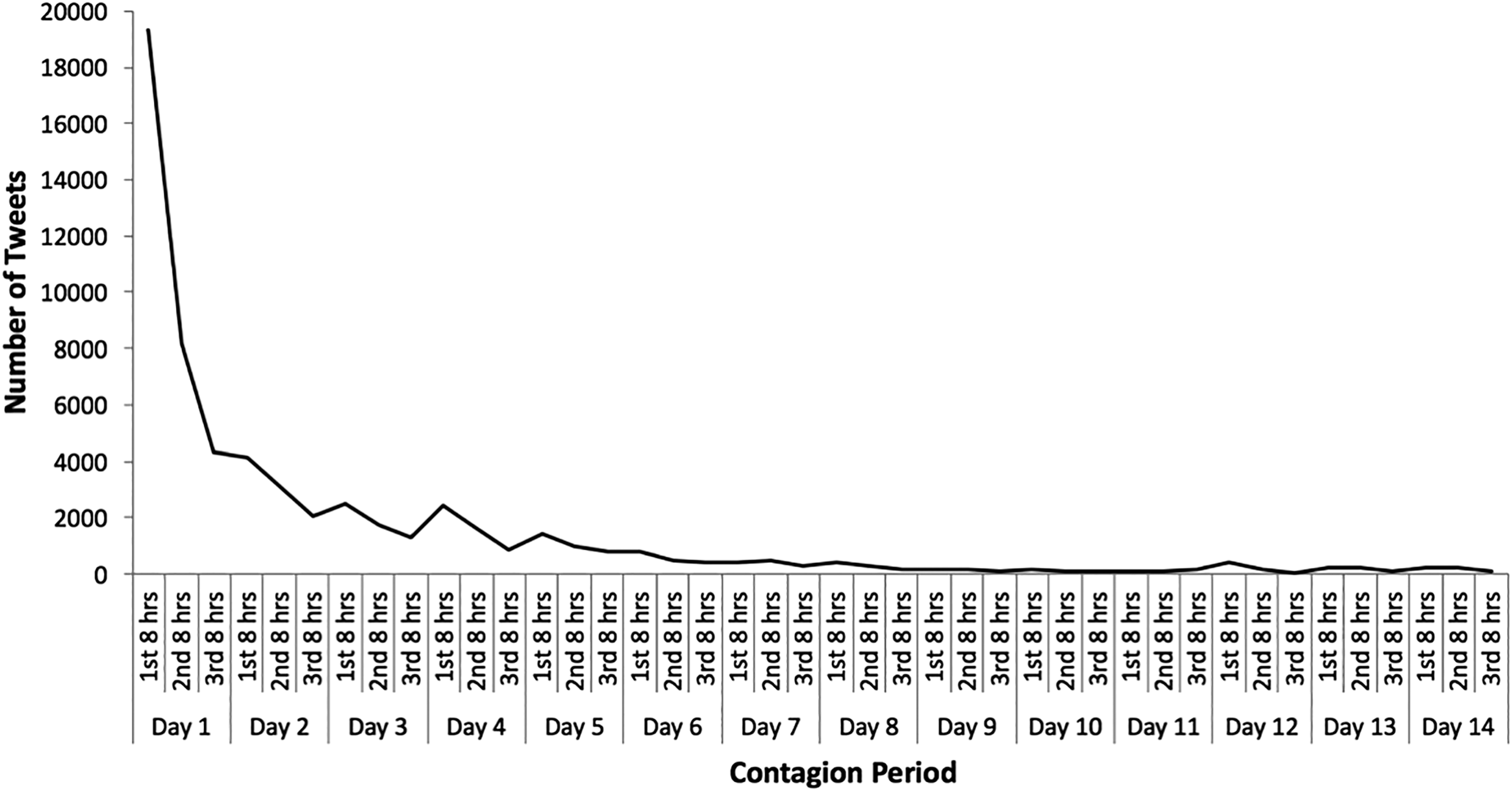
Changes in overall frequencies of Twitter Posts during the contagion period.
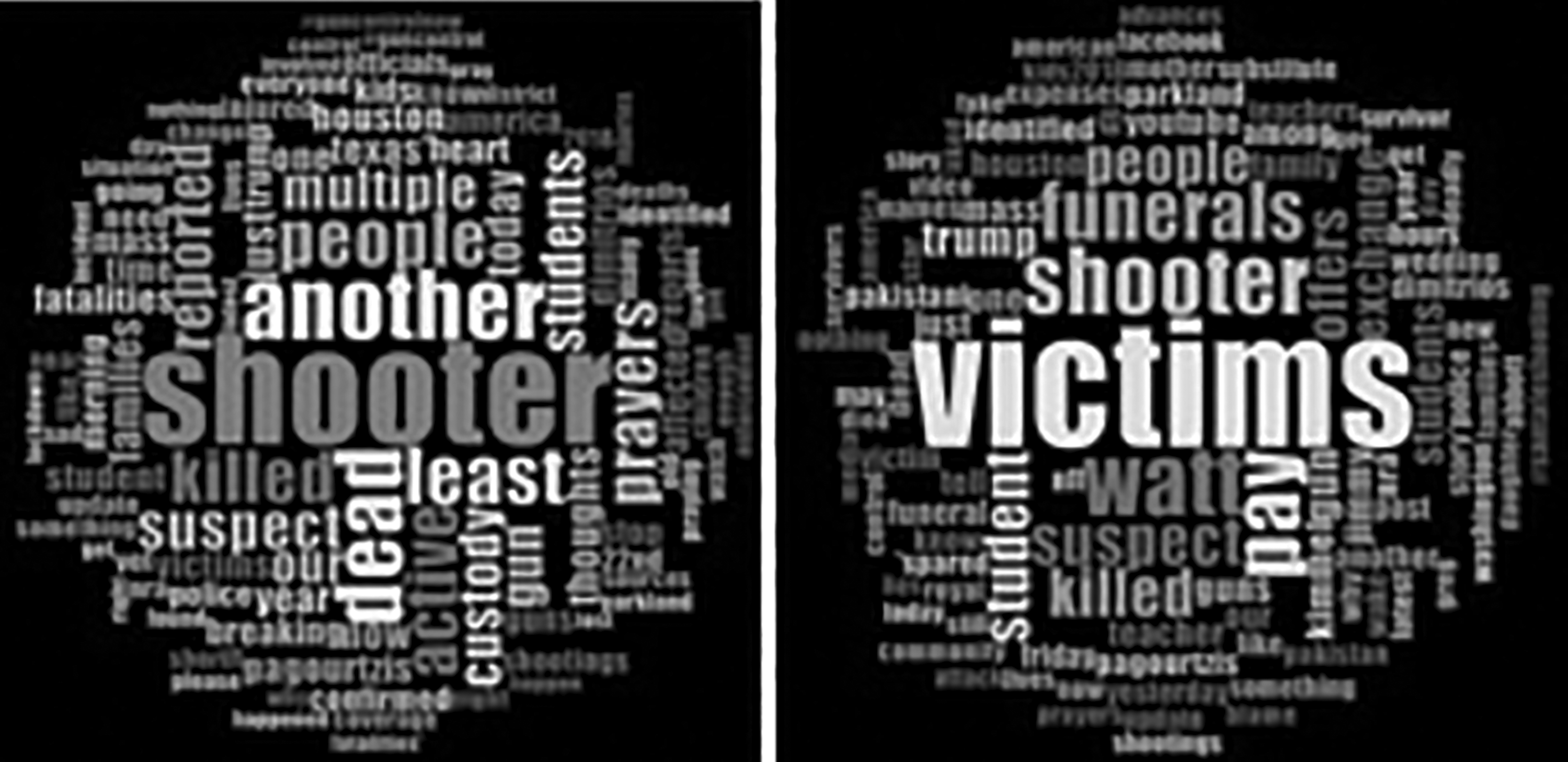
Word Clouds representing most frequent words used in Twitter Posts during day 1 versus day 2 following the incident.
An exploratory factor analysis was conducted to examine associations between themes. The results revealed six factors with eigenvalues >1. Factor loadings are presented in Table 2 and the correlation matrix for all themes are presented in Table 3. The first factor accounted for 28% of the variance (eigenvalue = 3.03) and reflected correlations between posts that included expressions of anger, expressions of sadness, the shooter's name, the shooter's details, and singular 1st person pronouns. All themes loaded positively onto the first factor. The second factor accounted for 16% of the variance (eigenvalue = 1.69) and reflected correlations between posts that focused on incident reporting and bullying as a possible cause. These two themes loaded positively onto the second factor. The third factor also accounted for 16% of the variance (eigenvalue = 1.70) and reflected correlations between posts that included the victim's name and plural 1st person pronouns. Both themes loaded positively onto the third factor. The fourth factor accounted for 14% of the variance (eigenvalue = 1.48) and reflected correlations between posts that included information about victims' details and generalized causes such as mental illness and access to guns. While posts about generalized causes loaded positively onto the fourth factor, posts about victims' details loaded negatively onto this factor. The fifth factor accounted for 14% of the variance (eigenvalue = 1.51) and reflected correlations between posts that included expression of contagion awareness and references to the media, both of which loaded positively onto this factor. The sixth factor accounted for 11% of the variance (eigenvalue = 1.21) and primarily reflected posts containing inferences about the shooter's personal motive. Anxiety did not load onto one particular factor, but was instead weakly associated with Factors 1, 5, and 6.
Factor Analysis: Loadings of Coded Themes for Each Factor
Bolded values indicate loadings >0.40.
Correlation Analysis for Coded Themes Submitted to Factor Analysis
p < 0.05; **p < 0.01.
We examined temporal changes in the themes that loaded onto each factor during the contagion period (Fig. 3). The themes that loaded onto the first factor, including anger, sadness, singular 1st person pronouns, and shooter name/details, were most frequent during day 1, decreased in frequency on day 2, remained relatively consistent until day 8, and then decreased further after that point. Themes that loaded onto factors 2, 3, and 5, including incident reporting, bullying, plural 1st person pronouns, and contagion awareness, peaked multiple times throughout the contagion period. Generalized causes and victim details, which loaded onto Factor 4, showed divergent patterns over time, with relative proportions of tweets about generalized causes decreasing over time, and relative proportions of tweets about information related to victims (other than victims' names) increasing over time. An examination of temporal changes in references to the shooter's motive (i.e., Factor 6) during the contagion period showed that they were relatively low during day 1 and that they increased during days 2 and 3. On these days, statements were released by family members of the victims and by other students regarding details of the shooter's experience at school. These themes remained higher during day 4 and subsequently dropped in frequency thereafter.
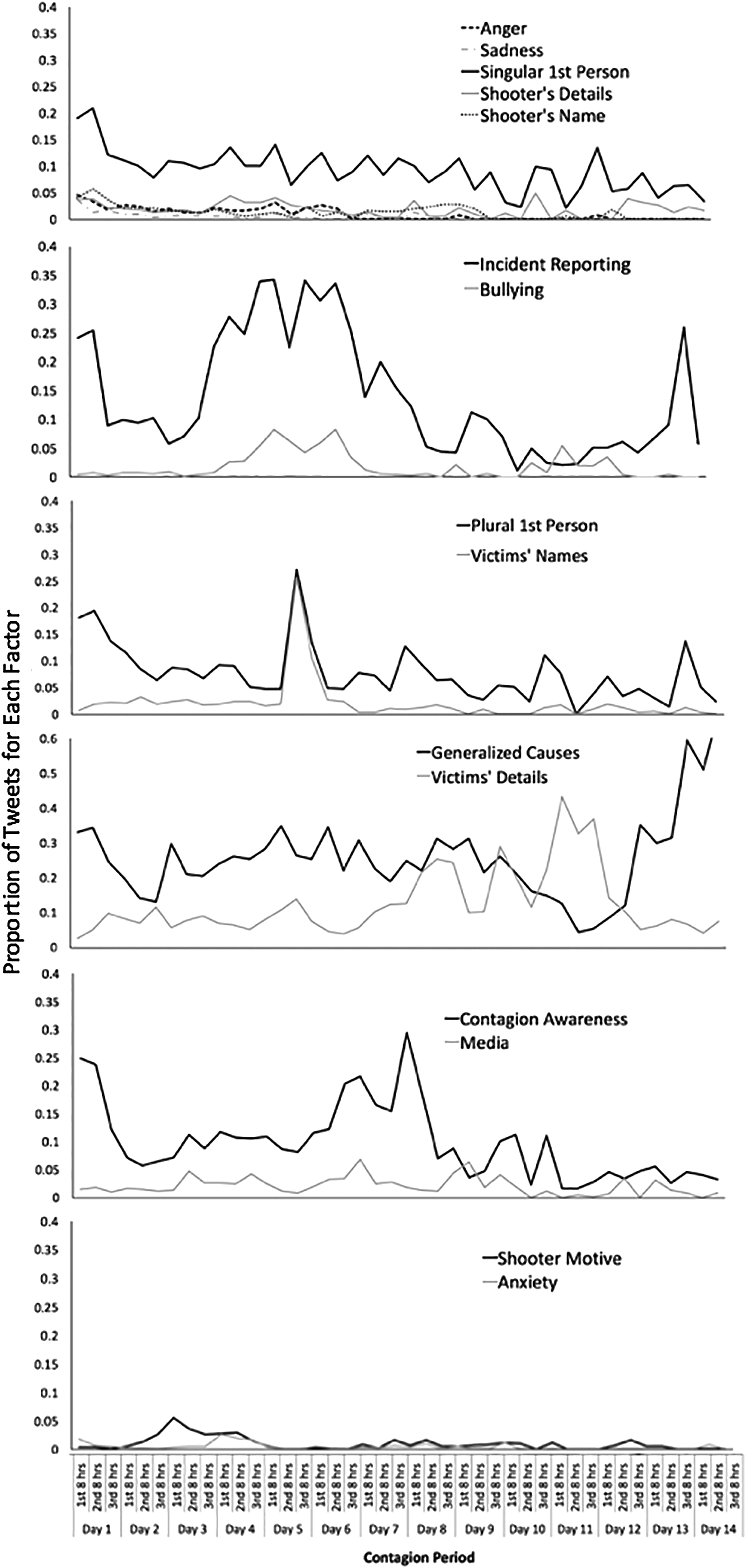
Proportion of tweets containing each theme throughout the contagion period. Graphs are in order of factors from 1 to 6.
Details about the shooting that emerged throughout the contagion period are listed in Table 4. These details provide some potential context for interpreting changes in themes throughout the contagion period. For instance, strong emotions and details about the shooter were most likely to be expressed in Twitter during days 1 and 2 when news of the shooting and details about the shooter were released. Tweets about bullying aligned with media reporting of a statement from the suspect's father that his son was bullied. Themes related to causal reasoning increased slightly after reports were made about a statement from a victim's mother that her daughter publicly rejected the suspect and also following the reports about bullying. Shooter motive and anxiety also aligned with release of these reports.
Details That Emerged About the Santa Fe, TX, School Shooting During the Contagion Period
Discussion
The results of the present research support previous findings that expressions of sadness are positively correlated with psychological closeness (i.e., use of 1st person pronouns) in social media about school shootings or mass shootings (Doré et al. 2015). In particular, our results demonstrate that this pattern is apparent during the more specific 2-week contagion period. However, our results for expression of anger showed a different pattern. While Doré et al. found that expression of anger was negatively correlated with psychological closeness during a 6-month period following a shooting, we found that expression of anger was positively correlated with psychological closeness during the 2-week contagion period. More research is needed to determine whether the nature of relationship between anger and psychological closeness changes over time for a particular event. Importantly, the present findings also show that sadness, anger, and psychological closeness are positively correlated with Twitter posts that emphasize the shooter's name and details during the contagion period. Together, these themes loaded onto the first factor and accounted for the largest proportion of the variance in Twitter themes. This factor was most prevalent during the first few days following the incident. As seen in Table 4, it was during these days that news of the shooting and details about the shooter were released.
It is possible that strong emotional responses, including both sadness and anger in connection with specific details about the shooter, may help sensationalize the shooter and the crime during the contagion period and may ultimately serve a shooter's tendencies toward narcissism and fame-seeking, thereby facilitating a contagion effect. Although the present research does not provide a direct test of this possibility, it does provide one step toward understanding the potential role of media in facilitating the contagion effect. The fantasies, goals, identities, and planning associated with mass shootings typically develops over the course of months or years (Langman 2009, 2018). Once a predisposition toward this type of violence is established, the media coverage of a high-profile shooting might serve as a trigger, particularly if media coverage triggers narcissistic and fame-seeking tendencies. More research is needed to investigate this phenomenon. One implication of the present findings is that it may not strictly be media emphasis on the shooter that helps sensationalize this type of violence, but public expression of emotional reactions to the shooter as well. More research is needed to investigate this possibility before we can make concrete recommendations to practitioners, educators, and nonresearch staff.
The results also showed that social media users shifted their attention toward details about the victims after the first 2 days during the contagion period as more details about the victims continued to emerge (Table 4). Themes related to causal reasoning, bullying, shooter motive, and anxiety increased slightly following reports of a statement from a victim's mother that her daughter publicly rejected the suspect as well as a statement from the suspect's father that his son was bullied. In this case, shifting focus to the victims may not provide a clear solution to addressing the narcissistic tendencies of the shooter, given that details about victims may be connected to shooter motive and these connections may be associated with emotional reactions such as anxiety. Furthermore, as mentioned above, emphasis on victims may ultimately enhance the newsworthiness of the event (Schildkraut et al. 2018) and fearfulness may enhance public interest in the event (Levin and Weist 2018). More research is needed to systematically compare the consequences associated with various types of victim reporting.
Other factors and associated themes appeared to fluctuate throughout the contagion period in response to news reporting that revealed new details about the incident (e.g., access to guns) or the victims. The fourth factor revealed that the more emphasis is placed on generalized causes, the less emphasis is placed specifically on details about the victims. Anxiety did not appear to load strongly onto one particular factor, but was instead weakly correlated with multiple factors, including a factor that reflected tweets about the shooter's personal motive. Contagion awareness loaded onto the same factor as expressions about the role of media, suggesting that social media users may be aware of a possible connection between media and the contagion effect. These findings are interesting because they represent the first attempt to analyze social media during the specific 2-week contagion period.
One limitation of the present research is the omission of Twitter posts that were written in languages other than English. This omission was due to lack of resources required for translation of non-English tweets. Future research should consider Twitter posts in languages other than English to enhance generalizability of the findings. In addition to addressing this limitation, future research should include a comparison of social media versus news media about school shootings versus mass shootings during the contagion period. Overall, however, the results of the present research have implications for understanding the specific reporting that is associated with mental health during the aftermath of a high-profile shooting and serves as one step toward better understanding the role of media during the contagion period.
Footnotes
Acknowledgments
The authors thank Jacek Radzikowski at George Mason University for providing the raw Twitter data for this the project. This article was developed under an appointment to the Department of Homeland Security (DHS) Summer Research Team Program for Minority Serving Institutions, administered for the U.S. DHS by the Oak Ridge Institute for Science and Education (ORISE) through an interagency agreement between DHS and the U.S. Department of Energy (DOE). ORISE is managed by Oak Ridge Associated Universities (ORAU) under DOE contract number DE-SC0014664. This document has not been formally reviewed by DHS. The views and conclusions contained in this document are those of the authors and should not be interpreted as necessarily representing the official policies, either expressed or implied, of DHS, DOE, or ORAU/ORISE. DHS, DOE, and ORAU/ORISE do not endorse any products or commercial services mentioned in this publication. Appropriate cultural protocols were taken to protect the Diné College faculty and students involved in this research.
Author Disclosure Statement
No competing financial interests exist.
Funding Information
No funding was received for this article.