




Abstract
Despite numerous awareness-raising programs and policies in Mizoram, a state in northeast India, girls in colleges are regularly converted into victims of annoying actions from male stakeholders. This article highlights the causes and types of violence experienced by girls in the colleges of Mizoram. Further, it highlights the effect of violence on their education. The mixed-mode method was used to examine the flora and fauna of violence, and the activities accepted by distinct colleges and the government to reduce the occurrence of violence. The data were collected from respondents comprising 727 students (496 from Arts and 231 from Science), 176 parents, and 131 teachers by using the simple random sampling method. The collected data from various sources were triangulated and analyzed. Most of the stakeholders stated that youth fashion, hostile family environment, exam pressure, peer group, girls' disabilities, drug and alcohol influence, and computer gadgets are the causes of violence against girls in Mizoram. The project provided several recommendations for the government and stakeholders regarding how to deal with the challenges of violence in colleges.
Introduction
Violence against women and girls (VAWGs) is one of the most oppressive forms of gender inequality and stands as a fundamental barrier to equal participation of women and men in social, economic, and political spheres. Such violence impedes gender equality and the achievement of a range of development outcomes (Abbott et al. 1995). VAWG is a complex and multifaceted problem that cannot effectively be addressed from a single vantage point. The prevention of, and response to, such violence requires coordinated action across multiple sectors. Sexual assault has been experienced in colleges (Anderson and Whiston 2005; Gerstmann 2019). Studies on sexual assault indicates that students in the first few months of their first and second semesters in college are at the highest risk (Armstrong and Hamilton 2013; Geggel 2017). During the first year of college 15% of young women experienced incapacitated rape (Carey et al. 2015). Griffin and Read (2012) found that women's sexual victimization during their first year of college was significantly associated with college attrition in the second year of college. These young girls were raped when they could not give permission (WHO 2005). Friends' pressure to participate in different anti-social activities makes them uncomfortable (Norris et al. 2015). Being forced into unwanted sexual activity for social acceptance is a type of sexual coercion (Singh 2004). Sexual violence has become more noticeable in institutions and workplaces in recent times.
Northeast India includes the adjoining Seven Sister States (Arunachal Pradesh, Assam, Manipur, Meghalaya, Mizoram, Nagaland, and Tripura and Sikkim). Mizoram, where women and girls are thought to be more valued in their society, is no exception to VAWGs. Regardless of numerous awareness-raising programs and policies, girls in colleges often become victims of annoying actions from their counterparts. Moreover, as physical and sexual violence has been tolerated for so long, it has become resistant to change. As per the government data, 99 cases of child rape were registered under Protection of Children from Sexual Offences (POSCO) Act in Mizoram in 2016, whereas it increased to 129 in 2017 declined to and 66 in 2018. Similarly, 27 cases of child rape were found under the Indian Penal Code in 2018. Incidence of sexual assault is high in Mizoram, with 62 cases in 2016, 74 cases registered in 2017, and 40 cases in 2018. Crime against women and girls have also been seen in Mizoram. Rape cases of 23 girls were registered in 2016, 46 cases were registered in 2017, and 24 cases were registered in 2018. The occurrence of molestation cases is high, that is, 71 in 2016, 115 in 2017, and 64 in 2018.
A study (Mishra 2016) was conducted on violence against girls in secondary schools of Mizoram (Ministry of Women and Child Development, Govt of India 2017) and identified different types of violence that includes physical (fighting with classmates, thrashing and hitting by teachers, burglary, grabbing food, planned stepping or being assertive, towing ear by teachers), sexual (assaulting by students and teachers, force dating and kissing, sexual gestures, touching of restricted body parts by students, disturbing messages and letters, touching of restricted body parts by teachers, showing unhealthy pictures, force smooching and sex, threatening by male teachers and students for refusing sex), and emotional (humiliating, teasing for a monthly period, neglect by teachers, assault by schoolmates, use of bad and abusive language, scolding ruthlessly, and assault by teachers) (Ministry of Women and Child Development, Govt of India 2015). In addition, the researcher is interested in studying the causes and consequences of violence against girls at the college level. Ultimately, the aim is to address the issues of the themes just cited. Therefore, the problem of violence against girls in colleges has been analyzed and an actionable policy mechanism is suggested toward tackling the problem.
Objectives of the study
This study aimed at determining the status quo of girls regarding their experience with violence in degree colleges. The following were the objectives of this study:
To find out the reasons and kinds of violence on girls in degree colleges in Mizoram. To assess the effectiveness of existing rules and regulations dealing with violence against college-going girls. To suggest measures for addressing the problems faced by the stakeholders.
Methodology
The researcher used the mixed method for the study. Of 32 general colleges, 22 are degree colleges in Mizoram. Mizoram state has eight districts. Out of 22 degree colleges, 10 colleges are in Aizawl district. From the 22 degree colleges in 8 districts, 12 degree colleges, that is, 5 degree colleges from Aizawl district out of 10 colleges and 1 college each from the rest of the seven districts of Lunglei, Lawngtlai, Champhai, Serchip, Kolaship, Saiha, and Mamit (because only 1 degree college is available in each of these districts) were selected for the study. Only five colleges offer both science and arts at the under-graduation level in Mizoram. Hence, the researcher targeted all the science colleges as the sample of this study. Twenty students were selected from each department of the five colleges that are offering BSc in Physics, Chemistry, Mathematics, Botany, and Zoology (total = 100); 10 students from each department of all the 12 degree colleges that are offering English and History, Political Science, Mizo, Education, and Economics were selected randomly as samples of the study. Collection of data from 500 Science students and 720 Arts students, 291 teachers, and 240 parents was scheduled for the present study. The aforementioned questionnaire was sent to all the respondents, but not all could be collected. After frequent visits to the colleges, project fellows were able to collect data from 727 students (496 from Arts and 231 from Science), 176 parents, and 131 teacher respondents. Moreover, the director of higher and technical education and the chairman of women commission were included as samples of the study.
A questionnaire was developed in a workshop conducted by the education department and was used to collect data from the stakeholders. Government officials and NGO personnel were interviewed with a structured interview schedule. Academicians and different experts prolonged their full participation through their opinions and appreciated submissions. As both the questionnaire and interview schedule were developed considering the valued submissions of these passionate professionals, content validity was established. The project director first used the tools for a sample of 10 students, 10 teachers, and 10 parents. Every sampled stakeholder was asked to answer each and every item of the tools and deliver factual data; after receiving responses, the investigator tabulated them. To estimate the reliability of the tool, the project director used the same questionnaire after 1 month on the same sample. The responses received from the stakeholders in the second phase were denoted statistically, and two sets of scores were analyzed and correlated by using the product movement method. The value of r was found to be 0.72, which was greater than the normal value. Thus, the tool was believed to be reliable. Further, two Focus Group Discussions (FGDs) were conducted for collecting the qualitative data from the respondents. The data were collected with the help of three project fellows from September to December 2018. All the 12 colleges were visited by the project director along with the project fellows with prior permission from the college principals. Then, the project fellows visited the colleges and distributed the questionnaire among the students, parents, and teachers. A thematic method was followed for analyses and interpretation of the findings. Collected data from different sources were used and analyzed by using frequency distributions and percentages.
Findings
The major findings of the study are as follows:
Most of the girls faced different types of violence in college campuses. The results indicated that four types of violence, that is, verbal, sexual, physical, and psychological violence, against girls are seen in different degree colleges in Mizoram. Verbal violence against girls is high in the degree colleges of Lawngtalai district. Physical and sexual violence against girls are prevalent in the degree colleges of Aizawl district, whereas it is negligible in Kolasib and Serchhip districts. Psychological violence is high among degree colleges in Aizawl district, whereas it is negligible in Champhai district (Table 1 and Fig. 1).
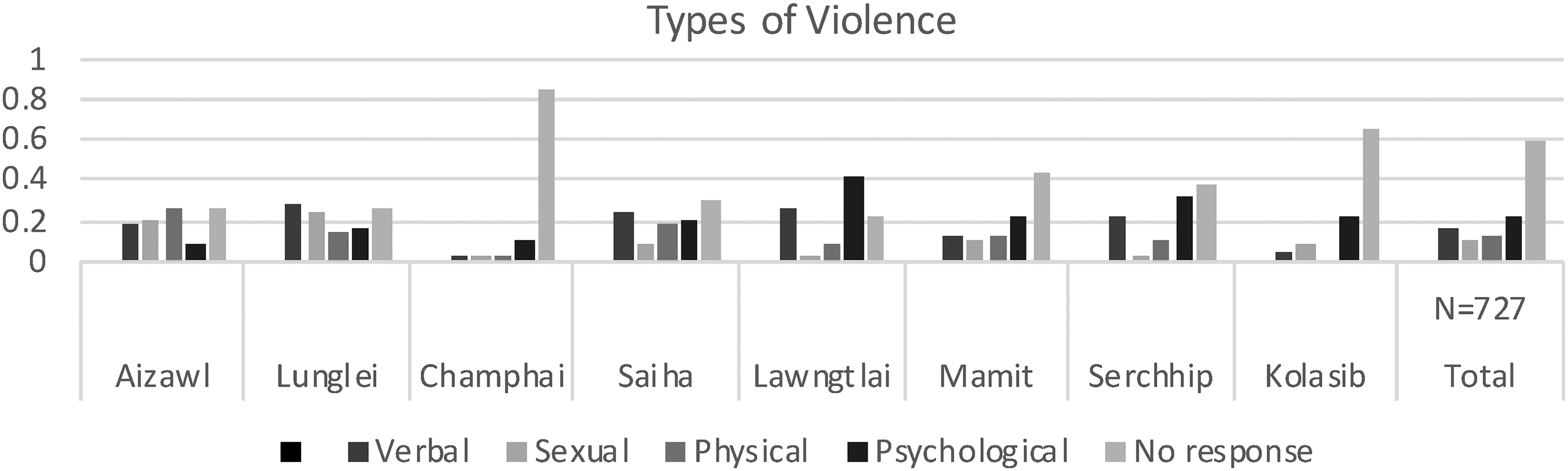
Types of violence.
Types of Violence Faced by Girl Students (N = 727) in Degree Colleges in Mizoram
During FGD, one of the students in Kolasib described her practice of being beaten by the teachers. She said,
“Out of all the teachers, I am most frightened of my mathematics teacher. I am poor student in mathematics; therefore, I always want to take note from my classmates for copying the homework and submitting to the teacher. One day I was unable to do that due to some reasons. The teacher collected the 29 notebooks as against 30. The teacher identified me in the class and started thrashing me. He told me to report to my parents. I was more afraid because when my parents know it, they would give me more punishment. Since then I regularly submitted my math homework in class to the teachers for correction.”
One student explained her experience, saying that she did not like the teacher's nature of calling her to meet him alone in the office. She said that one day she was called by the concerned teacher on the pretext of showing her homework book and the teacher touched her private part. This is really disheartening and unsafe for the girls.
The student “Y” said in personal interview that “One day I complain against a male teacher to my class teacher who is female. My class teacher counselled me to overlook, excuse and ignore. Such happening sometimes upset me. Particularly, as my miss is not understanding my problems and worry's. I cannot have respect for such teachers.”
Student “Z” of Kolasib district explains, saying that “One day one of my seniors from my school confesses me. As I was not interested and decline his offer, he became furious and would start threatening me and sending me inappropriate messages all the time. He would even spread untruthful rumor on my character. I blocked all his number and avoid him for the same. The above discussion shows that four types of violence are seen in degree colleges of Mizoram.”
When girls sought permission to leave the class because of their monthly period, teachers used to tease them. Most of the girls (68%) said that college mates and teachers tried to assault them through comments on their bodily appearance. Most of the girls (72%) stated that whenever they tried to go out of the class to the washroom, seeking permission from their teachers on the grounds that they were not feeling well was considered by their peers as well as by their teachers as being down with their monthly menstrual cycle. Most of the girls usually referred to their menstrual period with words such as “not well” or “down” while talking to others. However, it was highly likely that girls usually did not let others know whether they were passing through their menstrual period. They said that even on “normal days” when they sought permission to go out of the class, they were teased aloud through indicative pinching remarks such as “let her go, she again may not be feeling well” and so on. Such remarks were felt to be disgusting to most of the girls. Further, one girl from Chhampai district said during FGD that many a time, even some male teachers also “mocked” their conditions (Table 2).
Pabrents' Perceptions on Causes of Violence Among the College Girls in Mizoram
The figures in the parentheses indicate percentage.
Most of the parents (43.74%) believed that youth fashion among girls, particularly their dressing style, is one of the reasons of violence against adolescent girls in the degree colleges of Mizoram. Most of the parents (51.88%) agreed that a hostile family environment invariably leads to aggression. Moreover, 34.88% of parents said that exam pressure leads to violence against girls in the degree colleges of Mizoram. One parent of Lunglei district in an interaction said that their daughter faced many problems due to exam pressure. Similarly, peer group interference is a reason of viciousness against girls in these degree colleges according to the parents (39.49%). In aggregate, 57.17% parents agreed that cell phones and computers are the causes for the same. In a personal interview with teachers and during FGD, majority of the teachers believed that youth fashion, a hostile family environment, exam pressure, peer group, girls' disabilities, drug and alcohol influence, and computer gadgets are the causes of violence against college girls in Mizoram. A teacher from Govt. Kolasib College said that, “since in the college level, there is no longer such thing called ‘Uniform,’ some college girls wear dresses, which really reveal their bodies.” He continued to say that “such students are more likely to face problems as compared to those who never exposed their bodies” (Human Rights Watch 2018) (Fig. 2).

Causes of violence.
Most of the respondents (94%) unanimously thought that girls in the age group 18–23 years are more vulnerable to violent behavior. Thus, the effects of violence on girls' higher education range from mental trauma, reduced self-respect and self-assurance, and dropping out of colleges to the arousal of a non-conformist defiance without respect for the formation and progress of fear in girls, which incline to have far-fetching significance. Most of the rules and regulations in Mizoram were obtained from the central government schemes and adopted for the state. Exact policies, rules, and regulations in the context just cited are absent in the Mizoram state government.
The majority of the parents (76%) suggested that periodic awareness campaigns and self-defense training programs are needed for the girls. In addition, the parents believed that laws must be enforced on college campuses and students should be educated on laws, rules, and regulations of the Government of India to reduce violence against girls. Further, in the FGD they provided many other suggestions, which required the college authorities to take certain steps, such as Parent Teacher Association and Life Skills Program. Almost all participants (97%) suggested the need and importance of emerging and applying an institution and culturally suitable violence stoppage program by considering the needs and priorities of the college. Most of the respondents (82%) felt that the zero-tolerance strategy may be adopted in the colleges. The creation of welfare centers to accurately deal with violent activities; provision of basic needs for girls; opening of sports and other recreational activities such as games, debates, excursions, and club activities; establishment of guidance and counseling units; inclusion of peace education programs in the school curriculum; training of teachers; and restriction of cell phones are some of the plans suggested for reducing violence against girls in higher education institutions. Parents and newly recruited higher education teachers should be trained on how to help in reducing violence against girls and should be oriented toward the different plans and policies of the Government of India for preventing violence against girls.
Conclusion
As per the earlier discussions and findings, the following inferences are presented. Degree college girls in Mizoram faced physical, verbal, sexual, and psychological violence on the campus. Bullying, ruthless degrading, scolding, involuntary dating, smooching, sexual waves, touching, attempts at rape, disturbing messages, and pornography are some common types of violence seen in degree colleges of Mizoram.
Peer group effect, use of computers and cell phones, absence of awareness, and adolescence period are the reasons behind the various types of violence. The respondents unanimously felt that girls in their adolescence period show more aggressive behavior and suffer a lot.
The impact of violence on girls in higher education ranges from mental trauma, reduced self-confidence and self-respect, to dropping out from colleges, which is similar to my previous study on violence against girls in the secondary schools of Mizoram (Mishra 2016). Most of the policies in Mizoram state government were adopted from the central schemes of the Government of India. However, an assessment exposed that much is desirable. Specific policies in the given context are yet unavailable either in Mizoram or in the country.
Recommendations
This study posed a number of suggestions for the stakeholders and Government of India as well as Government of Mizoram regarding how to deal with the issues on girls. The following suggestions were concluded: Higher education institutions should organize awareness programs on nonviolence on the campus, cell phone use should be controlled for stakeholders on the college campus, and curriculum must be enriched, Individual attention and help must be given for girls at risk, guidance and counseling centers may be established and strengthened, sexual harassment cell must be strengthened in degree colleges, and a self-defense center may be opened for girls to learn martial arts. The policy framework suggested in this study that the government's involvement is desirable for policies making curriculum restructuring (gender curriculum family planning sex education, HIV/AIDS education may be included), strengthening co-curricular activities, faculty development programs for teachers, community mobilization, and research that may help in preventing violence on girls in degree colleges. Gender institution and society must be included as a compulsory paper at the degree level, irrespective of the stream of education, that is, Science, Arts, and Commerce.
Principals of different colleges must constantly screen reports of violence and take proper action against the culprit, and this necessitates revision of the existing rules and regulations of colleges and their effective implementation. All institutions must display the guidelines of sexual harassment prominently; hold workshops, conferences, and seminars for both students and staff; and publicly declare a zero-tolerance stance toward sexual harassment.
Women harassment cells in all degree colleges should be established and strengthened. Moreover, all institutions must constitute a committee, where half of the members will be women, and the chairperson must be a woman for hearing and addressing the issues of girls and cases of sexual harassment.
Awareness must be raised among parents and community members regarding the negative effects of harmful outdated practices. Religious and community leaders, health professionals, and educators should be sensitized about the causes and consequences of violence against girls. NGOs and Young Man's Associations must be involved in different plans and programs of the Government of India and Government of Mizoram for reducing violence against girls. Prompt and appropriate disciplinary action, including due process protection for people alleged to have perpetrated the offense, must be taken care of. Perpetrators should get the legal punishment they deserve as soon as possible, and the legal process must be effective and not time consuming. Code of conduct at colleges with respect to interaction with people of the opposite sex should be outlined and implemented. The Ministry of Women and Child Development, Government of India can frame a national plan of action for reducing violence in degree colleges.
The Ministry of Women and Child Development, Government of India in collaboration with other ministries and members of the civil society (including the private sector) can conduct national campaigns involving both print and non-print media on the negative effects of violence, including how to prevent it and where teachers, students, and parents can turn for help. The difficulties in this project show the exceptionality of the place of women in Mizo society. On one hand, Mizo people follow male-controlled norms, whereas on the other hand, their women's involvement has a comparatively high level of autonomy. The study recommends that general research on school- or college-level violence can be conducted and one can use the literature as a foundation to find out the causes of low levels of crime and violence in the state of Mizoram.
Footnotes
Acknowledgments
The author is immensely thankful to the Ministry of Women and Child Development, Government of India for providing financial support for conducting this need-based and time-honored project. The project team acknowledges the help of all the experts who have extended their kind help by giving valuable suggestions in the preparation of the tools used for this study. The author expresses his gratitude toward the principals, teachers, and students and their parents of degree colleges of Mizoram for their cooperation in the collection of data. Last but not the least, the author acknowledges the hard work and sincerity of the three project fellows working on this project.
Author Disclosure Statement
No competing financial interests exist.
Funding Information
This project is funded by the Ministry of Women and Child Development, and the Government of India vide File No. RU-3/2018 (Research) (e-51370).