




Abstract
This article aimed to measure the level of aggressive and delinquent behavior, identify the most common delinquent behaviors, and examine the associations of aggressive and delinquent behavior. This research involved two groups of adolescents: youth offenders from correctional facilities for minors constituting the research group (52 girls and 81 boys) and high school students constituting the control group (66 girls and 67 boys). In total, 266 people were assessed. The respondents' age at the time of the research was in the range of 16–18 years (M age = 17.22). The research was quantitative. Three diagnostic tools were used to examine the variables: a poll questionnaire developed for the purpose of this research, Self-Report Delinquency and Drug Use Measures, and the Buss–Perry Aggression Questionnaire Scale. The gathered and analyzed data provided grounds to assume that the study groups indeed differ from each other in terms of frequency of illegal and antisocial behaviors and forms of presented aggressiveness. The findings also showed significant associations between delinquent behavior levels with aggressiveness in both researched groups of adolescents. Based on the analysis of the stepwise regression approach, it was established that the factor strongly anticipating illegal and antisocial behaviors among adolescents from Correctional Facilities for Minors and High Schools is aggressiveness demonstrated in the form of physical aggression.
Introduction
Numerous studies and colloquial observation indicate that some young people cope well with the difficult situation. They do not succumb to fate, but treat this situation as a challenge for themselves, which encourages them to mobilize their resources to overcome obstacles preventing the needs. However, there are those who, in the face of a social conflict situation, are not able to undertake activism and cannot create realistic programs of their own activity, while they use typically defensive behaviors that allow them only to reduce the unpleasant emotional tension. They achieve well-being through aggression, taking the form of an initiated verbal or physical attack directed against specific persons; harming the well-being of others; by avoiding confrontation with the situation of the conflict, consisting in undertaking additional activities involving attention and reversing from the conflict; and by yielding, consisting in resigning from defending own interests or abandoning own goals.
It is easy to notice that in a situation where the period of difficulty persists or increases, an aggressive emotional tension increases in a young person; the intent is to harm and damage the physical, mental, and somatic well-being of other people (Chirstian et al. 1997; Lynum 1997) and reduce the level of activity to gradual abandonment of own aspirations, expressing desires and satisfying them (Borecka-Biernat 2012; Honess et al. 1997; Jaworski 2000; Trylińska-Tekielska 2005). The phenomenon of aggression of children and youth, due to the constant increase in frequency and drasticness, arouses the interest of researchers from many disciplines. This interest concerns dynamics, conditions, and forms of this behavior. Llorca-Mestre and colleagues (2017) suggested that the prevalence of aggressive behavior and delinquency in adolescence is a worrying subject for society in general.
Definition and Different Types of Aggression
A literature review shows that aggression can be defined, described, and explained in many ways. It takes different forms. It can be targeted internally (autoaggression) and externally. It can be overt and hidden, and it can reach different levels. Aggression is most often defined in the following categories: social (Aguilar et al. 2000; Contreras and Cano 2016; Gaik et al. 2010; Margolin et al. 2010; Poling et al. 2019), psychological (Llorca-Mestre et al. 2017), and biological (Cashdan 2003; Davidson et al. 2000a,b; Heitzman 2002; Krahé 2006; Moffitt 1990).
Aggression is most often defined as behavior that is intended to injure or harm someone physically or psychologically (Baron and Byrne 1994; Baron and Richardson 2004; Bushman and Anderson 2001). As Warren and associates (2011) pointed out the defining characteristic of aggression is the intent to cause harm to another person, but the form that aggression takes can be either direct, such as a physical confrontation with the victim, or indirect, often referred to as relational aggression.
The common meaning of the term aggression means hostile behavior, aimed at causing someone to be hurt, causing loss or pain. From the point of view of internal dispositions, aggressive behavior can be a single act or permanent disposition with complex causes and triggers. Aggressive behaviors are usually analyzed as learned behaviors; the effect of exerting social influence; lack of group bond; symptomatic of lack of social skills; the symptom of personality disorders; and the symptom of extreme experiences.
In reference only to clinical classification, two forms of aggression can be referred (Liu 2004). The first form is called “affective,” “reactive,” “defensive,” “impulsive,” or “hot-blooded” aggression. This type of aggression is defined as a violent response to physical or verbal aggression initiated by others that is relatively uncontrolled and emotionally charged. In contrast, the second form of aggression is referred to as “predatory,” “instrumental,” “proactive,” or “cold-blooded” aggression. This type of aggression is characterized as controlled, purposeful aggression lacking in emotion that is used to achieve a desired goal, including the domination and control of others (Dodge 1991; Liu 2004; Raine et al. 2006).
Sex differences studies
Studies show that childhood aggression is a strong predictor of adult crime and violence (Farrington 2001; Moffitt 1990). Moreover, Farrington (2001) found that early onset of aggressive and antisocial behavior was the strongest predictor of later convictions. A similar opinion is expressed by other researchers, such as Kupersmidt and colleagues (1990), Loeber (1990), Stattin and Magnusson (1989), Patterson and associates (1992), and Coie and Dodge (1998).
According to Liu (2004) studies, childhood and adolescent aggressive behavior is a strong predictor of delinquency (Farrington 2001; Moffitt 1993). Research on children and adolescent aggressive behavior have reported that, while boys tend to engage in physical aggression (hostile aggression) girls are more likely to express aggression in a relational sense (instrumental aggression). That is, girls tend to use their relationships to inflict harm, manipulate peers to harm others' feelings of social acceptance (e.g., social exclusion, rumors, and slander) (Abdullah et al. 2015; Basow et al. 2007; Miller-Ott and Kelly 2013). Generally, aggression is found to be more common in boys than in girls. While boys often engage in physical aggression, girls are more likely to exhibit what has been termed “relational aggression,” such as exclusion of others from their social group, and slander (Hadley 2003; Liu 2004). Similarly, Quinsey and associates (2004) found that in children and youth, although both males and females are more likely to engage in aggressive behavior and commit violent crimes between the ages of 14 and 24 years than at other ages, the onset for females tends to be 2 years earlier on average. Furthermore, there are gender differences in the seriousness of aggression. Males are more likely than females to commit more serious acts of aggression.
Existing evidence suggests that males are consistently more likely to engage in direct physical aggression than females (Archer 2004, 2009; Fagan and Lindsey 2014). Research confirms that young men are more prone to violence, and their personality is characterized by a higher level of readiness to aggression manifested in various forms and social situations (Masagutow 2000; Rathus 2004). Among adolescent males, physical aggression is used to achieve social dominance and effectively compete for status and resources, such as access to relationships, number of allies (peer network), and reputation or popularity (Nivette et al. 2018; Hoff et al. 2009; Pellegrini 2008).
The need for an integrated approach to studying relationally aggressive behavior is evident, considering the growing through scattered and fragmentary research documenting the predictors and outcomes of this behavior (Voulgaridou and Kokkinos 2015). The prevalence of aggressive behavior and delinquency in adolescence is a worrying subject for society in general. Analyzing and knowing the determinant factors is one of the main objectives of the research oriented toward prevention (Contreras and Cano 2016; Llorca-Mestre et al. 2017; Wertz et al. 2016).
Despite the long history of research into issues of aggression among criminals, there remains a lack of unambiguous findings concerning the personality characteristics that may intensify an individual's tendency to react with aggression or autoaggression.
Juvenile in Polish Low
Delinquency is a legal concept used to describe diverse antisocial actions, including theft, burglary, robbery, vandalism, drug use, and aggressive behavior (Farrington 1987). In turn youth delinquency is also referred to as juvenile delinquency, juvenile offending, or youth crime; and it has been defined as the participation in illegal behavior by young people under the statutory age of majority (Siegel and Welsh 2005), which in most countries is 19 years of age. Youth delinquent actions can range from status offenses (such as underage smoking) to property crimes and violent crimes (Abdullah et al. 2015). In turn, antisocial behavior is defined as behaviors resulting from an individual's inability to respect the rights of others. These behaviors include assault, vandalism, setting fires, theft, crime, and other delinquent acts, which conform to social norms (Gaik et al. 2010).
The juvenile can be defined as a child or young person who is not yet old enough to be regarded as an adult. As Sharma and Kirmani (2016, p. 214) pointed out, the juvenile is a child who is alleged to have committed/violated some law, which declares the act or mission on the part of the child as an offence. Currently in Poland, the rules of proceedings in matters related to minors are regulated by the Criminal Code 1997 and the Act on Juvenile Delinquency Proceedings 1982. In the light of applicable law in Poland, the juvenile is a person who (1) is younger than 18 years (in the field of preventing and combating demoralization), (2) committed a punishable act after the age of 13 and before the age of 17 (in criminal proceedings), and (3) is younger than 21years (in the scope of performing the educational or correctional goals).
Materials and Methods
Hypotheses
Taking into account the number of punishable offenses committed by youth, it becomes necessary to study the factors that have the largest share in creating a propensity to commit delinquency behavior and violate social norms. Therefore, the basic aim of the study was to identify the existing differences in the studied group (taking into account the factor: group and sex) in the intensification of delinquency behavior and violating social norms, determining differences in aggression intensity and determining the existing mutual correlations between the examined dimensions of aggression (physical aggression, verbal aggression, anger, hostility) and delinquency behavior and violating social norms.
Specifically, three hypotheses have been examined:
H1. Sex and group differentiate the studied youth in terms of undertaken delinquent and violating social norms behavior. H2. Sex and group differentiate the studied youth in terms of manifested forms of aggressiveness. H3. The relationship between different dimensions of aggressiveness (physical aggression, verbal aggression, anger, and hostility) and the intensity of delinquent and violating social norm behavior significantly differentiates girls and boys from both studied groups.
Procedure
The draft of this study was evaluated and approved by the Ethics Committee for Scientific Research of the Institute of Social Sciences of the Polish University Abroad in London. The data used in this article were obtained from study designed to identify patterns of delinquency behavior among youth offenders and teenagers and students in Poland, and examine the aggressive issues linked to these behavior patterns. The project used quantitative research methods and analysis. Data were elicited using three questionnaires. To create conditions conducive to obtaining honest and reliable answers, the questionnaire statements were preceded by an instruction given about the voluntary and fully anonymous nature of the research. Respondents could use the researcher's explanations in case of any doubts. The average time to complete the survey was 40 min in both groups of subjects. Data collection was performed in July 2015.
Assessment of the representativeness of the group was not based on strictly statistical criteria, but on knowledge of the characteristics of the general population of youth offenders in Poland; studied population does not seem to differ from the one that was subjected to examination. Examinations were conducted using ex post factum procedure, which in the case of youth offenders is a difficult diagnostic process—the behavior of a person in a given situation is analyzed taking into account experiences preceding her/his action.
Participants
The method used involved questionnaires and self-report. The research group (youth offenders) was selected on the basis of their age and sex. The comparative group constituted pupils of the classes of secondary schools (most similar to juvenile criminals in their age and level of education) who had not violated the law (ascertained on the basis of examination using the scale of social maladjustment—self-report method). In the case of both groups, an additional criterion was availability and readiness of respondents to participate in the study.
This research involved two groups of adolescents: youth offenders from correctional facilities for minors constituting the research group (52 girls and 81 boys) and high school students constituting the control group (66 girls and 67 boys). In total, 266 young people were assessed. The respondents' age at the time of the research was in the range of 16–18 years. The collected data allowed to conclude that the research and control group are not significantly different in terms of sex (t = −7.24; p = 0.080). The control group is composed of equal proportions of girls and boys, while in the research group, the boys are slightly predominant, but it is not statistically significant. On the basis of the empirical data obtained, it was found that the youth from the research and control group does not significantly differ in terms of age (t = 4.33, p = 0.066). The age average for both groups was 17 years (M age = 17.22). The study was carried at the Correctional Youth Center and Shelter for Minors in Zawiercie (for girls), Falenica (for girls), Racibórz (for boys), and Pszczyna (for boys). The control group was created by students from High School No. 1 in Wloszczowa and High School named Helena Malczewska in Zawiercie.
In the research group, the largest number of studied youth come from cities with more than 100,000 inhabitants (girls n = 30; 22.5%; boys n = 36; 27.0%). In the control group, the largest number of youth come from a small town of <20,000 inhabitants (girls n = 35, 26.3%; boys n = 36, 27.0%) and from the village (girls n = 29, 21.8%; boys n = 23, 17.3%). The data showed that the dominant family environment among studied youth from the research group is an incomplete family with caring mother (girls n = 20, 15.1%; boys n = 24, 18.0%) and a complete family (girls n = 16, 12.1%; boys n = 29, 21.8%). In the control group, the largest percentage of youth come from a complete families (girls n = 56, 42.1%; boys n = 58, 43.6%). All young people from the control group are high school students (at the time of the study). Referring to the level of education of youth from research group, it is worth emphasizing that despite the lack of age differences between the studied groups, they are characterized by a lower level of education (p < 0.001) than their peers from high schools, what may testify about problems with fulfilling the school obligation in this group of adolescents. Based on the obtained data, it was found that girls and boys from research group do not differ significantly in terms of education (p = 0.181). The lower level of education then secondary education is characteristic for youth 17 (n = 31; 56.4%), 16 (n = 23; 88.5%) and 18 years of age (n = 17; 53.4%).
Materials
A poll questionnaire developed for the purpose of this research contained information about age, sex, family environment, and ethnic group studied youth.
The use of Self-Report Delinquency and Drug Use Measures (Agnew and White 1992) was aimed at determining the type, number, and frequency of delinquent and violating social norm behaviors among the studied youth based on their own declarations. The questionnaire has been used in the research group and in the control group. In the original form used by Agnew and White (1992), the questionnaire contained 13 items and the respondents were asked about the frequency of involvement in various criminal acts in the last 3 years. Similar to the Agnew and White (1992) studies, the frequency of a given type of behavior included in the range from “0–never” to “10 times or more.” For the purposes of the survey, the number of questions was extended to a total of 22 including physical fight, robberies, burglaries, thefts, car thefts, acts of vandalism, truancy, escaping from home, abusing alcohol, taking part in fights, selling drugs, hitting a parent, hitting a teacher, self-harm, suicide attempts, hitting someone for no particular reason, psychological abuse of colleagues (ridiculing and insulting), physical bullying of weaker colleagues (pushing, poking, and digging), and tormenting animals. Cronbach's alpha in the research group was 0.90 and in the control group was 0.79.
The Buss–Perry Aggression Questionnaire (BP-AQ) is a 29-item, four-factor instrument that measures physical aggression, verbal aggression, anger, and hostility (Gallagher and Ashford 2016). BP-AQ (adapted in Poland by Lucyna Kirwil) makes it possible to assess the level of general aggressiveness as an individual's personality characteristic and his or her tendency to use physical or verbal aggression, experiencing anger, and manifesting hostility (four subscales). It consists of 29 statements describing various aspects of aggressive behavior. An examined person's task is to position him/herself against 29 statements and self-report using a 5-point scale, where 1 means “extremely uncharacteristic” and 5 “extremely characteristic” (Abd-El-Fattah 2007; Gerevich et al. 2007; Pham et al. 2011).
The popular tool for the measurement of aggression among youth offenders is the Aggression Questionnaire by Buss and Perry, which is based on their understanding of aggression as expressed in an article from 1992 (Anderson and Bushman 2001). The BP-AQ assesses aggression by means of four subscales: physical aggression, verbal aggression, anger, and hostility. It is based on the Buss and Durkee Hostility Inventory (1957), which has been validated in different contexts and populations (Buss and Perry 1992). This work, in turn, referred to Buss and Durkee's theory from 1957 (Gallagher and Ashford 2016), which has endured for many years as the popular method and approach where the examination of aggression is concerned. Despite the numerous analyses conducted since that time, the basis of Buss's theory of aggression remains unchanged (Buss 1961). Buss (1961) defines aggression as an isolated act and as a stable attribute manifested in the tendency toward aggressive behavior. A Likert-type response format was used, which ranged from 1 (extremely uncharacteristic of me) to 5 (extremely characteristic of me), and exploratory factor analysis yielded four factors: Physical Aggression (nine items), Verbal Aggression (five items), Anger (seven items), and Hostility (eight items). The first two factors represent a motor or instrumental component; anger, which implies psychological activation and preparation for aggression, is the emotional or affective component and hostility represents the cognitive component. Thus, the questionnaire was made up of 29 items, yielding a minimum score of 29 points and a maximum score of 145 (Morren and Meesters 2002; Valdivia-Peralta et al. 2014). According to Aranowska and Rytel (2012) studies regarding the factorial structure of the BP-AQ in the Polish population established that the value of the Cronbach's alpha reliability coefficient for the entire questionnaire was 0.80.
As Buss and Perry (1992) pointed out, physical and verbal aggression associated with harming and hurting others constitute the behavioral or motor component of an instance of aggressive behavior. In this study, it should be noted, the authors understand physical aggression as any use of force against another person. Meanwhile, in Buss and Perry's (1992) reading, the category of verbal aggression contains several forms, such as hostile comments, rejection, humiliation, and threats. Hostility, on the other hand, is understood by Buss and Perry (1992) as expressing itself mainly in the form of negative attitudes and opinions. Meanwhile, anger, which this theory describes as decisive in the readiness to deploy aggression, is described as a strong negative emotion connected with physiological arousal that leads to aggressive reactions (Buss and Perry 1992). Anger constitutes one of the most basic emotions felt in response to repetitive instances of stress, failure, or emotional turbulence. Anger can be expressed through shouting, gestures, and occasionally fighting (anger directed at the outside), but it may also be suppressed, in which case, we deal with inwardly directed anger.
Results
The characteristics of the tested variables were started from descriptive statistics. The mean, standard deviation (SD), skewness and kurtosis, and minimum and maximum values were determined, and then the distribution of results and the coefficient of variation—group differentiation, were checked in the Shapiro-Wilk test. The analysis of the obtained data was started by checking the intensification of individual dimensions of aggressiveness (physical aggression, verbal aggression, anger, and hostility) and manifestation of delinquency behavior in both youth groups, including the sex factor.
Characteristic of delinquent behavior and violating social norms in the studied groups of adolescents
Based on the data, it was found that the average result of delinquent behavior in the research group amounted to 94.67 (SD = 46.80). Among girls from the research group (Fig. 1), the average result of delinquent behaviors was 106.54 (SD = 47.82), while among boys, it was 87.05 (SD = 44.76). In the control group, the average result of antisocial behavior was 13.30 (SD = 16.34), among girls 7.18 (SD = 7.24) and boys 19.33 (SD = 20.20). The empirical data collected on manifestations of criminal behavior and violating social norms in the research group and violating social norms in the control group unambiguously gave grounds for stating that belonging to the group significantly differentiates the persons examined in relationship to the antisocial behaviors they undertake. The average of behaviors that violate legal and social norms (Z = −13.29, p < 0.01) is statistically higher in the criterion group. In addition, it was found that in the intensity of antisocial behavior undertaken, boys and girls from the research group differ significantly. The girls from the research group, compared to the boys from this group, are characterized by a significantly higher average of delinquent behaviors (Z = −2.32, p < 0.05). From the figures it is apparent that in the control group, boys had higher average of behavior violating social norms than girls (Z = −4.42, p < 0.01).

Average results of delinquent behavior and violating social norms in the studied groups.
To check the existing differences between manifestations of antisocial behavior between the studied groups of adolescents, the Mann–Whitney U test has been used (Table 1). The general results regarding the average ranks of behavior in both groups of subjects showed the existence of statistically significant differences in all forms of antisocial behavior with their significant advantage in the research group. These behaviors include the following: physical fight (Z = −11.52, p < 0.01), participation in the robbery (Z = −10.33, p < 0.01), theft of cheap items up to $20 (Z = −13.00, p < 0.01), stealing valuable things, for example, cars and jewellery (Z = −12.57, p < 0.01), burglary (Z = −10.62, p < 0.01), acts of vandalism (Z = −11.93, p < 0.01), staying out of school (Z = −8.62, p < 0.01), escape from home (Z = −10.08, p < 0.01), drinking alcohol (Z = −7.49, p < 0.01), using marijuana (Z = −11.87, p < 0.01), using lysergic acid diethylamide: hallucinogenic drug (LSD), amphetamine, and heroin (Z = −11.18, p < 0.01), participation in assault (Z = −12.70, p < 0.01), selling drugs (Z = −9.90, p < 0.01), teacher assault (Z = −5.56, p < 0.01), parent assault (Z = −4.24, p < 0.01), self-harm (Z = −8.34, p < 0.01), suicide attempts (Z = −7.09, p < 0.01), hitting someone without a specific reason (Z = −8.01, p < 0.01), psychological abuse of weaker colleagues (Z = −8.63, p < 0.01), physical abuse of weaker colleagues (Z = −8.35, p < 0.01), animal abuse (Z = −4.67, p < 0.01), and scaring others with weapons or other sharp tools (Z = −8.55, p < 0.01).
Analysis of Differences in Mean Prevalence of Social Maladjustment Symptoms in Studied Groups
p < 0.01.
LSD, lysergic acid diethylamide: hallucinogenic drug; N, a number of studied people; Z, Mann–Whitney test result.
The above data allowed us to accept the hypothesis one (H1) assuming that sex and belonging to the group significantly differentiate studied youth in the field of behaviors that violate legal and social norms. The obtained empirical data confirmed a statistically significant difference (p < 0.001) in the occurrence of delinquency behavior and violating social norms in the studied groups, with the prevalence of their occurrence in the research group.
To investigate the role of sex in the phenomenon of taking delinquent behavior and violating social norms among the studied youth, a Two-Factor Analysis of Variance in the intergroup model has been used to test the both variables: the sex and interaction effect (group and sex). The obtained results allowed to conclude that girls from the research group (M = 106.53, SD = 47.84, p = 0.002) are statistically significantly more likely to take delinquent behavior and violate social norms than boys (M = 87.04, SD = 44.76). Performing a pairwise comparison showed that in the control group, no sex differences were found (p = 0.08).
To check what percentage of the total variance of the delinquent behavior and violating social norms in both studied group is explained by the effect of the group, sex and group and sex (interaction) eta-squared (η2) have been calculated.
Based on the obtained data, a significant group effect was found [F(1, 262) = 343.59, p < 0.001; η2 = 56.7%] and interactive group and sex effect [F(1, 262) = 8.49, p < 0.005; η2 = 0.31%] were found. This means that no differences were observed between boys and girls in view of sex. In turn, a significant group effect (research vs. control) was found as well as group and sex effect, explaining 31% of the dependent variable studied—delinquent behavior and violating the social norms.
For the variable physical fight, the results showed a statistically significant main effect of the group variable [F(1, 262) = 188.76, p < 0.001, η2 = 0.41, M = 3.36, SD = 3.94], which can be explained that affiliation to a peer group in 41% is related to behavioral behavior oscillating around participation in fights. Pairwise comparisons (with Bonferroni correction) have shown that the result for the research group is higher for each sex (p < 0.001) than in the control group. In the research group, the boys' scores do not differ (p = 0.066) from the result obtained by the girls, as in the control group (p = 0.08).
For the variable acts of vandalism, the results showed a statistically significant simple sex effect [F(1, 262) = 4.65, p = 0.032, η2 = 0.017] and group and sex effect [F(1, 262) = 3.71, p = 0.055, η2 = 0.014], which explains that both sex and affiliation to a specific group (research or control) are related to the acts of vandalism. Based on pairwise comparison, results were obtained showing that the sex and interaction effect of the group and sex are higher in the research group for both sex (p < 0.001) compared to the control group. In the research group, the boys' scores are significantly higher (p = 0.005) compared to girls from this group.
In relationship to the variable escape from home, results were obtained showing a statistically significant straight sex effect [F(1, 262) = 40.40, p < 0.001, η2 = 0.134] and group and sex interaction effect [F(1, 262) = 49.15, p < 0.001; η2 = 0.158]. Tests of simple effects comparing individual pairs, the averages showed that sex (in 13.4%) and group and sex interaction (in 15.8%) show a statistically significant relationship to escape from home behaviors. Collected data also allowed to state that girls from the research group more often show a tendency to escape away from home (p < 0.001) than boys from this group. Young people from the research group of both sexes are more likely to escape away from home (p < 0.001) than boys and girls from the control group.
The results also showed a significant effect of group and sex interaction on the variable using marijuana [F(1, 262) = 4.06, p = 0.045, η2 = 0.015]. This result indicates that membership in a given group (criterial or control) and sex is related to the consumption of marijuana. And so, in the research group, there is a higher level of this variable regardless of sex (p < 0.001) in contrast to the youth from the control group. It was also found that girls from the research group more often use marijuana drugs than boys (p = 0.031).
Regarding the variable, using LSD, amphetamine, and heroin on the basis of the eta-squared coefficient (η2) showed a significant effect of group and sex interaction [F(1, 262) = 5.48, p = 0.020; η2 = 0.20]. It means that statistically higher abuse of LSD drugs, amphetamine and heroin (in 20% of respondents), depend on belonging to a specific peer group and sex. It was also found that in the research group, the level of analyzed variable is higher among girls (p = 0.005) then boys and that the level of this variable is higher (p < 0.001) in the research group regardless of sex, than in the control group.
Statistically significant results were also provided by data on the phenomenon of self-harm of the studied youth. The effect of sex and the effect of group and sex interaction turned out to be statistically significant. For the sex effect, the following data were obtained: F(1, 262) = 30.15; p < 0.001; η2 = 0.103, which can be understood that the sex effect correlates significantly with the adoption of autoaggressive behaviors. With regard to the interaction effect: group and sex, the obtained data [F(1, 262) = 23.72, p < 0.001, η2 = 0.083] show that both group membership and sex determine self-aggression behaviors. Girls in the research group obtain a higher score (p < 0.001) than boys from this group. The level of autoaggression behavior in the research group is also higher regardless of sex (p < 0.001) in comparison to the control group.
Similar information was provided by data referring to suicide attempts in the studied groups of adolescents. A statistically significant sex effect was observed [F(1, 262) = 19.46, p < 0.001, η2 = 0.069] and the interaction effect of both group and sex factors [F(1, 262) = 18.83, p < 0.001, η2 = 0.067]. In addition, data were obtained that girls from the research group obtained a higher score (p < 0.001) than girls from the control group. The level of suicide attempts in the research group is higher regardless of sex than in the control group. The difference in the case of girls from the research group is higher (p < 0.001) than among boys (p = 0.026) from this group.
Taking up the role of sex and group in relationship to the variable hitting someone without a specific reason, an important effect of group and sex interaction was observed [F(1, 262) = 5.57, p = 0.019, η2 = 0.021]. This proves that belonging to a given group determines significantly the actions defined as hitting someone without a specific cause. The level of considered variable in the research group is higher regardless of sex than in the control group. The difference for girls from the research group is higher (p < 0.001) than for boys (p = 0.005) from this group. The girls from the research group are characterized by the highest frequency of behavior such as hitting someone for no particular reason.
With regard to the variable psychological abuse of weaker colleagues on the basis of the η2 fractional value, a statistically significant group and sex interaction effect, F(1, 262) = 9.39, p = 0.002, η2 = 0.035, was established on the basis of which, as in the previously analyzed variables, the intensity of behaviors aimed at psychological torment of weaker colleagues is differentiated by belonging to a given peer group and sex. The girls from the research group get a higher score (p = 0.001) than the boys from this group. The level of this variable in the research group is significantly higher (p < 0.001) irrespective of sex than in the control group.
Among the variables not showing significant differences due to the sex factor or the interactive effect were such events as selling drugs; participation in the robbery; participation in the assault; theft of small items up to £20; stealing valuable things, for example, cars and jewellery; participation in the assault; burglary; drinking alcohol; hitting a teacher; hitting a parent; physical bullying of weaker colleagues (pushing, poking, and kicking); animal abuse, and scaring others with weapons or other sharp tools. The lack of significant differences due to sex and the interactive effect give grounds for believing that among the girls and boys, the above forms of delinquent behavior and violating the social norms are at a similar level.
Characteristic of aggression intensity in the studied groups of adolescents
On the basis of the obtained data, it was found that among youth offenders, the average result of physical aggression amounted to 30.50 (SD = 7.80); verbal aggression 17.75 (SD = 4.21); anger to 23.38 (SD = 6.45), and hostility to 25.21 (SD = 7.50). Among girls from the research group, the average of physical aggression was 31.56 (SD = 8.59); verbal aggression was 19.62 (SD = 3.18); anger was 26.42 (SD = 5.12); and hostility was 27.63 (SD = 6.29). Among the boys from the research group, the average of physical aggression score was 29.83 (SD = 7.23); verbal aggression was 16.56 (SD = 4.37); anger was 21.42 (SD = 6.48); and hostility was 23.65 (SD = 7.83) (Fig. 2).
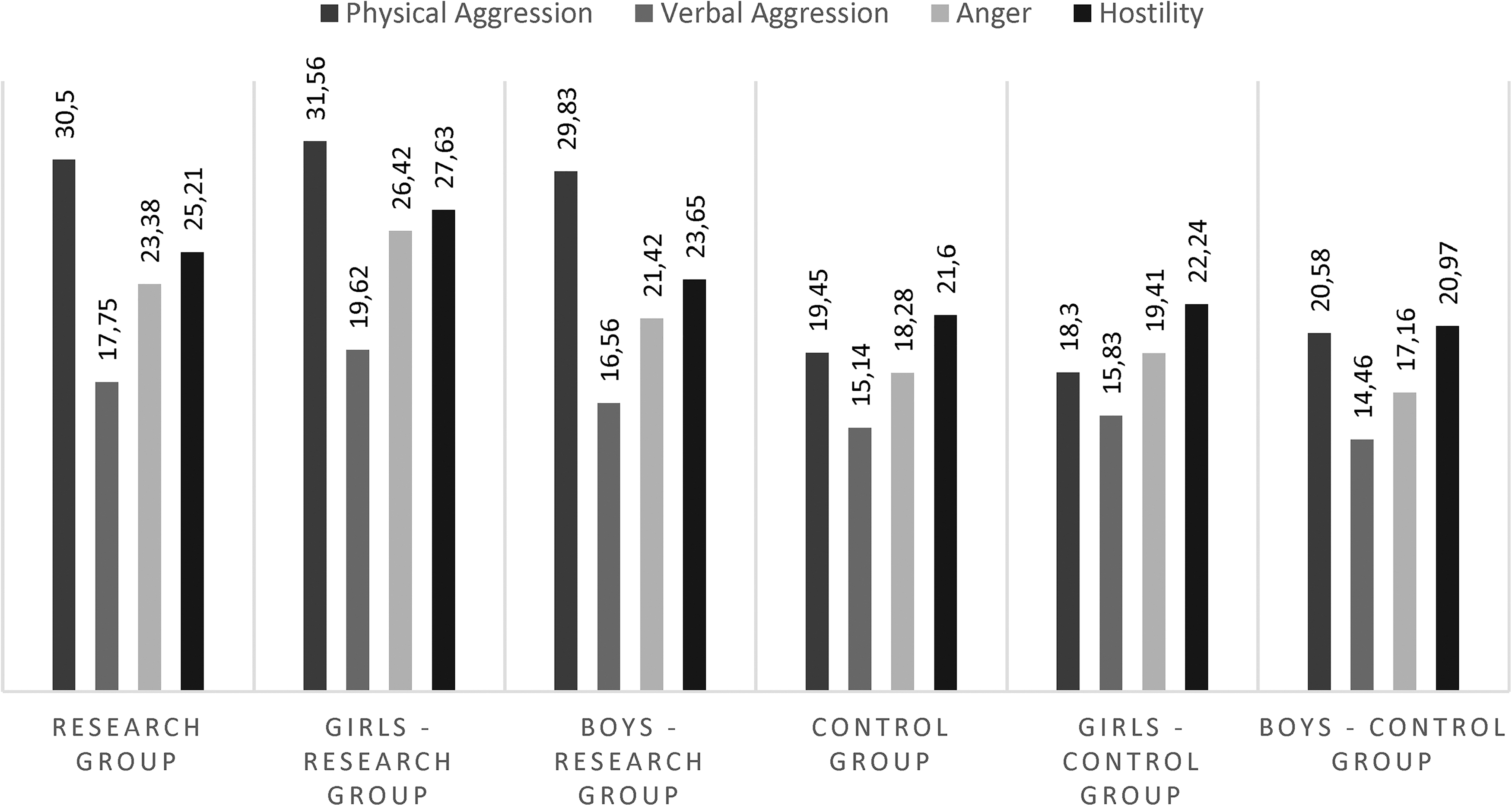
Average results of aggressiveness dimensions in the studied groups.
In turn, in the group of high school students, it was found that the average result of physical aggression amounted to 19.45 (SD = 7.61); verbal aggression to 15.14 (SD = 4.09); anger to 18.28 (SD = 6.53); and hostility to 21.60 (SD = 7.39). Among girls, the average result of physical aggression was 18.30 (SD = 6.72); verbal aggression was 15.83 (SD = 3.96); anger was 19.41 (SD = 6.42); and hostility was 22.24 (SD = 6.92). In the group of boys, the average score of physical aggression was 20.58 (SD = 8.30); verbal aggression was 14.46 (SD = 4.13); anger was 17.16 (SD = 6.50), and hostility was 20.97 (SD = 7.82).
Based on the results obtained with the Mann–Whitney U test (Z), it can be concluded that belonging to a group significantly differentiates the subjects in relationship to all aggressiveness scales. The mean severity of aggressiveness in the form of physical aggression in the research group is statistically higher (Z = −9.68, p < 0.001) in comparison to the control group, as well as the severity of verbal aggression (Z = −4.91, p < 0.001), anger (Z = −6.10, p < 0.001), and hostility (Z = −4.21, p < 0.001).
In the severity of physical aggression (Table 2), boys and girls from the research group do not differ significantly between each other (Z = −1.57, p = 0.12). In other dimensions of aggressiveness, girls from the research group achieve significantly higher scores than boys in this group: in verbal aggression (Z = −4.26, p < 0.01), anger (Z = −4.34, p < 0.01), and hostility (Z = −3.43, p < 0.01). In the control group (Table 3), in relationship to physical aggression (Z = −1.49, p = 0.14) and hostility (Z = −0.87, p = 0.39), no statistically significant difference in terms of sex was found. Girls from the control group show significantly greater severity of verbal aggression (Z = −1.98, p < 0.05), similar to anger scale (Z = −2.24, p < 0.05). The above results gave confirmation to adopt the second hypothesis (H2) assuming that sex and belong to the group significantly differentiate the researched youth in the field of manifested dimensions of aggressiveness.
Mean Rank of Aggressiveness Dimensions in the Research Group
p < 0.01.
Z, Mann–Whitney test result.
Mean Rank of Aggressiveness Dimensions in the Control Group
p < 0.05.
Z, Mann–Whitney test result.
Taking into account belonging to a peer group, data were obtained showing that youth offenders from research group (in contrast to peers from the control group) to a large extent are characterized by greater severity of physical aggression, verbal aggression, anger, and hostility.
This is in line with the theoretical assumption of Glueck and Glueck (1950), Friedlander (1945), and Johnson (1996), where the aggressive behavior was found to be higher among the delinquent adolescents than the nondelinquent adolescents and recent research findings such as Shivakumara and colleagues (2014), Dolan and Doylle (2000), Farrington (1991), Moretti and Odgers (2002), Roszkowska and Kucharewicz (2007), and Niewiadomska and Markiewicz (2004).
Correlations between aggressiveness and delinquency and antisocial behavior in studied groups of adolescents
In the further course of the research, it was attempted to determine the existing relationships between the analyzed dimensions of aggressiveness (physical aggression, verbal aggression, anger, and hostility) and antisocial behavior in the research and control group. For this purpose, the value of the Spearman correlation coefficient R was calculated. The analysis of the obtained results allowed to conclude that all dimensions of aggressiveness correlate significantly with delinquency behavior in the research group and behaviors violating social norms in the control group.
Analysis of the obtained data allowed to state that physical aggression (R = 0.51, p < 0.01), verbal aggression (R = 0.39, p < 0.01), anger (R = 0.43, p < 0.01), and hostility (R = 0.24; p < 0.01) are in a significant positive relationship to delinquency behaviors in the research group. Similarly, in the case of adolescents from the control group, results suggesting that physical aggression (R = 0.60, p < 0.01), verbal aggression (R = 0.32, p < 0.01), anger (R = 0.35, p < 0.01), and hostility (R = 0.23, p < 0.05) correlate positively with behaviors that violate social norms were obtained.
The analysis of R-Spearman's correlation coefficients (Table 4), including sex factor, showed that among girls from research group, only physical aggression correlates significantly with delinquency behavior (R = 0.51, p < 0.01). It was found that verbal aggression (R = 0.25, p > 0.05), anger (R = 0.27, p > 0.05), and hostility (R = −0.14, p > 0.05) do not remain in relationship to delinquency behaviors among girls from the research group. While in the boys' group from the research group, significant correlations with delinquency behavior were found with reference to all dimensions of aggressiveness manifested in the form of physical aggression (R = 0.50, p < 0.01), verbal aggression (R = 0.40, p < 0.01), anger (R = 0.45, p < 0.01), and hostility (R = 0.39, p < 0.01).
The Value of Spearman's R Coefficient in the Correlation Between Dimensions of Aggressiveness and Behaviors Violated Legal and Social Norms Among Boys and Girls from the Studied Groups
p < 0.05; **p < 0.01.
Regarding the population of girls from the control group, the results showed statistically significant relationships between physical aggression (R = 0.44, p < 0.01), verbal aggression (R = 0.27, p < 0.05), anger (R = 0.34, p < 0.01), and behaviors that violate social norms. Only the correlation with hostility did not exceed the materiality threshold (R = 0.21, p > 0.05). Among the boys from the control group, statistically significant correlations with behaviors violating social norms showed all examined dimensions of aggressiveness: physical aggression (R = 0.67, p < 0.01), verbal aggression (R = 0.43, p < 0.01), anger (R = 0.42, p < 0.01), and hostility (R = 0.28, p < 0.05).
Based on the obtained results, it was found that
Among girls from the research group, the higher intensity of physical aggression corresponds to increased severity of delinquency behavior and violating social norms. Furthermore, among boys from the same research group, it was found that the higher severity of physical aggression, verbal aggression, anger, and hostility corresponds to higher levels of delinquency behavior and violation of social norms.
Among girls from the control group, the increased intensity of physical aggression, verbal aggression, and anger corresponds to the higher intensity of behaviors violating social norms. Among the boys from the same group, correlations were obtained, suggesting that the higher intensity of physical aggression, verbal aggression, anger, and hostility corresponds to the increased intensity of behaviors violating social norms.
In view of the above, there are grounds for partial acceptance of the third hypothesis (H3), assuming the relationship between different dimensions of aggression (physical aggression, verbal aggression, anger, and hostility) and the intensity of delinquent behavior and violating social norms in the population of girls and boys from both studied groups. The lack of confirmation of the above hypothesis was found in the results concerning the lack of significant correlations between the studied variables only in relationship to the population of girls from both studied groups. Among girls from the research group, no significant relationship was found between delinquent behavior and violating social norms with verbal aggression, anger, and hostility. In the population of girls from the control group, no significant relationships were found that violate social norms only with aggressiveness manifested in the form of an attitude of hostility.
Discussion
This study contains some limitations that may provide guidance for future research in this field. These limitations are primarily related to the practical and methodological aspects of the conducted research.
The first of these concerns the selection of a sample of the studied delinquent adolescents. The study uses a correlation scheme, the justification of which is the inability to reach a representative group of delinquent adolescents in Poland and the lack of consent from all entities to carry out research in a given period, resulting from differences in the internal functioning of institutions (different organization of extracurricular activities, workshops, and passes allocated). The study used the selection of equivalent groups design, which means a deliberate choice among the two communities most similar to each other, also taking care of the comparable numbers of both groups drawing the youth from the control group. It should also be noted that correlation scheme prevents cause and effect reasoning, which is a limitation for understanding the causes of delinquent behavior and violating social norms among youth.
Second limitation is the inability to deepen and refine the respondents' answers and the lack of personal contact with the respondents, which makes it impossible to obtain additional data. Therefore, in future studies, it would be valuable to consider the possibilities of using different measurement methods to get more reliable results. However, such a way of conducting research would involve more financial and time expenditure.
The results obtained on delinquent behavior and violating social norms, with their predominance among the youth from the research group, are not surprising. It can be assumed that the prior taking of behaviors oscillating around the violation of legal and social norms is an expression of the existence of negative environmental factors in the life of the young people creating conditions for modeling themselves on people from the closest environment. Often the negative role model is played by peers (Padilla-Walker and Bean 2009; Tomé et al. 2012), but also parents presenting the antisocial style of social functioning (Collins et al. 2000; Maccoby 2000).
The scripts shaped in the course of socialization to react to the stimuli occurring in the life of young people do not remain outside the line of significant participation in the decision-making process, when the youth decides to participate in the socially unacceptable act. In the literature on the subject, it is often stressed that youth offenders are largely characterized by growing in a dysfunctional family environment. It should be assumed that behavior patterns presented in the family home form the basis for imitation of this behavior in the future. It should be noted that dysfunctional families often do not demonstrate (or have a poor performance) social control over a child, giving him excessive freedom in the proceedings. In the period of adolescence, it is also often observed that the ties between children and parents are broken. The loss of authority by parents is often replaced by informal peer groups, often characterized by nonconformist patterns of behavior. Loss of authority by parents for a peer group (e.g., criminal) is also associated with a rebellion and disobedience that generate aggressive, punishable behaviors that are inconsistent with the social norm and other educational problems.
The aggressiveness results are confirmed by Dolan and Doylle (2000), Farrington (1991), and Moretti and Odgers (2002), whose research showed that the population of juvenile offenders is characterized by a generally higher level of aggressiveness and a significant diversity of its forms, for example, hostility, emotional aggression, instrumental aggression, physical aggression, verbal aggression, and anger. Support for the hypothesis concerning the existing differences between boys and girls in terms of the manifested dimensions of aggressiveness can be found in numerous studies confirming (or not) the existence of these differences. These studies consistently confirm that criminal girls show a higher level of verbal aggression, anger, and hostility. In turn, the population of delinquent boys is characterized by a significantly higher level of physical aggression (Barwiński and Gierowski 2009; Gierowski and Porańska 2007; Gierowski and Rumszewicz 2006; Gierowski et al. 2008).
Likewise, Larson and Richards (1994) emphasize the fact that the strong emotional states experienced by the youth concern both positive and negative emotions, which, in the light of this research results, are much more. Negative emotions, particularly strongly experienced during adolescence, include the following: depressive states, sadness, anxiety, feelings of shame, and feelings of guilt, as well as a sense of unwillingness and hostility toward oneself and others.
Conclusions
These findings highlight the need to effectively address the issues of child and adolescent aggression. The results obtained also allow to put forward a few practical conclusions referring to educational actions oscillating around preventive and resocialization activities. It is well known that preventive measures oscillate around minimizing risk factors, while maximizing protective factors. Above results showed that aggressiveness turned out to be a more important factor predisposing the criminal behavior and violating social norms in the studied population, which is why it would be necessary to take into account primarily therapeutic activities aimed at correcting adverse effects in rehabilitation activities (first of all, one should turn to Aggression Replacement Training (Brännströma et al. 2016) based on the belief that the basic causes of aggressive behavior are deficits regarding the ability to control one's impulsiveness, the lack of prosocial skills, and the insufficient development of moral thinking, which does not play a corrective role in making behavior that violates social norms. An important solution in working with aggressive youth can also be Cognitive Behavioral Therapy (CBT) focus on challenging and changing unhelpful cognitive distortions (e.g., thoughts, beliefs, and attitudes) and behaviors, improving emotional regulation, and the development of personal coping strategies that target solving current problems (Benjamin et al. 2011; Sukhodolsky et al. 2004). CBT is another well-studied psychosocial treatment for anger and aggression in children and adolescents. During CBT, children learn how to regulate their frustration, improve their social problem-solving skills, and role-play assertive behaviors that can be used during conflicts instead of aggression. CBT can be offered in the format of time-limited psychotherapy in outpatient mental health centers (Sukhodolsky et al. 2016).
To reduce or eliminate the tendency to aggressive activities, professional psychotherapeutic techniques should be used to make the detriment of criminal acts and aggressive behaviors more aware (Alpert and Spillmann 1997). The treatments for different ways of satisfying needs without harming the environment, interpersonal training strengthening the development of social competences, problem-solving skill training, multisystemic therapy, and developing group work skills may be important (Kazdin and Wassell 2000). Taking preventive measure and preventing the escalation of social maladjustment, it is necessary, inter alia to closely observe and disclose criminogenic factors that predict aggression.
Particular attention should be paid to the family environment, because its operation is fundamental in the process of child socialization. The family environment should be subject to observations not only due to the defectiveness of parental functions but also for the purpose of parent education (Davis-Kean 2005) by providing Parent management training (PMT). PMT is aimed at improving aversive patterns of family interactions that engender children's disruptive behavior. Anger/irritability and aggression are among the most frequent reasons for mental health referrals in children and adolescents. PMT is a form of behavioral therapy that aims to ameliorate patterns of family interactions that produce antecedents and consequences that maintain the child's anger and aggression. (Sukhodolsky et al. 2016).
The results obtained indicate the need to improve preventive activities, which should be based on engaging young people in activities in line with social norms. An important role may be played by nongovernmental organizations, which propose various forms of work with young people exposed to factors predisposing to violation of legal and social norms. As Harwood and colleagues (2017) pointed out, martial arts is a popular activity for youth worldwide. Martial arts appears to be a worthwhile intervention in reducing aggressive behavior.
It should be noted that social rehabilitation activities aimed at young people who do not comply with legal and social norms, and thus show symptoms of social maladjustment, should focus on development of supportive activities focused around therapy and self-awareness of consequences of own behavior; moral development; change of habitual reaction patterns and modification of normative beliefs; development of research on social aspects of the social functioning of young people; equalizing educational opportunities; teaching valuable free time; forecasting the fate of a minor; developing awareness of one's emotions and ways of controlling them; and development of interpersonal skills and assertiveness.
Summarizing, it should be noted that the problems raised in this work are still an open subject that can inspire further theoretical and empirical research, and thus new practical arrangements for the diagnosis, therapy, and resocialization of youth offenders.
Footnotes
Authors Disclosure Statement
No competing financial interests exist.
Funding Information
The research was financed from private authors' funds.