




Abstract
This study investigated the social and cultural representations that employees of the Municipality of Naples hold concerning violence against women. The aim of this research was to explore if and how they attribute blame for gender-based violence and their perception of the effectiveness of resolution strategies focused on either preventing or actively combating violence against women. Their results showed that when respondents attribute violence to sociocultural factors, they recognize the importance of implementing effective resolution strategies. Conversely, those who primarily place the blame for violence against women on male individual characteristics generally do not support and propose strategies to stop this kind of violence. Moreover, violence perpetrators not resulting in the work context or in the neighborhood of the respondents and implications of these data will be further discussed.
Introduction
Violence against women is a widespread phenomenon in the European context, where 62,000 women report being victims of violence each year (FRA 2014). Violence against women is more common in Northern European countries (UN 1993; WHO 2012, 2016). In contrast, Italy falls in the bottom half of the ranking; 27% of Italian women reported being victims of physical and/or sexual violence.
Nevertheless, the National Institute of Statistics (ISTAT 2014) found that 31.5% of women between the ages of 15 and 80 have suffered physical or sexual violence. ISTAT found that 20.2% of Italian women have suffered physical violence, 21% have been victims of sexual violence, and 5.4% of women in Italy have been raped or suffered an attempted rape. The report also indicates that 13.6% of Italian women were subject to violence by their current partner, while 18.9% by their ex-partners.
An ecological framework gives us a full understanding of the origins and actions of gender-based violence: Heise (1998) described the interplay of personal, situational, and sociocultural factors encouraging authors to develop a more integrated approach to theory building on gender violence. Recently Di Napoli et al. (2019) proposed an ecological approach rooted in community psychology theoretical experience focusing on the need of a multidimensional theory, as well as on the urgency of interventions, aimed at ending the fragmentation of existing measures. Furthermore, these authors operationalized and prioritized in the Italian context, the previous mentioned ecological dimensions (i.e., personal, relational, organizational, and cultural/political).
GREVIO, the independent expert body responsible for monitoring the implementation of the Council of Europe Convention on Preventing and Combating Violence against Women and Domestic Violence (Istanbul Convention), reported that adequate policies to assist victims of gender-based violence in Italy are still scarce, highlighting the absence of sufficient housing for the victims, scarce public funds, and the poor preparation of the police and sociomedical personnel in dealing with the phenomenon of violence against women (Baggioni and Pirrone 2018).
The poor preparation of social and health operators in caring for female victims of violence is in fact strongly affecting the organizations of health and social services, as well as their intervention strategies (Di Napoli et al. 2019; Francis et al. 2017; Procentese et al. 2019a,b).
Social attitudes, prejudice, and stereotypes toward violence against women are strongly rooted at the collective level, often inspiring ideas of justification and tolerance in relation to violent behaviors toward women (Grubb and Turner 2012). These social representations reflect the just-world hypothesis (Lerner 1980), which stipulates that people's actions are inherently inclined to bring morally fair and fitting consequences. Attitudes toward violence against women behind the responses toward victims who report violence (Powell and Webster 2018) are essential to comprehend the perpetration and victimization aspects of intimate partner violence (Wang 2019).
According to Bourdieu (2001) violence against women in private and public life is the effect of social patriarchal power; meanwhile, Kaufman (2013) focused it on seven factors affecting men's violent behaviors such as men's sense of entitlement of privilege. Rollero (2019) indeed analyzes social and cultural stereotypes and their influence on gender violence, and she (Rollero et al. 2009) explains them within the framework of the Social Dominance Orientation and the ambivalent sexism theory. Furthermore, Fasanelli et al. 2020 focalize the effects of this hostile and benevolent sexism even among adolescences.
Therefore, there is the need that personnel of public offices specially when related with violence issues are aware of the spread of the phenomenon and of their own attitudes, positionality, and reflexivity toward violence perpetrators and victims (Esposito 2017; Fine 2015).
The literature has investigated the attitudes of professionals who often work with violence victims, including health care workers (Carnevale et al. 2020; Procentese et al. 2019b; Ranjbar and Speer 2013), law enforcement officers (Sleath and Bull 2015; Venema 2016), members of the judiciary (Barn and Kumari 2015), jurors (Ellison and Munro 2009; Sommer et al. 2016), and informal support networks (Hayes et al. 2013). Victim-blaming and minimization attitudes are in fact reported as being widespread behaviors among legal, medical, and health care professionals (Jackson et al. 2001; Procentese et al. 2019a). These personnel victimize women and attribute the responsibility for the violence that women suffer to the women themselves (Reale et al. 2017). Operators' moral evaluations further victimize women who have suffered from gender-based violence by attributing responsibility for the violence to victims who may already feel responsible for the violence that they have been subject to (Baldry and Pagliaro 2014; Baldry et al. 2015; De Vincenzo and Troisi 2018; Pagliaro et al. 2018; Troisi 2018).
To deepen the knowledge about personnel of institutional public context, the present study aims to understand the representation toward violence against women, their attribution of blame for gender-based violence, and their vision concerning the strategies to combat violence against women.
The present study was conducted in collaboration with the Municipality of Naples' Department of Equal Opportunities and in partnership with trade unions. The authors choose municipal employees as participants because they consider them to be the best voice of the town citizens. Furthermore, the town administration in its duty and through its services plays a central role in fighting against violence, that is, police department, welfare policies, school, and social preventative services. Furthermore, the authors assumed that this research on gender violence in its collaborative procedure may improve violence awareness among respondents and public services intervention strategies and policies.
Objectives of the study
To comprehend the social representations of violence against women among employees of the Municipality of Naples;
to evaluate which factors they perceive as being responsible for the occurrence of violence against women; and
to identify which strategies are perceived as being the most effective in tackling violence against women.
Materials and Methods
The questionnaire was built together with town union representatives with the aim to create an easy tool able to detect personnel attitudes and their representations of gender violence. The goal of this collaborative approach (Gonzalez and Trickett 2014) was to use the questionnaire administration as an awareness strategy implemented by the discussion of results in a public event involving employees and administrators. Moreover, the final aim was to create a procedure aimed at improving and enhancing reflectivity and positionality among the respondents. Several meetings brought to the definition of the areas to investigate. The university team enriched the first proposal made by the employees, deepening the topic by developing questions related to stalking and sexual harassment, both in an information approach and detecting employees' personal experience in family and work contexts.
Two union representatives involved in personnel training gave to the university team 57 questionnaires filled by administrative services personnel during a training course. The collected data were analyzed by the university team and further discussed in a larger meeting with the active participation of representatives of different unions (i.e., CGil, CSL, UIL, and others) and of the municipal CUG, Central Guarantee Committee for equal opportunities, enhancement of workers' health and against discrimination. The meeting was conducted by the Equal Opportunities Assessor. The participants gave then to the University team the task to implement the items, as well as to take into account the comments and suggestions of the audience. Finally, a revised version of the questionnaire was produced and presented to the same audience that then decided its dissemination strategy.
An email inviting the employees of the Municipality of Naples provided them with a link to the online questionnaire. The requests were sent to a total of 318 individuals belonging to 6 different city departments, encompassing the municipal council, the welfare office, the mayor's office, and the local police, in addition to other public services.
The questionnaires collected were screened. The following were eliminated from the research: participants who were not of age (under the age of 18) or who did not specify their age; participants who have not specified that they are actually employees of the municipality; and finally the participants who have not granted their authorization to use the data for research purposes. The final sample was composed of 235 participants with an average age of 52.85 years (SD = 10.378). Around 57% of participants were males, and 43% were females. Respondents' sociodemographic characteristics are shown in Table 1.
Characteristics of the Sample (N = 235)
To detect representations of violence a questionnaire was constructed ad hoc. The questionnaire was divided into the subsequent three sections:
Section 1—Blame attribution: Six items were related to factors that perpetuate violence against women, utilizing a 5-point Likert scale ranging from 1 (not at all) to 5 (extremely). They included themes related to sociocultural-based gender inequalities, such as men's difficulty in accepting the economic and emotional independence of women, and to specific male characteristics, such as men's lower educational levels and their propensity to abuse alcohol and drugs. Section 2—Strategies against violence: Using a 5-point Likert scale ranging from 1 (not at all) to 5 (extremely), six items were included to evaluate which strategies for combating violence against women were deemed to be the most effective by respondents. Items used to evaluate the effectiveness of different strategies included operative strategies, such as advocacy and awareness campaigns, the creation of curricula designed to teach nonviolence, human rights and gender issues in primary and secondary schools, the installation of surveillance cameras in potentially risky areas, an increase in the number of antiviolence centers and women's shelters, increased funding for women's shelters, and enacting legislation to introduce tougher penalties for violence against women. Section 3—Demographic data: This final section includes questions related to the biological sex, age, marital status, and educational level of the study participants. This section also included two questions about the level of knowledge of the participants about the spread of the phenomenon and one question about their relationship with the people implicated in such acts. Specifically, participants were asked to report their perception about the spread of violence against women in the housing and working areas. For both questions, they were able to choose a response from 1 (very little widespread) to 5 (very widespread). Finally, in the last question, the participants were asked to indicate whether the people involved in the situation of violence were their family members, partners, friends, acquaintances, or strangers.
Data analysis
The authors ran analyses in a series of steps. First, an exploratory factor analysis and a confirmatory factor analysis were conducted to evaluate the factor structure of the two scales presented in the questionnaire. The authors performed a principal axis factor analysis with oblimin rotation to identify any potential dimensions underlined by the items used to measure attributions of blame and to evaluate the effectiveness of different strategies to combat violence against women. The authors conducted subsequent confirmatory factor analyses to verify the psychometric properties of the scales. As a preliminary analysis, the authors performed a set of repeated measures analysis of variance (ANOVA) to evaluate differences in blame rating attributions and strategy effectiveness (within-subject factor). Furthermore, the authors also tested the moderating role of participants' gender (between-subject factor) and controlled for their educational levels, marital status, and age. Finally, the independent attributions of blame on the effectiveness of antigender-based violence strategies were examined using structural equation modeling. All effects were controlled for age, gender, and educational level. Multiple fit indices were used to evaluate the model fit, including the chi-square likelihood ratio statistic, the Comparative Fit Index (CFI) (Bentler 1990), and the Root Mean Square Error of Approximation (RMSEA) (Browne and Cudeck 1993), all of which utilized an associated 90% confidence interval (CI). The fit indices found a CFI ≥0.90 and a RMSEA ≤0.08, indicating that the model possesses an acceptable fit to the data (Kline 2016).
Results
Analysis results showed that scales, related to blame attributions and the effectiveness of strategies to combat violence against women, are normally distributed. The results in fact showed adequate values for univariate skewness (ranging from −1.045 to 0.097) and kurtosis (ranging from −0.977 to 0.638).
The authors conducted an exploratory factor analysis using principal-axis factor analysis on the six items of the blame attribution scale. After examining the scree plot (Cattell 1966), a two-factor solution emerged that explained 55.31% of the variance. All items had loadings of at least 0.40 on any scale and no cross-loadings higher than 0.20 (Henson and Roberts 2006; Park et al. 2002). Factors were positively correlated (r = 0.47, p < 0.001), and the eigenvalues were equal to 2.20 and 1.12 for the first and second factors, respectively. The first factor accounted for 36.66% of the variance and contained two items reflecting sociocultural-based gender inequalities. The authors labeled this factor sociocultural factors. Four items comprised the second factor, which accounted for 18.64% of the variance. The second factor items reflected male way of being behind men's aggressive behavior toward women. The authors named this factor male characteristics. The confirmatory factor analysis showed an adequate model fit, confirming this factor structure, χ2(df = 8) = 10.649, p = 22, CFI = 0.98, RMSEA = 0.03, 90% CI [0.00–0.09].
Indeed, the scree plot of the exploratory factor analysis conducted on the six items measuring the effectiveness of antiviolence against women strategies indicated a two-factor solution explaining 70.3% of the variance. All items had loadings of at least 0.40 on any scale and no cross-loadings higher than 0.20. The factors were positively correlated (r = 0.69, p < 0.001), and the eigenvalues were equal to 3.33 and 0.90 for the first and second factors, respectively. The first factor accounted for 55.45% of the variance and contained three items reflecting operative strategies at the preventive level, which encompass strategies that include educational programs and the spread of a culture based on respect for women to prevent the emergence of gender-based violence. The authors labeled this factor strategies focused on preventing violence. Four items comprised the second factor, which accounted for 14.85% of the variance. The second factor items reflected strategies operating at a restorative level, which can be described as strategies that are directed toward women facing situations of violence and whose purpose is to stop gender-based violence and to offer material and psychological support to female victims. The authors named this factor strategies focused on combating violence.
A confirmatory factor analysis was used to establish the factor structure, χ2(df = 8) = 26.53, p ≤ 0.001, CFI = 0.97, RMSEA = 0.08, 90% CI [0.05–0.14]. Factor loadings are shown in Table 2.
Factor Loadings from Exploratory Factor Analysis
Bivariate correlations between all studied variables are shown in Table 3. Results highlighted a negative association between age and attributing blame for violence against women to sociocultural factors. However, a positive association was found between attributing blame to sociocultural factors and sex and educational level, respectively, with female and more highly-educated participants with a higher educational level scoring higher. Being female also correlated with higher effectiveness of strategies focused on prevention. It may say that they agreed most on cultural programs for social changes. Meanwhile having a lower educational level was linked with higher effectiveness of contrasting strategies. It means that they were most appreciating of strategies fighting effects of violence, in restorative perspectives. Marital status did not correlate with any variable in the study, so it was removed from further analyses.
Correlations Among Study's Variables
p ≤ 0.05, **p ≤ 0.01, ***p ≤ 0.001.
AB, attributions of blame; SE, strategies' effectiveness.
As regards the perception of the spread of acts of violence against women, the most frequent response from the participants was “not very widespread,” both with reference to the housing area (64%) and the working area (69%). The participants then indicated that when they learned of violent acts against a woman in the living or working area, she was often a stranger to them (76%).
Repeated-measures ANOVA for attributions of blame showed no significant main effect, F (1, 231) = 0.109, p = 0.74, but did demonstrate a significant interaction with gender, F (1, 231) = 12.548, p < 0.001. Women attributed greater levels of blame to sociocultural factors than to male characteristics, F (1, 100) = 24.739, p < 0.001, whereas men reported no significant differences when evaluating attributions of blame, F (1, 133) = 1.039, p = 0.31. The between-subject test showed that gender had a significant effect, F (1, 231) = 9.28, p < 0.01, with women scoring higher on both levels of attributions (M = 3.74) than men (M = 3.36). Similarly, the results of repeated-measures ANOVA concerning the effectiveness of strategies showed no significant main effect, F (1, 231) = 0.136, p = 0.71, but did demonstrate a significant interaction effect with gender, F (1, 231) = 17.211, p < 0.001. In this regard, men were more likely to cite the importance of strategies focused on preventing violence than on strategies focused on combating violence, F (1, 133) = 32.046, p < 0.001, whereas women demonstrated no significant difference in their propensity to support either of the two kinds of strategies, F (1, 100) = 0.135, p = 0.71. The between-subject test showed that gender possessed a significant effect, F (1, 231) = 20.143, p < 0.001, with men (M = 4.00) scoring lower on both dimensions of strategy effectiveness than women (M = 4.48).
The structural equation modeling showed an adequate fit to the data, χ2(72) = 132.764, p < 0.001, CFI = 0.93, RMSEA = 0.06, 90% CI [0.04–0.08]. Moreover, the results highlighted the significant effect of sociocultural factors on strategies focused on preventing and combating violence against women. Furthermore, the results concerning strategies for combating violence against women focused on sociocultural factors were not statistically different from societal factors focused on preventing violence (Wald test = 2.55, p = 0.11). No significant associations were found between male characteristics and strategy effectiveness. Concerning the control variables, the authors found that women presented higher scores than men regarding sociocultural factors and strategies focused on combating violence, whereas higher educational levels were negatively associated with higher levels of perceived effectiveness for both strategies focused on preventing and combating violence, respectively (Fig. 1).
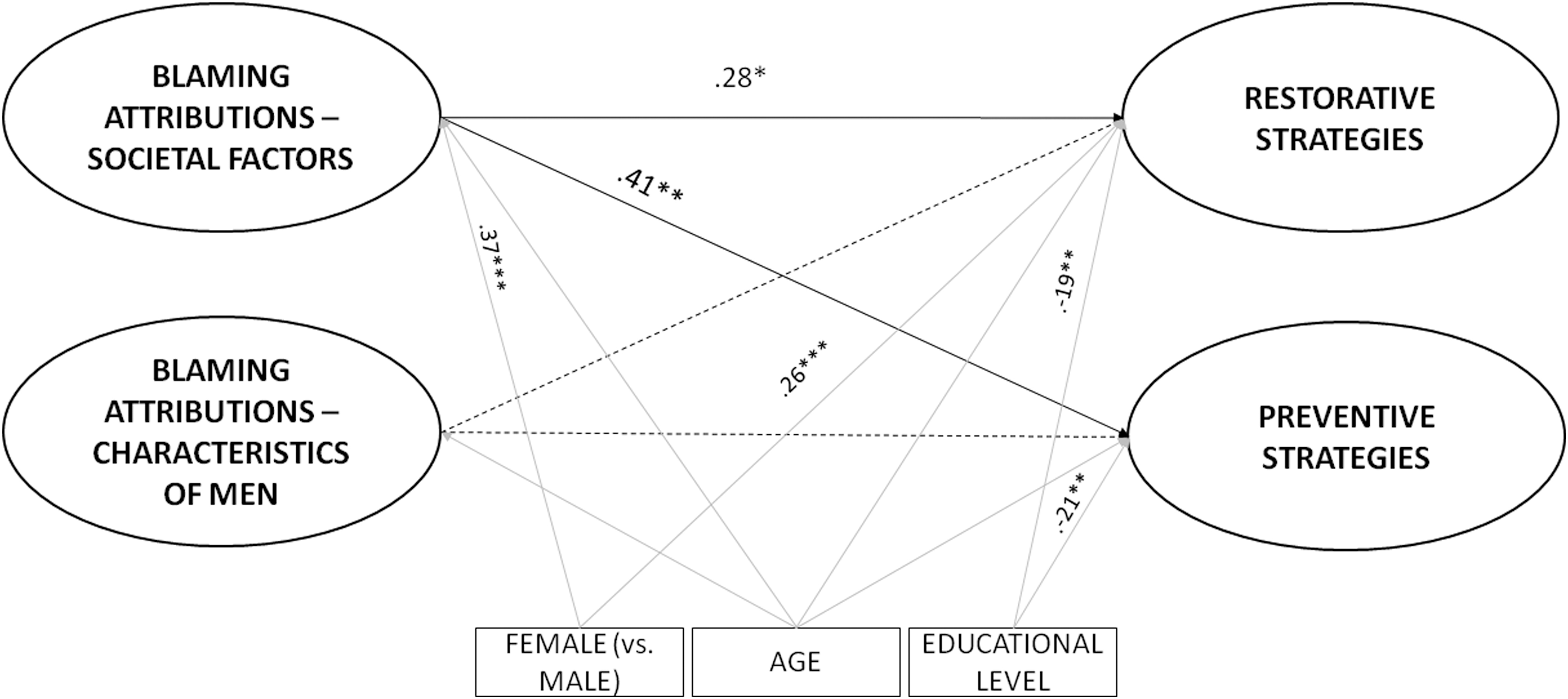
Independent contribution of attributions of blame on effectiveness of strategies. *p ≤ 0.05, **p ≤ 0.01, ***p ≤ 0.001.
Discussion
The results reveal a significant association between the attribution of violence to sociocultural factors and both strategies focused on preventing and combating violence, respectively. Therefore, participants were able to propose concrete and clear intervention responses to violence in relation to social factors.
Moreover, women's perspectives are more oriented toward strategies to combat gender-based violence in comparison to men, especially when they consider social aspects to be a cause of violence, which may be due to women's expectations of measures to guarantee greater protection for themselves.
Conversely, it is interesting that strategies to combat gender-based violence are not associated with attributing responsibility for violence against women to male characteristics. It means that in their vision change is possible only if the authors act in a cultural and social dimension and not in an individual frame. It may also say that if single men are violent, it will be difficult to interact with their behavior. This result is very surprising because it leads us to the conclusion that, among their respondents, there are no possible measures designed to empower men and encourage them to implement the regulation of their behaviors.
Nonetheless, the present study's findings are in line with many studies (Amodeo et al. 2018; Chiurazzi and Arcidiacono 2017; Chiurazzi et al. 2015) that highlight the deep difficulties that antiviolence operators face in managing interventions directed to the perpetrators of violence.
Antiviolence training should foster a more active and receptive attitude toward stories of violence, in addition to acting as a useful strategy to detect and face the enormous and, unfortunately, still rampant phenomenon of submerged violence.
Conclusion
It has become increasingly evident that violence against women arises as a hidden and secret aspect of one's personal and interpersonal life. In this vein, events related to violence against women are in some way not perceived as belonging to participants' personal experiences, nor occurring among their friends and/or relatives, but, rather, viewed as problems occurring only among others. Results furnish evidence regarding the widespread diffusion of violence against women, but also indicate a high prevalence of NIMBY (Not in My Back Yard)-like attitudes toward this phenomenon (Pol et al. 2006). The difficulty of recognizing violence against women as a phenomenon that is present in closer relationships could also be connected to the difficulty of representing the perpetrator as an unapproachable person recognizing him as a recipient of care. In fact, data showed a lack of representation concerning any sort of intervention dealing with gender-based violence at the individual level of perpetrators. In fact, when participants attribute blame for violence against women to male characteristics, they do not present and propose effective strategies to prevent or combat gender-based violence. The perpetrators of gender-based violence are therefore not viewed as possible beneficiaries of interventions modifying their emotions and the conditions that lead to violence. The perpetrators are represented as helpless and without any hope of changing. Furthermore, the authors could connect this result to the perception of shame of recognizing themselves close to violent men; shame is a main aspect also in the treatment with the perpetrators (Brown 2004).
Therefore, difficulty in thinking about treatments for perpetrators highly contrasts with an ecological integrated vision of the phenomenon of violence against women (Di Napoli et al. 2019; Heise 1998).
While recognizing that the sociocultural heritage on which gender stereotypes are based is central to understanding violence against women, the results of their study allow us to put forward further interpretations of this phenomenon.
In particular, the widespread belief that specific interventions targeting the perpetrators of gender-based violence are unthinkable is connected to the absence or partial recognition of the perpetrators' responsibility for their violent actions; in addition the possibility for the perpetrators to responsibly change their aggressive behaviors is also unforeseen. Meanwhile no strength is attributed to possible change when dealing with a single perpetrator. At this level, the interlacement of individual behavior and sociocultural structural factors seems to be lost, while it is really difficult to imagine these two aspects separately in matters of violence against women (Krahé et al. 2005).
These results should be interpreted while keeping in mind the study's limitations, such as the local nature of the sample and the small number of participants, which prevent the generalization of its results at the national level.
Finally, future research should focus on how the respondents associate intervention strategies with the factors that induce gender-based violence. Their results show that when violence is attributed to sociocultural factors, both strategies focused on preventing violence, and those focused on combating violence are viewed as useful. Meanwhile preventative programs directed to perpetrators of gender violence are still lacking. According to UN (2020) suggestions they may reduce the risk of repetition of violence and increase safety of women and children at risk of violence (Hester et al. 2014). Therefore, it would be interesting for future studies to enhance violence prevention strategies directly focused on combating gender-based violence among potential perpetrators.
Footnotes
Acknowledgments
The authors thank Prof. Simonetta Marino, Councilor in charge of Equal Opportunities of Naples town administration. In particular, the authors are grateful for the assistance provided by Alessia Piccirillo, Municipality staff manager, Annamaria De Fraia, CUG member, and trade union representatives (Anna Letizia, Isabella Bonfiglio, and Luciana Del Fico).
Author Disclosure Statement
No competing financial interests exist.
Funding Information
The study was approved by the Ethics Committee of Psychological Research of Humanities Department., University Federico II., Naples (Italy).