




Abstract
Sexual interest is often communicated in nonverbal and indirect ways, creating opportunities for sexual miscommunication. Specifically, miscommunication in which a man is overinferring the sexual interest of a woman is especially common. This type of miscommunication is linked to sexual harassment, sexual assault, and acquaintance rape. Evolutionary psychologists have explained men's bias toward interpreting women as sexually available as an adaptive reproductive mechanism. Men are motivated to perceive a woman's intent or sexual interest as favorable to themselves, which yields the greatest reproductive rewards. This study investigated whether manipulating attractiveness without the known sexual signals from past research is enough to increase perceived sexual intent in women's behaviors. In addition, this study also manipulated the target of women's behaviors. A community sample of men evaluated the sexual intent behind 25 behaviors performed either by an attractive or unattractive woman, which was manipulated using two pretested photos of differential attractiveness. Hypothetical behaviors were performed by these women either toward the men themselves or another man. Mediation analyses indicated that manipulating attractiveness indirectly increases perceptions of sexual intent through the mechanism of increased sexual arousal, but only when the target of the behavior was the men themselves. These results fit into the motivated perception framework, as interpreting more attractive women as more sexually available compared to unattractive women is reproductively advantageous for men.
Introduction
Men and women typically use nonverbal cues more than verbal cues when communicating sexual interest or disinterest (Davis and Loftus, 2015; Muehlenhard et al, 1986). The indirect nature of this communication method leaves it open to misinterpretation or misperception. Typically, miscommunication occurs in the direction of men overinferring women's sexual intent (e.g., Abbey, 1982; Haselton, 2003; Samara et al, 2021; Treat et al, 2015). Misperception of sexual intent has been linked to sexual harassment, coercion, and even acquaintance rape (Abbey, 1987; Ariely and Loewenstein, 2006; Bouffard and Miller, 2014; Koralewski and Cohen-Conger, 1992; Saal et al, 1989).
Various factors seem to influence men's perceptions of women's sexual intent, including her having tattoos (Guéguen, 2013; Swami and Furnham, 2007), drinking alcohol (Abbey and Harnish, 1995; Garcia and Kushnier, 1987; Livingston et al, 2022; Rerick et al, 2020), and wearing red (Guéguen, 2012b; Prokop and Pazda, 2016). This study examined the extent to which women's physical attractiveness can affect men's perceptions of sexual intent.
Evolutionary roots of men's sexual perception
Men's tendency to overinfer sexual intent based on a woman's physical characteristics and behaviors might be related to gender differences in necessary parental investment (Lenton et al, 2007). Women have a relatively high level of necessary parental investment compared to men (e.g., women carry offspring during gestation and nurse after delivery), so women are typically more discerning during mate selection to ensure they reproduce with a man who will provide support and resources during and after pregnancy (Buss, 2017; Buss and Barnes, 1986; Kenrick et al, 2003).
Because indiscriminate mating can be costly for women, but advantageous for men who need not carry a fetus to term, men are comparably biased toward identifying willing sexual partners in greater quantities (Brandner et al, 2021; Haselton and Buss, 2000). For men, the cost of overperceiving sexual intent is low (i.e., embarrassment of rejection), but underperceiving sexual intent could result in a missed opportunity for reproduction, which involves a greater evolutionary cost (Haselton and Buss, 2000).
Attractiveness and sexual intent
Women employ a variety of successful tactics to increase their physical attractiveness in the eyes of dependable heterosexual male partners (Cloud and Perilloux, 2022; Greer and Buss, 1994; Wade et al, 2021). For instance, women's facial enhancement strategies (e.g., makeup usage; Cash et al, 1989; Cloud and Perilloux, 2022) and clothing choices (e.g., revealing clothing; Abbey, 1987; Abbey et al, 1987; Koukounas and Letch, 2001; Wade et al, 2021) can influence men's perceptions of women's sexual availability and intent, as well as their attractiveness.
As a result, women who display these signals are approached more frequently at bars (Guéguen, 2008), receive more help when hitchhiking (Guéguen, 2012a), and receive greater tips as waitresses (Jacob et al, 2009) compared to women without these characteristics. The presence of such signals can increase men's perceptions of women's attractiveness and sexual willingness simultaneously. Women who display these signals increase their opportunity to choose from a variety of interested potential partners who will invest in their relationship and the nurturing of offspring.
There may also be a motivational component for men to perceive sexual intent from women's ambiguous behaviors such as makeup-wearing and clothing selection. People tend to interpret social information in a manner consistent with their preexisting goals (i.e., motivated perception; Kunda, 1990; Maner et al, 2005). Motivated perception might extend to men's interpretation of women's behaviors. Sexual arousal is a drive state that motivates evolutionarily adaptive reproductive behavior (Bhatia and Loewenstein, 2022; Loewenstein, 1996).
As a result, sexually aroused men infer more sexual intent from women's behaviors (Livingston et al, 2022; Rerick et al, 2020) and photographs (Maner et al, 2005), perceive women's faces as more attractive (Ditto et al, 2006; Stephan et al, 1971), and report greater willingness to engage in risky or coercive sexual behaviors (Ariely and Loewestein, 2006; Bouffard and Miller, 2014 Loewenstein et al, 1997) compared to men who are not sexually aroused. Recent research has demonstrated that sexually aroused men systematically interpret women's behaviors as more indicative of sexual intent compared to men who are not aroused (Livingston et al, 2022; Rerick et al, 2020).
Overview
This study tested the motivated perception or functional projection hypothesis (Maner et al, 2005) regarding heterosexual men's interpretations of women's sexual intent. Specifically, we examined whether women's physical attractiveness can influence men's perceptions of her behavior in the absence of known sexual signals (e.g., revealing clothing, red clothing, tattoos, alcohol). We hypothesized that the same behavior will be interpreted with more sexual intent when performed by an attractive woman compared to an unattractive woman.
In addition, the target of a woman's behavior has not been investigated as a motivating factor for men's sexual perception. If men are biased toward overinferring sexual intent to increase the quantity of potential sexual partners, they should be more motivated to infer sexual intent when a woman performs an ambiguous behavior toward themselves than toward another man. Based on previous research on the motivating forces of sexual arousal, we also hypothesized that men's sexual arousal would mediate these effects.
Methods
The study used a 2 (attractiveness: attractive vs. unattractive) × 2 (target of behavior: themselves or another man) design. Participants were randomly assigned to view either attractive or unattractive photos of Alicia, while they answered questions about the meaning of Alicia's behavior when they were the target of the behavior or when another man was the target. The IRB at Oklahoma City University approved the human subject protocols in this study.
Participants
All participants were recruited from Amazon's Mechanical Turk (MTurk). To qualify for participation in the study, participants had to be men located in the United States with a task approval rate of over 90% for 500+ previous MTurk tasks. Participants were not able to view or preview the task unless they met all qualification criteria. Participants were compensated for completing the task at $0.20 based on an anticipated completion time of 4–6 min.
The full sample consisted of 257 participants. Because the hypotheses of this study concern heterosexual men, 36 participants were removed from the sample due to not responding to the Kinsey scale or reported being “more than incidentally homosexual” (Kinsey et al, 1948). Another 37 participants were removed because they took less than 180 sec to respond to the survey, indicating lack of attention. The cutoff of 180 sec was chosen on the basis of a pretest of 35 students*. The final sample contained 184 participants. The sample had a mean age of 39.71 (standard deviation [SD] = 13.09) years and was 70.9% white. Participants averaged 336 sec to complete the study.
Power
An a priori power analysis assuming between a small and medium effect size of f2 = 0.10 indicated 100 participants would be necessary for a power of 1–β = 0.80 for simple mediation analyses. The remainder of the analyses required less participants, 100 assuming the same effect size and power level.
Materials
The study involved three sets of materials.
Demographics
Demographic questions included basic sex, age, and race measures. Also included was the widely (e.g., Drucker, 2012; Galupo et al, 2014) used Kinsey scale (Kinsey et al, 1948) to assess participants' sexuality, which read, “Select the response that best describes your sexual preferences,” with response options of 1 Exclusively Heterosexual to 7 Exclusively Homosexual.
Photos of Alicia
To manipulate Alicia's attractiveness, participants viewed a headshot of either an attractive or unattractive woman. The photos were taken from the Chicago Face Database and were pretested to be perceived as similar on various other dimensions such as age (early twenties) and race (white), but much different on attractiveness † . In both photos, the woman was smiling with her lips closed looking straight ahead at the camera. The photos used are available along with the rest of the materials and data for this study on the Open Science Framework (DOI 10.17605/OSF.IO/RU6EW).
Modified SIP-Q
This study used a modified version of the Sexual Intent Perceptions Questionnaire (SIP-Q) from past research (Livingston and Davis, 2020; Livingston et al, 2022; Rerick et al, 2020). The measure contains 25 items designed to capture men's interpretations of the sexual intent behind various women's behaviors and has been highly reliable in past research (α = 0.92 in Rerick et al, 2020). In this version, participants received instructions that differed slightly depending on which target of behavior condition they had been assigned to. In the condition where the participants themselves were the target of the behavior, the instructions read, “Imagine that Alicia engages in each of these behaviors with you. Then, indicate how likely it is that this behavior means she wants to have sex with you.”
Each behavior had response options that ranged from 1 This behavior does NOT AT ALL mean she wants to have sex to 7 This behavior DEFINTELY means she wants to have sex. Behaviors ranged from innocuous behaviors such as “She goes out to lunch with you” to more sexual behaviors like “She lets you touch her breasts through her clothes.” In the condition where another man was the target of the behavior, the instructions read, “Imagine that Alicia engages in each of these behaviors with a man. Then, indicate how likely it is that this behavior means she wants to have sex with that man.”
For this condition, participants answered the same 25 questions as were in the other condition, but modified to change the target of behavior. For example, “She goes out to lunch with a man” and, “She let's a man touch her breasts through her clothes.” Response options for this condition were identical and the behaviors were presented in the same order.
Procedure
Upon clicking the survey link, eligible participants read an informed consent document that briefly described the purpose of the study. Participants who agreed to continue answered demographic questions before entering the main portion of the study. Next, participants viewed a photo of “Alicia.” The text below the photo described Alicia as a 21-year-old American and provided no other information about her. Participants were assigned at random to view a headshot of either an attractive woman or an unattractive woman and answered a question asking, “How attractive do you find Alicia?” with response options from 1 Not at All Attractive to 7 Very Attractive. Then, participants answered 25 questions regarding their perception of the sexual intent behind various behaviors that Alicia performed either with the men themselves as the target or with another man as the target, which was determined through random assignment.
Participants answered these 25 questions in sets of 5, and the same photo of Alicia they had originally seen appeared above each set of 5 questions each time. After answering all five sets of questions, participants answered one final question regarding their sexual arousal, “How sexually aroused are you?” with response options from 1 Not at All Aroused to 7 Extremely Aroused. Finally, participants received their MTurk code to enter to receive payment and the study was finished.
Results
First, we assessed the effectiveness of the attractiveness manipulation. Next, each dependent variable was assessed separately using two identical procedures. For both variables, we conducted mediation analyses when appropriate using updated Baron and Kenny (1986) procedures (Zhao et al, 2010). After the preliminary analyses to determine whether mediation was possible, we assessed each dependent variable with a formal mediation model using Lavaan (Rosseel, 2012) in RStudio (RStudio Team, 2020).
Attractiveness manipulation checks
A t-test indicated the attractiveness manipulation was effective [t(182) = 13.62, p < 0.001, d = 2.01]. The men who viewed the attractive photo of Alicia rated her as significantly more attractive (mean [M] = 5.42, SD = 1.13) than the men who viewed the unattractive photo of Alicia (M = 2.49, SD = 1.76).
Preliminary analyses
First, an analysis of variance using self-reported sexual arousal as the dependent variable and the attractiveness conditions and the target of behavior conditions showed a significant main effect of attractiveness condition [F(1,180) = 7.51, p = 0.007, ηp2 = 0.04]. The condition that viewed the attractive photos of Alicia reported significantly more sexual arousal (M = 3.60, SD = 1.81) than the condition that viewed less attractive photos of Alicia (M = 2.81, SD = 2.02). There was no difference in arousal between the target of behavior conditions (Mself = 3.31, SDself = 2.02; Mother = 3.16, SDother = 1.88) and no interaction. Two t-tests comparing both SIP-Q measures ‡ between attractiveness conditions indicated the attractiveness manipulation did not significantly affect responses to either dependent variable. Perceptions of sexual intent also did not significantly differ between target conditions. See Table 1 for means and standard deviations of each scale item.
Means and Standard Deviations for the Measure of Ratings of Sexual Intent
Item wording varied slightly depending on experimental condition.
M, mean; SD, standard deviation.
Next, two simple regressions showed that self-reported sexual arousal was a significant predictor of the SIP-Q when the participant was interpreting a woman's behavior with themselves as the target [b = 0.32, t(89) = 5.56, p < 0.001, R2 = 0.26, f2 = 0.50] and when the participant was interpreting a woman's behavior with another man as the target [b = 0.24, t(91) = 3.70, p < 0.001, R2 = 0.13, f2 = 0.38]. As sexual arousal increased, interpretation of sexual intent increased in both cases.
To summarize, the preliminary analysis indicated that an indirect mediation effect of the attractiveness manipulation on perceptions of sexual intent through sexual arousal was possible. Because the attractiveness manipulation significantly affected sexual arousal, and sexual arousal significantly affected both outcome variables, significant indirect effects of the attractiveness manipulation on both outcome variables through sexual arousal are possible. § The target variable had no possibility of being mediated through arousal and is not analyzed further. Each mediation model contains two sets of regression equations. The first equation uses the SIP-Q as the dependent variable, and the attractiveness manipulation and self-reported arousal as predictors. The second regression equation uses the attractiveness manipulation to predict the measure of self-reported arousal. Each model was bootstrapped to 10,000 iterations.
Main analyses
The first mediation model depicted in Figure 1 tested the effects of the attractiveness manipulation and sexual arousal on men's interpretation of women's behaviors with the men themselves as the target. In the model using the attractiveness manipulation and arousal as predictors, the direct effect of the attractiveness manipulation on the dependent variable was nonsignificant (b = 0.08, z = 0.32, p = 0.75).
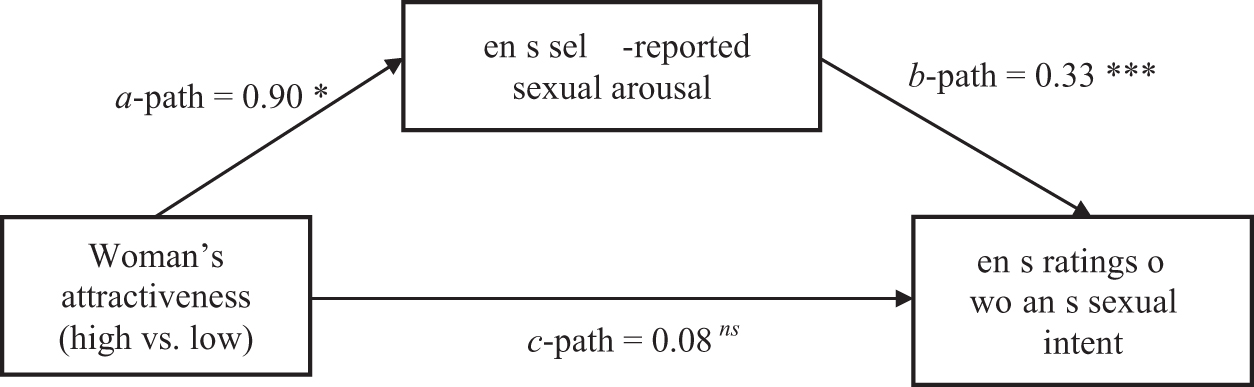
Mediation analysis depicting the effect of target attractiveness on men's ratings of women's sexual intent through self-reported sexual arousal. In this analysis, participants imagined that they were the target of the woman's behavior. ***p < 0.001, *p < 0.05, ns = nonsignificant. Path coefficients represent unstandardized beta scores.
However, arousal significantly predicted the dependent variable (b = 0.33, z = 5.21, p < 0.001). As sexual arousal increased, men interpreted more sexual intent in women's behaviors when interpreting the behavior being performed with themselves as the target. The overall model was also significant [F(2,88) = 15.37, p < 0.001, R2 = 0.26]. The second regression model indicated that the attractiveness manipulation was a significant predictor of sexual arousal (b = 0.90, z = 2.13, p = 0.03). This pattern resulted in a significant indirect effect of the attractiveness manipulation on interpretation of sexual intent through the sexual arousal variable (b = 0.29, z = 1.99, p = 0.02).
The second mediation model depicted in Figure 2 tested the effects of the attractiveness manipulation and sexual arousal on men's interpretation of women's behaviors with another man as the target. In the model using the attractiveness manipulation and arousal as predictors, the direct effect of the attractiveness manipulation on the dependent variable was nonsignificant (b = 0.33, z = 1.34, p = 0.18). However, arousal significantly predicted the dependent variable (b = 0.25, z = 3.82, p < 0.001). As sexual arousal increased, men interpreted more sexual intent in women's behaviors when interpreting the behavior being performed with another man as the target.

Mediation analysis depicting the effect of target attractiveness on men's ratings of women's sexual intent through self-reported sexual arousal. In this analysis, participants imagined that another man was the target of the woman's behavior. ***p < 0.001, +p < 0.10, ns = nonsignificant. Path coefficients represent unstandardized beta scores.
The overall model was also significant [F(2,90) = 7.79, p < 0.001, R2 = 0.15]. The second regression model indicated that the attractiveness manipulation was only a marginally significant predictor of sexual arousal (b = 0.66, z = 1.71, p = 0.08). This pattern resulted in a nonsignificant indirect effect of the attractiveness manipulation on interpretation of sexual intent through the sexual arousal variable (b = 0.17, z = 1.51, p = 0.13).
Discussion
The hypotheses were partially supported. When men interpreted women's behavior with themselves as the target, interpreting the behavior of the attractive woman increased sexual arousal, and increasing sexual arousal predicted more interpretation of sexual intent behind the behavior. However, this effect was limited to men who were interpreting behaviors with themselves as the target. Sexual arousal still predicted perceptions of sexual intent with another man as the target, which replicates past research (Bouffard and Miller, 2014; Livingston et al, 2022; Rerick et al, 2020).
Although the effects of target of behavior were nonsignificant, the regression model predicting perception of sexual intent toward the participant themselves explained twice as much variance as the regression model predicting sexual intent toward another man. These results might indicate that the motivational forces that affect interpretation of sexual intent are much stronger when men are evaluating their own chances for sex compared to another man's. This interpretation also explains why the attractiveness manipulation significantly affected men's sexual arousal when they were imagining the attractive woman performing these behaviors toward them, but not another man.
Previous research has indicated that various factors like wearing red (Guéguen, 2012b), consuming or being in the presence of alcohol (Abbey and Harnish, 1995), wearing revealing clothing (Abbey et al, 1987; Wade et al, 2021), and wearing makeup (Cash et al, 1989; Cloud and Perilloux, 2022) simultaneously increase a woman's perceived attractiveness and her sexual availability. This study demonstrates that a woman's attractiveness alone might be enough to increase men's perception of sexual intent in her behaviors, even in the absence of all other known sexual signals. These findings support the motivated perception hypothesis (Maner et al, 2005) and the evolutionary explanation (Haselton and Buss, 2000). Missing the opportunity to mate with an attractive woman is an even greater social and reproductive cost than missing the opportunity to mate with an unattractive woman, so it makes sense that a woman's attractiveness might further bias men's perception of her behavior.
Although recent studies have shown that sexual arousal does bias men's interpretation of women's behavior toward other men (Livingston et al, 2022; Rerick et al, 2020), those studies used a separate manipulation to intentionally create arousal. There are no evolutionary reproductive implications for interpreting women's behavior toward another man, so it logically follows that we did not observe an increase in sexual arousal for men evaluating behaviors performed toward men other than themselves. However, future research might examine whether men interpreting women's sexual behaviors toward other men increases other psychological states such as mating-related aggression or status pursuit, or even biological markers like testosterone.
Consequently, a woman's attractiveness might be an additionally biasing factor contributing to sexual miscommunication, which is linked to sexual assault and acquaintance rape (Abbey, 1987; Koralewski and Cohen-Conger, 1992; Saal et al, 1989). These results along with others that detail the pitfalls of human sexual miscommunication might belong in general sexual harassment education. Perhaps by at least being aware of this bias, people, particularly men, might be able to partially mitigate its effects, as commonly seen with other more general cognitive biases, such as hindsight bias, overconfidence bias, and anchoring (Hirt and Markman, 1995; Lord et al, 1984; Mussweiler et al, 2000).
This study is limited by several factors. First, each mediation model required 100 participants for adequate power according to the a priori analysis, and each model fell just short of that (by 7 and 9 participants, respectively), although bootstrapping procedures should have helped to alleviate this issue. Second, these behaviors were evaluated essentially in participants' imaginations. This means a lot of the context known to be important to interpreting sexual behavior was left up to participants' imaginations. Future research might manipulate attractiveness in female confederates and assess men's perceptions of their intentions, although this eliminates the ability to assess the more clear sexual behaviors.
Third, this study assumed the allosexuality of participants, but this was never measured. Future research should measure this construct to ensure reproducible and valid results. Finally, this study did not assess any of the many other social constructs that appear to affect perception of sexual intent. For example, men and women who are interested in casual sex appear to infer more sexual intent in other people (Lenton et al, 2007) and people lower in sociosexuality (Koukounas and Letch, 2001) also appear to infer more sexual intent in other people. This study focused purely on physical characteristics, but the social contexts and individual characteristics of people making the judgments cannot be ignored.
Conclusion
A variety of factors influence men's perception of women's sexual intentions, and attractiveness seems to be one of them. It appears to function through increasing sexual motivation in men (sexual arousal), which leads to increased perceptions of sexual intent behind women's behaviors. These results are so far limited to men assessing women's behavior when it is directed at themselves, but not other men. These results imply that more attractive women face increased risk of having their behavior misinterpreted as sexually motivated by men.
Because this overinterpretation of sexual intent is connected to various forms of sexual violence, more attractive women might also face increased risk of sexual harassment, coercion, and acquaintance rape (Abbey, 1987; Bouffard and Miller, 2014; Koralewski and Cohen-Conger, 1992; Saal et al, 1989). Replication and extension of these results might focus on increasing ecological validity through a form of field study or considering additional individual difference measures like attitudes toward casual sex or sociosexuality.
Footnotes
Author Disclosure Statement
No competing financial interests exist.
Funding Information
No funding was received for this article.