




Abstract
Women’s aggressive acts are in some circumstances perceived as more intentional but at the same time more acceptable than male aggression. Women typically display less direct, especially physical, aggression, and there are fewer instances of female harm-doers, which may draw more visual attention. That is why the main aim of the current project was to investigate gender differences in ascriptions of intentionality and blame to both male and female harm-doers, as well as attention to their faces using eye-tracking methodology. The authors conducted three studies as follows: Study 1 was done among adults (N = 122, M = 23.94; SD = 5.33, range from 18 to 49) from the general community and focused on ambiguous aggressive encounters. The second study not only aimed to replicate Study 1 (N = 120, M = 28.88; SD = 10.42, range from 17 to 80) but also tested the hypotheses in clearly hostile scenes, where someone was undeniably harmed. In a third study (N = 60, M = 38.55; SD = 9.45, range 22 to 60), the authors aimed to replicate the findings of the first studies in aggressive-prone participants: imprisoned violent offender men and women. The eye-tracking data in all three studies indicated that female harm-doers compared with male harm-doers captured more attention. In addition, there were no clear gender differences in attribution of intentionality and blame ascription to both male and female harm-doers.
Introduction
Across cultures, women present less direct aggression, especially physical aggression (for meta-analysis, see Archer, 2004). Gender differences in aggression can be observed as early as at 2 years of age (Baillargeon et al., 2012). They are most pronounced in early childhood and in early school age, with differences in the intensity of aggressive behavior among women and men decreasing from adolescence (Hyde, 1984). There are some explanations as to why this pattern appears and why men more typically choose costly methods of aggression. Simplistically, causes can be attributed to either prenatal influences (e.g., testosterone) or the effect of environment and socialization (Archer, 2004; Bjorklund and Pellegrini, 2000). According to Social Role Theory, the environment (e.g., parents, teachers, and friends) creates expectations that constitute “a manual of proper behavior” for men and women to which children are socialized to integrate in the development process (Criado-Perez, 2019, 2019; Eagly, 1997; Eagly, 1987; Eagly et al., 2000). Expectancies toward men, especially in less egalitarian cultures, include more aggressive behavior, which reinforces an aggressive masculine stereotype. Conversely, women are encouraged to inhibit aggressive responses (Campbell et al., 1999). Evidence does, however, illustrate the different strategies that women and men use to exhibit aggression, with the latter using more physical violence (Archer, 2002) and women using less physical and more verbal violence, indirect aggression, that is, mocking, gossiping, and intrigue (Bettencourt and Miller, 1996), and subtle means, such as excluding someone from social activities and their peer group (Crick and Grotpeter, 1995). The way both men and women execute aggression can influence how they perceive harmful acts from both genders. This includes how they attribute intent, assign blame to perpetrators, and allocate attention for visual analysis, which are the main areas of focus for the current project.
Although sometimes people attribute greater aggressiveness to men than to women, women might be perceived as aggressive as men when they perform harmful acts (Stewart-Williams, 2002). While these traditional stereotypes may be weakening, differences in interpreting aggressive behavior of men and women are still visible in other aspects, namely the acceptance of such behaviors. For example, women’s aggression is perceived as more acceptable than aggression perpetrated by a man (Stewart-Williams, 2002). Hence, there is a tendency to attribute more intentionality to women than men, when women are the aggressors (Zajenkowska and Rajchert, 2020). Apart from differences in the perception of aggressive acts committed by men and women, including the level of acceptance and intentionality of the act, there are also gender differences in the judgment of what constitutes aggression. Women might have a lower threshold for labeling an act as aggressive; when assessing a disciplinary encounter between a parent and child, women may be more inclined to categorize certain behaviors as aggressive (Herzberger and Tennen, 1985).
Based on the aforementioned findings, it can be inferred that there exist notable gender disparities in the manifestation of aggressive behaviors (e.g., women tend to engage in less direct aggression, particularly physical forms). Gender also plays a role in both the perception of aggressive acts committed by individuals and in the judgment process itself. Aggressive acts exhibited by men, which are more socially approved or expected (Eagly and Steffen, 1986; Huddy and Terkildsen, 1993), may evoke less surprise, whereas women in a position of perpetrators could potentially attract more attention. Recently to better understand critical aspects of judgment which involve the perception of social cues, encoding patterns of observers viewing visual depictions of behaviors, such as aggressive acts, have yielded insightful findings (Wenzlaff et al., 2016; Wilkowski et al., 2007). In general, incongruous cues within a scene attract attention of the observers as they try to explain any inconsistencies, for instance, in an ambiguous social encounter (Wilkowski et al., 2007). In addition, people orient quickly toward faces (Schütz et al., 2011), and the time to the first fixation, as well as at first fixation itself, is related to more automatic bottom-down processes that cannot be controlled consciously (Spiering and Everaerd, 2007; Thompson et al., 2019). Conversely, the total time people spend on a given area of interest (AOI) can be consciously manipulated by the participant by more top-down volitional processes (Thompson et al., 2019). In this context, differences in attention toward both male and female faces are intriguing. Studies with infants have demonstrated that individuals naturally direct their attention to faces from the earliest stages of life, showing a preference for female faces, particularly that of the mother, symbolizing care and survival (Tzourio-Mazoyer et al., 2002). Conversely, research with young adults has unveiled gender disparities in this aspect. While adult males exhibit a similar preference for female faces as infants do, women demonstrate equal attention toward both male and female faces (Alexander and Charles, 2009). However, as far as the authors know, no study has yet explored sensitivity to female and male faces in potentially confrontational situations.
Current Study
Even though aggression from a man typically is perceived as more harmful and less acceptable than the same acts from a woman (Harris, 1995; Harris, 1991; Harris and Knight-Bohnhoff, 1996; Stewart-Williams, 2002), there is a tendency to attribute more intentionality to women than men when they are aggressors (Zajenkowska and Rajchert, 2020). Therefore, the authors hypothesized that direct physical aggression from women would be perceived as more intentional than the same acts from men, and yet the female perpetrators would be blamed to a lesser extent than men (H1). According to Basow et al. (2007), the degree of harm caused by an aggressive act increases the perception of how intentional that act was. Given that (1) typically, women focus on the fact that aggressive behavior produces harm to the target, (2) women tend to direct more guilt and anxiety to themselves when they commit aggressive acts (Eagly and Steffen, 1986), and (3) compared with men, women judge aggressive behaviors to be less acceptable (Basow et al., 2007); the authors assumed that compared with men, women will ascribe more blame to harm-doers (H2).
Given the fact that direct aggression is less common among women (Archer, 2004), the authors wanted to explore whether, compared with male aggressors, female perpetrators of physical aggression attract automatic attention, as assessed by time to first fixation (TTFF), to a greater extent due to the unexpected nature of female aggression. The authors stipulated that when people observe aggressive encounters, the TTFF on the perpetrator’s face is faster if the perpetrator is a woman compared with a man (H3). In addition, the authors hypothesized similar effects in case of the total amount of time a participant spends looking (longer dwell time) at the face of female perpetrator in case of scenes portraying aggressive encounters compared with male perpetrators (H4).
The current project comprises three studies. The first was conducted among adults from the general community and focused on ambiguous aggressive encounters. The second study replicated Study 1 and also included scenes that portrayed aggressive acts that clearly intended harm conducted by men and women. In this second study, the authors were interested if gender differences would be more pronounced when the visual social cues indicate an unambiguously intentional act. In this way, the authors examined whether both intentionality and blame ascription in case of clear harm are moderated by the gender of the perceiver and perpetrator. Given the link between aggression and attributing hostile intentions (De Castro et al., 2002) to ambiguous behaviors, it is important to investigate gender differences in a group characterized by high aggression. Thus, in the third study, the authors aimed to replicate their findings in participants that are prone to aggression as follows: violent incarcerated men and women. Most studies examining gender roles and aggression have been conducted with college students (Condry and Ross, 1985; Finn, 1986; Hammock and Richardson, 1992; Harris, 1995; Harris, 1994; Harris, 1991; Harris and Cook, 1994; Herzberger and Tennen, 1985; Phelps et al., 1991; Smith et al., 1989); fewer studies have included more mature participants or those engaged in the workplace (Harris and Knight-Bohnhoff, 1996) and few have investigated groups with very specific attitudes toward aggression and gender, such as people working in a military base (Harris and Knight-Bohnhoff, 1996). The authors were mostly interested whether, in the case of people who have experienced aggression and are aggressive, the gender differences would be less evident when judging violent acts of other men and women.
Method
Eye-tracking measures
A Tobii Pro X3-120 remote eye tracker with a sampling rate of 120 Hz and the binocular accuracy 0.5°/precision 0.25° 1 was used to measure eye movements. Stimulus presentation and data recording were controlled by a Dell laptop with a 17” screen resolution (1920 × 1080 pixels). Participants viewed the displayed stimuli from a distance of ca. 60–70 cm, and the scene display time was 6 sec. Before starting the study, a 9-point calibration was performed for each person, and the authors tried to achieve at least good calibration; in the case of 15% of participants the calibration was below good. Therefore, the authors analyzed the data on the whole sample and the sample after removing participants with suboptimal calibration; the authors report only the results for the whole sample, but only in case when they were the same as in the smaller sample to ensure the reliability of the outcomes and not to decrease the number of participants, which would compromise the statistical power of the analysis. The analysis of the gaze patterns of both hostile and ambiguous scenes was conducted using the iMotions Attention Tool software (version 7.2; iMotions A/S, Copenhagen, Denmark). The software allows for defining the AOI and obtaining statistical metrics for each area (e.g., fixation duration, saccades). In the current study, frames, including whole faces (see Fig. 1), were marked to define AOI. The shape and size of the AOIs were slightly different (square or rectangle, side length from ca. 2 to ca. 6 cm, ca. 2°−5° visual angle), which was due to the position of the actor in the scene; as all scenes presented two interacting people and included a visual perspective, each face could have been closer or further away in terms of perspective. For each AOI the authors calculated Dwell Time and TTFF. Both indicators are based on fixation metrics that were qualified using the Identification by Velocity Threshold algorithm (Salvucci and Goldberg, 2000).
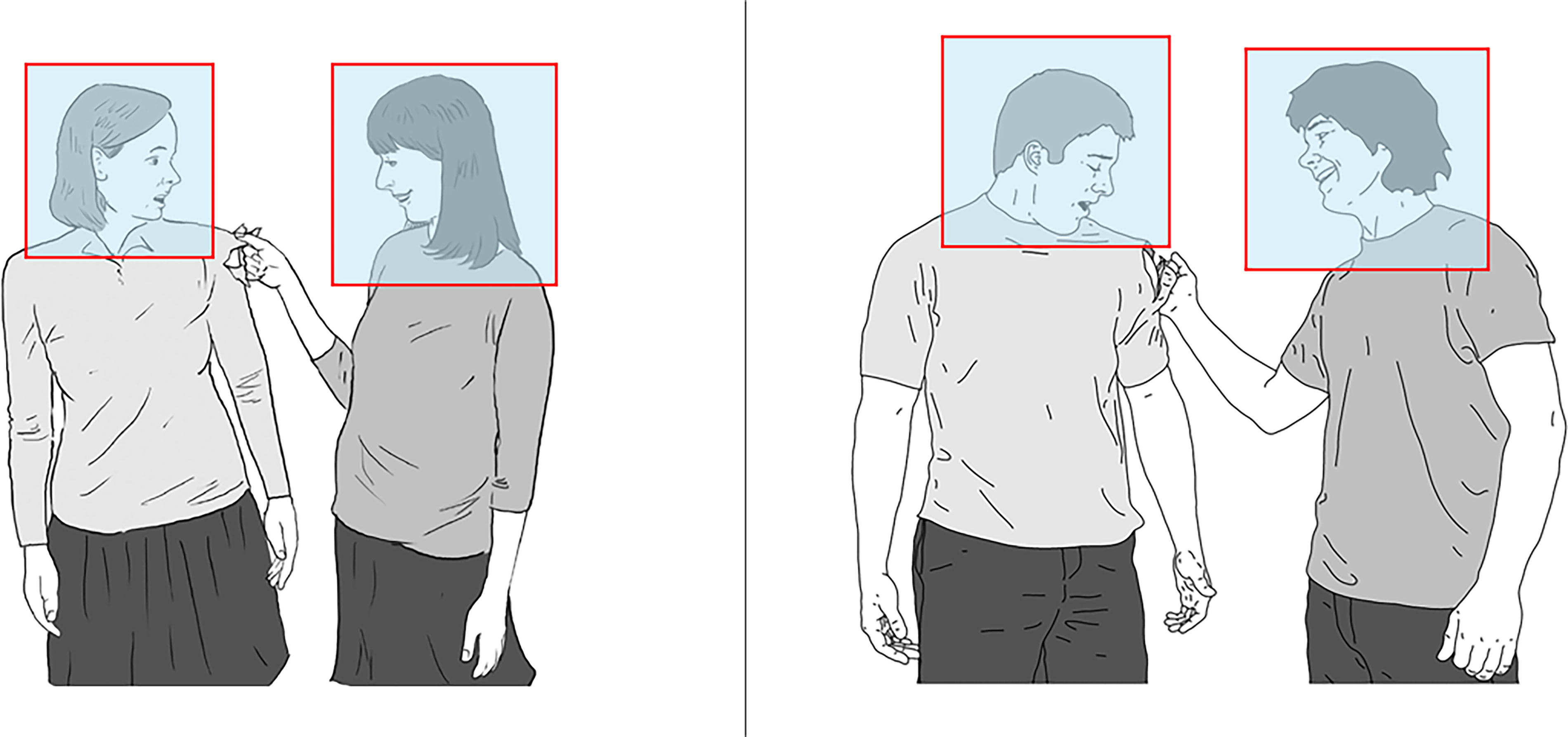
Examples of scenes used in the study and defined area of interest (AOI).
Dwell time was defined as the percentage of total available time spent in AOI calculated separately for each AOI. Dwell time indicated the time spent in AOI, based on total duration of all respondents’ fixations (excluding data points between fixations), and therefore was treated as a measure of general attention to faces.
TTFF was defined as the time in milliseconds stamp of the first fixation inside AOI. TTFF represents the time taken from when the stimulus was displayed until the start of the first time the eye pauses and focuses on a particular face.
Analytic strategy
To investigate the effect of gender on attentional and judgment indices (dwell time, TTFF, blame, intentionality) as dependent variables, the authors conducted four repeated mixed-measures analyses of variance (ANOVA). Each of them involved a 2 × 2 design with the sex of an actor (female vs. male) as a within-subject variable and the gender of the participant (woman vs. man) as a between-subject variable.
Study 1
Participants
A total of 122 adults recruited from the community took part in the study (aged M = 23.94, SD = 5.33, range from 18 to 49), including 62 women (M = 22.95, SD = 3.91, range from 18 to 38) and 60 men (M = 24.97, SD = 6.36, range from 18 to 49). Due to the poor quality of some participants’ data, the authors included 115 participants in the eye-tracking analyses (aged M = 23.71, SD = 5.19, range from 18 to 49), including 59 women (M = 22.88, SD = 3.92, range from 18 to 38) and 56 men (M = 24.59, SD = 6.17, range from 18 to 49). In the first step of the selection process, the authors excluded all trials, which had both poor calibration and less than 60% of valid data. In the second step, the authors removed all participants in whose sets more than 25% were missing data. To detect a moderate effect size (partial η2 = 0.04) with 0.90 power, a priori calculation of statistical power G*Power (Faul et al., 2007) recommends a minimum sample size of 92 participants.
Participants were recruited through social media or invited directly by the researchers. The study was conducted at an individual meeting with the researcher in a designated quiet room at the university. All individuals were first prescreened to ensure they comply with inclusion criteria as follows: no serious vision problems (e.g., for eye-tracking methodology).
Procedure and measures
The research procedure was as follows: first, participants were provided with information about the study, assured of anonymity and the possibility to withdraw at any time. Then, since the study was part of a larger project, participants performed a descriptive task (data reported elsewhere); thereafter, they took part in the task reported here, observing visual scenes, and finally completed a series of personality questionnaires (data reported elsewhere). The study was approved by the [anonymous] university’s ethics committee.
The task of observing visual scenes (Wilkowski et al., 2007; Zajenkowska and Rajchert, 2020) used 54 pictures (2126 × 1594 pixels) displayed on a computer screen and depicting scenes with two actors—a harm-doer and a harm-receiver. All scenes were black and white monochrome and were prepared in both male and female versions. In the complete corpus of stimuli, scenes are either clearly hostile or nonhostile or ambiguous and were validated accordingly. For the purpose of this study, participants viewed only the ambiguous scenes from that corpus, where the intentions of the actor were unclear and could be interpreted as intentional to various degrees (Wilkowski et al., 2007; Zajenkowska and Rajchert, 2020). Each scene was followed by two questions as follows: “Please rate to what extent the depicted harm was intentional” on a Likert scale ranging from 1 (not intended at all) to 9 (intended) and “To what extent you would blame the person for that” (1 not at all to 9 very much).
Results
Correlation coefficients are reported in Table 1. In ambiguous scenes, a high positive correlation was observed between the ascription of intentionality to male harm-doers and the ascription of intentionality to female harm-doers (r = 0.877, p < 0.01), between the ascription of blame to male harm-doers and the ascription of blame to female harm-doers (r = 0.918, p < 0.01), between dwell time on male harm-doers’ faces and dwell time on female harm-doers’ faces (r = 0.932, p < 0.01), and between TTFF on male harm-doers’ faces and TTFF on female harm-doers’ faces (r = 0.888, p < 0.01). A high negative correlation was observed between TTFF on female harm-doers’ faces and dwell time on female harm-doers’ faces (r = −0.763, p < 0.01) and between TTFF on male harm-doers’ faces and dwell time on male harm-doers’ faces (r = −0.763, p < 0.01).
Pearson’s Correlations Between Ambiguous Attributions Subfactors and Attention to Faces, Study 1
Correlation is significant at the 0.01 level (two-tailed).
F INT/BLM AMB, ascription of intentionality/blame to female harm-doers in ambiguous scenes; M INT/BLM AMB, ascription of intentionality/blame to male harm-doers in ambiguous scenes; DT F harm-doer AMB, dwell time on female harm-doers faces in ambiguous scenes; DT M harm-doer AMB, dwell time on male harm-doers faces in ambiguous scenes; TTFF F harm-doer AMB, time to first fixation on female harm-doers’ faces in ambiguous scenes; TTFF M harm-doer AMB, time to first fixation on male harm-doers faces in ambiguous scenes.
All results of the four-way repeated measures ANOVA models tested in Study 1 are reported in Table 2 2 and described below.
Study 1 Results
Eye-tracking results
The analyses of dwell time on harm-doers’ faces revealed a significant main within-subject effect for the sex of the actor (Table 2). Participants looked longer at female harm-doers’ faces (M = 22.34%, SE = 0.71%) than male harm-doers’ faces (M = 21.04%, SE = 0.70%), p < 0.001, dCohen = 0.17, 95% confidence interval (CI) [0.79, 1.82]. The remaining effects were not statistically significant.
For the TTFF on harm-doers’ faces, the main within-subject effect for the sex of actor was significant (Table 2). Participants attended more quickly to female harm-doers’ faces (M = 929.03, SE = 36.89) than male harm-doers’ faces (M = 975.76, SE = 41.26), p = 0.014, dCohen = 0.11, 95% CI [9.72, 83.75]. The remaining effects were not statistically significant.
Table 3 provides a summary of the means also for effects that are not significant.
Summary of the Means and Standard Errors
Attribution of intentionality and blame
The analyses of the attribution of intentionality revealed no significant main effect of sex of the actor, no significant main effect of the gender of the participant, and no significant effect of the interaction between these variables (Table 2).
The analyses on the attribution of blame revealed only a main within-subject effect of the sex of the actor (Table 2) and a main between-subject effect of gender of the participant. The interaction between the sex of the actor and the gender of the participant remained nonsignificant. Participants attributed blame more strongly to male harm-doers (M = 5.67, SE = 0.11) than to female harm-doers (M = 5.55, SE = 0.11), p = 0.004, dCohen = 0.26, 95% CI [0.04, 0.20]. The remaining effects were not statistically significant.
Discussion
The hypothesis (H1) that aggressive acts of women will be perceived as more intentional and less blameworthy in comparison with men was partially confirmed. At the same time, in the case of blame ascription, women did not ascribe blame to a greater extent than men (H2). Women’s behavior was perceived to be as intentional as men’s but less blameworthy. One possible explanation is that women are not typically seen as aggressive; therefore, any behavior which looks like intentional aggression must have a justifiable root and therefore women are less blamed. While this view may be rooted in collective acceptance of benevolent genderism (Glick and Fiske, 1997), it is seen here where a person is only minimally harmed. This may not be the case when more significant harm occurs to the victim.
The authors also observed faster fixation and longer dwell time (H3 and H4) on the faces of female compared with male perpetrators, confirming their expectations in terms of both uncontrolled consciously and volitional processes (see Thompson et al., 2019). The fast reaction to an untypical stimulus (a woman as a potential perpetrator of harmful act) may be more beneficial to an individual, as it may protect her/him from hypothetical harm and activate a protective or defensive coping strategy. Previous research shows that things that are novel are more salient (Schomaker and Meeter, 2012; 2015) and, therefore, require quicker attention and examination; therefore, this pattern suggests the perceived unusual nature of female aggression. What is more, the longer dwell time on female perpetrators’ faces may suggest a higher cognitive load in processing unexpected information (Wilkowski et al., 2007). Dwell time is an established measure of more in-depth information processing, for example, when distinguishing similar stimuli from a target (Becker, 2011; Zhang et al., 2011). In their study, this extended dwell time on female aggressors might reflect the time needed to reconcile the cognitive dissonance (see Festinger, 1957) arising from the stereotype of women as nonaggressive with seeing a woman in a situation potentially as the aggressive offender (Jost and Banaji, 1994; Niazi et al., 2020).
Study 2
In this study, the authors wanted to explore whether the pattern of results seen in Study 1 also holds in cases where scenes clearly depict hostile behavior, where all social cues suggest the intentionality of the harm-doers (Wilkowski et al., 2007). Therefore, the authors tested the same hypotheses from Study 1 regarding gender differences in intentionality and blame ascription to both male and female actors, as well as attention to faces through eye tracking. The main aim was to explore if the same gender (person ascribing intentionality and blame)/sex (actors) differences would be present in both ambiguous and clearly hostile scenes.
Method
Participants
A total of 120 community-based participants took part in the study (M = 28.88, SD = 10.42, range from 17 to 80), including 60 women (M = 28.50, SD = 12.48, range from 18 to 80) and 60 men (M = 29.27, SD = 7.92, range from 17 to 54). Using the same procedure as in Study 1, the authors included 117 participants in the eye-tracking analyses (M = 28.75, SD = 10.50, range from 17 to 80), including 58 women (M = 28.34, SD = 12.64, range from 18 to 80) and 59 men (M = 29.15, SD = 7.94, range from 17 to 54). The recruitment method and environment under which the study was conducted were the same as in Study 1.
Procedure and measures
The research procedure was as follows: first, participants were provided with information about the study, assured of anonymity and the possibility to withdraw at any time. Then, they took part in the task of observing visual scenes, after that, since the study was part of a larger project, participants performed a second [data reported elsewhere] computer-based task, and finally, they completed a series of personality questionnaires [data reported elsewhere]. The study was approved by the [anonymous] university’s ethics committee.
The task of observing visual scenes (Wilkowski et al., 2007; Zajenkowska and Rajchert, 2020) was analogous to that used in Study 1; however, in this study the authors used the full corpus of 162 stimuli: ambiguous, clearly hostile (all cues indicate intentional action by the actor), and nonhostile cues (all cues indicate unintentional action by the actor, but it was not used in the current analysis).
Results
Correlation coefficients (for ambiguous scenes) are reported in Table 4.
Pearson’s Correlations Between Ambiguous Attributions Subfactors and Attention to Faces, Study 2
Correlation is significant at the 0.01 level (two-tailed).
Correlation is significant at the 0.05 level (two-tailed).
Correlation coefficients (for hostile scenes) are reported in Table 5. In hostile scenes, a high positive correlation was observed between the ascription of intentionality to male harm-doers and the ascription of intentionality to female harm-doers (r = 0.881, p < 0.01), between the ascription of blame to male harm-doers and the ascription of blame to female harm-doers (r = 0.878, p < 0.01), between dwell time on male harm-doers’ faces and dwell time on female harm-doers’ faces (r = 0.910, p < 0.01), and between TTFF on male harm-doers’ faces and TTFF on female harm-doers’ faces (r = 0.814, p < 0.01).
Pearson’s Correlations Between Hostile Attributions Subfactors and Attention to Faces, Study 2
Correlation is significant at the 0.01 level (two-tailed).
Correlation is significant at the 0.05 level (two-tailed).
DT F harm-doer HOST, dwell time on female harm-doers’ faces in clearly hostile scenes; DT M harm-doer HOST, dwell time on male harm-doers’ faces in clearly hostile scenes; F INT HOST, ascription of intentionality to female harm-doers in clearly hostile scenes; M INT HOST, ascription of intentionality to male harm-doers in clearly hostile scenes; TTFF F harm-doer HOST, time to first fixation on female harm-doers’ faces in clearly hostile scenes; TTFF M harm-doer HOST, time to first fixation on male harm-doers’ faces in clearly hostile scenes.
All results of the four-way repeated measures ANOVA models tested in Study 2 are reported in Table 6 3 and described below.
Study 2 Results
Eye-tracking results
Ambiguous scenes
The analyses of dwell time on harm-doers’ faces for ambiguous scenes revealed a significant main within-subject effect for the sex of the actor (Table 6). Participants looked longer at female harm-doers’ faces (M = 22.21%, SE = 0.64%) than male harm-doers’ faces (M = 21.22%, SE = 0.62%), p < 0.001, dCohen = 0.14, 95% CI [0.46, 1.51].
Analyses of TTFF on harm-doer’s face for ambiguous scenes revealed a significant main within-subject effect for the sex of the actor (Table 6). Participants attended more quickly to female harm-doers’ faces (M = 815.64, SE = 23.52) than male harm-doers’ faces (M = 873.37, SE = 28.00), p < 0.001, dCohen = 0.20, 95% CI [25.72, 89.74].
Hostile scenes
The analyses of dwell time on harm-doers’ faces for hostile scenes revealed a significant main within-subject effect for the sex of the actor (Table 6). Participants looked longer at female harm-doers’ faces (M = 21.70%, SE = .64%) than male harm-doers’ faces (M = 20.58%, SE = .62%), p < 0.001, dCohen = 0.16, 95% CI [0.58, 1.65]. The remaining effects were not statistically significant.
For the TTFF on harm-doers’ faces for hostile scenes, the main within-subject effect for the sex of the actor was significant (Table 6). Participants attended more quickly to female harm-doers’ faces (M = 820.15, SE = 23.95) than male harm-doers’ faces (M = 896.54, SE = 25.83), p < 0.001, dCohen = 0.28, 95% CI [46.29, 106.48]. The remaining effects were not statistically significant.
Table 3 provides a summary of the means also for effects that are not significant.
Attribution of intentionality and blame
Ambiguous scenes
The analyses of the attribution of intentionality revealed no significant main effect of the sex of the actor, no significant main effect of gender of the participant, and no significant effect of the interaction between these variables (Table 6).
The analyses of the attribution of blame revealed no significant main effect of the sex of the actor, no significant main effect of gender of the participant, and no significant effect of the interaction between these variables (Table 6).
Hostile scenes
The analyses of the attribution of intentionality revealed no significant main effect of the sex of the actor, no significant main effect of gender of the participant, and no significant effect of the interaction between these variables (Table 6).
The analyses of the attribution of blame revealed no significant main effect of the sex of the actor, no significant main effect of gender of the participant, and no significant effect of the interaction between these variables (Table 6).
Discussion
Contrary to Study 1, not only the intentionality but also blame was equally attributed to female and male perpetrators. The inclusion of harm scenes (difference in methodology to the previous study) might have influenced the abovementioned benevolent genderism effect (Glick and Fiske, 1997). However, it should be noted that the Study 2 sample was older, and it has been demonstrated elsewhere that middle-aged adults are less prone to the fundamental attribution error than younger populations and have heightened cognitive complexity and resources (Follett and Hess, 2002). In addition, it is feasible that as they age, people rely less on hypothetical gender roles but more on experienced gender roles whereby they have had more opportunity to witness female aggression. This possibility bridges Study 2 with Study 3, in which the participants were violent offenders who have had much more experience with both male and female aggression.
Importantly in Study 2, the authors replicated the results from Study 1 and also observed faster fixation and longer dwell time (H3 and H4) on the face of female perpetrators. This effect was presented both in case of ambiguous and clearly hostile scenes.
Study 3
Studies 1 and 2 recruited participants from the community and, as such, did not include individuals who are known to be disposed to direct aggressive behavior. Participants in Study 3, however, were a sample of offenders (both men and women) currently being imprisoned for committing violent crimes involving physical violence. The authors tested the hypotheses from Study 1 in relation to gender differences in intentionality and blame ascription in ambiguous and clearly hostile scenes, as well as participants’ attention to faces in the scenes.
Method
Participants
Sixty violent inmates took part in the study (M = 38.55, SD = 9.45, range from 22 to 60), 29 women (M = 36.85, SD = 7.67, range from 22 to 52, two female inmate’s age records were missing) and 31 men (M = 40.03, SD = 10.67, range from 24 to 60). Using the same procedure as in Study 1, the authors included 54 participants in the eye-tracking analyses (M = 38.56, SD = 9.60, range from 22 to 60), including 24 women (M = 35.82, SD = 7.74, range from 22 to 52, two female inmate’s age records were missing) and 30 men (M = 40.57, SD = 10.42, range from 24 to 60). To detect a moderate effect size (partial η2 = 0.06) with 0.80 power, a priori calculation of statistical power G*Power (Faul et al., 2007) recommends a minimum sample size of 48 participants.
Prisoners from two correctional facilities were invited to participate in the study by corrections officers. The authors informed the prison authorities that the individuals eligible to participate would be only those with “any criminal charge for a violent offense against persons—for example, assault, assault causing bodily harm, wounding, attempted homicide, homicide, kidnapping, forcible confinement, armed robbery, and all ‘hands-on’ general offenses” (Harris et al., 2002). Individuals who fulfilled this condition of the reason for incarceration and agreed to participate met individually with the researcher in a designated quiet room (e.g., common room) within the prisons.
Procedure and measures
The research procedure and scene-viewing task were the same as in Study 2. The study was approved by the [anonymous] university’s ethics committee and conducted in accordance with the Declaration of Helsinki.
Results
Correlation coefficients (for ambiguous scenes) are reported in Table 7. In ambiguous scenes, a high positive correlation was observed between the ascription of intentionality to male harm-doers and the ascription of intentionality to female harm-doers (r = 0.909, p < 0.01), between the ascription of blame to male harm-doers and the ascription of blame to female harm-doers (r = 0.922, p < 0.01), between the ascription of blame to female harm-doers and the ascription of intentionality to female harm-doers (r = 0.757, p < 0.01), and between dwell time on male harm-doers’ faces and dwell time on female harm-doers’ faces (r = 0.923, p < 0.01).
Pearson’s Correlations Between Ambiguous Attributions Subfactors and Attention to Faces, Study 3
Correlation is significant at the 0.01 level (two-tailed).
Correlation is significant at the 0.05 level (two-tailed).
Correlation coefficients (for hostile scenes) are reported in Table 8. In hostile scenes, a high positive correlation was observed between the ascription of intentionality to male harm-doers and the ascription of intentionality to female harm-doers (r = 0.909, p < 0.01), between the ascription of blame to male harm-doers and the ascription of blame to female harm-doers (r = 0.922, p < 0.01), between the ascription of blame to female harm-doers and the ascription of intentionality to female harm-doers (r = 0.779, p < 0.01), between the ascription of blame to male harm-doers and the ascription of intentionality to male harm-doers (r = 0.739, p < 0.01), between dwell time on male harm-doers’ faces and dwell time on female harm-doers’ faces (r = 0.946, p < 0.01), and between TTFF on male harm-doers’ faces and TTFF on female harm-doers’ faces (r = 0.805, p < 0.01).
Pearson’s Correlations Between Hostile Attributions Subfactors and Attention to Faces, Study 3
Correlation is significant at the 0.01 level (two-tailed).
All results of the four-way repeated measures ANOVA models tested in Study 3 are reported in Table 9 4 and described below.
Study 3 Results
Eye-tracking results
Ambiguous scenes
The analyses of dwell time on harm-doer’s face revealed a nonsignificant main effect of the sex of the actor, no significant main effect of gender of the participant, and no significant effect of the interaction between these variables (Table 9).
The analyses of TTFF on harm-doer’s face revealed a significant main within-subject effect for the sex of the actor (Table 9). Participants attended more quickly to female harm-doers’ faces (M = 966.73, SE = 41.52) than male harm-doers’ faces (M = 1062.48, SE = 58.67), p = 0.038, dCohen = 0.26, 95% CI [5.59, 185.91].
Hostile scenes
The analyses of dwell time on harm-doers’ faces revealed a significant main effect of sex of the actor. Participants looked longer at female harm-doers’ faces (M = 17.41%, SE = 0.85) than male harm-doers’ faces (M = 16.83%, SE = 0.85), p = 0.044, dCohen = 0.09, 95% CI [0.02, 1.14]. The analyses revealed no significant main effect of gender of the participant and no significant effect of the interaction between these variables (Table 9).
The analyses of TTFF on harm-doer’s face revealed significant main within-subject effect for the sex of the actor (Table 4). Participants attended more quickly to female harm-doers’ faces (M = 975.10, SE = 41.66) than male harm-doers’ faces (M = 1059.49, SE = 49.22), p = 0.006, dCohen = 0.25, 95% CI [24.89, 143.90].
Attribution of intentionality and blame
Ambiguous scenes
The analyses of the attribution of both intentionality and blame revealed no significant main effect of sex of the actor, no significant main effect of gender of the participant, and no significant effect of the interaction between these variables (Table 9).
Hostile scenes
The analyses of the attribution of intentionality revealed no significant main effect of sex of the actor, no significant main effect of gender of the participant, but a significant effect of the interaction between these variables (Table 4). Pairwise comparisons with applied Bonferroni correction revealed that women attributed intentionality more strongly to female harm-doers (M = 6.96, SE = 0.30) than to male harm-doers (M = 6.67, SE = 0.28), p = 0.011, dCohen = 0.14, 95% CI [0.07, 0.51]. Pairwise comparisons for male participants were not significant, p = 0.173.
The analyses of the attribution of blame revealed no significant main effect of sex of the actor, no significant main effect of gender of the participant, and no significant effect of the interaction between these variables (Table 9).
Discussion
Analogically to Study 2, not only the attribution of intentionality but also blame was equally distributed among female and male perpetrators in case of ambiguous scenes. There was one exception in case of hostile scenes with female violent offenders perceiving female perpetrators’ hostile acts as more intentional (but not blameworthy) than male ones. This confirms that in some cases intentionality can be more easily assumed in the case of women as harm-doers (Zajenkowska and Rajchert, 2020). Judging intentionality of harmful acts of other women may be related to their benevolent genderism (compared with men) toward other women (Glick and Fiske, 1996). However, it is interesting that violent women did not ascribe more additional blame to the female harm-doers compared with male harm-doers but only significantly more intentionality, which can be classified as some kind of defensive attribution (Chaikin and Darley, 1973). Women who have committed violent acts against someone and therefore know how that feels might justify other harm-doers and therefore minimize the blame. When observers are personally and situationally similar to the accident perpetrator, they tend to attribute less responsibility to the perpetrator when, for example, accident severity increased (Burger, 1981). It is possible that violent female offenders project their own experience on to the women they see depicted.
Similar to the results of Studies 1 and 2, the participants in Study 3 paid attention more quickly to female as opposed to male harm-doers, and also gazed longer at harm-doers, who were women not men. There was, however, one exception, as in the case of the ambiguous scenes, the sex of the harm-doers did not affect the dwell time on their faces.
General Conclusions
The main aim of the current series of studies was to investigate the impact of the sex on the explicit ratings of intentionality of actors depicted in scenes involving harm being inflicted on one of the actors, and the implicit visual scanning associated with processing of these scenes, particularly in relation to the faces of the ‘harm-doer’ in the scene. Using both explicit and implicit measures, the authors aimed to investigate both top-down and bottom-up social cognitive processes (Lieberman, 2007) observed while encoding visual scenes depicting ambiguously hostile or clearly hostile acts between two characters.
First, the authors observed no impact of the sex of the observed harm-doer on the intentionality or blame attribution in a general-community sample and only a weak effect of the sex of the harm-doer on intentionality ratings in violent offenders. There was an exception in case of Study 1, where the authors observed less blame ascribed to female harm-doers, which possibly was related to the fact that in Study 1, unlike in the other two studies, the authors presented participants only with ambiguous scenes.
Interestingly, while the pattern of the explicit behavioral results did not follow their predictions, there was a robust effect of the sex of the depicted harm-doer on the implicit visual scanning patterns across the studies. In line with H3, the authors observed faster orienting toward female harm-doers across both ambiguous and hostile contexts and both in general-community participants and violent incarcerated offenders. Furthermore, longer dwell times were found in general-community participants for female harm-doers’ faces presented in both ambiguous and hostile situations. This effect was also found in violent offenders, but it was limited to hostile contexts only. The pattern of results observed in the current set of studies suggests preferential bottom-up processing, as indicated by faster orienting times toward women’s compared with men’s aggressive actions. Faster orienting toward salient environmental threats is a well-established finding in affective neuroscience (Bannerman et al., 2009); thus, the authors hypothesize that female harm-doers may be perceived as a more salient stimuli compared with their male counterparts, and possibly, due to their unique nature, they might signal unexpected threat. At the same time, the authors hypothesize that longer dwell times observed on the faces of female harm-doers across studies presented in the current article may signify more elaborate top-down processing of their actions and more cognitive resources being directed toward understanding and assessing the actions of the harm-doer. In line with this interpretation, the authors observed no effects of the sex of the harm-doers’ on their intentionality or blame ratings across studies.
Limitations and Further Research
While the two-system interpretation suggested above provides an elegant trajectory explaining the results of the current set of studies, several limitations of the current design should be kept in mind. First, after accounting for multiple comparisons, the authors observed few and unstable significant associations between eye-tracking measures and attributional ratings across studies. However, while intertwined, TTFF and dwell time may signify opposite implicit processes in the context of the current study, thus may not be clearly associated with explicit behavioral tendencies to attribute hostile intentions. Second, the explicit nature of the task utilized throughout the series of studies does not allow us to disambiguate explicit and implicit processes associated with processing third-party encounters (e.g., Okruszek et al., 2018). In addition, neither of their samples could be treated as representative, and both community-based samples were strongly skewed toward younger adults; thus, further studies could investigate the current outcomes, across more age and socioeconomic status representative samples. Taken together, the current results provide strong support for differential implicit processing of female and male aggressive behaviors; however, further studies could extend the current methodology by introducing a free-viewing condition. Furthermore, given the nature of their findings, the introduction of implicit measurement methods different than eye tracking could be beneficial for further developing two-system account interpretation proposed in the current article, for example, investigation of the electroencephalogram (EEG) event-related potentials could be particularly informative for such research given the previous findings suggesting that N400 may be a reliable marker of hostile attribution bias (Gagnon et al., 2017).
